Grandma’s Tattoos https://t.co/ogDwSGJ5tF: A family story that reveals the fate of the Armenian women driven out of Ottoman Turkey during the First World War.
Filmmaker: Suzanne Khardalian
Anthony Bourdain Blacklisted, Then Dead. Coincidence? The Chef Who Pissed Off the Globalists | E40
00:00 Introduction to the conspiracy theory
04:57 Asking Grok if there were any conspiracies around Anthony Bourdain
12:45 Armenian conspiracy regarding Bourdain
27:55 The symbolism around his death and the war that followed
39:34 Azerbaijan - Armenia war conspired by US, UK, Israel and Turkey
43:34 Grok analyzes all of the coincidences
49:09 The meticulous destruction of history and Christianity
51:44 Identical script: Rothschild dies in Paris hotel ruled suicide by hanging
59:48 Clip of Anthony Bourdain on Joe Rogan
1:07:21 The globalist grand finale that didn’t work out
1:14:36 Turkish & Jewish lobby deleting the Armenian Genocide & Danis Preger
GRAB NEW MERCH ► https://t.co/SMJiSSbqEa
Channel Support ► https://t.co/rctSHNF5fk
YouTube: https://t.co/FYCgmpGqbV
Rumble: https://t.co/Ne5547qj5e
Battle of Sarikamish - Ottoman Turks invade the ethnic-Armenian town of Yeghegnik in Tsarist Russia’s Kars Oblast and sacrifice 120,000 of their own troops for nothing then blame Armenians for their loss, resulting in the #ArmenianGenocide. #sarikamiş
We hear many stories about how ‘Armenians owe everything to Russia.’
The Armenian Photius (Patriarch Photius), who lived in 820–896, was the first to begin the process of the Christianization of Rus. In the Russian language, there remains a concept known as the ‘Photian Baptism,’ when Christian missionaries sent by the Armenian Photius converted the Kievan princes Askold and Dir to Christianity.
The Armenian Constantine Porphyrogenitus (905–959)—Emperor of Byzantium from the Armenian dynasty. Known in Russian history for baptizing the Russian Princess Olga, converting her to Christianity.
The Armenian Saint Anna Porphyrogenita—sister of the Byzantine Emperor Basil from the Armenian dynasty. Known for marrying the Russian Prince Vladimir on the condition that all of Kievan Rus would be baptized into Christianity. After this marriage, her brother Basil (Varsegh) sent thousands of Armenian and Greek builders to Kievan Rus to construct stone churches, as well as thousands of priests and preachers to convert pagan Slavs to Orthodoxy.
Leo the Mathematician—an Armenian from Constantinople, teacher of Cyril and Methodius, who created the ‘Cyrillic’ alphabet—the Russian alphabet—based on the Greek alphabet.
Boris and Gleb—the first saints canonized by the Russian Church, sons of the Armenian Anna Porphyrogenita.
Russian church architecture
The first stone churches in Rus, starting from the 10th century up until the beginning of the 13th century, were mostly built by Armenian and Greek architects who actually laid down the stylistic features of Russian Orthodox architecture.
The word ‘Russia’
The word ‘Russia’ first appears in writing in the work of the Armenian Constantine Porphyrogenitus in the 10th century. This word itself was originally created and used only in Armenian and Greek aristocratic circles in Constantinople, and only 500 years later did the Russians themselves begin calling their country by this Armenian-Greek term.
The Armenian Constantine Monomakh—Emperor of Byzantium from the Armenian dynasty. One of his descendants was Vladimir Monomakh, the Great Prince of Rus.
George the Victorious—the saint depicted on the Coat of Arms of Russia and the Coat of Arms of Moscow. It is known that his father lived in Lesser Armenia; his name was Gerontius, and he was the head of the city of Sebastia in Armenia. George the Victorious himself was born in Lesser Armenia, in the city of Mazaka (Caesarea), the very city where Saint Gregory, the first Catholicos of All Armenians, Saint Vrtanes, the second Catholicos, and his son Saint Grigoris were born.
El-Registan—an Armenian poet who co-authored the lyrics of the Russian National Anthem with Mikhalkov Sr.
The double-headed eagle
The symbol of Russia depicted on the country's Coat of Arms was the Coat of Arms of Greater Armenia in the 1st–5th centuries, then remained the Coat of Arms of many Armenian noble families, and through them—via Byzantium—reached Russia by the 15th century, becoming the Coat of Arms of Russia.
The capture of Kazan
Among those who participated in the capture of Kazan by Tsar Ivan the Terrible was a regiment of Armenian gunners. In memory of these Armenian warriors, Tsar Ivan the Terrible ordered one of the 8 churches of Saint Basil’s Cathedral on Red Square in Moscow to be named the ‘Church of Gregory the Illuminator, the Apostle of Greater Armenia.’
Visual arts
The first portrait painter in Russia was the Armenian Bogdan Saltanov, court painter to the Russian tsars, who decorated the Kremlin Palace with murals. The most famous marine artist was the Armenian Hovhannes Aivazian (Ivan Aivazovsky).
Serfdom
The first ideologist behind the liberation of the Russian people from serfdom was the Minister of Internal Affairs of the Russian Empire, the Armenian Mikael Loris-Melikov.
Theater
The most famous figure in theater, who stood at the origins of theatrical art in Russia, was the Armenian Vakhtangov.
Russo-Persian Wars
In all the Russo-Persian Wars of the 18th–19th centuries, almost the entire militia of the South Caucasus fighting on the side of Russia consisted of ethnic Armenians, thanks largely to whom Russia managed to defeat Persia.
Alexander Suvorov
The greatest military commander in Russian history was Suvorov, son of the Armenian Manukova, a representative of the noble Armenian Manukov family originating from Artsakh (Nagorno-Karabakh).
Russo-Turkish Wars
In all Russo-Turkish wars without exception, Armenian regiments participated en masse on Russia’s side. The total number of Armenian warriors fighting with weapons in hand on Russia's side in more than 30 major and minor wars and battles between Russia and Turkey, from the 18th to the early 20th centuries, was at least 500,000 people, a significant portion of whom died on the battlefields. Many battles and wars ended in Russian victory mainly due to Armenian participation.
Austro-Hungarian Front
On this front in the early 20th century, over 150,000 ethnic Armenians fought on Russia's side, half of whom perished.
Wars of the Soviet Union
In all wars of the USSR, from the Soviet-Finnish War to the Great Patriotic War and the Afghan War, hundreds of thousands of Armenian soldiers participated, over 300,000 of whom died in these battles, and dozens became generals, marshals, and admirals.
Outstanding Armenians
There is no point in listing all the ethnic Armenians in science, culture, politics, sports, etc., who elevated Russia each in their own field, as this list would be far too vast to fit into a single article.
Suffice it to say that the number of Armenian academicians in the Russian Academy of Sciences (RAS) is greater than the number of RAS academicians from all the Muslim peoples of Russia combined. Or who knows that the name of the ‘MiG’ aircraft stands for ‘Mikoyan and Gurevich,’ or that one of the main designers of the ‘Su’ aircraft is Academician Pogosyan? This list is huge, but without them, Russia would not be the way we know it.
And all these points are just a drop in the ocean, by no means a complete list.
So who owes its existence to whom? Does Armenia owe Russia, or does Russia owe Armenia? What do you think?”
Hovhannes Minas, Armenian historian
The First Armenians in America: Martin the Armenian and His Compatriots
Armenians are one of the oldest and most resilient nations in the world, with a rich and diverse history and culture. Their presence in America dates back to the early 17th century, when the first recorded Armenian immigrant arrived in Virginia, more than a year before the Pilgrims landed in Plymouth. His name was Martin the Armenian, and he was not the only one of his kind to seek a new life in the New World.
Martin the Armenian: The Pioneer
Martin the Armenian, also known as John Martin or Martikyan, was born in Iran, where many Armenians had settled after the Ottoman invasion of their homeland. He was a tobacco grower who learned his trade from the English merchants who visited Iran. In 1618, he decided to join them on their voyage to Virginia, where they hoped to establish a profitable tobacco plantation.
Martin the Armenian was the first naturalized citizen of what would later become the United States of America. He received a land grant of 100 acres from the Virginia Company, and introduced the cultivation of silkworms into the colony. He also worked as a tobacconist, and gave testimony in a trial in Jamestown in 1619. He was well respected by the English colonists, who called him “a very honest, industrious, and well-conditioned planter”.
The Armenian Companions: The Skilled Workers
Martin the Armenian was not alone in his journey to Virginia. Around the same time, Capt. John Smith, the famous explorer and leader of the Jamestown colony, brought a number of foreigners with him, among them many Armenians. Smith had visited Armenia in 1603, and was impressed by the people and their skills. He wrote in his report:
“These are the most expert in all trades, of all nations, and the most faithful and trusty, and therefore the most esteemed and best used of any nation in Turkey, Persia, or any part of the East.”
Smith recruited the Armenians to help him develop the colony, and to teach the English colonists how to produce various commodities that were in high demand in Europe. The Armenians were skilled in the manufacture of pitch, tar, glass, beads, and soap ash, which the English colonists used as currency in trading with the Native Americans. They also helped to build houses, boats, mills, and fortifications.
The Armenians were hard workers, who did not shun labor like some of the “vagabond gentlemen English colonists wearing silk”. They were also loyal and peaceful, who did not cause trouble or rebel like some of the other foreigners. They were well integrated into the colony, and some of them married English women and had children.
The Armenian Legacy: The Survivors
The Armenians who came to Virginia in the early 17th century were among the first immigrants to America, and among the first to contribute to its economic and social development. They were also among the first to experience the hardships and dangers of the colonial life, such as famine, disease, war, and slavery. Many of them did not survive, and their names and stories have been largely forgotten.
However, their legacy lives on in the descendants of those who did survive, and in the records and documents that attest to their presence and achievements. They also paved the way for the later waves of Armenian immigration to America, which were driven by the persecution and genocide of the Armenians by the Ottoman Empire in the late 19th and early 20th centuries.
Today, there are more than half a million Armenian Americans, who form the second largest community of the Armenian diaspora after Armenians in Russia. They are proud of their heritage, and of their contributions to the American society and culture. They also honor the memory of their ancestors, who were among the first Armenians in America.
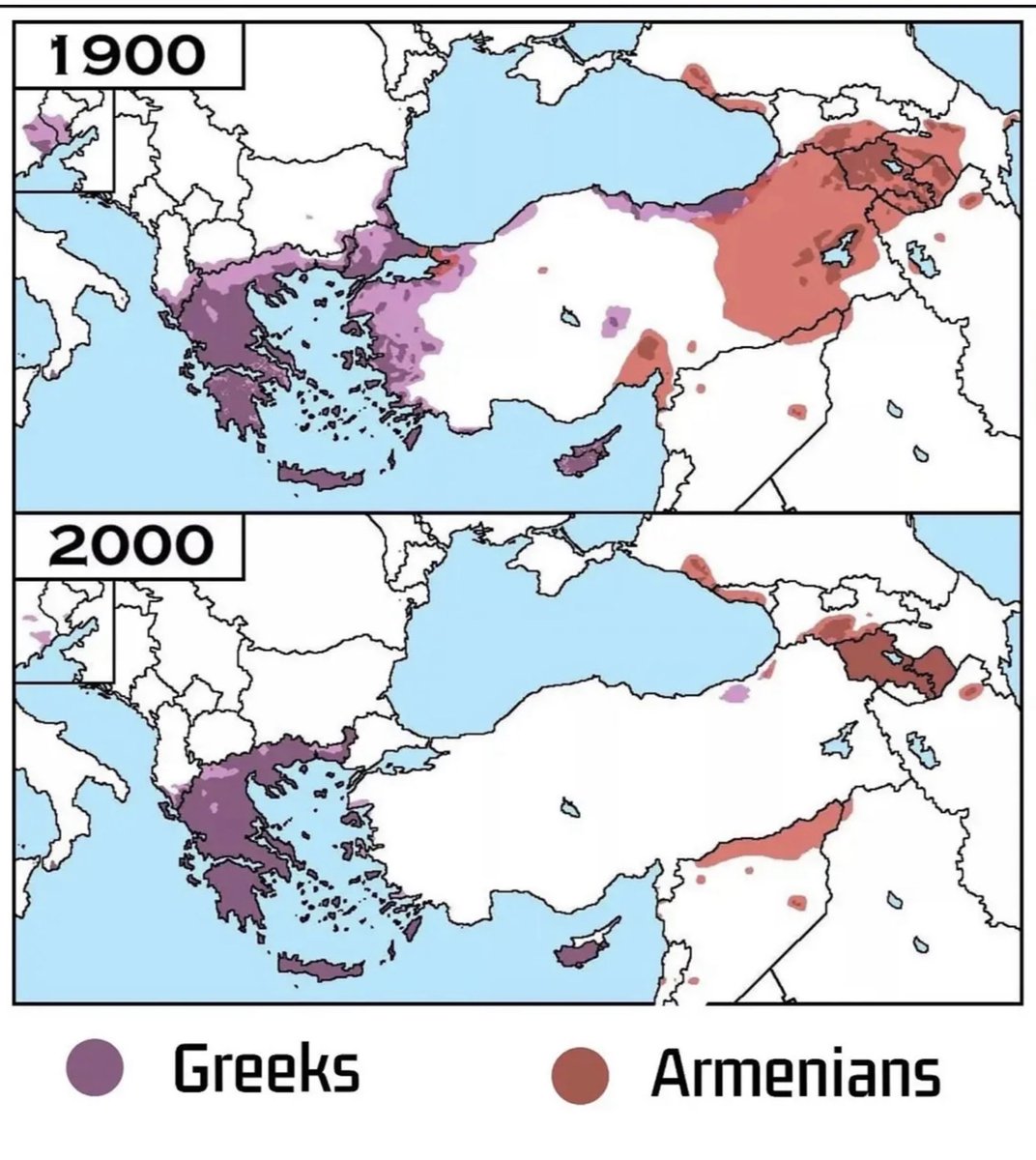
WHERE DID THESE INDIGENOUS PEOPLE DIASAPEAR⁉️
A Century That Erased Ancient Homelands -
This map highlights one of the most dramatic demographic transformations of the 20th Century. In 1900, millions of Greeks and Armenians lived across the Ottoman Empire, maintaining communities that had existed for centuries—many since antiquity.
Greeks had thriving populations in Smyrna (Izmir), Constantinople (Istanbul), Pontus along the Black Sea, Cappadocia, Eastern Thrace, the Aegean coast, and Cyprus. These communities built churches, schools, businesses, and preserved the Greek language and Orthodox faith for generations.
Armenians formed one of the oldest Christian civilizations in the world, with historic populations spread throughout Western Armenia (eastern Anatolia), Cilicia, and the Caucasus. Their monasteries, cities, and cultural heritage dated back over 2,000 years.
The collapse of the Ottoman Empire brought immense tragedy. Between 1913 and 1923, the region witnessed the Greek Genocide, the Armenian Genocide, and the persecution of other Christian minorities. Hundreds of thousands were killed, while many more were deported or forced to flee their ancestral homes.
The Burning of Smyrna in 1922 marked the end of one of the Eastern Mediterranean’s greatest Greek cities, and the 1923 Treaty of Lausanne formalized the compulsory population exchange between Greece and Turkey. Around 1.5 million Orthodox Christians left Asia Minor for Greece, while approximately 500,000 Muslims moved from Greece to Turkey. Constantinople’s Greek community remained exempt from the exchange, but its numbers declined sharply over the following decades due to discriminatory policies, including the 1942 Wealth Tax, the Istanbul Pogrom of 1955, and the 1964 expulsions of many Greek nationals.
By the year 2000, once-vast Greek and Armenian populations across Asia Minor had largely disappeared, surviving mainly in Greece, Armenia, Cyprus, and diaspora communities around the world.
This map is more than a demographic comparison—it is a reminder of how war, genocide, persecution, and forced migration reshaped the Eastern Mediterranean, ending millennia-old communities whose cultural legacy still lives on today.
#archaeohistori
🇮🇱🇦🇲 System of a Down frontman Serj Tankian unloading on Netanyahu’s government.
He blasted them for using the Armenian Genocide for political gain and dropped a straight "F*ck you!"
Writer: Sol
Yerevan State University has decided to dissolve its Department of Foreign Literature, one of the university's oldest academic units, according to department head Anush Sedrakyan.
Sedrakyan, a political scientist who ran in the recent elections on the list of the "Wings of Unity" Party and has been a vocal critic of Nikol Pashinyan and his government, said the decision is part of a broader state policy directed from the center.
"This is centralized authoritarianism," Sedrakyan said, adding that when it becomes difficult to target an individual through professional, corruption-related, or personal allegations, authorities instead move against the institution associated with that person.
According to Sedrakyan, the university administration informed the acting dean of YSU's Faculty of European Languages and Communication that the department would be dissolved.
The decision comes despite the fact that YSU currently operates a master's degree program in Foreign Literature and has students actively enrolled in the program.
The development comes amid years of increasing government involvement in Armenia's higher education system. Under Pashinyan's government, university governance structures have been reshaped, government representatives have been placed on university governing bodies, and disputes over university leadership, academic independence, and alleged political influence have repeatedly generated controversy.
"Politicians who take money from Azerbaijan - an anti-Christian dictatorship that has recently ethno-religiously cleansed 150,000 Armenian Christians from their homeland - should have no place in the U.S. Congress." - @JohnEibner, @CSI_humanrights
Secretary Rubio took the time to endorse the re-election of Nikol Pashinyan, but not to raise issues of urgent concern to American citizens of Armenian heritage:
- Freeing illegally held Armenian hostages (Baku)
- Returning ethnically-cleansed Artsakh refugees
- Releasing jailed Armenian archbishops (Yerevan)
- Ending Azerbaijani occupation of Armenian land
- Reaffirming US Armenian Genocide recognition
- Protecting Armenian Christian sites in Artsakh