BREAKING: Jensen Huang officially returns to Nvidia's office, $NVDA, and receives a standing ovation from Nvidia employees.
"I'm going to be a better CEO the second time around," Jensen Huang told employees.
Scholastic works that survived only as old prints and unsearchable scans, now transcribed: English beside the Latin, the printed page beside both.
Anyone can propose a fix. An editor reviews every change.
176 works. 52 authors. Growing every day. Free to read.
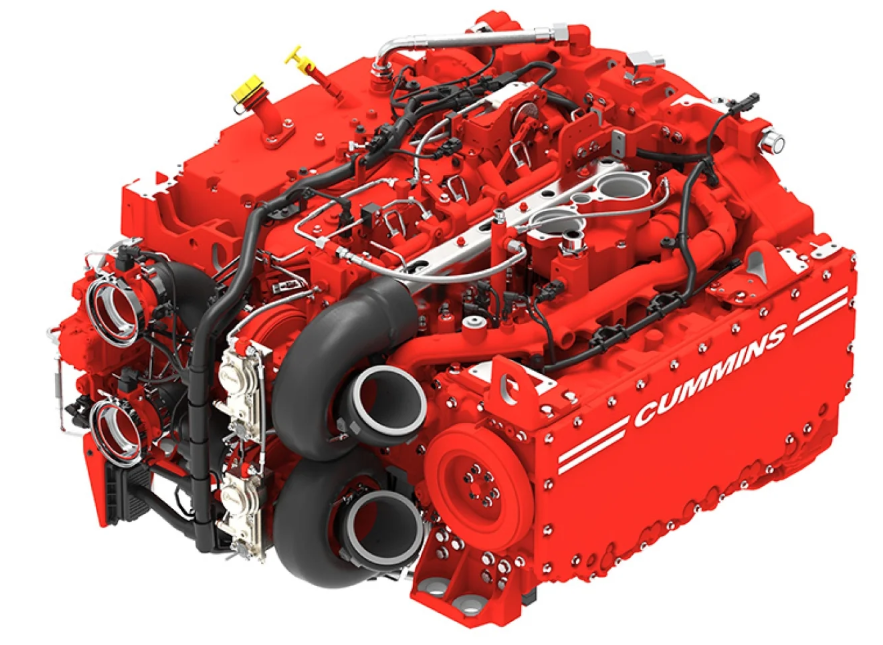
...And Cummins designed one too. An opposed-piston, 4-cylinder, 2-stroke diesel that makes 1,000 horsepower and it’s going in Army tanks.
Thanks to @Loggingmedia for bringing it to my attention.
It’s called the Advanced Combat Engine, or ACE, and Cummins built it with a San Diego outfit called Achates Power (from yesterdays post). It’s a 14.3 liter two-stroke diesel, and here’s where it gets weird. Four cylinders, but eight pistons. Each cylinder has two pistons facing each other, and they slam together in the middle to fire. Each row of pistons turns its own crankshaft, and the two cranks are geared together to put the power out.
No cylinder heads. No valves. No camshaft. Air comes in through ports in the cylinder walls, pushed by a gear-driven supercharger and two Holset turbos.
And it makes 1,000 horse and over 2,400 lb-ft of torque. Cummins says that’s 50 percent more power for its size than the combat engines out there now, with 13 percent better fuel economy. They can build it as a three, four or six cylinder, from 750 horse all the way up to 1,500.
The Army gave Cummins an $87 million contract in 2021 to finish developing it for the Bradley and the next generation of combat vehicles.
The idea goes way back. The Germans put opposed pistons in airplanes in the 1930s, and the Brits put them in trucks in the 50s. Now Cummins is putting them in tanks.
I’d still like to see one in a Pete someday. Just once. 🚛
We shrank 1 GB of Wikipedia to 105.39 MB, losslessly.
Introducing tufazip: the best entry on the Large Text Compression Benchmark using a neural network as its sole predictor. Everything above it mixes a transformer with hand-built models.
Full post 👇
https://t.co/cllPF90gsb
AI runs on GPUs, so I wondered: how good would @ChatGPT be if it ran on the Super NES's best GPU, the Super FX 2 chip?
With the help of GPT-6 Astra and gpt-oss, I present unofficial ChatGPT for SNES: 2.2M parameters on a real Super Nintendo. It can make mistakes, but it's fun
i asked GPT-6.2 Astra to write a classical piano piece and make it as original and realistic as possible and this is what it created
music theory is solved
Transformers have barely changed since the 1890s: copper coils in a tank of oil.
Batteries, solar and compute run on DC. The grid runs on AC. Bridging the two has meant inverters plus transformers.
Powercore is a solid-state transformer, breaker and inverter in one box. Finally, one conversion and about half the losses.
Hats off to the Tesla power electronics engineers!
🎉 Introducing SiliconForest: a new open operating system built on Darwin and XNU, the open-source core of macOS, running natively on an M1 MacBook Pro.
Here’s the interesting part: it runs unmodified Mac apps. This first version runs Apple’s Terminal and Activity Monitor, copied straight from a macOS install, plus the stock Mac build of Firefox.
Working today on a 13" M1 MacBook Pro: GPU acceleration (Vulkan 1.4), hardware video decoding, Wi-Fi, sound, keyboard and trackpad, and the Touch Bar.
It’s Apple’s open-source kernel, with the parts Apple doesn’t publish reimplemented from scratch.
I’ve also brought my Wayland compositor, Chonkstep, over to Darwin, and the results so far are fantastic.
The idea: a free, hackable OS that can run native Mac apps.
It’s early. Big apps like Logic Pro and Photoshop need a lot more (Metal, for a start), but that’s the direction.
It stands on great work: PureDarwin (which we fork), the Asahi Linux GPU and hardware drivers, Omacom Mesa, and the Finch frameworks project.
Source is coming soon. Right now it runs on one machine, the 13" M1 MacBook Pro. If you’d like to help bring it to other M-series Macs, get in touch.
https://t.co/XhQ0e2VKUU
The cyber attacks we are seeing will be used to regulate and criminalize open-source local models.
They wiped Jensen out for believing in open models and next they’ll blame those same models for the attacks we are experiencing.
They want us using their gated, cloud-based, and controlled models for the surveillance state.
Decentralized AI is the only way humanity survives AI without subjugation: