@Credib1eGuy yeah its just infinite money glitch, why would you tell anyone? and if it was that hard to find (unnoticed for 4y) it's unlikely for there to be multiple threat actors
@ThePumponomics 100 - you really have to put in the work to not let money define you. Family, friends, health at the end of the day are the only real things that matter
"Revenue must be raised somewhere"
Or government could stop getting larger and larger as a proportion of the economy with bugger all to show for it for the average person.
Last month an ABC News analysis concluded that the cost of the NDIS in 2029-30 was projected to be around $28.2bn in the 2015-16 budget.
In reality its on track to be $67.2nbn (PBO baseline), depending on the effect of the changes.
The blow out is $39.0bn a year.
To put that into perspective, it's the total impact of the changes negative gearing, capital gains tax and family trusts multiplied more than 5x.
We have a spending problem.
Want a full article on this, let me know in the comments below.
Inference got a hundred times cheaper this year. The compute bill went up anyway.
If you understand why those two sentences are both true at the same time, you understand the most important thing happening in AI right now.
I work on inference for a living, at @nebiustf, where we run open-source managed inference at scale. Most of what follows is what I'm seeing from inside the bill.
12 months ago, the cost of 1M tokens of frontier-class reasoning was somewhere on the order of $60.
Today, an equivalent quality of output costs roughly $0.50.
Price /token of o1-level intelligence has dropped about a 128x in a year.
Price of GPT-4-level output has dropped roughly 100x since the original GPT-4 shipped.
By any normal reading of a technology cost curve, this should be deflationary. It should be saving customers money.
The opposite has happened. The total compute bill at every hyperscaler is going up, not down. Anthropic just signed multi-year capacity deals with both XAI and Amazon. Microsoft's Azure capex guide for 2026 starts with an eight. OpenAI is reportedly spending more on compute every quarter than it did in all of 2023. Nvidia paid roughly twenty billion dollars to acquire Groq, an inference-specialist company that did not exist as a serious commercial entity three years ago.
The cost curve and the demand curve crossed, and then the demand curve lapped the cost curve.
Here is what happened underneath.
A reasoning model burns roughly 10x the output tokens of a non-reasoning model on the same task, because it spends most of its tokens thinking out loud before answering. An agentic workflow chains roughly twenty times the requests of a single-shot completion, because it loops, calls tools, plans, retries, and synthesizes. A modern deep-research query (the kind a research analyst can fire off in fifteen seconds and then walk away from for ten minutes) costs more compute than 10 original GPT-4 queries combined. We made every individual token a hundred times cheaper, and then we built a generation of products that consume ten thousand times more tokens.
This is the Jevons paradox playing out at trillion-dollar scale, in compressed time, in front of everyone. Jevons noticed in 1865 that making coal-burning more efficient did not reduce coal consumption. It increased it, because efficiency unlocked uses that were previously uneconomic. Steam engines became more practical at smaller scales. Whole industries that could not afford coal at the old price suddenly could. Britain's coal consumption rose sharply, not despite the efficiency gains, but because of them.
The same thing is happening to AI compute right now and it is happening faster than any analogous historical cycle. Falling token prices did not contract demand. They unlocked agents, deep research, code-writing systems, multi-step reasoning, persistent memory, the entire next layer of AI products. Every product in that next layer consumes orders of magnitude more compute than the chat interfaces it is replacing.
The math at the aggregate level is brutal: 100x cheaper tokens times 10 000 more tokens equals a 100x larger total bill.
The implications stack quickly.
If you are running a hyperscaler, your 2026 capex guide is not a peak. It is a step on a curve. Inference is structurally always-on, twenty-four hours a day, in a way that training never was. Training is bursty. You spin up a cluster, run for weeks or months, and stop. Inference runs continuously, scales with usage, and the usage curve is exponential. Your power bill, your cooling bill, your transceiver count, your storage footprint, all of these were sized for a workload mix that no longer exists.
If you are running an AI software company built on top of someone else's closed API, you have a problem that did not exist a year ago. Your gross margins get worse as your customers get more value out of your product, because the more they use it, the more compute you pay for. The companies that win this are the ones that figured out vertical integration before the math caught them.
If you are watching this from a distance and trying to understand where the next bottlenecks form, the answer is everywhere downstream of "more inference compute, always-on, with massive memory state per session." The KV cache, the running memory state of a long conversation or an agent loop, is the silent monster of the inference era. It does not scale linearly with parameters. It scales linearly with context length and number of agent steps. A long agent session can hold tens of gigabytes of state per user, per session.
Multiply that by every concurrent user of every product, and you understand why $MU, $SNDK, $TOWCF, and the entire memory and packaging layer have re-rated the way they have.
The CPU-to-GPU ratio is evolving. Training is 1:8. Basic chat inference is 1:4. Agentic inference is 1:1, sometimes CPU-heavy. Google has split its TPU line in two, with a dedicated inference chip carrying tripled SRAM for KV cache. $INTC and $AMD just spent two earnings calls explaining that this shift is structural, not cyclical. The hardware map is redrawing in real time and the financial press is mostly still writing about training clusters.
The right framing of where we are right now is not that AI is hitting a wall. The framing a year ago that scaling was hitting a wall was the most expensive bad take of the cycle. The right framing is that AI got dramatically cheaper, dramatically more capable, and dramatically more useful, and the cost of running it at the new equilibrium of demand is much higher than the cost at the old equilibrium of demand, because the new equilibrium is enormous.
A meaningful share of what we actually do at Token Factory, day to day, is help customers stop their bills from running away from them. KV-cache management. Speculative decoding. Quantization. Routing. The kind of vertical integration that, eighteen months ago, every product team was happy to leave abstracted away behind a closed API. The reason this stack matters now is the same reason this whole essay matters: at the new equilibrium of inference demand, the cost of treating compute as a commodity is no longer survivable. The companies that figure out the layer beneath the API are the ones who keep their margins.
Cheaper tokens. More tokens.
Same coal as 1865.
There are two other dire consequences of this budget that nobody is talking about. The first is that the budget’s introduction of an effective capital gains tax of up to 45 per cent - 47 per cent – previously capped at 23.5 per cent for assets held more than 12 months – hits younger savers hardest, precisely because they have the highest portfolio exposures to high-growth assets such as listed global equities, Australian shares, crypto, venture capital and private equity.
When anyone builds a portfolio for younger investors, they rationally load them up with the highest-growth and most volatile assets on the basis that a long investment horizon allows them to weather the inevitable volatility storms.
As investors age, these portfolios shift into more stable and income-rich asset classes such as cash and bonds, which are net beneficiaries of the CGT increase, because their post-tax returns now look more attractive relative to growth assets.
As many investors have noted online, why would you allocate to a bunch of high-risk growth companies when Albanese and Chalmers are going to take almost half the upside while wearing none of the downside? Rather than helping younger generations, the highest CGT rate in the developed world will hammer them.
And it is a double whammy because the many early-stage companies that have historically employed 20- and 30-somethings will now consider moving overseas. Their investors will simply not want to trade away half of their upside to the public oligarchs.
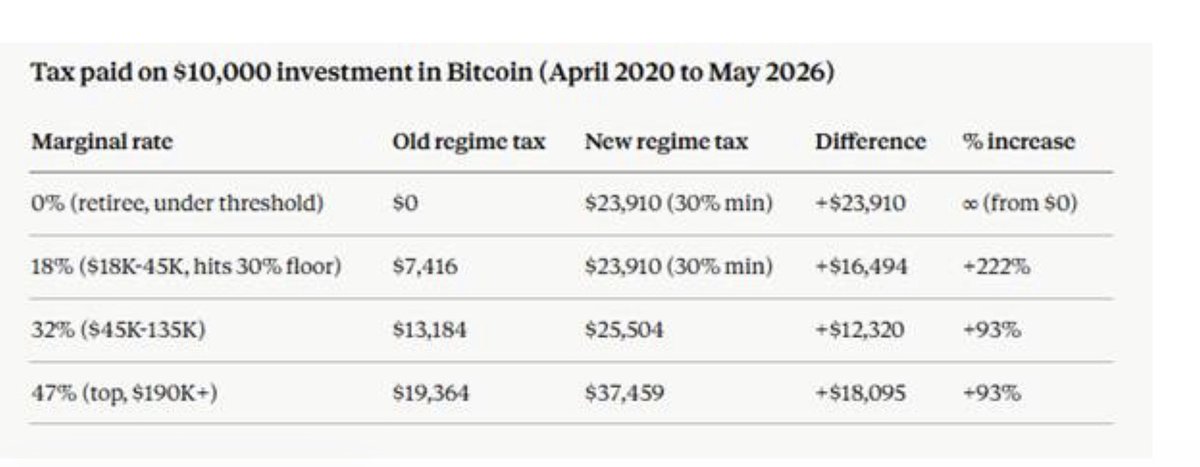
If you allocated $10,000 to bitcoin after the March 2020 pandemic shock – which many young punters did, and which would now be worth approximately $92,000 – the new CGT regime imposes vastly higher amounts of tax.
A self-funded retiree on the tax-free threshold would go from paying nothing to almost $24,000. Somebody earning between $18,000 and $45,000 a year would see their tax bill jump from $7400 to $23,900 – a 222 per cent increase. Those in the $45,000 to $190,000-plus tax brackets would have their bill rise by 93 per cent.
Since the new CGT regime is, by definition, much more costly on higher-growth investments, it will punish younger investors who have much greater risk appetites and lower average incomes.
https://t.co/MJKvQZXvKw
@spayszcin From what I read CGT is somewhat grandfathered - old rules of flat 50% applies until new date. Then new tax rules come into play for any gains made as of that date moving forward
The single biggest winner from the budget: the tax-free owner-occupied home, which is where people will put their money. After the budget doubles the capital gains tax on productive businesses/assets from circa 23.5% to 46-47%, investors will understandably pull money from businesses, shares, commercial property and rental housing and plough it into their tax-free owner-occupied home. It's a great way to push up the prices of these houses. On the other hand, cutting negative gearing while also doubling CGT makes investing in rental properties extremely unattractive. It hammers the capital gain upside on any asset: shares, commercial property, the small or medium sized business you built, venture capital and private equity. It will give Australia the most unattractive capital gains tax in the WORLD (see table below)! So the government's policies will (1) push up owner-occupied house prices, (2) push up rents, and (3) reduce the capital available for investing in any small, medium or large sized business that is driving employment, innovation, growth and productivity/prosperity. Investors will go to other countries where they pay half the capital gains tax, or less. Since these pollies have never worked a day of their lives in the private sector, it is no surprise that when they decide to completely and unilaterally rewrite the entire tax system for all investors and businesses -- after promising before the last election more than 50 times NOT to change the capital gains tax and negative gearing rules -- that they would blow the entire Aussie economy up... Your best bet will be to buy a house, live in it, and hope they keep dropping 500,000 new people into the country every year to pump-up prices...
The government sector as a share of the total economy is the largest since World War II. It is a greedy python asphyxiating private activity. Why work hard when you can get a government-guaranteed income that is more than a real company will pay you? New Zealanders joke that some of their smartest students move to Australia to earn more than A$200,000 a year holding a stop sign on a worksite.
By 2028, Aussie politicians at the federal and state levels will have spent and borrowed $1.0 trillion of extra taxpayer money since 2019. That is the real-world value of their borrowings.
The media lets politicians off the hook by relentlessly citing “net debt” figures. Nobody in the real world cares about net debt. They care about actual, or real-world, borrowings: how much you owe.
If you have a 45 per cent mortgage against the value of your home, do you tell everyone that you have “negative net debt” because your home is worth more than the mortgage? No.
What you worry about is the debt that you have to pay interest on every day. And as rates rise, that interest bill is rocketing through the roof.
Do you believe that the NBN is actually worth the $22 billion that the Treasury deducts from gross debt to get the net number? Could Starlink destroy much, if not all, of the NBN’s value? Possibly. The net numbers are so rubbery they are meaningless.
The media likes to claim that Victoria’s government owes net debt of $150.9 billion. But in the real world, Victoria’s actual, or gross, government debt is $72.5 billion higher at $223.4 billion.
Back in 2019, the Victorian state owed just $63 billion. By 2028, that liability will have ballooned to $270 billion. To put that more bluntly, state politicians will have racked up total debts worth $36,600 per Victorian. The problem is that the people owe much more because the federal politicians in Canberra are just as addicted to the game of spending other people’s money.
Yet most folks seem not to think about their pork-barrelling that way. When you start considering how much we each owe care of political largesse, it hammers home the point that they are robbing Peter to pay Paul.
On a national scale, Aussies will owe the world $1.8 trillion of public debt by 2028, up from $789 billion in 2019. That is not our personal private debt. It is the debt politicians have borrowed on our behalf. That means every man, woman and child will owe $63,300. It is an incredible sum. Even more remarkably, it was only $4,600 per person as recently as 2007, when all levels of Australian government owed the world just $96 billion.
https://t.co/QClTXhfFgV
@Shah_G_Patriot@brobson_politic To earn an income you need businesses to work for. And your chance of a 3m exit is very small look at delinquency rates of small businesses. Why make it harder?