You think I'm happy living abroad?
I have a family I grew up with, whom I love with all of my heart - and the reality keeps dawning on me, on how many times I will see them before I one day turn 60.
People I saw daily, or once a month - I haven't seen in years, and would realistically only see once a year, going forward.
You think I'm happy?
That one day, I might end up having children and my siblings might not have the relationship with them - the relationship I had with my uncles, in my formative years? I remember clearly how they would take us to MrBiggs every Sunday - I am currently reliving the flavour from that meatpie.
How we would go to the family house in Ikeja, every year for Eid. The grandchildren uniforms, the snacks while watching your uncles slaughter rams.
You think I'm happy that I might one day lead a family of children who might not know their version of that?
WTF will I be doing in another man's land, if I did everything they asked me to do from childhood (face your studies, be exceptional, stay away from crime, be hardworking) and opportunities lined up for me to be the best I could, in my motherland? WTF will I be doing here?
Why will I condescend myself to living in a clime where I have to mentally switch from sun burning weather to teeth clenching winter - when I came from a land where I never needed gloves? You think I'm happy?
If I could do honest work, be on my way home and not have to bother about the risk of getting shot by the people meant to protect me, because I have some lines of tattoos on my body - you think I would leave?
If I could trust a justice system to defend me, ensure my rights even though I am a nobody - have trustworthy institutions banking on the highest standards, not have to worry about the bread I eat, the fake drinks from the club or streets, the fake drugs - you think I would leave?
Don't get me wrong. I am grateful for the opportunities this clime has given me, to test my limits - to be everything I thought I could be. But all of these, in replacement for the soul I grew up with?
You know the satisfaction that settled within me when I could wake up on a Saturday morning, stroll to the Iya wanke's place - relish an entire plate, or some ewa agonyin while watching children battle it out, in a 5 v 5 across the streets.
That communal living that relished my soul, is now replaced with silent streets and finely divided sealed terraces.
You walk through the city centres in the evenings - you see friends having an aperitif (they do so every evening), you see grandfathers meeting up with their children, you see entire families with extended families living across the streets, first cousins are even able to use the same gym and you remember what that looked like for you back home?
You think of all your friends scattered across continents, some you might never get to hug again.
For a lot of diasporans, you don't want Nigeria to work more than us. A lot of us want to come home, but what is home? Where is home? When will home feel like home?
I hope to continue living life without lack, in comfort, with accomplished dreams - but I want to do so, with soul. When I die one day, I want to do so - with soul.
Guys…I have a girlfriend.
Now I know what you’re thinking…how is it possible that anyone would want to be with me? I understand where you’re coming from. I think the answer is: her puzzle piece fits mine.
In my early twenties, I read the biography of the American founding father John Adams. He and his wife Abigail had one of the great partnerships in American history; intellectually matched, emotionally intertwined, and co-architects of something bigger than themselves. I wanted what they had.
But it wasn’t within reach. Years before, I’d married in a sort of arranged Mormon marriage. Unsure how else to explain it. We were functional, but we weren’t John and Abigail. We split after thirteen years.
At age 34, after selling Braintree Venmo, and emerging from a mismatched marriage and the repression of Mormonism, I set out to rebuild myself and find partnership. I met a woman in LA who became my first-ever girlfriend. Coming from a sheltered background, I was blind to the obvious warnings. I was dangerously naive. That relationship unraveled and was followed by litigation. The experience was unnerving and left me wondering if I could ever trust again.
By the time I was 44, I started reconciling with the possibility of a life without partnership.
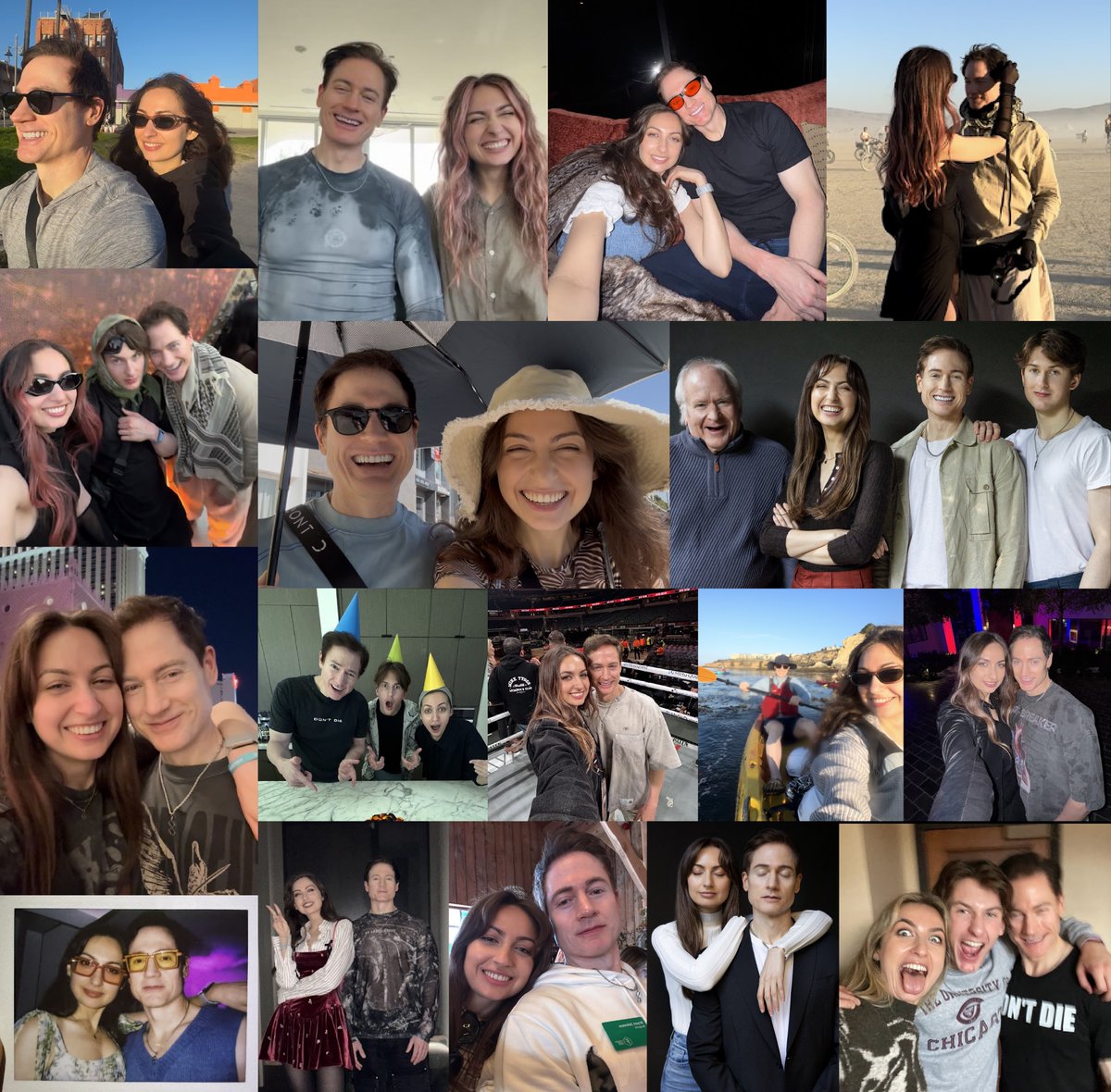
@_katetolo and I met at my brain interface company Kernel. She’d discovered my work using neurotechnology to improve human well-being and merge human and AI. Even though she’d been dreaming of a career in fashion, she was drawn to what she foresaw as the defining question of our time: how will humans successfully co-evolve with AI. We shared the same obsession.
The puzzle piece fit was immediate, as immediate as either of us had ever experienced.
Yet we maintained our professional boundaries. When we worked on our first project together, the back and forth was effortless. She could conceptualize and feel what I couldn’t and vice versa. It helped that both Kate and I had a natural disposition towards hard work. Our joy came from creation.
Kate was luminescent. When I saw her about the office, butterflies fluttered in my stomach. Each day she’d show up wearing some unexpected combination of colors, textures, styles and accessories. Always tasteful, playful and interesting. She didn’t chase fancy brands. Most of her clothing was from the thrift store. It wasn’t how she looked but how her mind worked: original, eccentric, entirely her own. She was art.
We both worked very hard and valued every second of the day. One evening around 6:30 pm she dropped by my office and we talked for hours. It had been all business before. This was the first time we stepped into each other’s personal lives. My heart strings pulled but my brain pushed back. ‘We know we can’t trust again’, my mind firmly stated.
Our after-hours meet-ups in my office became a daily ritual. The favorite part of my day. We’d reminisce about work and tiptoe a bit deeper each time into each other’s personal lives.
I’d recently started my new anti-aging project and one night Kate suggested to me that I should put the entire thing online to allow others to follow on. We worked together to put up a website and got a v1 out. We pondered what to call it, and decided on ‘Project Blueprint’.
We were oddly from entirely different worlds but somehow the same person. Yet neither of us dared take the next step. We didn’t want to imperil our work relationship and we remained deeply skeptical of each other. The combination of Kate being raised to distrust all things and me still feeling the sting of the previous relationship left us stirring in a pot of anticipatory disaster.
Before long, whether we liked it or not, we’d become each other's favorite person. We’d spend every moment we could together. Social events and the weekends were still off-limits as our relationship was professional. We were both secretly wondering, ‘does the other person feel what I’m feeling?’
Unable to withstand any longer, after a year and a half of unspoken affection, one night I softly floated the balloon of inquiry. She confirmed it was reciprocal.
Still, with things being so new, neither of us wanted to make our relationship public. We needed time to stabilize, mature and assess whether this was short or long term. I’m a 48 year old American, raised Mormon, with three children. She’s a 30 year old Bosnian-Australian-American. It took time to bridge our worlds. In our years of knowing each other, three of them have been navigating a relationship. All while building a business and movement. There have been many times where we didn’t know if we’d make it.
In the last year, we’ve found our flow. I trust Kate as much as my mother. She knows how to scaffold trust. She anticipates your anticipation and knows your reaction before you react. She’s meticulous in the integrity of our relationship. She’s even been pivotal in helping my father and me reconcile and navigate the contours of our relationship.
In the past few years, Blueprint and Don’t Die have become global phenomena. Kate is the unsung hero. She and I have been stride on stride since inception. She’s proven an exceptional executor and despite her unconventional background, intuitively knows things. Her creativity keeps me forever guessing what she’ll say or come up with next. Our minds have become so intertwined that life feels naked without her.
Her story warrants being told as others will be better off emulating her practices and abilities.
What I find most impressive about Kate is her prescience and thoughtfulness. She sees forwards, backwards, and side to side. Relative to her, I feel myopic in my awareness of the world. She can see through others, as an x-ray would. She then structures all that information and can package it in simple, understandable terms. In ways that allow for everyone to win.
Kate is soft spoken, self-deprecating and understated. These attributes cloak her ferocious ambition, piercing intellect, and delightful creativity. Give her five minutes and she will reframe your world. But most people don’t know to look. They assume she’s my assistant. It’s such a loss because people are looking for what she has to offer.
My son Talmage, Kate, and I are family. Nothing makes us happier than being together. Our conversations are fast, dark, and rowdy. Family feeds the soul, and we are nourished. As my son considers possible partners, he wisely models them off of Kate.
Deep companionship is a universal human want. And while there are eight billion of us on this planet, most struggle to achieve it, including those in relationships. It’s the most fulfilling of human experiences and also the most elusive. The joy of being seen, appreciated and loved, and offering the same to another.
I wrote dozens of different sentences trying to capture what the want and struggle for deep companionship feels like. I deleted them all as none could holistically capture the emotional architecture of it.
Then one day while exercising, I realized what it feels like: what the explorer Ernest Shackleton and his crew must have felt returning to land after being shipwrecked and surviving 497 days adrift in brutal Antarctic.
It’s a bit of a dramatic comparison, however, I suspect many of you can relate. Kate feels like land to me after being adrift and searching for 25 years.
Life sinks or sails based upon the quality of our most intimate relationships. No amount of professional success can plug the sinking hole of an acrimonious personal relationship.
At this point, Kate and I have nearly become one person. We have entire conversations with a single look, sound, gesture or image. We independently come up with the same ideas and insights, suggesting to me that maybe it’s our tandem effort generating them. Our relationship is stable, positive, and calm.
I’ve wanted this my entire life and impatiently waited 25 years for it to arrive. It’s better than anything I imagined.
Lucky me, I found my Abigail Adams.
typical day as a crypto trader
6:00 – wake up, check if asia nuked my bags overnight. btc flat, random sol memecoin +700%.
6:05 – make coffee. scroll twitter. everyone posting “bottom is in.”
6:10 – open binance. realize i left a limit order overnight that got filled. price instantly down 4%. classic.
6:15 – check discord. some guy with 4 followers is shilling a coin i’ve never heard of. “partnership with google.” chart looks like a ski slope. tempted.
6:20 – funding rates at +200% on some microcap. obvious short. enter small. immediately squeezed.
6:30 – drink coffee. tell myself i’ll stop chasing. open dexscreener. start chasing.
6:45 – telegram alert. dev just rugged a token i “aped small.” define small.
7:00 – twitter full of influencers calling for 200k btc. realize they were bearish yesterday. nod in respect.
7:15 – discord meme channel claims airdrop snapshot in 15 mins. scramble to bridge. gas fee higher than potential reward. do it anyway.
7:30 – price action flat. decide to scalp some illiquid pair. enter. nothing happens. cancel order. price rips instantly.
7:45 – check defi dashboards. net worth swings ±20% in real time. heart rate the same.
8:00 – liquidity vacuum on some obscure perp. throw in a clip. instant slippage. my fill becomes the candle.
8:15 – wife asks how work is going. tell her “good.” hide the chart.
8:30 – tell myself i’ll take a walk. open coinmarketcap instead. scroll for gems like i’m panning for gold in sewage.
9:00 – btc wicks down 5%. liquidation cascade. entry looks obvious. hesitate. miss bottom. buy top of bounce.
9:05 – twitter clown posts “easy long.” 3k likes. i stare at my red pnl.
9:30 – think about coding a bot. open vscode. close vscode. back to clicking candles.
10:00 – random alt rallies 120% because some influencer tweeted a frog emoji. regret not buying frogs.
10:30 – swear i’ll stop trading. set one more order. instantly regret.
11:00 – down bad. cope by writing “patient accumulation” in my notes.
11:30 – friend texts “wen lambo.” i mute him.
12:00 – take lunch break. check charts every 45 seconds.
12:30 – market still flat. realize i’ve been “working” six hours without one profitable trade.
1:00 – open twitter again. timeline full of “gm.” i reply “gn.”
Regarding the button poll
At first glance, pressing the button seems like a golden opportunity. Each press has a 50% chance to double your wealth and a 50% chance to halve it, resulting in a 25% expected gain per press (EV = 1.25x). Mathematically, this implies infinite presses should lead to infinite wealth. It becomes an infinite random walk where every positive integer occurs with certainty.
Let's get a bit more practical here and look at how this matters for trading crypto.
The problem
A game can offer a seemingly generous +25% average return on each press, yet most participants can still lose money because of the nature of multiplicative betting and the divergence between mean and median outcomes.
When simulated many times, the mean (average) wealth can explode to extremely large amounts (because of rare lucky streaks). However, the median (the wealth of the “middle” participant) and the majority of players can still end up losing money.
In this game, wealth compounds multiplicatively, not additively. The average outcome is wildly profitable. The typical outcome is stagnation or loss. The majority of participants go to zero, on a series of highly +EV trades.
Even with a 25% edge, most participants lose due to compounding risks. The multiplicative nature of gains/losses creates a highly skewed distribution. Over time, this creates a log-normal distribution of outcomes: a few massive winners dominate the average, but the majority clusters near zero.
If you wager all your wealth repeatedly, you’re exposed to massive variance. Even if the expected value is positive, repeated halving events (no pun intended) can severely damage your wealth.
Solution: Position Sizing
The problem isn’t the button—it’s how much you bet each time. Position sizing transforms this risky gamble into a sustainable strategy. Example: The Kelly Criterion maximizes logarithmic utility, which prioritizes preserving capital over chasing asymmetric upside.
The fix isn’t avoiding the button — it’s betting a fraction of your wealth each time. You never go broke. Even after a losing streak, in this example, 75% of your wealth remains intact, allowing recovery. Wins and losses balance out over time, letting the 25% EV compound sustainably. Smaller bets = less volatility = smoother compounding.
Conclusion
In any high-volatility, positive-EV scenario, the path to long-term profitability for the majority is careful position sizing. It’s not always about pushing EV as high as possible in a single shot, but about staying in the game and letting your edge work in your favor over many iterations without getting wiped out by volatility.
If you’ve read this far, you now see why the mantra “just survive” isn’t motivational fluff on CT—it’s math. Survival is a prerequisite for realizing your edge. Staying in the game by protecting your capital is the only way to realize that edge in practice. Therefore, “just survive” is not simply feel-good advice; it’s the core risk-management principle that keeps you around to see the long-term fruits of a winning strategy.
Illustrations by @AeternusLucrum. Go read his answer under the poll and follow him.
$200k+/yr changes your life a lot:
→ Buy a Rolex
→ Drive a G-Wagon
→ Book a vacay to Bali
→ Take your partner to Nobu
→ Max out your 401k and invest
→ Live in a luxury condo/apartment
Here’s how I got there (while the government paid for it)... 🧵
it’s ludicrous the amount of guys that made $50-100-500m off of being execs at early internet companies like Facebook
and now want to run around tell you these very same companies are evil and that only they can be trusted now that they’ve seen truth (the inside of a g550)
Introduction to my personal @tradewithPhoton settings and how I would set up a brand new account
Sign up: https://t.co/XpzztcZ6K3
These are my personal settings and what works for me
But you can interpret everything and refine the concepts I highlight into your own setup