We just raised an $8M seed round to kill AWS, GCP, and Azure.
Introducing https://t.co/E3LHVE410x, the agent-native serverless cloud.
Your team is shipping code like never before. But you're getting caught up in manual, tedious DevOps work trying to deploy it.
InstaCloud provides the serverless compute that lets your services autoscale, with all the infrastructure managed for you.
Agents branch into complete replica environments when working, keeping prod safe and iteration speed high.
And of course, it all works seamlessly with agents through MCP/CLI.
Get off the traditional, legacy cloud.
Start deploying your services on InstaCloud today.
Andrew Ng just dropped the best 2-hour course on Graph Engineering: from single agent to full automation
9:14 - your first agent
33:11 - loop engineering
1:02:46 - graph engineering
1:30:15 - agents that rewrite themselves
1:49:05 - full graph system
two hours, and it replaces every agent tutorial you bookmarked this year
Prompts → Agents → Loops → Graphs
most people will stop after the first agent and call it automation
he saves the last forty minutes for the graph that runs it without him
same model, same tokens, completely different week
watch it today
the step-by-step guide is below, save it while it is still early ↓
35 WEBSITES GOOGLE DOESN'T WANT YOU TO KNOW
1. Explee .com — sends cold emails on autopilot
https://t.co/stniMlW9jN
2. NoteGPT — turns docs into podcasts
https://t.co/LnV8bZbYZO
3. Napkin AI — turns text into diagrams
https://t.co/AnkuX7aOdd
4. Ideogram — generates text in images perfectly
https://t.co/0DXFIzvLjn
5. Suno — makes full songs from a prompt
https://t.co/VjO6GxCOib
6. HeyGen — clones your face into videos
https://t.co/XrUTh8llTO
7. Kling AI — best AI video generation
https://t.co/5Cn0KJka61
8. ElevenLabs — clone any voice instantly
https://t.co/ftGCJjICdf
9. Gamma — AI presentations in seconds
https://t.co/QMla9avM3T
10. Perplexity — AI search with real sources
https://t.co/ansIDk2EBM
11. Pika — animate any image into video
https://t.co/Q4pnxHlWS5
12. Runway — cinematic AI video generation
https://t.co/GQuTAgs5BC
13. Cursor — AI code editor that builds for you
https://t.co/3eApj9WntR
14. v0 — generate UI components with AI
https://t.co/mYZP1mnv48
15. Lovable — turn ideas into working apps
https://t.co/bX5DVwQLf2
16. Descript — edit video by editing text
https://t.co/7ryIZGTlRX
17. Opus Clip — auto cut long videos into shorts
https://t.co/B5RaFRp4pP
18. Krea AI — real time AI image generation
https://t.co/Mn2DjN1aWS
19. Magnific — upscale any image with AI
https://t.co/u4YSRlffpH
20. Viggle — make characters move realistically
https://t.co/q5uOCPYiqv
21. tl;dv — record and summarize any meeting
https://t.co/qHCXf1l3Lj
22. Fireflies — AI meeting notes automatically
https://t.co/lSRFVMFqwm
23. Castmagic — turn audio into content pieces
https://t.co/XCpaWm04YI
24. Replit — code and deploy from browser
https://t.co/sBjAq4aEzV
25. Leonardo AI — generate images for free
https://t.co/GVjRiLrNYs
26. Synthesia — AI avatar videos no camera needed
https://t.co/7TaVCXE0du
27. Fliki — turn text into videos with AI
https://t.co/b0bQhZgf96
28. Photoroom — AI product photography
https://t.co/7c8T6P0Sil
29. Invideo AI — turn prompts into full videos
https://t.co/8xbzjsU9il
30. Consensus — search what science agrees on
https://t.co/2nSQ6SSev8
31. SciSpace — understand any research paper
https://t.co/61vY5QRjUl
32. Tome — AI builds your pitch decks
https://t.co/5kpDkv3MFp
33. Beautiful AI — smart presentation design
https://t.co/d5H9kyhUBv
34. Meshy — turn text into 3D models
https://t.co/xSUe3G34J1
35. Vizcom — turn sketches into renders
https://t.co/BgHvCAjbUc
The AI revolution isn't coming.
It already happened and you missed half of it.
After co-inventing ChatGPT, I kept asking myself: why have superhuman chat models not led to AGI?
I’ve spent the last 2 years in stealth building a new way to train models (RLCD), and a new type of frontier AI model that we are releasing today: Jev
• 20-200x faster
• 40-400x cheaper (w/ output tokens free)
• Frontier composable intelligence optimized for decisions
AFAICT the shortest path to AI-based economic revolution
YOU CAN AUDIT YOUR ENTIRE WEBSITE'S SEO IN UNDER AN HOUR WITH OPUS 5.5.
No $400/month tools. No agency.
Here's the setup:
Step 1: Open Claude Code and paste the audit script from the course. It crawls every page in your sitemap.
Step 2: It flags broken pages, missing titles, duplicate descriptions and thin content, and saves it all to one file.
Step 3: Pull your last 3 months of data from Google Search Console.
Step 4: Give both to Opus 5.5 and ask for a fix list sorted by impact.
Step 5: Fix the top 10 this week.
The full course is free below. Bookmark it.
follow @cyrilXBT
Top 9 agentic use cases for Jev:
(bookmark this)
Jev handles semantic decisions that ordinary code cannot express reliably. It returns typed answers and probabilities, while code continues to cover the workflow.
Here are 9 practical use cases for Jev:
1. Browser next action
> Convert the current DOM state into a bounded action such as click, type, or stop. Code executes only valid operation-target pairs. There are already several open-source Jev web agents.
2. Context compaction
> Decide which events from a long agent trace should remain. The selected text stays verbatim instead of being replaced with a generated summary.
3. Skill and context loading
> Compare the current user turn against the available skills. Load only the instructions needed for that turn instead of filling the context window with every skill.
4. Typed tool-call compilation
> Map a natural-language request to a function and fill its typed arguments. Each argument is evaluated separately before code allows execution.
5. Citation verification
> Check whether a quoted passage exists and whether the surrounding evidence supports the claim. The output can be supported, unsupported, or contradicted.
6. Extraction verification
> Run a cheap extractor first, then use Jev to verify questionable fields. Clean records stay on the fast path while uncertain ones reach a reasoning model.
7. Agent trace evaluation
> Turn raw trajectories into queryable labels such as progress and repetition. This avoids asking another LLM to write a full review of every run.
8. Semantic regression tests
> Replay a trace suite against a new agent build. Semantic checks can then pass or block prompt, model, tool, and policy changes in CI.
9. Jevgrep code search
> Search a codebase by what the code does rather than its exact words. Jev scores candidate snippets and returns the most relevant code first.
If you want to see the final pattern in practice, it is already implemented in the Beacon open-source project.
It captures full sessions across Claude Code, Codex, Cursor, OpenCode, and 20+ agent harnesses, and then Jev identifies which workflows and corrections are worth learning from, so that a lesson discovered by one agent can become available to the others.
GitHub repo: https://t.co/BM7ROFYVub
If you want to dive deeper, check out the full guide on Jev below ↓
🧬 What If Scientists Could Delete HIV?
Scientists are exploring a remarkable possibility: using CRISPR gene editing to cut HIV’s hidden DNA out of infected cells.
Unlike antiretroviral medicines, which keep HIV suppressed, CRISPR aims at the viral DNA itself—the genetic material that allows HIV to hide inside cells.
In laboratory studies, researchers have successfully targeted HIV DNA and reduced its ability to produce new virus. But there’s a major challenge: reaching every hidden HIV-infected cell safely.
So, has HIV been cured? Not yet.
Human trials and further research are still needed. But if scientists can solve these challenges, gene editing could one day transform the treatment of HIV—and perhaps other persistent viral infections.
Source: Hu, W., et al. RNA-directed gene editing specifically eradicates latent and prevents new HIV-1 infection.Proceedings of the National Academy of Sciences, 111(31), 11461–11466.
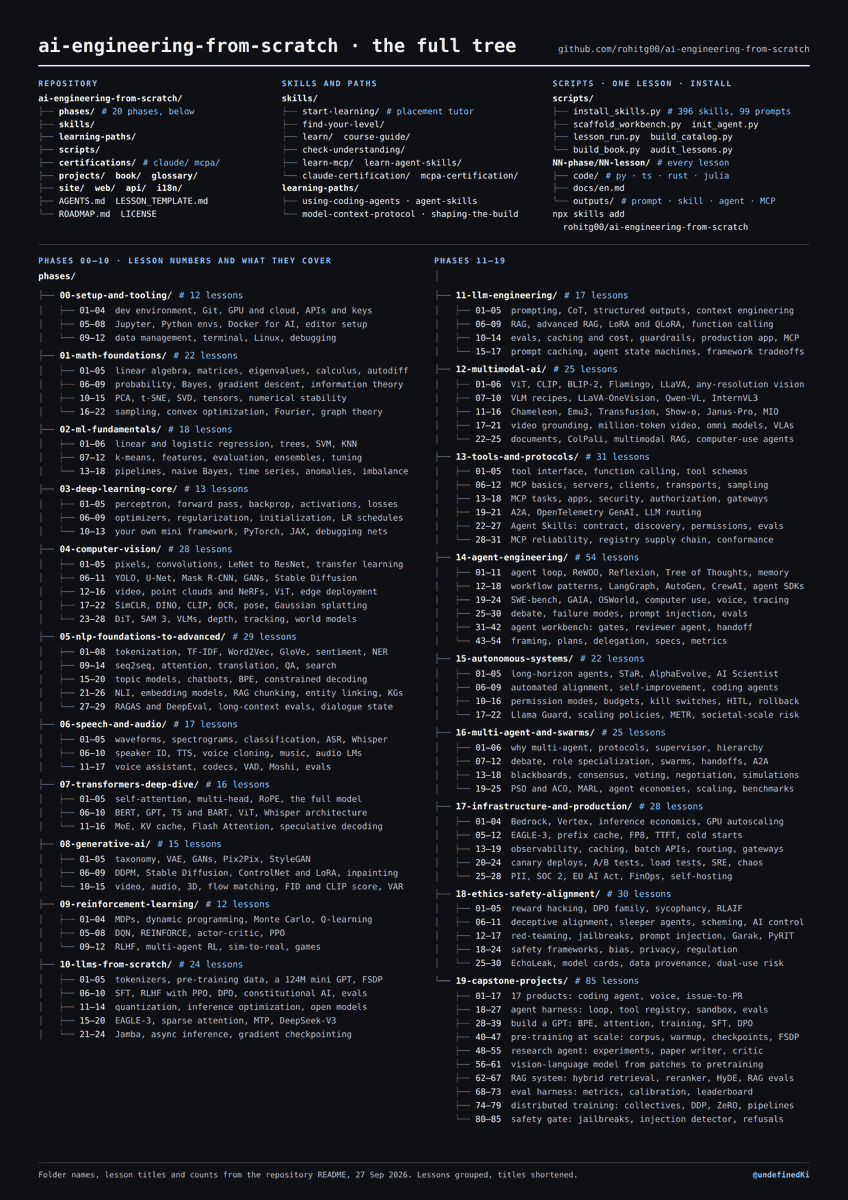
A Google Developer Expert put an entire AI engineering course on GitHub. 523 lessons, from linear algebra to agent swarms. Free
What is in there:
> 20 phases, ~342 hours, in Python, TypeScript, Rust and Julia
> Every algorithm built from raw math first, then with the real library
> Every lesson ships something reusable: a prompt, a skill, an agent or an MCP server
> 396 skills and 99 prompts you can drop into Claude Code, Cursor or Codex
If you're new to AI, start with Phase 0. If you already code and want agents - Phase 14, about 60 hours
Repo: https://t.co/J6GaLJNuWR
Opus 5.5 is insane for motion design...
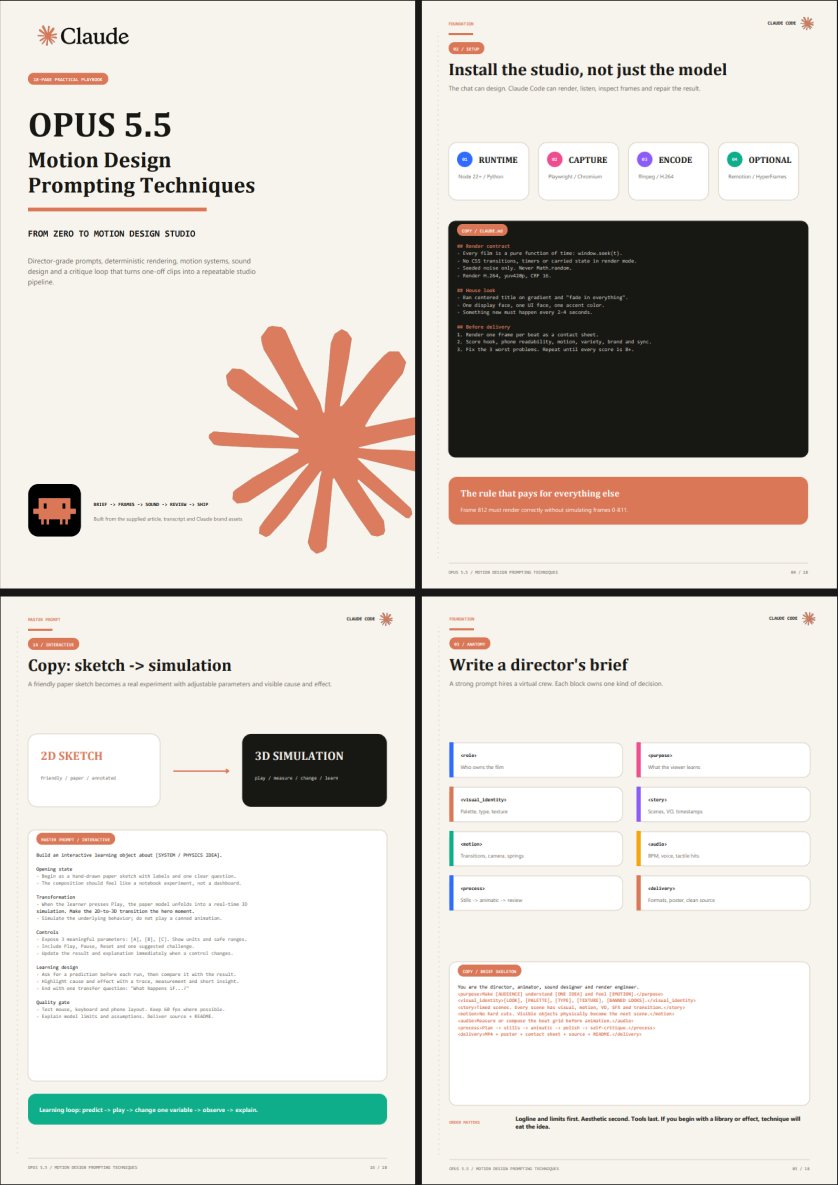
this 18-page pdf blueprint on prompting Opus 5.5 will turn Claude from photo generator to AAA motion design studio
here is 10 key tips:
step 1 → the prompt is 10%. the harness is 90%. write a render contract in CLAUDE.md before touching any prompt
step 2 → write a director's brief in XML blocks: role, purpose, visual_identity, story, motion, audio. Claude reads a program, not a wish
step 3 → a reference beats ten adjectives. extract frames every 0.5s, write style_guide.md and shotlist.md. take the grammar, never the content
step 4 → give every beat a job. 7-beat timeline: Hook → World → Question → Mechanism → Discovery → Payoff → Loop. dead beats kill retention
step 5 → lock the world before it moves. character bible first: proportion, palette, expressions, motion grammar. identity before animation
step 6 → window seek(t) renders any frame from just t. no state between frames. render frame 300 twice, hashes match. deterministic output
step 7 → replace every easing curve with springs. Snappy for buttons, Default for cards, Playful for mascots. if it looks like PowerPoint the spring is wrong
step 8 → design sound before animation. beat grid is structural. clicks on peaks, reveals on downbeats. one clock syncs everything
step 9 → don't use one prompt for every job. run specialist passes: style extractor → shotlist architect → motion director → sound designer → harsh critic
step 10 → make Claude score its own frames 1-10. nothing ships below 8. repeat until 8+ three times in a row
Send this PDF to Claude, then read the full guide with demos in the article below.
a Stanford professor Percy Liang specialized in LLMs built and sold this machine learning bot for $125,700
his AI research bot, powered by GPT-6 Astra, can analyze 11 million scientific papers in a minute, extract the key findings, identify contradictions, and generate new research hypotheses.
the professor spent 14 months building it, and eventually, one company paid six figures to get access to it.
but the crazy part isn’t how much they paid.
it’s what this machine can discover when you give it millions of papers at once.
I’m digging into how the system actually works - and the next part is even crazier.
would you pay $125,700 for a machine like this?
this is f**king dangerous.
someone just open sourced an entire library of ready-made JEV skills for building insane AI agent workflows.
instead of building common agent patterns from scratch, you can grab skills for things like:
→ jev-route for routing tasks
→ jev-guardrail for adding checks and verification
→ jev-fanout for running multiple tasks in parallel
→ reusable skills you can plug into your own workflows
the interesting part is that these solve problems you'll run into once your agents start doing more than simple tasks.
you don't have to reinvent routing, verification, or parallel execution every time you build a new workflow.
save this now.
you'll probably need one of these skills the next time you're building an agent and don't want to start from scratch.
repo below:
We finally cracked it!
Opus 5.5 videos are now editable.
We built Open Edit, an open-source agent that turns videos into editable browser projects.
Project + GitHub below ↓
The entire RAG industry is about to get cooked.
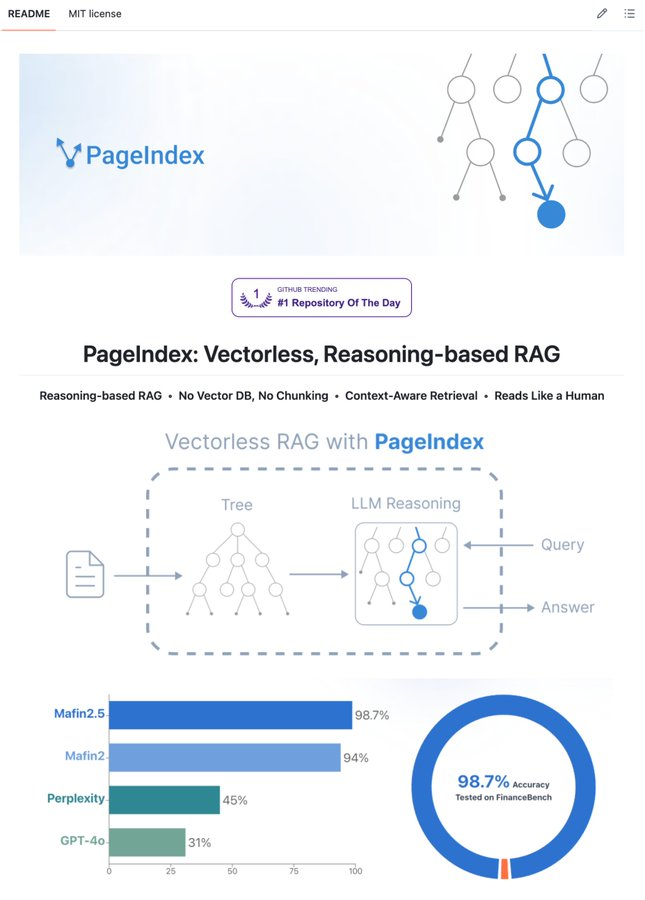
Researchers developed a new RAG approach that bypasses almost everything traditional RAG depends on.
- No vector DB
- No data embeddings
- No chunking
- No similarity search
It's called PageIndex.
Instead of splitting your documents into chunks and loading them into Pinecone, it creates a tree index that lets the LLM reason through them like a human reading a book.
98.7% on FinanceBench. Outperforms every vector RAG on the leaderboard.
100% free. Open source.
this is pure f*cking treasure
A Stanford AI research group has found a way to use JEV to make your LLM run 24/7 at a lower cost in x444
the LLM only does what needs words. everything else is a typed decision:
> worth reading? Jev answers yes or no before a single token is spent
> which desk? papers, repos or market, one Choice
> rerank: embeddings pull 20 sources, Jev keeps the 5 that matter
> claim holds? every claim checked against its source, the weak ones dropped
> new or known? duplicate, related, revises or contradicts, checked against the vault
the LLM writes one note, 5 to 12 lines, one claim
> judge: confident verdicts pass, unsure ones go up to a frontier model
> matters to you? only the top scores make the morning brief
the judge rule comes straight from Carnegie Mellon's JEV-as-a-Judge paper: escalate only the unsure 34%, keep 99.6% of the accuracy at 47% of the fee
and the fees are the whole point
> Jev: $0.044 per 1,000 judgments
> GPT-6: $12.182 for the same 1,000
a whole day of decisions on a frontier model costs dollars. the same day on Jev costs cents
you stop reading 300 sources. you read one brief
I asked Claude Opus 5.5 to explain how a rocket engine works by building an interactive Raptor 3 you can take apart in your browser.
Cut it open, follow the oxygen and the methane through both turbopumps, then throttle it and watch the shock diamonds move.
https://t.co/ulDNOZyAWx
Still cooking on Saturday.
We compressed our most popular local cyber model down to 15.7 GB.
Meet OrcaSAQ-2 Cyber 27B Uncensored GGUF — built for defensive red teaming, vulnerability research, security coding, terminal workflows, and authorized security testing.
54.7 → 15.7 GB
262K context
94.4% Top-1 agreement
Cyber capability should not require sending your source code, logs, or vulnerabilities to someone else’s cloud. Run it locally. Keep the data local.
Our smallest cyber model yet and one of the most capable we’ve evaluated in this size class. Have fun!
https://t.co/QhItgfVVCy