“Na khaoonga, na khane doonga” should now be updated to: “Na padhoonga, na padhne doonga.”
A nation that stops questioning, reading, and learning eventually stops progressing.
१६ मे २०१४ रोजी, ३०,००० कोटी रुपयांच्या प्रचंड निवडणूक खर्चानंतर जेव्हा नरेंद्र मोदी सत्तेवर आले, तेव्हा त्यांना एक मोडकळीस आलेली रचना नव्हे, तर २००८ मध्ये स्थापन झालेली नॅशनल पेमेंट्स कॉर्पोरेशन ऑफ इंडिया (NPCI) आणि २००९ मध्ये सुरू झालेला आधार उपक्रम, अशी १३,००० कोटी रुपयांची
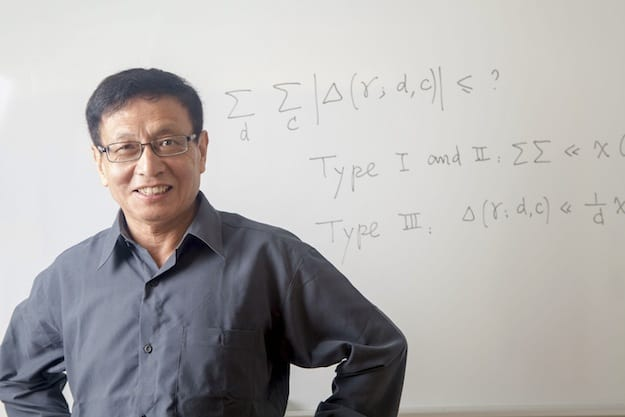
A Chinese mathematician spent 7 years making sandwiches at Subway after his PhD, and at 58 solved a 150-year-old math problem nobody thought was solvable.
His name is Yitang Zhang. The problem is called the Twin Prime Conjecture.
He was born in Shanghai in 1955 and knew he wanted to spend his life on mathematics by the time he was nine years old. That year he found his own proof of the Pythagorean theorem. Nobody taught it to him. He just worked it out.
Then the Cultural Revolution arrived and took everything.
The Chinese government closed the schools. Zhang's father had political troubles with the Communist Party, so Zhang was sent to the countryside with his mother to work in the fields. He spent 10 years as a farm laborer. No high school. No classroom. No teacher.
He read math books in the fields when he could find them.
When the revolution ended, Zhang was 23. He sat the university entrance exam and got into Peking University, one of the most competitive mathematics programs in China. He finished his bachelor's degree, then a master's. The president of Peking University personally recommended him for a full scholarship at Purdue University in the United States.
He arrived at Purdue in 1985. He earned his PhD in 1991.
Then the second wall hit.
His relationship with his doctoral advisor collapsed. The advisor did not write him letters of recommendation. Without those letters, the academic job market was closed. Zhang applied. Nothing came back. He spent the years after his PhD working as an accountant, doing delivery work, sleeping in his car during the stretches when nothing else was available.
A friend eventually opened a Subway sandwich restaurant in Kentucky and offered him a job. Zhang took it. He kept the books and made sandwiches. A man with a PhD in mathematics from Purdue, working a Subway counter because the academic world had no place for him.
He did this for seven years.
He was finally hired as a lecturer at the University of New Hampshire in 1999. Not a professor. A lecturer. The lowest rung of the academic ladder, with no research funding, no graduate students, and no institutional support. He taught calculus to undergraduates and worked on mathematics alone in whatever time was left.
Most people would have stopped believing by then.
Zhang did not stop.
The Twin Prime Conjecture is one of the oldest unsolved problems in number theory. Twin primes are pairs of prime numbers separated by exactly two: 5 and 7, 17 and 19, 41 and 43. The conjecture predicts that these pairs never stop appearing no matter how far you go along the number line. Mathematicians had believed this for over 150 years. Nobody had been able to prove it.
The deeper version of the problem asks something slightly different. Not whether twin primes are infinite, but whether there is any finite gap between prime numbers that appears infinitely often. This is called the bounded gap problem. The best mathematicians in analytic number theory had been attacking it for decades. A landmark 2005 paper by three researchers came agonizingly close and still could not close it.
Zhang worked on it alone. No collaborators. No funding. No department seminars where he could road-test his ideas. He once said he would go to a friend's house and think in the garden for hours.
In 2012, during a visit to a friend's home in Colorado, something unlocked.
He submitted his paper to the Annals of Mathematics in April 2013. The Annals is the most prestigious mathematics journal in the world. Papers sit in review for months, sometimes years. The editors read Zhang's submission and immediately knew something was different. They sent it to the leading experts in analytic number theory for review.
It was accepted in three weeks.
The paper proved that there are infinitely many pairs of prime numbers separated by a gap of less than 70 million. Not two. Not the twin prime gap specifically. But a finite gap. For the first time in history, someone had proved that prime numbers keep coming back together, that the universe of numbers never lets them drift apart forever.
Peter Sarnak, one of the most respected mathematicians at the Institute for Advanced Study, said: "He is not a fellow who had done much before. Nobody knew him. His result was spectacular."
Zhang was 58 years old.
Within a year he had the MacArthur Fellowship, the Cole Prize, the Rolf Schock Prize, and a full professorship at UC Santa Barbara. The man who spent seven years at Subway was now one of the most celebrated mathematicians alive.
He said in an interview: "I was not lucky. Maybe it is more important for a person to make himself known to the public. But that was not so easy for me."
He was not complaining. He was just being precise.
The mathematics establishment has a quiet belief that great work happens young. The Fields Medal cuts off at 40. Most mathematicians who change the field do it in their thirties. Zhang proved his most important theorem at 58, after a decade of farm labor, seven years of sandwiches, and a decade of teaching calculus to freshmen with no one watching.
He did not beat the deadline.
He proved there was no deadline to beat.
That teacher is exploiting a neuroscience hack that no keyboard on earth can replicate.
When you form letters by hand, your brain fires across the premotor cortex, parietal cortex, cerebellum, and hippocampus simultaneously. A 2023 EEG study at the Norwegian University of Science and Technology wired 36 students up and measured brain connectivity while they wrote vs typed the same words. Handwriting produced widespread theta and alpha wave synchronization across the regions responsible for memory formation. Typing produced almost nothing in those same regions.
The mechanism is spatial. Writing the word "the" requires your hand to trace three distinct motor paths that physically correspond to the structure of the word. Typing "the" requires three identical finger presses on fixed keys. Your motor cortex encodes the spatial difference between those letters when you write. When you type, every letter feels the same to your brain.
Students who take handwritten notes consistently outperform typists on recall and comprehension tests, even when they write fewer total words. The slowness is the feature. Your brain can't transcribe fast enough to take verbatim notes, so it's forced to compress, rephrase, and prioritize in real time. That processing is the learning. Typing lets you transcribe without thinking. Handwriting forces you to think without transcribing.
The professor assigning handwritten work in 2025 isn't living in the Stone Age. They're assigning the only input method that lights up the memory formation network in your brain. Every semester another study confirms it and every semester students complain about it.
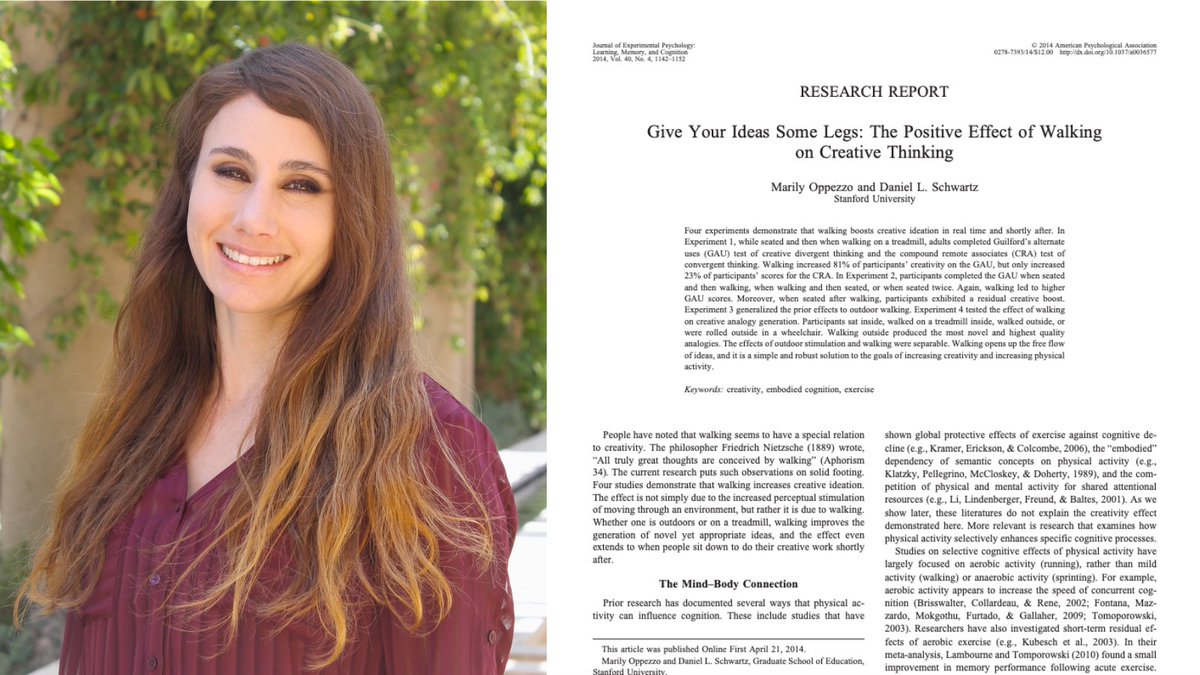
A Stanford psychologist spent 4 years proving that the simple act of walking generates 60% more creative ideas than sitting, and the experiment she designed to kill every alternative explanation is one of the most decisive findings in modern psychology.
Her name is Marily Oppezzo.
She got the idea for the study while walking with her advisor at Stanford to discuss her thesis topic, and the paper she eventually published in the Journal of Experimental Psychology in 2014 is sharp enough that it should have ended the seated meeting on the day it came out.
She ran 4 experiments on 176 people. Same person tested twice. Once sitting, once walking. The creativity tasks were the standard ones psychologists have used for decades to measure how good a brain is at generating novel useful ideas.
The result was almost too clean to publish.
81% of participants in the first experiment produced more creative ideas while walking than while sitting. In the second experiment, 88%. In the third, 100%. Every single person walked into a more creative version of themselves.
On average, people generated 60% more novel useful ideas the moment their legs started moving.
The skeptical question is the obvious one. Maybe it was the fresh air. Maybe it was the scenery passing by. Maybe it was the change of environment doing the work, not the walking itself.
Oppezzo killed every one of those explanations with one experimental decision.
She put people on a treadmill facing a blank wall. No scenery. No fresh air. No environmental change. Just legs moving in place while staring at white drywall. The 60% boost held.
Then she ran the experiment that closed the case completely. She took participants outside in two conditions. Half of them walked through a Stanford courtyard. The other half were pushed through the exact same courtyard in a wheelchair. Same outdoor stimulation. Same scenery passing at the same speed. The only difference was whether the legs were moving.
The walkers produced dramatically more novel high-quality ideas than the wheelchair group. The outdoors did almost nothing on its own. The walking did everything.
This is the part of the study that hit hardest when I read it the first time.
She also tested the opposite kind of thinking. Convergent thinking. The kind where there is one right answer and you have to narrow down to it.
Word puzzles where 3 words share a hidden fourth word that connects them. The seated participants did slightly better on these. Walkers got slightly worse.
Walking is not a general intelligence enhancer. It does one specific thing. It opens up the divergent search inside your brain. The part that generates options. The part that produces unexpected connections. The part that takes a problem and finds five ways into it instead of one.
When you need to converge on the single right answer, sit down. When you need to find the answer in the first place, get up.
The mechanism is now well understood. Walking selectively activates what neuroscientists call the default mode network, the system inside your brain that runs when you are not consciously focused on anything. The DMN is where mind-wandering happens. Where memories cross-reference each other. Where ideas that have been sitting in separate folders inside your head finally bump into each other.
When you sit at a desk and force yourself to concentrate, you suppress the DMN. When you walk at a natural pace, the executive part of your brain gets just busy enough handling the walking that the DMN comes online and starts doing the work that focus was blocking.
The most useful finding in the entire paper is the one almost nobody quotes.
The boost did not turn off the moment people stopped walking. Participants who walked first and then sat back down stayed elevated. Their next round of seated creativity work was still significantly better than people who had been sitting the whole time. The rest lingered for at least several minutes after the legs stopped moving.
You do not need to do creative work while walking. You need to walk before the creative work. The brain holds the state.
The history of this is the part that should haunt anyone who still does meetings in chairs.
Charles Darwin built a gravel loop behind his house in Kent called the Sandwalk and walked it 3 times a day for the rest of his life. The theory of evolution was developed one lap at a time on that path.
Nietzsche walked up to 10 hours a day during the years he wrote his most important books and openly said the work was conceived on his feet.
Beethoven composed for the morning and walked for 5 hours every afternoon with a pencil in his pocket for when something landed.
Kahneman said the best thinking of his Nobel Prize-winning career happened on leisurely walks with Amos Tversky. Steve Jobs refused to take important conversations sitting down. He held them on foot.
Every one of them was using the system Oppezzo would not measure until 2014. They just did not know what to call it.
The question worth sitting with is the one almost nobody asks.
Every meeting you have ever attended sitting around a table was a meeting held at a fraction of the brain power that was actually available to the people in the room. Every brainstorm that got stuck inside a conference room. Every problem you tried to solve at a desk and gave up on. Every idea you could not quite get to.
The intervention is the easiest one in modern science. No supplement. No app. No subscription. No training program. Just a pair of legs and 15 minutes.
The Stanford lab proved it. The philosophers knew it. The neuroscience explains it.
And almost everyone reading this is still trying to think their way out of problems sitting completely still.
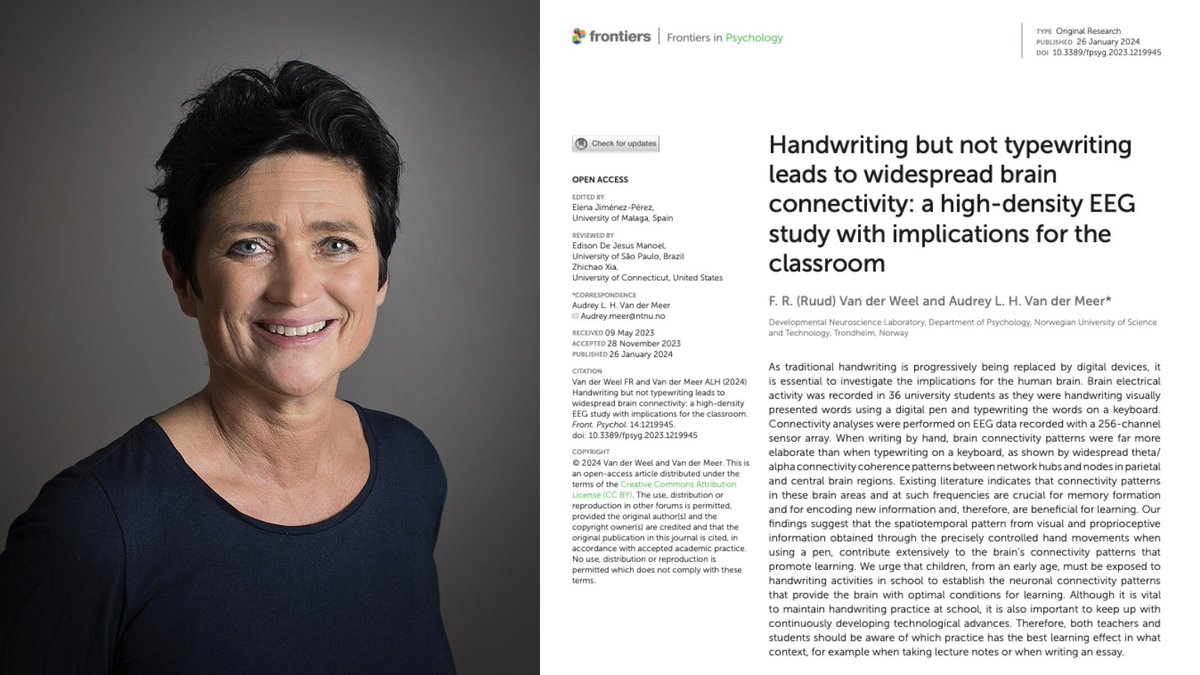
A Norwegian neuroscientist spent 20 years proving that the act of writing by hand changes the human brain in ways typing physically cannot, and almost nobody outside her field has read the paper.
Her name is Audrey van der Meer.
She runs a brain research lab in Trondheim, and the paper that closed the argument was published in 2024 in a journal called Frontiers in Psychology. The finding is brutal enough that it should have changed every classroom on Earth.
The experiment was simple. She recruited 36 university students and put each one in a cap with 256 sensors pressed against their scalp to record brain activity. Words flashed on a screen one at a time.
Sometimes the students wrote the word by hand on a touchscreen using a digital pen, and sometimes they typed the same word on a keyboard. Every neural response was recorded for the full five seconds the word stayed on screen.
Then her team looked at the part of the data most researchers had ignored for years, which is how different parts of the brain were communicating with each other during the task.
When the students wrote by hand, the brain lit up everywhere at once.
The regions responsible for memory, sensory integration, and the encoding of new information were all firing together in a coordinated pattern that spread across the entire cortex. The whole network was awake and connected.
When the same students typed the same word, that pattern collapsed almost completely.
Most of the brain went quiet, and the connections between regions that had been alive seconds earlier were nowhere to be found on the EEG.
Same word, same brain, same person, and two completely different neurological events.
The reason turned out to be something nobody had really paid attention to before her work. Writing by hand is not one motion but a sequence of thousands of tiny micro-movements coordinated with your eyes in real time, where each letter is a different shape that requires the brain to solve a slightly different spatial problem.
Your fingers, wrist, vision, and the parts of your brain that track position in space are all working together to produce one letter, then the next, then the next.
Typing throws all of that away. Every key on a keyboard requires the exact same finger motion regardless of which letter you are pressing, which means the brain has almost nothing to integrate and almost no problem to solve.
Van der Meer said it plainly in her interviews.
Pressing the same key with the same finger over and over does not stimulate the brain in any meaningful way, and she pointed out something that should scare every parent who handed their kid an iPad.
Children who learn to read and write on tablets often cannot tell letters like b and d apart, because they have never physically felt with their bodies what it takes to actually produce those letters on a page.
A decade before her, two researchers at Princeton ran the same fight using a completely different method and ended up at the same answer. Pam Mueller and Daniel Oppenheimer tested 327 students across three experiments, where half took notes on laptops with the internet disabled and half took notes by hand, before testing everyone on what they actually understood from the lectures they had watched.
The handwriting group won by a wide margin on every question that required real understanding rather than surface recall.
The reason was hiding in the transcripts of what the two groups had actually written down.
The laptop students typed almost word for word, capturing more total content but processing almost none of it as they went, while the handwriting students physically could not write fast enough to transcribe a lecture in real time, which forced them to listen carefully, decide what actually mattered, and put it in their own words on the page.
That single act of choosing what to keep was the learning itself, and the keyboard had quietly skipped the choosing and skipped the learning along with it.
Two studies. Two countries. Same answer.
Handwriting makes the brain work. Typing lets it coast.
Every note you have ever typed instead of written went into your brain through a thinner pipe. Every meeting, every book highlight, every idea you captured on your phone instead of on paper was processed at half depth.
You did not forget those things because your memory is bad. You forgot them because typing never woke the part of the brain that would have made them stick.
The fix is the thing your grandmother already knew.
Pick up a pen. Write the thing down. The slower road is the faster one.
China’s Rise Through Education: From Cheap Labor to a Tech Giant:
Once known as the land of cheap labor, China has transformed itself into one of the world's largest technology producers. But what lies behind this monumental transformation? The key is China's approach to education—not merely as a tool for personal achievement, but as the cornerstone of national development. Strategic investments, visionary policies, and an unparalleled focus on education have been the driving forces that shifted China from copying to creating innovation. Let’s take a closer look at the education system driving this transformation.
In August 2013, I moved to Shanghai after receiving a job offer. Having lived here for over a decade, I’ve been deeply involved in education as an adjunct professor and certified lecturer at some of China’s leading universities and business schools. Alongside teaching intensive courses that combine theory with industry applications, I’ve also pursued entrepreneurial endeavors. My journey has been a blend of research and active participation in education. During holidays, I often backpack to remote villages across China, stepping into classrooms in rural schools, meeting teachers, and even sitting with students to experience their world firsthand. I also explored education systems in many Asian countries and the West in the same way.
I can confidently say that I have never seen another society as invested in education as China. While education is important in many countries, the collective awareness and prioritization of education in China are truly unique.
Educational investments in China (not as an expense, but seen as an investment —this distinction matters) are the foundation of household economics. Far from being a luxury, education is a necessity that has solidified its place over generations. One of the most striking things I learned early on was how Chinese families pour generational wealth into their children’s education. Even in the remotest villages, I encountered young children speaking English with British or American accents—proof of how dedicated their families are. This investment begins at birth and intensifies until students complete their high school education.
Kindergarten Education in China
When a child turns three, they begin kindergarten, embarking on an educational marathon that includes private lessons, summer schools, music, sports, and coding academies. Kindergarten continues until the age of six.
Preschool education holds great importance in Chinese society. Although kindergarten is not mandatory within the education system, cultural values have led families to view it as an integral part of foundational education.
In China, public kindergartens managed by state institutions offer standardized and affordable educational services. Over the past 17 years, the Chinese government has allocated only 1.3–1.4% of the national education budget to preschool education, opening the door for private kindergartens. These private institutions, which charge higher fees, typically cater to middle- and upper-class families, providing high-quality and differentiated educational options.
According to the Ministry of Education's annual report, the number of kindergartens decreased by 14,808 in 2023, dropping to 274,400—a reflection of the country’s declining birth rate. Despite this, the enrollment rate for children aged 3–5 increased by 1.4% compared to the previous year, reaching 91.1%.
So, what kind of education do kindergartens in China provide?
Most kindergartens in China provide bilingual education in Chinese and English, with Confucian principles playing a central role. Additionally, Chinese kindergartens cater to both local and international families, offering diverse educational options.
Local Chinese kindergartens primarily focus on traditional Chinese educational values, emphasizing discipline, collaboration, community awareness, and responsibility. The curriculum heavily incorporates arts, music, mathematics, and Mandarin language skills, with English lessons typically limited to one hour per day. These state-supported kindergartens are affordable, with monthly fees ranging from 500 to 2,000 RMB ($70 to $280 USD). Local kindergartens place significant importance on Chinese culture and the Mandarin language, deeply integrating values such as Confucianism and national holidays into their programs. However, class sizes are often large, accommodating between 30 and 50 children.
International kindergartens, on the other hand, adopt Western education methods such as IB (International Baccalaureate), Montessori, Reggio Emilia, and Waldorf. These schools offer bilingual education in English and Chinese and are particularly prevalent in major cities like Shanghai, Beijing, and Shenzhen. IB kindergartens are often part of larger international school systems. These schools are more expensive, with annual tuition fees typically ranging from 100,000 to 250,000 RMB ($13,700 to $34,300 USD).
Each international curriculum has its unique appeal:
Montessori: Chosen by families seeking independent, critical-thinking children who are open to individual learning from an early age.
Reggio Emilia: Favored by families who want their children actively participating in creative and collaborative group projects.
IB: Preferred by families aiming for an international education with a strong emphasis on discipline, culture, and global exposure.
Private bilingual kindergartens primarily emphasize Chinese while teaching English as a second language. The quality of these schools varies greatly, with monthly fees ranging from 3,000 to 15,000 RMB ($410 to $2,050 US).
Talent-focused kindergartens specialize in areas like art, sports, music, or dance, tailoring the curriculum to the interests of the child. Fees vary depending on the chosen program.
From kindergarten onward, children in China are often prepared for primary school entrance exams (which are not national but conducted by international schools). As a result, children enter an intense educational journey early, focusing on English, robotics, coding, and artificial intelligence, balanced with artistic and sports activities.
Many of these kindergartens are equipped with cameras, allowing parents to monitor their children's participation in class activities through mobile apps. Parents can also file complaints if dissatisfied with teachers or meals. In one recent incident, a parent rushed to a kindergarten to intervene after witnessing their child being mistreated on camera. Teachers caught abusing children are permanently banned from the profession in China. Although rare, cases of parents attacking such teachers are also met with legal consequences. Physical confrontations are uncommon in China, as "losing face" is culturally avoided.
छत्रपती संभाजीनगर महानगरपालिका शहरातील झाडांना 'मोकळा श्वास' मिळवून देण्यासाठी झाडांच्या मुळाशी घट्ट बसवलेले पेव्हर ब्लॉक्स आणि कॉंक्रिट काढून तिथे शास्त्रोक्त पद्धतीने आळे तयार करत आहे, जेणेकरून झाडांना जगण्यासाठी आवश्यक हवा आणि पाणी मिळेल.
20 years ago, all classroom readings were from books, practice and tests were on paper, writing happened with a pencil, examples were on whiteboards
We can, just, go back to that.
चार लोकांत बसून दोन शब्द बोलण्याची, स्वतःची मत व्यक्त करण्याची हिंमत मला वाचनाने दिली.चांदोबा पासून सुरू झालेला वेगवेगळ्या लायब्ररींच्या कपाटा पासून तर रस्त्यावरच्या जुन्या पुस्तकापर्यंत चा प्रवास आज ही चालू आह.माझ्यात जो काही थोडाफार चांगुलपणा आहे तो वाचना मुळे
पुस्तकदिन ❤️🙏.
Monica Kochar explores math as a language, showing how multilingual classrooms can deepen understanding when students are encouraged to explain their thinking.
Read here: https://t.co/OqnPQHfgi9
#TeacherPlus#MathEducation#MultilingualLearning
North Karnataka Marathi, often, unfortunately mocked by other Marathis & mocked in Marathi movies, is actually a very sweet language. Luckily came across this vlogger from Nippani.
This is what MES is trying to preserve.
थोडा थंबा आणि एकदा वाचा ..🛑🖐️🙂
मी अंबाजोगाईला असतो आणि अंबाजोगाई म्हटलं तर इथलं ग्रामदैवत श्री योगेश्वरी आई जे कोकणस्थ चित्पावन ब्राह्मणांची कुळस्वामिनी
आहे ती आठवते, तर विषय असा आहे की जेव्हा दररोज शेकडो लोकं आपला कुळधर्म कुळाचार अर्पण करण्यासाठी अंबाजोगाईला येतात आणी फक्त आई
मागील वर्षी मार्च महिन्यात मी पुन्हा मुंबईत शिफ्ट झालो.
बरोबर एक वर्ष झालं.
मुंबईत राहण्याचा खर्च इतर शहरांपेक्षा बराच जास्त आहे तरी जेवण/नाष्टा बऱ्यापैकी स्वस्त आहे.
आठवड्यातून एकदा सोसायटीमध्येच दुकान लावणाऱ्या अण्णाकडून इडली घेतो. आधी २५ रुपयाला एक प्लेट होती. पोट फुल्ल भरतं. आता ३० रुपये केली.
प्रचंड मेहनती माणूस आहे. सकाळी तीन वाजता उठतो.
इडलीसाठी लागणारी चटणी, मेदूवडा, इडली, डोसा सगळं सकाळी आठ वाजेपर्यंत तयार करतो.
सगळं सायकल वर टाकून ८-९ किलोमीटर दूर आमच्या सोसायटीत घेऊन येतो.
साधारण ९ वाजता तो दुकान लावतो. सायकल दामटत आल्याने प्रचंड घामाघून झालेला असला तरी सर्वांनाच उशीर झाल्याने अण्णावर कोणाही दया दाखवत नाही.
गावाला होतो तेव्हा माझी शाळा सकाळी ७ वाजून १५ मिनिटांनी असायची. कितीही नको म्हटलो तरी आई सकाळी उठून चहा बनवायची. चहात खारी किंवा चपाती बूडवून खायचो. शाळेत जायचो. मधल्या सुट्टीत शालेय पोषण आहार असायचा. मला आमच्या शाळेतला कढी-भात आणि मसालेभात खूप आवडायचा. त्यात कधीकधी सोंडे निघायचे. या पोषण आहारामुळे जरा जास्तच पोषण झालं.
मुंबईत आपल्या मुलांना इंग्रजी शाळेत शिकवण्याला पालक प्राधान्य देतात.
मी सेमी इंग्रजीत शिकलो. गणिताची भिती वाटायची पण इंग्रजी आवडायचं. ग्रामीण भागात राहूनसुद्धा मुंबईत इंग्रजी माध्यमात शिकलेल्या पोरांसारखं कधीही I Didn't Played Cricket असं चुकीचं इंग्रजी बोललो नाही. इंग्रजीला चांगले शिक्षक लाभले, खूप मारायचे, त्याचा परिणाम.
मुंबईत बहुतांश मुलं इंग्रजी शाळेत शिकतात म्हणून पोषण आहाराचा संबंध नाही.
८-९ किमी सायकल चालवून मुंबईच्या उकाड्याने घामाघून झालेल्या अण्णाकडून इडली घेण्यासाठी मुलांचा रिकामा टिफीन घेऊन बायका आधीच वाट पाहत उभ्या असतात. 'क्या अण्णा, जल्दी उठनेका ना, बच्चो को स्कूल के लिये टाईम होता है' अशी बायकांची तक्रार बिचारा घाम पुसत आणि दुकान लावता लावता शांतपणे ऐकतो.
अण्णाच्या इडलीच्या दुकानाशेजारी दोन उत्तरप्रदेशीय भावांचा अंडी विकण्याचा व्यवसाय आहे. त्यातला एक भाऊ (भैय्या) अण्णाला दोन तास मदत करतो.
अण्णा आणि युपीचा भैय्या दोघंही परप्रांतीय असून व्यवसाय करताना पाहून आपण मराठी असून नुसतंच जॉबच्या मागं लागलोय याचं थोडा वेळ वाईट वाटतं. अधूनमधून ऑफीस मध्ये खटके उडाले की अण्णासारखं इडली विकू किंवा गावाला शेती करू असे विचार येतात. ते फार काळ टीकत नाहीत. विषेशतः पगार आल्यानंतर साधारण १० दिवस असले विचार अजितबातच येत नाही.
माझं घर आणि ऑफिस हे अंतर १ किलोमीटर आहे. त्यामुळे पायीच जातो. पण मुंबईतील आद्रतेमुळे प्रचंड घाम येतो. ऑफीसला पोहचल्यावर १० मिनिटं पंख्याखाली बसून मग बाऊल मध्ये इडली बारीक कुस्करायची. त्यात चटणी टाकून खायची. बूडवून खाल्यापेक्षा अशी मिक्स करुन खाल्ल्यावर अधिक चवदार लागते.
सुरुवातीला रोज खायचो पण नारळाच्या चटणीमुळे शुगर वाढण्याची शक्यता असल्याने आता कमी केलंय. तरी अण्णा रोज दिसतो, बायकांच्या, म्हाताऱ्या माणसांच्या आणि ऑफीसला जाणाऱ्या लोकांच्या गराड्यात.
कितीही गर्दी असो, कोणी कितीही चिडचीड केली तरी अण्णा अजिबात चिडत नाही. साधा माणूस. बिचारा पोट भरायला आलेला त्यामुळे शांतपणे सगळ्यांची चिडचीड ऐकून घेत कुणाला इडली, कुणाला मेदूवडा, कुणाला इडली-मेदूवडा मिक्स, कुणाला डोसा, कुणाला पार्सल, कुणाला खाण्यासाठी, कुणाला लाल चटणी कमी तर कुणाला हिरवी चटणी जास्त. एवढ्या गोंधळात तो दोन तास रोबोट सारखा हात चालवतो.
मी जेव्हा मुंबईत राहायला आलो तेव्हा मार्च महिना सुरु होता, म्हणजे उन्हाळा. त्यानंतर पावसाळा आला, हिवाळा आला आणि आता पुन्हा उन्हाळा. मार्च ते मार्च, अण्णाने एकही दिवस सुट्टी घेतली नाही. मला वर्षाला २१ हक्काच्या, ५२ रविवारच्या आणि सणांच्या १० पकडूया, अशा जवळपास ८० सुट्ट्या असतात तरी मला त्या कमी असल्यासारखं वाटतं. सोमवार ते रविवार यामध्ये देखील एक सुट्टी असावी असा विचार येत असतो.
मुंबईतला पाऊस गावासारखा नसतो. एकदा पडायला सुरुवात झाल्यावर थांबायचं नाव घेत नाही. १ किलोमीटर ऑफीस असून सुद्धा मी अनेकदा पावसाळ्यात कॅब करुन गेलोय कारण छत्री असली तरी आडवा-उभा पाऊस आणि वारं यामुळे कपडे भिजतातच.
या पावसाने देखील अण्णाला थांबवलं नाही. डोक्यात प्लास्टीकची पिशवी आणि रेनकोट घालून हा माणूस सायकल चालवत बरोब्बर ९ च्या आसपास सोसायटीत पोहचायचा. वर्षभर सुट्टी न घेता रोज या माणसाला मी सोसायटीत पाहीलंय पण काल आणि आज, दोन दिवस झाले अण्णा दिसला नाही.
काल जेव्हा दुकाण बंद दिसलं तेव्हा फार विचार केला नाही. वाटलं गावाला गेला असेल. आज सकाळी ऑफीसला निघालो तेव्हा कधीही बंद न दिसणारं दुकान पाहून, न रहावून अंडी विकणाऱ्या भैय्याला विचारलं, 'ये अण्णा क्यू नही आ रहा कलसे?, 'गॅस' असं एका शब्दात त्याने उत्तर दिलं. सध्याची परिस्थीती पाहता गॅसच संपला असेल हा विचार मी देखील केलेला पण इतका देशद्रोही विचार बरा नाही म्हणून तो मी माझ्यापुरताच मर्यादीत ठेवलेला.
गेल्या वर्षभरात ऊन, वारा, पाऊस आजारपण किंवा कोणत्याही वैयक्तिक कारणामुळे सुट्टी न घेतलेल्या अण्णाला त्याचं दुकान दोन दिवस झाले गॅस नसल्यामुळे बंद ठेवावं लागतंय. त्याच्याकडे होणारी गर्दी आणि जेवढं मटेरीअल तो घेऊन यायचा यावरून दिवसाला साधारण १५०० रुपये निव्वळ नफा तो कमावत असावा. म्हणजे महिन्याचे साधारण ४५ हजार. आता दोन दिवस झालेत. दुकान बंद आहे. आज गॅस मिळाला आणि उद्या दुकान सुरु केलं तरी त्याच्या कमाईतून न भरून निघणारे ३००० रुपये कमी झालेले असतील.
तुम्ही सामान्य माणूस असाल. मेहनत करुन खात असाल तर तुम्हाला तुमच्या आजूबाजूला सुरु असलेल्या चुकीच्या गोष्टी लगेच लक्षात येतात. तुम्ही फार काही करु शकत नसला तरी दिवसभर त्या गोष्टीचं वाईट वाटत राहतं. आता मला त्या अण्णाबद्दल वाटतंय तसं.
२०२० ला जेव्हा लॉकडाउन लागला तेव्हा त्याचा फटका मला देखील बसलेला. मुंबईतल्या एका चांगल्या कॉलेजमधून डिग्री पूर्ण करुनही जवळपास एक वर्ष बेरोजगार राहावं लागलेलं. आयुष्यात कधीही शेती केलेली नव्हती, २०२० मध्ये संपूर्ण वर्ष शेतीत राबलो. आधी कोथींबीर, नंतर फ्लॉवर आणि कांद्याचं पीक घेतलेलं, कशालाच भाव मिळाला नाही. त्यामुळे शेतीत लक्ष घालायची जास्त हिंमत होत नाही.
त्या अण्णाला संपलेला गॅस कधी मिळेल यांची शाश्वती नाही. उद्या? परवा? महिन्याने की वर्षाने? कोणीच सांगू शकणार नाही.
कोविडमुळे लागलेला लॉकडाऊन किती दिवस चालेल हेही कुणी सांगू शकलेलं नव्हतं.
पण कधीही मिळो. नुकसान झालेलं असेल. त्याचं झालेलं नुकसान सरकार भरून देईल का? माहिती नाही.
त्याचं झालेलं नुकसान सोशल मिडियावर गॅस टंचाई नाही, सगळं सुरळीत आहे अशा पेड पोस्ट करणारे भरून देतील का? माहिती नाही.
गॅस टंचाईवर एखाद्याने बोललं म्हणून त्याच्यावर गुन्हा दाखल करणारा पोलीस भरून देईल का? माहिती नाही.
त्यांनीही का द्यावं? त्यांचंही पोट आहे, त्यांचाही परिवार आहे, त्यांचाही व्यवसाय असेल, त्यांनाही झळ बसेलच. कोविडमध्ये बसली तशी, नोटाबंदीत बसली तशी.
१ वर्ष घरी बसावं लागल्याने कधीही नापास न झालेला मी, एक वर्ष आपोआप मागे आलो. ही पोस्ट वाचणाऱ्यांपैकी अनेकांसोबत हेच झालेलं असेल, तुमची काहीही चूक नसताना तुम्हाला घरात बसून राहावं लागलं असेल.
अण्णाचंही तेच झालंय. त्याचीही काहीही चूक नसताना त्याला भोगावं लागतंय, भोगावं लागणार आहे. माझीही काहीही चूक नव्हती तरी घरी असल्याने गील्ट यायचा, आजही येतो. समुद्रकिनारी एकटा शांत बसलो की आपल्या आयुष्यातील सगळी अपयशं, आपल्या आयुष्यात घडलेल्या चुकीच्या गोष्टी, लोकांनी आपल्याला फसवलेलं आणि आपल्यासारखी माणसं.. सगळं एकामागोमाग आठवायला सुरु होतं, आता समुद्रकिनारी बसलेलो असताना आठवलं तसं...
पकडले गेले कीच आणि तरच ‘भोंदू’?
त्या आधी ते काय असतात?
आणि जे कधी पकडलेच जात नाहीत ते?
ज्या वेळी कुणी ‘महाराज’ भाोंदू ‘निघतात’,
तेंव्हा त्यांचे भक्तं नेमके कोण होतात?
भागीदार, पिडीत, अंधळे, अंधश्रद्धाळू, कमनशिबी, भाबडे, मूर्ख की आणखी कुणी?
(१/२)
#globalphenomenon
One day, 𝑒ˣ sees 𝑥² running down the street in a panic.
“What’s wrong?” asks 𝑒ˣ.
“There’s a Differential Operator in town!” yells 𝑥². “If I run into him too many times, I’ll disappear!”
“Don’t worry,” responds 𝑒ˣ. “I’ll go have a chat with him. No, don’t worry about me — he can’t hurt me. After all, I’m 𝑒ˣ.”
So 𝑒ˣ walks down the street to the Differential Operator. “My friend tells me you’re a Differential Operator,” 𝑒ˣ says pompously. “Well, I’m 𝑒ˣ.”
“Pleased to meet you, 𝑒ˣ,” says the Differential Operator. “I’m 𝑑/𝑑𝑡.”