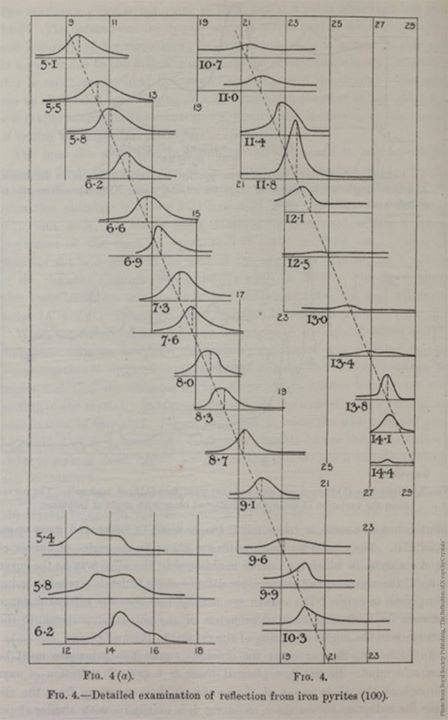
On 1 July 1913, William Henry Bragg and William Lawrence Bragg published their article 'The reflection of X-rays by crystals.'
Read the full article: https://t.co/oy696HuAoT
🟥 ⛏️ 🔎 The Juan de Fuca micro‑plate is a remnant of the once‑immense Farallon Plate, now reduced to a narrow band of young oceanic crust off the Pacific Northwest.
YT 🎞 Please visit:
🔁 ❤️ Greatly Appreciated
What makes it scientifically compelling is the speed and intensity of its life cycle.
It forms at the Juan de Fuca Ridge through rapid seafloor spreading, cools as it moves eastward, and is then pulled beneath the North American Plate at the Cascadia Subduction Zone.
This conveyor‑belt motion drives constant geological change.
The plate’s basaltic crust records hydrothermal circulation, mineral alteration, and magnetic striping that reveal its spreading history.
As it subducts, water‑rich minerals descend into the mantle, triggering melting that feeds the Cascade volcanoes and reshapes the deep crust.
Its boundaries, especially the transform faults linking the ridge segments, generate distinct seismic signatures that help scientists map its internal structure and fragmentation into the Explorer, Juan de Fuca, and Gorda segments.
Even though it is small, its interactions influence regional earthquakes, volcanic activity, and long‑term continental evolution.
#JuanDeFucaPlate
https://t.co/V5vafUFdhu
Venezuela’s double earthquakes left massive destruction across Caraballeda, with hundreds of buildings destroyed. High-res satellite imagery from Airbus gives us a better look.
🌏Explore 3D Map: https://t.co/hNO8TYPBs0
#VenezuelaNoEstáSola#venezuella
#Copernicus#Sentinel 1A has concluded its operations, closing a remarkable chapter for @ESA_EO and operations teams at @esa's #ESOC.
Now, the mission’s legacy continues with Sentinel 1C and 1D.
So long, Sentinel-1A – and thanks for all the fish! 🐠
🎥 ESA/ATG medialab
La comunidad de @hotosm está trabajando en el mapeo de edificios destruidos por el reciente terremoto en Venezuela: https://t.co/uQOfyxPJCJ
Más sobre HOTOSM aquí 👉 https://t.co/ZJB8DioFSo
In the cellular world, complex living machines endure physical forces and stresses, much like machines in a factory. How does the spindle, the fibrous “rib cage” driving cell division, manage the strain?
https://t.co/9X13Jv5wXL
Humans changed an🪨asteroid - now we find out how!
Especially for Asteroid Day,🎥watch the full story so far of our Hera mission🛰️, on its way thru deep space to probe the first Solar System body transformed by human action💥: https://t.co/nhDHFNU2Wo
Asteroids regularly slam into Earth, but in 2022 a little bit of Earth slammed into an asteroid - in the shape of NASA's DART spacecraft hitting Dimorphos. This autumn ESA's Hera spacecraft reaches this same body to try and find out: could we save Earth from an incoming asteroid? #AsteroidDay
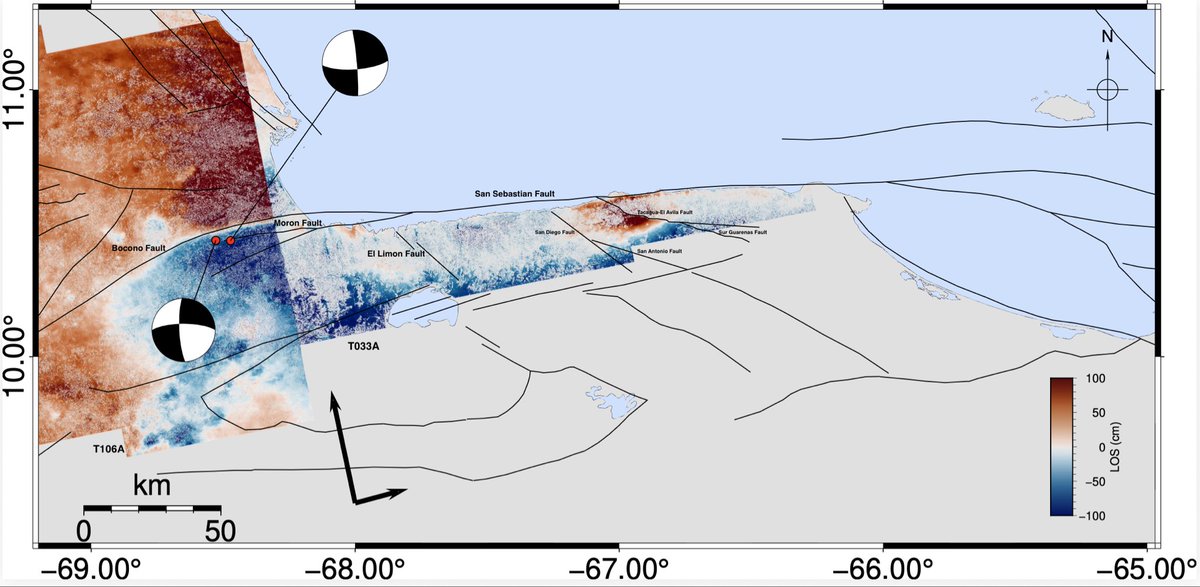
Missing the fault motion of Tacagua fault on slip modeling? This unwrapped ifg from ascending trajectory of S1 shows surface deformation associated to the Tacagua-Avila fault in Caracas. #USGS#Venezuela#Sentinel#earthquake#NISAR
New theropod remains from the Lower Jurassic Fengjiahe Formation of Yunnan, China: Historical Biology: Vol 0, No 0 - Get Access https://t.co/xmcGkeQwJ3
🟥 ⛏️ 🔎 Earth’s convection currents are the engine that keeps the planet geologically alive. Deep in the mantle, heat rising from the core makes solid silicate rock behave like an ultra‑slow fluid.
🔁 ❤️ Greatly Appreciated
Hotter, buoyant material ascends while cooler, denser material sinks.
This circulation drives tectonic plate motion, fuels volcanism, and shapes the mineralogical evolution of the crust.
As convection cells rise, they push molten material toward the surface, creating spreading ridges where new oceanic crust forms.
As cells descend, they drag cold, dense lithosphere downward into subduction zones, generating deep trenches and triggering volcanic arcs.
The sinking slab undergoes mineral phase transitions, causing spinel to transform into silicate perovskite and magnesiowüstite, altering density and influencing how far the slab penetrates into the lower mantle.
Mineralogically, convection governs how mantle rocks melt, differentiate, and crystallize.
Basaltic magmas rising at ridges and hotspots carry olivine, pyroxene, and plagioclase signatures, while subduction‑related melts incorporate water‑rich minerals from descending oceanic crust.
These processes generate the planet’s volcanic diversity, from mid‑ocean ridge basalts to explosive arc volcanism.
Tectonically, convection acts as a planetary conveyor belt: new crust is created at divergent boundaries and destroyed at convergent ones, keeping Earth’s surface area constant.
The interplay of slab‑pull, ridge‑push, and mantle flow explains why plates move, collide, and reshape continents over geologic time. #EarthConvectionCurrents
https://t.co/r5g1fgbped
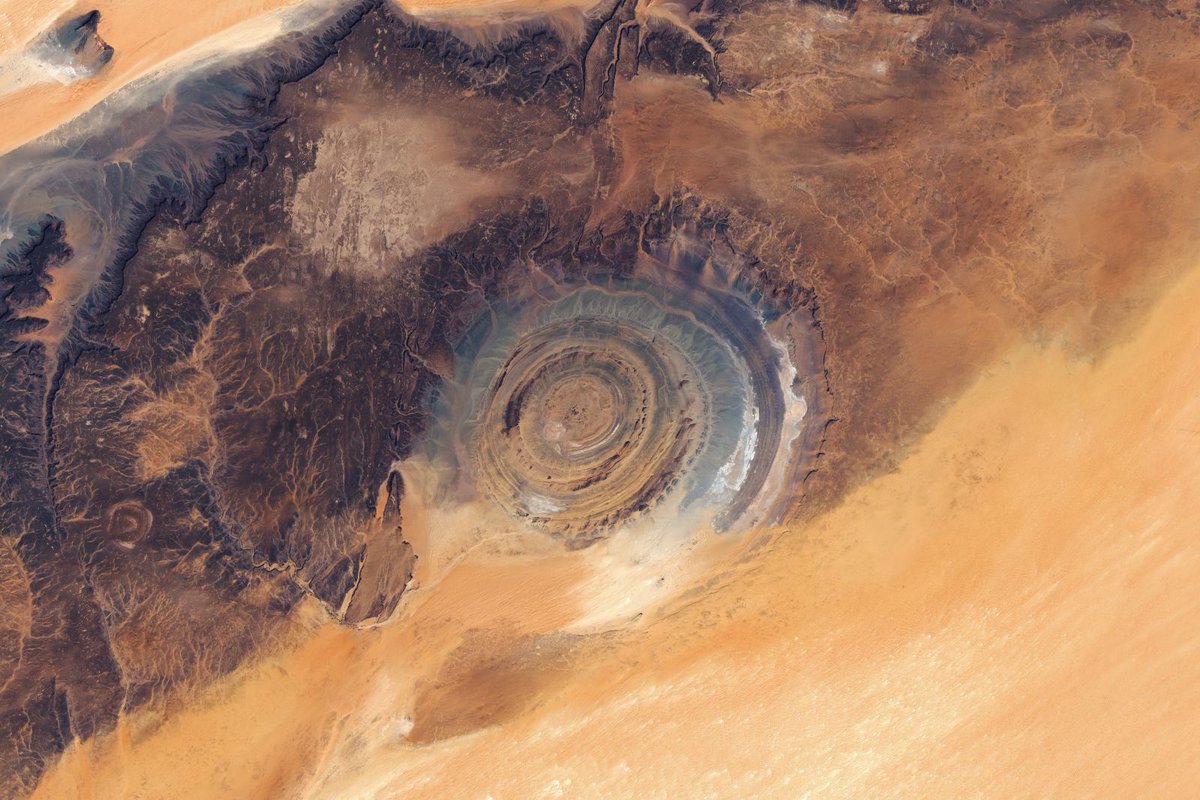
#PPOD: Eyeing the Richat Structure 👁️
In a remote part of northern #Mauritania, on the Adrar Plateau, lies a desert landscape that appears to be shaped primarily by natural forces. The region's most eye-catching feature when seen from above is the Richat Structure—a large geologic formation made of concentric ridges on the eastern side of the plateau.
The 40-kilometer-wide structure was initially thought to be an impact crater. However, researchers later showed that it is actually a deeply eroded geologic dome formed by the uplift of rock above an underground igneous intrusion. Over time, differing erosion rates among rock types in the exposed upper dome led to the development of circular ridges known as cuestas. The orange and gray colors reflect differences in sedimentary and igneous rock types across the structure and the surrounding landscape.
Credit: @NASAEarth Observatory/Lauren Dauphin
#planetaryscience
Venezuela presenta una complejidad tectónica que involucra distintas fallas. Debido a ello, se registró un fenómeno conocido como doblete sísmico. #ExpertosUNAM del @GeofisicaUNAM explican los factores que dieron origen a los sismos del 24 de junio > https://t.co/033qSvDr0l
The main river drainage basins of North America trace their origins to regression of the Cretaceous interior seaways, 75 Ma left, 65 Ma right. In geology as in biology, the past is the key to the present.
https://t.co/9be8pnDC4e
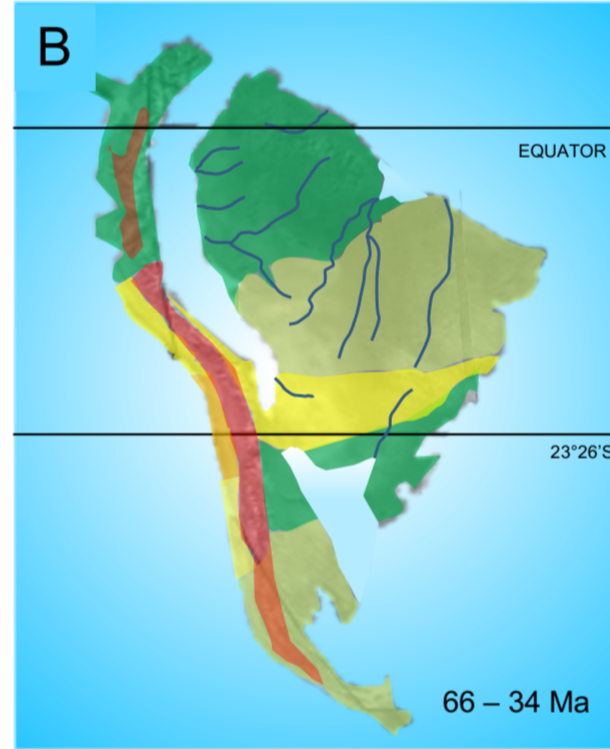
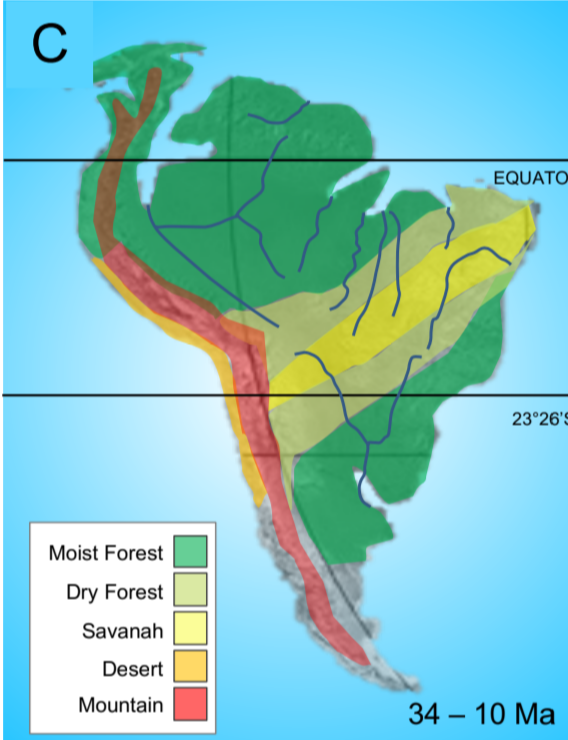
Paleogeographic maps of South America showing how the Eocene-Oligocene global cooling event at c. 34 Ma transformed millions of sq. km from shallow seas to tropical rainforest and riverine ecosystems.
Maps with references from our forthcoming book: https://t.co/ZQBwyU2sMn