The #Syriac (#Aramaic) word of the day is ܛܒܥܐ (ṭabʿā), "nature / impression." Pronounced "ṭabʿo." Cognate with Hebrew טֶבַע (ṭebaʿ), Arabic طَبْع (ṭabʿ), Akkadian ṭabāʿu; related to the idea of sinking. #Assyrian#Aramaic#Languages#WOTD
✨ A beautiful moment of Assyrian heritage in the heart of London ✨
On February 22, 2019, Assyrian youth from across the globe gathered at the British Museum in London, proudly dressed in traditional Assyrian attire, during the exhibition dedicated to the life of their beloved ancestor, King Ashurbanipal. 👑🪽
What a wonderful sight—young Assyrians standing beside the magnificent treasures of a civilization that flourished thousands of years ago. ❤️
🏛️ The British Museum is home to one of the world’s most remarkable collections of ancient Assyrian heritage. Among its greatest treasures are tens of thousands of clay tablets and fragments from the Library of King Ashurbanipal in Nineveh. 📜 These ancient writings preserve literature, history, religion, medicine, astronomy, royal correspondence and so much more from the world of ancient Mesopotamia.
And the tablets are only part of the story! 😍 Visitors can walk among majestic Lamassu 🪽, enormous palace reliefs, royal inscriptions, stelae, sculptures of Assyrian kings and many other breathtaking artefacts from ancient Assyria.
For Assyrians, seeing these treasures can be something very special—a connection across thousands of years to Nineveh, Nimrud and the land of ancient Assyria. For lovers of Mesopotamian history, it is simply a collection you should experience at least once. 🏺✨
And Assyrian and Babylonian heritage is certainly not found only in London! 🌍 Wonderful collections can also be discovered at the Louvre in Paris 🇫🇷, museums in Berlin 🇩🇪, Chicago 🇺🇸, the Metropolitan Museum of Art in New York 🗽, and the Alexander Pushkin State Museum of Fine Arts in Moscow 🇷🇺. Many smaller museums and collections around the world also preserve beautiful pieces of Assyrian, Babylonian and wider Mesopotamian heritage.
So, whenever you find yourself in London, Paris, Berlin, Chicago, New York or Moscow, make some time for the ancient Mesopotamian galleries. ❤️ And wherever else your travels take you, have a look at the local museum—you never know where another little piece of ancient Assyria may be waiting for you. 🪽🏛️
Our history is ancient, our heritage is priceless, and its story continues to be discovered around the world. ✨
#Assyria #Assyrian #Assyrians #Ashurbanipal #Nineveh #Nimrud #Mesopotamia #AncientMesopotamia #AssyrianHistory #AssyrianHeritage #AssyrianCulture #Babylon #Babylonia #BritishMuseum #LouvreMuseum #PushkinMuseum #AncientHistory #Archaeology #Lamassu #MuseumLovers #HistoryLovers #CulturalHeritage #AncientAssyria #ܐܬܘܪ
**Mrs. Ashtar Khnan-Eshoo Abraham**, an **Assyrian Christian woman**, is pictured in **1893 in Urmia, Persia (present-day Iran)**, wearing a beautiful traditional **Assyrian Hakkari mountain costume**. ❤️
Behind the beauty and dignity of this photograph lies a history of both an ancient culture and immense suffering. 💔 In **1843 and 1846**, Assyrian communities in **Hakkari** suffered devastating massacres associated with **Kurdish leader Bedr Khan Beg and allied Kurdish forces**. Thousands were killed, villages were destroyed, and many survivors were displaced, with some finding refuge in **Urmia and Salmas**.
An even greater catastrophe came during **World War I**. Beginning in **1915**, Assyrian Christians faced mass killings, deportations, starvation, and displacement during **Seyfo — “the Sword” — the Assyrian Genocide**. Ottoman forces and allied irregular forces committed atrocities across Assyrian regions, while **Urmia and Salmas** also experienced terrible violence during the upheavals of 1915–1918. Entire families and villages were lost. 💔🕯️
The tragedy continued after the war. In **1924**, renewed conflict and military operations by the young **Republic of Turkey** contributed to the final large-scale expulsion of the Hakkari Assyrians from their ancestral mountains, scattering survivors across Iraq, Iran, Syria, and eventually the worldwide diaspora. 💔
Yet this is also a story of **survival, faith, and resilience**. ❤️🩹 For centuries, **Urmia and Salmas** were important centers of Assyrian Christian faith, education, and culture. Despite genocide, massacres, persecution, and exile, Assyrians preserved their **churches, language, traditions, identity, and memory**.
The magnificent Hakkari clothing worn by Mrs. Ashtar—with its embroidery, jewelry, silver coins, woven belts, and elaborate headpiece—is more than traditional dress. It carries the memory of a homeland and a people who endured unimaginable loss but continued to preserve their heritage. ❤️🕯️
**May those who were lost never be forgotten, and may Assyrian culture continue to live for generations to come.** 💔❤️🩹
#Assyrian #AssyrianWoman #AssyrianChristian #AssyrianHistory #AssyrianGenocide #Seyfo #NeverForget #Hakkari #Urmia #Salmas #Assyrians #Assyria #AssyrianHistory #AssyrianHeritage #AssyrianCulture #AssyrianAttire #Mesopotamia #Iran 🕯️💔
I don't care what my government says, I recognize the Armenian genocide. I also recognize the Greek and Assyrian genocides, committed by Turkey at the same time.
🚨 SHOCKING : Hidden Christian Genocide – Britain’s Betrayal of the Assyrians, 1933
In August 1933, Iraqi army units led by a Kurdish general carried out a systematic massacre of Assyrian men across Simele and nearby villages in northern Iraq.
British officer R.S. Stafford, who witnessed the aftermath, condemned it as “a cold-blooded and methodical massacre of all the men… as foul a crime as any in the bloodstained annals of the Middle East.”
The Assyrians had already lost roughly half their population to Ottoman Turkish and Kurdish forces during the Seyfo genocide of 1915–1924.
Having fought as British allies in World War I, they were later branded a colonial “fifth column” by the newly independent Iraqi state.
Survivors mostly women and children watched their male relatives slaughtered in front of them. The Simele massacre broke the remaining spirit of a people already devastated, driving Assyrian communities into isolation and self-protection.
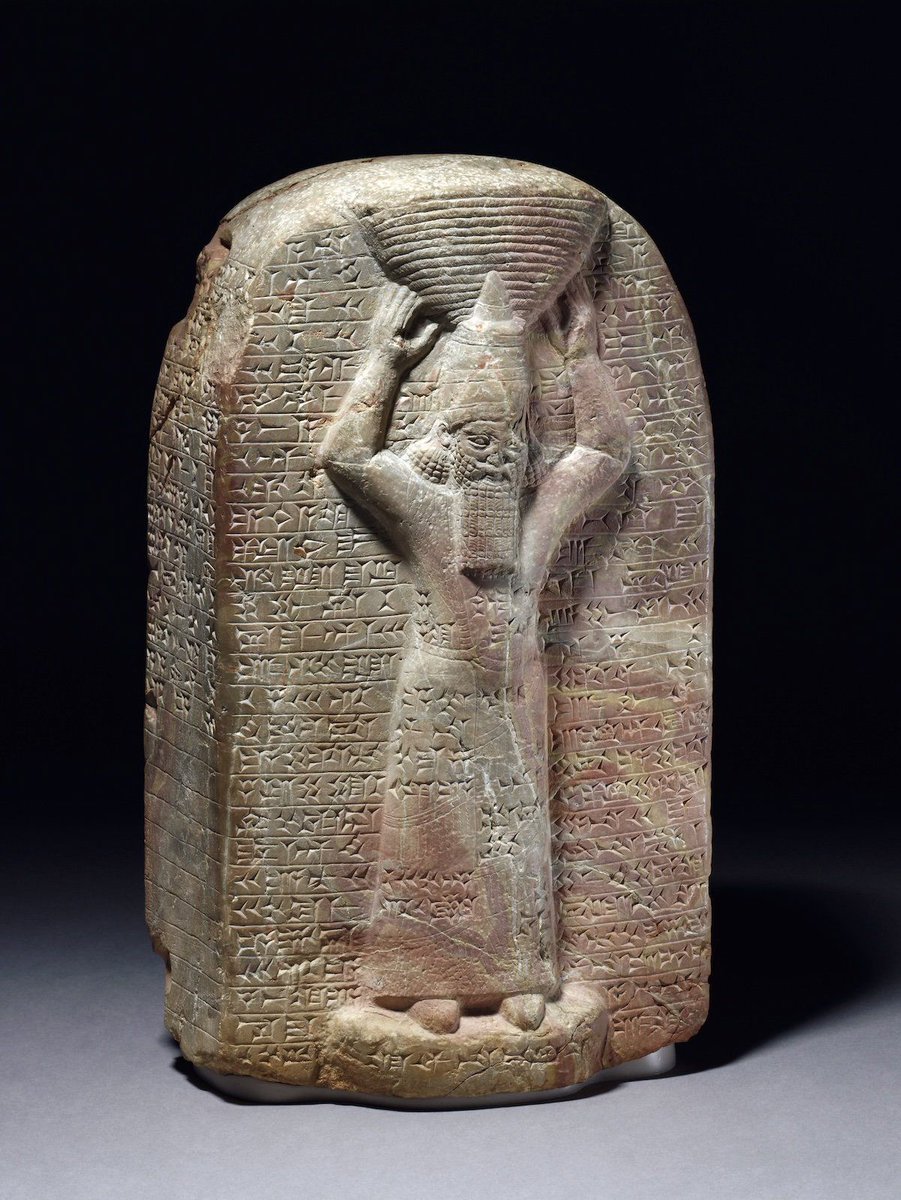
مسلة الملك الآشوري اشوربانيبال وهو يحمل سلة من الطوب اللازم لتشييد الصروح والمعابد ومنقوش بكتابة مسمارية
توضح كيف أكمل الملك آشوربانيبال إعادة إعمار بابل والتي شملت ترميم وإعادة بناء المعابد فيها كمعبد الإله مردوخ كما رمم معبد الإله ( أنآنا) عشتار في مدينة أوروك ومعبد الإله أنليل في مدينة نيبور عثر عليه في نينوى شما العراق
القرن السابع قبل الميلاد
A stela of the Assyrian king Ashurbanipal, depicting him carrying a basket of bricks used for the construction of monumental buildings and temples. It bears a cuneiform inscription describing how King Ashurbanipal continued the reconstruction of Babylon, including the restoration and rebuilding of its temples, such as the temple of the god Marduk. He also restored the temple of the goddess Inanna (Ishtar) in the city of Uruk and the temple of the god Enlil in the city of Nippur.
It was discovered at Nineveh, northern Iraq, and dates to the 7th century BCE.
The Library of Ashurbanipal.
When it was discovered in the 19th century, the Library of Ashurbanipal revealed an ancient Assyrian empire previously known only through myth (via @HistoryExtra) https://t.co/4GqirwF6r9 #History#twitterhistorians
'Escondidos nas Sombras': Descoberta de 3 Novos Reis Assírios Revela uma História Mais Brutal do que os Registros Sugerem: ScienceAlert
https://t.co/WVJkDXg6lS
Syriacs in Europe – some thoughts and suggestions
I think we Syriacs (Assyrians/#Arameans/#Maronites) should slowly understand that it is rude to Europeans to constantly demand Christian values, Christian principles and Christian behavior from them.
Europe was probably never really Christian.
Europe has been actively eradicating Oriental Christianity for centuries.
Europe actively denies everything that is #Oriental Christianity, especially Syriac Christianity.
Europeans were and are experts in the falsification of Christian history.
For them, Christian history and Christianity are exclusively linked to Europe, the West, and Rome as their centre.
They do not want to hear anything about #Bethlehem, #Jerusalem, #Damascus, #Antioch or the semitical origins of Christianity.
And we Syriacs here in the West think that they (that is, the Europeans) are at least formally Christians and so they need to be familiar with it and we need to remind them. Syriacs must understand that Europeans do not want this and that they are not interested in it at all.
They know only themselves, exclusively themselves and their culture, their history and their nation.
These are nation states, not religiously defined entities.
In principle, they are not interested in other cultures and peoples.
Europeans are only interested in Syriacs-Assyrians in the context of historical artifacts that they can exhibit in their museums.
They want to park us in museum halls and pay entrance fees from visitors - that's all.
And even then, the historical testimonies are only vaguely told and written about.
There is no Christian solidarity of Europeans with the Christian Syriac peoples of the Orient (i.e. #Syria, #Iraq, Turkey, #Lebanon) - we #Assyrians must gradually understand this.
#History forgery is an expertise in the West.
We should have understood all this at some point.
Justice, freedom, human rights - these are not the values that Europe and the West actually stand for.
They want and know only one word, which is: power.
Power over other peoples and habitat with resources.
Everything else is exploited by them, including faith.
Christianity, as a religion of love and freedom, is difficult to exploit.
Valhalla and Islam, on the other hand, are more appropriate instruments of oppression and subjugation. Hence the powerful's love for Islam and the powerful's hatred of Christianity in the West.
And we should accept and respect the decision of the Europeans. We should not interfere with their chosen and preferred way of life.
Syriacs are guests, even though most of us already have citizenship in the respective European countries where we live.
Despite holding citizenship in the various European countries where we live, Syriacs are regarded as guests, and that, too, is perfectly acceptable and is the right of the indigenous peoples of Europe.
We Syriacs should no longer waste our energy trying to explain #Christianity to the indigenous peoples of #Europe or tell them how they ought to be.
The descendants of the #Vikings, #Germanic tribes, #Franks, #Anglo-Saxons, etc. prefer Valhalla to messianic peace and paradise.
They want #atheism, #paganism, #Islam and #Satanism – that is their choice; we should accept that and draw the right conclusions from it for ourselves as a community of #Syriac Christians.
God's earth is big, today there are planes, ships and cars - you can look for other places to live.
Dear Aday, think about this in your political work for the Vikings. Take care of yourself and stay healthy.
❤️🕊☦️✝️☀️🍾
👑🔥 Three Previously Unknown Assyrian Kings Emerge From the Shadows of History
For centuries, their names were missing from the official story of Assyria. Now, ancient cuneiform evidence has revealed three previously unknown Assyrian kings—rulers whose turbulent reigns may expose a darker and more violent chapter of Assyrian history. 🏺⚔️
A fascinating discovery that reminds us: the ancient past still has secrets waiting to be uncovered. 📜✨
https://t.co/MNftyseOVY
#Assyria #AssyrianHistory #AncientAssyria #Assyrians #Mesopotamia #Archaeology #Cuneiform #AncientHistory #History #HistoricalDiscovery
القرى الاشورية في محافظة اربائيلو (اربيل):
الجزء التاسع....
القرى الاشورية في قضاء خبات....
1. قرية مفشومة (الواقعة على تخوم خبات الشمالية)
* الاسم السرياني الأصيل: ܒܹܝܬܼ ܦܫܘܼܡܵܐ (Beth Pshuma) وتحورت إلى (مفشومة).
* المعنى والمعلومات: تعني حرفياً "بيت الهدوء"
Assyrian capital Khorsabad in 1852.
Dur-Sharrukin (Fortress of Sargon), present-day Khorsabad, was the Assyrian capital in the time of Sargon II of Assyria. Khorsabad is a village in northern Iraq, 15 km northeast of Mosul. The great city was entirely built in the decade preceding 706 BC. After the unexpected death of Sargon in battle, the capital was shifted 20 km south to Nineveh.
The fortified citadel to the north of the city had two gates guarded by bulls. At the foot of the palace were four residences (K, L, J and M) and a temple dedicated to Nabu, the god of scribes.
This Aramaic hymn will give you goosebumps.
A Eucharistic hymn.
“Jesus, My Creator.”
Aramaic heightens the experience of the Eucharist.
The language of Christ is slowly going extinct in the Middle East.
Sung by an Assyro-Chaldean choir in California.