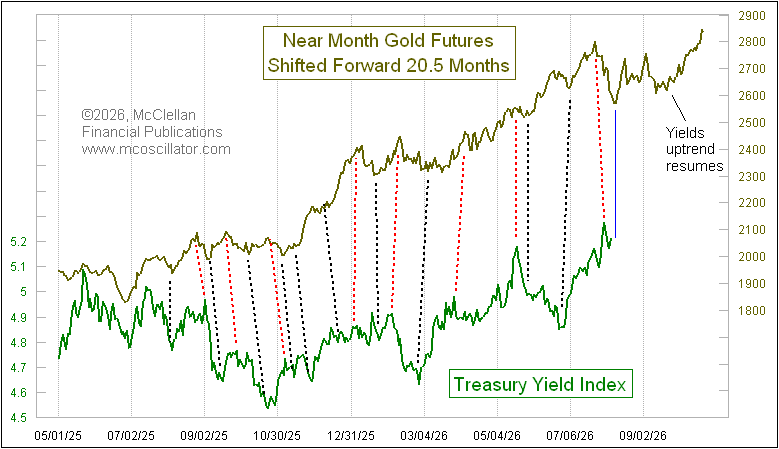
The US Treasury increasing LT debt buybacks is driving an intra-day 8bps decline in 30yr ylds, +0.4% S&P but also a 0.8% decline in the US dollar which puts upward pressure on inflation. This follows yen intervention earlier this month to alleviate upward pressure on US ylds. There is an adage that the bond market will stop panicking when the government starts panicking. So the bulls will be heartened by today’s reaction given credit is the life blood of the economy.
Having said that, what bothers me is none of this solves the underlying upward pressure on rising treasury ylds of 1) 6% US deficits (and high deficits around the globe) despite a strong economy, 2) high US government debt of $40T vs $33T in GDP , 3) increasing hyperscaler debt issuance due to a near doubling in capex this year to nearly $900B & likely over 30% next year to $1.2 trillion taking away some of the demand for treasuries.
The reaction tomorrow to the reaction today will be an important tell. Does the rally continue or was today a temporary reprieve? As I posted on Sunday, there is normally a 10% peak to trough decline in the S&P between 7/31-11/9 since 1990 at some point during mid-term election years. I worry that the odds are increasing of seeing a repeat.
@EmanuelDerman Is language the medium? Recent advances in the field of affective Neuroscience evidence that cognition itself - never mind language - is downstream from emotion. AI compounds confusion - words like consciousness, intelligence and empathy are thrown about and never defined.
@EmanuelDerman Thank you for this. I am contemplating similar from standpoint of "homogenization" of culture, information, standards, etc. and the diversity (heterogeneity) the creative process requires.
@Anthony_IV@DougKass@TheJudgeCNBC@CNBC And cash is never truly "sidelined" unless it is withdrawn and stuffed in a mattress. It goes into money market or govys. I've never met an investor who didn't have to sell something to buy something.
@CooperHitAndRun 1- 10 day trades. Not much signal beyond that. But when we used it, while we consistently made money, for the effort we shoulda gone to the beach and rode long. When it trends it is secular.
@CooperHitAndRun I once did a multi-time window analysis of cash gold, using 30-min bars. Prob would not work with miners as correlations are poor. Having said that the 13-bar (1 trading day) MA and the 78-bar (6 days = 20 hr) MAs were magnet S&R levels in a bull trend.
@DougKass@CNBC You make a cogent argument against the muscle-wasting of AI. AI is consensus, not truth - only that which is plausible. Critical thinking skills will atrophy. AI is great, but in this way it is like going to the gym and having your trainer lift the weights for you.
It's a bit disappointing how few investors understand portfolio construction - across decades of market cycles, that has ultimately become a source of disappointment for them too.
For a full discussion, see my June comment, Record Extremes, Alternative Assets, and the Hippo.
@DougKass@TheStreetPro We are living in an experiment of a dynamic, untested and increasingly vulnerable market structure combined with political and social instability, pushed around by Bots and Leopold-like risk-agnostic traders. What could go wrong?
@WalterDeemer Walter love your work, and loathe to correct something you say, but that is not a Freud quote. The quote aggregators take what is popular and not necessarily true. It did not sound like Freud, and searched his collected works (2m+ words).
The economy is soft and vulnerable. This is the clear message in today’s GDP, income, and spending data. Abstracting from the vagaries of the data, real GDP growth is at best 2%, driven largely by AI-related investment and wealth effects that support consumer spending among the well-to-do. But housing, government, and international trade are more or less headwinds to growth. And given that real disposable income is flat and personal savings are about as low as they ever get, spending by middle- and lower-income households is under significant pressure. The longer the Iran war drags on, and the higher energy prices and interest rates go, the more likely these consumers are to pull back – and take the rest of the economy with them.