Enough with the bleak local politics for a minute. Very excited to share that pre-proofs are out for our JDE article, “Local and Spillover Effects of Trade on Structural Transformation: Evidence from Brazil,” with @JosecoronadoAr and @GuilhermeKlei11. Thread below. 1/9
Best discussion I ever had was at the NBER. Only a couple years out of school, I gave a paper with Sargent, to some dismissive comments from participants. But Tao Zha’s discussion showed precisely how we could estimate the model (with theorems). It led directly to our joint work.
We are pleased to share the release of a major open data resource on Harvard Dataverse:
Indian Census Data Collection, 1901–2026: Digitised Subnational Population and Administrative Datasets
DOI: https://t.co/zsSOTCGyuD
#OpenData#India#Census#SocialScience
What’s included?
• Population time series (1901–2011)- Census A02 (cleaned and strcutured)
• first time digitization of Primary Census Abstract tables (state & district level)-1961, 1971, and 1981
• 2026 subdistrict-level administrative directory linked to census data (2011)
#DataInfrastructure #ResearchData
📢We’re hiring a Data Scientist!
Use big data to shape policies that boost economic mobility.
📍Cambridge, MA | Hybrid
🔗Link to apply: https://t.co/wig9iBwAcR
#DataScience#EconomicMobility#Hiring
Highly recommended!
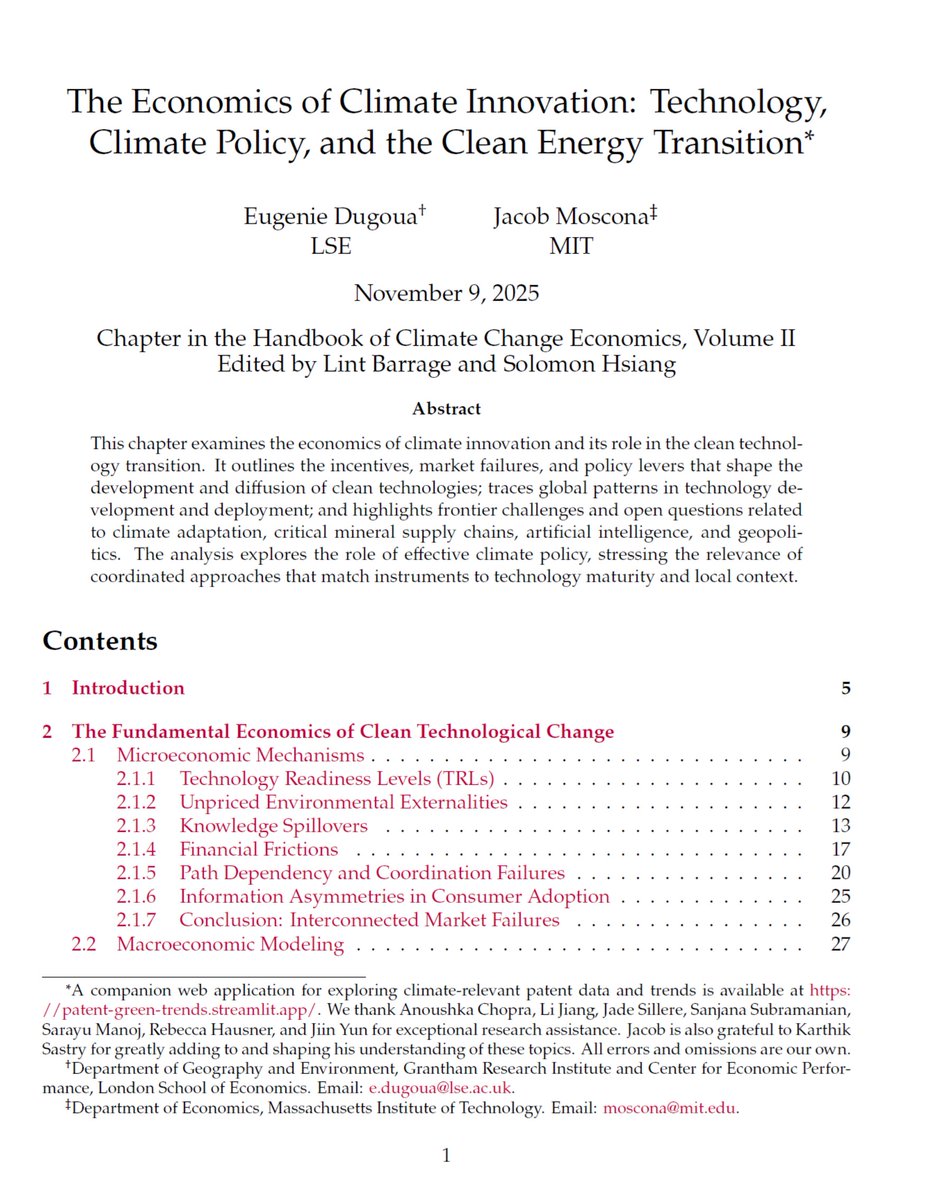
"The Economics of Climate Innovation: Technology, Climate Policy, and the Clean Energy Transition" by E Dugoua and J Moscona
"This chapter examines the economics of climate innovation and its role in the clean technology transition."
https://t.co/OHVr4dRAvg
1. Algebra is good for problem-solving.
2. Geometry is good for visual thinking.
3. Calculus is good for understanding change.
4. Statistics is good for decision-making.
5. Number theory is good for logical discipline.
6. Linear algebra is good for modern science and engineering.
7. Discrete math is good for computer science.
8. Differential equations are good for modeling the real world.
9. Optimization is good for smart planning.
10. Graph theory is good for network thinking.
11. Set theory is good for structured reasoning.
12. Practice is good for mathematical fluency.
13. Curiosity is good for lifelong learning in math.
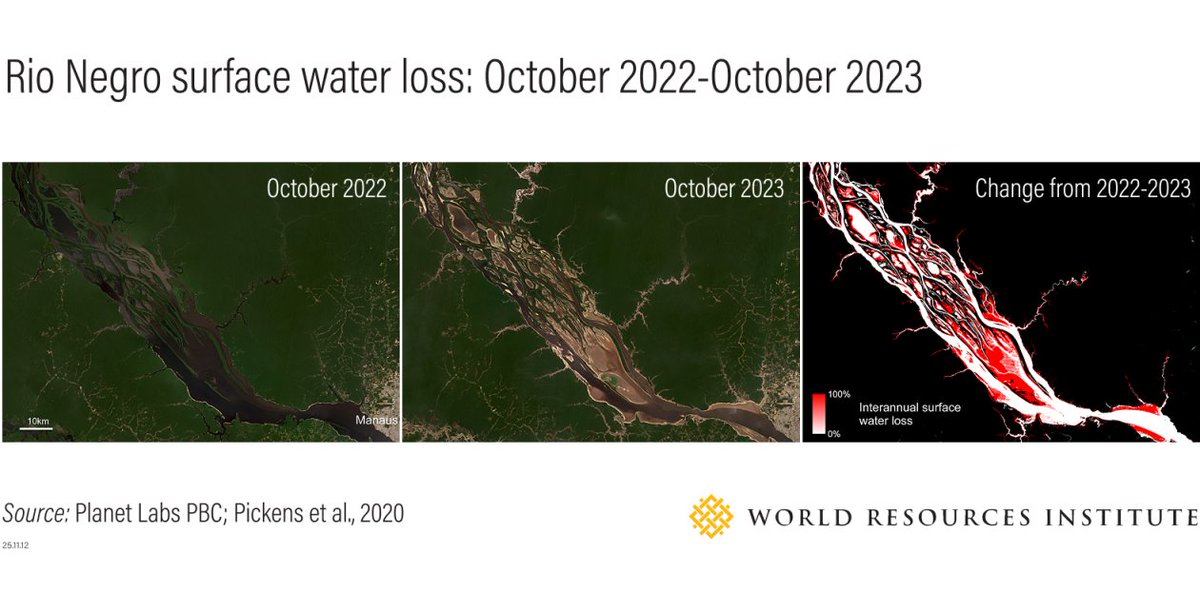
NASA Harvest partner and @UMD_GLAD Director Matt Hansen co-wrote a blog post for the @WorldResources on how shifting global conditions are driving land loss through fire, drought and storms, creating a reinforcing loop of impacts.
Read it here! 👉https://t.co/DKiEZBtgnp
Very thankful to the Virtual Israel Macro Meeting (@vimacro_org) for inviting me to present today some of my recent work on “Deep Learning for Solving Economic Models.”
The slides are here:
https://t.co/3oZtsoarDA
And the paper:
https://t.co/UTxFco9jjv
Let me emphasize that our focus was exclusively on how to use deep learning to solve an economic model. This is quite different from using deep learning to estimate a function from the data or to specify a model. The points of contact are obvious, but the purpose, the tools, and the intuition are not the same.
Our goal was to show how deep neural networks can approximate the objects that arise in dynamic models (e.g., value functions, decision rules) and help economists tackle problems that would otherwise be computationally intractable.
IMHO, the intersection of macroeconomics, computation, and machine learning is quite fascinating.
Curious why job seekers turn down job offers after EASY interviews? We use ~500K interview reports plus a field experiment to show interview difficulty signals to workers whether the job is a good fit.
Check out the fantastic @JSockin's talk from NBER ORG Econ (w/ @ellliottt).
When I was young, I sucked at math. Even in early college. Then I sat down and did alot of practice. It did three things: a) made me realize I was bad because I wanted to get it right away but that it could not work that way; b) building up slowly but continuously would work in long-run; c) gave me the mathematical maturity to work on things.
90% of complaints about mathematics, mathematical economics and statistics come from impatience and a feeling of inability to immediately get it.
We are excited to announce the release of the Environmental Hazard Adaptation Atlas, an effort to map ongoing and future environmental hazards and their impacts on society, and to provide up to date evidence on what policies and interventions work to reduce impacts. Quick thread
Public R&D investment in Brazilian agriculture increased agricultural productivity by 110 percent, with a benefit-cost ratio of 17, by catalyzing the development of locally appropriate technology, from Ariel Akerman, Jacob Moscona, @HPellegrina, and Karthik Sastry https://t.co/IyZLjEE1pp
Life is too short to worry about little things. Have fun. Fall in love. Regret nothing, and don't let people bring you down. Study, think, create, and grow. Teach yourself and teach others.