Our team @Meta Superintelligence Labs is hiring current PhD students for 3-6 month, paid internships to work with us in London on reinforcement learning post-training of LLM agents.
If this sounds interesting move fast and apply today at: https://t.co/QgWBIUuACj
Next reading group: @__JohnNguyen__ will explain why diffusion LLMs are a strong fit for multimodal generation, presenting OneFlow [1] and touching on Edit Flows [2].
[1] OneFlow: https://t.co/5KmjRqhgX3
[2] Edit Flows: https://t.co/eImz95h6tm
Work with @HavasiMarton, Tariq Berrada, @LukeZettlemoyer and @RickyTQChen
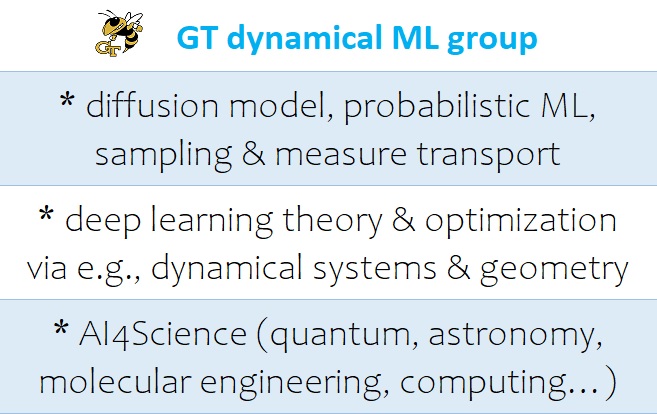
I'm hiring 2 PhD students & 1 postdoc @GeorgiaTech for Fall'26
Motivated students plz consider us, especially those in
* ML+Quantum
* DeepLearning+Optimization
-PhD: see https://t.co/h4anjm6b8j
-Postdoc: see https://t.co/548XVaahx3 & https://t.co/4ahNE7OOwV
Retweet appreciated
I've observed 3 types of ways that great AI researchers work:
1) Working on whatever they find interesting, even if it's "useless"
Whether something will be publishable, fundable, or obviously impactful, is irrelevant to what these people work on. They simply choose something that feels interesting, weird, beautiful, or off in a way they can't ignore. For many of these people, "interestingness" is also often strong research intuition for an important problem that hasn't fully materialized yet, but their ideas often end up being meaningful during the process of exploration.
The canonical example for this in physics is Richard Feynman who got intrigued by the way that plates wobbled. He followed this curiosity on something that seemed like a useless endeavor, and it ended up feeding into deeper physics (and eventually won him a Nobel prize):
"It was effortless. It was easy to play with these things. It was like uncorking a bottle: Everything flowed out effortlessly. I almost tried to resist it! There was no importance to what I was doing, but ultimately there was."
The AI version of this that I've observed before is when someone obsesses over a "minor" failure case, a weird training dynamic, a small theoretical mismatch, or just something that most people think is pointless to chase down. These threads end up becoming interesting and impactful more often than you'd expect. The risk is that one can spend a long time on a pointless rabbit hole, but I've observed that the best researchers often have a very good sense for when an idea is a dead end vs. whether it's promising given more effort.
2) Working on what they feel extremely strongly is the "right" way to do something
These people have a clear picture of how the field *should* progress, and they're willing to work on unpopular things to prove their vision. They'll commit to something that others think is wrong, premature, or not worth it. An interesting quantitative way of measuring this is the citation graph of a paper. If you see a paper that has been around for many years but only started getting cited a lot more in recent years, that means that they were early (and right!). An obvious example is diffusion, the first paper of which was as early as 2015 (Sohl-Dickstein et al., 2015) but the ideas only started getting real traction in 2021 or later.
The failure mode here is getting stuck defending a pet theory long after it's been falsified. And there's obviously many examples in our community of people who do a lot of goal post shifting or beat a dead horse for many decades. But when these ideas are legitimately undervalued, they result in paradigm shifts instead of incremental progress.
3) Crushing SOTA
There's a type of researcher who isn't necessarily the most "philosophically original" or creative, but they are extremely effective at pushing a system to its limits. You can give these people a pre-existing task and benchmarks, check in on them in a month, and they will have crushed SOTA. Obviously this is not about benchmark hacking or short term wins. It's a real skill to take a combinatorial space of noisy research ideas and papers and conduct a rigorous search and ablation process.
I've also found that this type of researcher has great intuition about the field: a sense for which ideas will scale, which tweaks are meaningful, good values for hyperparameters, and quickly figuring out which papers are worth paying attention to.
—————
I think that these archetypes are all concrete expressions of good "research taste". (1) is a taste for interesting questions, (2) is a taste for long term worldviews, and (3) is a taste for careful execution and science. The best researchers I know often have a preference for operating in one of these modes, but frequently weave in and out of each depending on the stage of the project.
🎓 Internship Opportunity – Deep Research Agents @ Microsoft M365 🎓
Hi all! Our team at Microsoft M365 is hiring interns for Spring 2026 (tentative start date: Feb 1). The position is flexible: full-time or part-time, in-person or remote (within the US).
You’ll work closely with me (Khanh) and other applied scientists on evaluating and developing deep research agents for enterprise scenarios. We are a product team overseeing Researcher (Microsoft’s deep research agent), but the internship will be research-oriented with a strong focus on publishing papers. This is a unique chance to do serious research while tackling real-world problems that impact millions of users.
👉 Apply here (this is just our gateway for hiring interns; don’t worry about the content): https://t.co/JdsQ1r0uBO
Khanh’s research background: https://t.co/T8GbpjpAaF
We're hiring on the Code RL team at Anthropic! Small, fast-moving team. Low ego, high impact.
If you're a star engineer/researcher excited to push the frontier of AI-powered SWE, there's nowhere better to be. We care about getting this right. DM or apply here! https://t.co/er9vZKjbLc
I’ll be at #NeurIPS2025 (Dec 1–5)! 📷 Would love to connect and chat about AI Agents, Multimodal LLMs, VLA, and anything agentic AI.
We’re also recruiting for PhD/Postdoc/Intern (multiple openings for Fall 2026).
DM or email me if you'd like to talk about opportunities or collaborations!
My students @richardxp888, @AiYiyangZ, @JiaqiLiu835914 will be there too. Feel free to connect with them!
I too am recruiting PhD students this year! things I think about: cognitively plausible LLMs, interpretability, evaluating and improving multi-turn interaction, LLMs for cognitive science and neuroscience, psycholinguistics... the deadline for Data Science is Dec 6 and for Linguistics Dec 18.
Our PRIOR team @allen_ai is recruiting research interns for Summer 2026!
Topics include Language & Vision, Embodied AI, Agents, and more.
If you are excited about VLM robustness, synthetic data, and vision-based agents, please select me as a potential mentor in your application. I will also be at NeurIPS from Dec 4–5.
Apply here: https://t.co/Bf3JxAE3t6
🚀We’re looking for amazing scientists and engineers to join @PolymathicAI (NYC)!
Want to work on scientific foundation models + ML for physics, biology, astronomy, solar physics & more?
Want to contribute to frontier research in AI with the most brilliant and fun crowd?
Please sign up on our interest form:
👉https://t.co/zSWOh4dHJf
#Hiring #MachineLearning #Science
1/ Hiring PhD students at CMU SCS (LTI/MLD) for Fall 2026 (Deadline 12/10) 🎓
I work on open, reliable LMs: augmented LMs & agents (RAG, tool use, deep research), safety (hallucinations, copyright), and AI for science, code & multilinguality & open to bold new ideas!
FAQ in 🧵
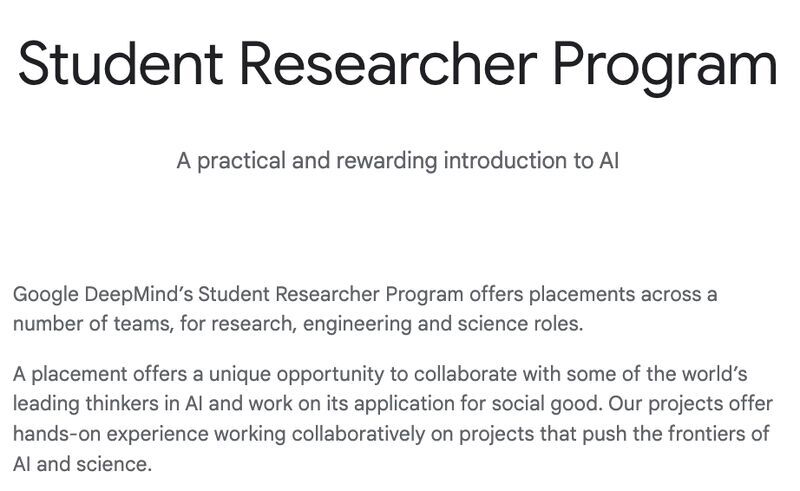
I am hiring a Student researcher at Google DeepMind for Winter/Spring or Summer of 2026!
🛠️ Interested in tool-use and reasoning for LLMs?
🚀 Up-to-date with frontier research?
🔬 Love to understand code & algorithms from first principles?
📚 Currently studying for a BS/MS/PhD?
📢 Calling all top PhD talent!
Meta Superintelligence Labs is looking for Summer Research Scientist Interns to help build the future of multimodal intelligence.
If you’re passionate about:
🧠 Multimodal reasoning
🤖 Intelligent agents
🎥 Unified understanding & generation models
…this is your chance to help shape the next era of AI. 🚀
Join us and build the future!
Feel free to reach out! ✉️
📢 2026 Summer Internship
Our group at Microsoft Research is now accepting applications for PhDs interested in multimodality, reasoning, and agents.
If you or someone you know is looking for a research internship, please help spread the word!
🔗 Apply: https://t.co/OUNd5oOriA
📩 Send your CV to [email protected].
Thanks for helping great candidates find their next opportunity!