🚨🇩🇪🇮🇱 ÚLTIMA HORA: En el 88.º aniversario de la Noche de los Cristales Rotos, el canciller alemán Friedrich Merz acudió a sinagoga de Múnich y declaró:
«El antisemitismo vuelve a estar en todas partes», incluso «disfrazado de luchas de liberación anticoloniales o de críticas a Israel».
Y fue contundente: «Nos situamos sin reservas al lado de Israel».
«Nuestra responsabilidad histórica significa alzar la voz y luchar contra el antisemitismo dondequiera que aparezca. También significa preocuparnos por el destino de Israel».
College student:
“Jews are refugees. They have no right to self-determination. Israel has no sovereignty.”
The response that shut the room down:
“Millions of Jews left Auschwitz with nowhere to go.
Not one country on Earth took them in.
A million and a half Jews fought in World War II…
and still couldn’t bomb the tracks to the gas chambers.
Because they had no army.
No country.
No power.
The day Jews could finally defend themselves…
is the day Jews stopped dying.”
Hamas has said it out loud for two years:
They will keep going until every last Jew is dead.
You’re telling Israelis to dismantle their self-defense “for peace.”
Hamas is telling them: “Do it and we’ll slaughter you.”
And somehow… Hamas is winning the argument inside your head.
Go learn the actual history.
Then come back and talk. 🇮🇱
“Hamas obstructed attempts to protect Palestinians before the devastating winter storms. Professionals were coerced by Hamas into signing pledges not to undertake humanitarian projects without Hamas approval. Those who defied Hamas risked ‘field justice’ — beatings and worse.”
@nerfbatplz@mitchellh I think that is part of his point, very expensive STEM courses people drive to in order to command a high salary but that do not necessarily cultivate or filter by that kind of engineering curiosity and understanding/ experience.
@GergelyOrosz Not just that though I think, we hated it because it is understood people / customers / stakeholders do not know what they want until they get it so the overhead of longer term fine grained planning bites you.
Jason Alexander said he and his Seinfeld co-stars asked for a share of the profits.
The answer, by his account, was a flat no.
It happened during the 1997 negotiations for what became the final season. Alongside Julia Louis-Dreyfus and Michael Richards, Alexander sought back-end participation. He called it “something that I will go to my grave saying we should have had.”
“It was categorically denied to us, which forced us to then ask for ungodly salaries.”
Alexander said the refusal led them to seek higher salaries. Variety reported in May 1997 that Alexander, Louis-Dreyfus and Richards would each earn $600,000 an episode for season nine.
Huge salaries. Alexander also acknowledged standard rerun residuals. But those payments were not the profit participation he said the three had been denied.
In 2004, Alexander recalled telling Jerry that leaving them out had “created a rift between you and the three of us” and “a chasm that is also inappropriate.”
Alexander also described negotiations for participation in the DVD release as “a happy arrangement.” He still insisted they should have had the profit share.
Zelda producer Eiji Aonuma explains why Nintendo values keeping devs around long-term rather than constantly replacing staff.
“I think you see a real benefit to having some very long-term-tenured staff members around who have shared the same experiences over time.”
He says having veteran developers helps pass knowledge between projects and makes it easier to bring new people into the team.
“There is a continuity of core staff […] so that we have that base that we can build from and bring up new staff within it.”
Aonuma believes this balance helps Zelda evolve while keeping what makes the series special
It’s really different from the mass layoffs from western gaming culture
The amount of Microsoft energy that went into trying out this theory—a database running locally as a file system—would be hard to calculate across Windows, Office, email.
It is one of those ideas that seems interesting on paper. In practice it is never good enough for everything you want to do and the constraints do not help you to think of better or more clever ways to get things done. The constraints just got in the way of getting anything done.
There's significant utility in having a local database available for use in the platform, but that too carries with it challenges in backup/restore/upgrade/security/privacy/etc.
In https://t.co/HO6BEn7SN1 I think I wrote about this adventure in four times (working on strategy for Bill, Outlook, SharePoint, Longhorn.) I don't know if there is another example of a technology aspiration that endured so long and lacked a solution that worked. And also caused so much division and consternation inside Microsoft.
Perhaps more than anything it is the lesson of a big company thinking it can invent the future in isolation—all sorts of isolation or tunnel vision. Big companies, it turns out have a surplus of two things:
1. Hubris. There was no shortage of people starting at the top who become "obsessed" with delivering on an idea and believed the success Microsoft had recently achieved was a license to know how to build it.
2. Doubt. There was also no shortage of people who thought from the first days that the idea made no sense and believed the defined solution in no way benefitted the products that are being made, loved by customers, and pay the bills.
This 1-2 punch is fascinating because it sets up a divisive dynamic where you are either an "innovator" who is "on board" with the future OR you are a "obstacle" who does not see the value in "big bold bets" on the future of the company. Along comes a book like "Innovator's Dilemma" [1998] and suddenly resisting the next big corporate strategy makes one throw out common sense engineering because you don't want to get disrupted. It is the other side of the disruption coin no one talks about—sometimes the new thing does not in fact work very well nor will it in any finite time. The lesson applies to the product and technology leadership of a company.
Part of what happens in a big company as well is the ability for the company to speak broadly and enroll their ecosystem in their own excitement for the future. Microsoft described WinFS as early as 1992 and over the course of more than a decade it polluted our ability to talk about new products. The email product (Exchange, today the mail for 365) was famously the most important product to be launched and for the first decade of its life was always about to become strategic even while it was in fact the most strategic product the company made. The strategy nearly wrecked Outlook the face of the email strategy. It did in fact derail an entire generation of Windows. There was fallout across a range of products never released. All the while Microsoft was talking about the grand future of this product while customers were investing and buying into products built an entirely different way. A dynamic few are willing to speak about is another 1-2 punch:
• Customers and the press talk all about waiting and seeing if the current product will adopt the all important strategy. The first signs of this are the sales force freaking out and escalating their concerns.
• Customers actually ignore the strategy because "product market fit" dynamics take over and they can't buy and adopt the actual product soon enough. The first signs of this are visible to those in the real world who never get asked about the strategy because customer have a million feature requests.
This is the second way the whole dynamic divides the company. The "obstacle" people start to look like they are focused on the past to the "innovators" who are clearly focused on the "future."
You can find many examples of this near computing technology and broadly in other industries:
• Intel Itanium (which Dave below knows well) was a chipset architecture that just never panned out. Itanium occupied Intel for more than two decades.
• Copeland OS pursued by Apple muddled their decaying ecosystem and divided the company, cancelling it set the stage for Jobs return with NeXT becoming the future OS.
• IBM "Stretch AND "Future Systems." IBM was such a defining company it had two generations of this dynamic in an effort to reinvent (or invent!) mainframes. Stretch was much like Microsoft Longhorn in that there were portions that went on to greatness in the 1960s. FS just got cancelled.
• IBM also had the Micro Channel Architecture (MCA) which divided the hardware side of PCs at just the wrong moment. It just went away. Also IBM had OS/2 which I think still runs some bank ATMs :-) [There's a theme that maybe IBM invented this whole level of hubris which would follow from second-system-syndrome in "Mythical Man Month"]
• Hydrogen Fuel cars have been surpassed by improved gas and now EV yet you can still see them being pushed in Japan though at last Detroit moved on. This one has been going on since I was a kid.
• GE Predix was a broad SAP-like industrial information technology bet that was the technical undoing of GE IMO, though the 2008 financial crisis really did the work. Predix was Immelt's bet (his book details this) while cleaning up was left to a successor as often happens.
There's a difference between a failed product and a failed all-consuming strategy. All companies have failed products essentially all the time. Technology companies seem unique at hubris required to broadly pursue—in public—a direction that doesn't work. They do so under the guise of preventing the decline of the company that makes it all the more painful.
Likewise there is a difference between a successful product line that can't escape its own success gravity and failed attempts to reinvent it. The most common thread is the inability of a successful company to find a new strategy for an existing product. We are living in this moment now with AI as we see Intel which could not transform its chip architecture into something different while at the same time Nvidia's long term architectural bet ended up as the foundation of the the AI era. Had we found ourselves in some other chip architecture from a third company it might very well be that we'd be talking about Nvidia's GPU bet as a strategy initiative they just would not give up on.
One of the things that happens over time is this corporate hubris can get rewritten into "we had the right idea but were just early." The problem with this is it separates the broad concept at 30,000 feet from the actual technology and implementation. I've watched this happen with everything from Clippy to TabletPC to Windows Phone. There's a huge difference between a concept and an implementation that makes the claims of being right. I love Clippy but there was no path where it went from what we did in 1995 to today's AI agents, any more than the clipboard Captain Kirk used was a product precursor to an iPad.
And of course as always with product development, no matter what happens...someone always said it would. Which makes me sharing all the times I thought WInFS would fail all the less satisfying for me.
Here are the places in Hardcore Software where WInFS was part of key decision making and controversy.
024. Discovering “Cornell is WIRED!” [1994] https://t.co/wuZ5EQq4JM
053. Strategy Tax: Outlook Storage, First Attempt https://t.co/V7zYKxVC3m
065. SharePoint: Office Builds Our Own Server https://t.co/673sfSOAC6
069. Mega-Scale, Mega-Complexity https://t.co/rsALL9I4N0
074. Outlook Pride, Finally https://t.co/SFpstApoLE
085. The Memo (Part 1) https://t.co/BygGfEPBwL
091. Cleaning Up Longhorn and Vista [2006] https://t.co/EVDQ1VBM15
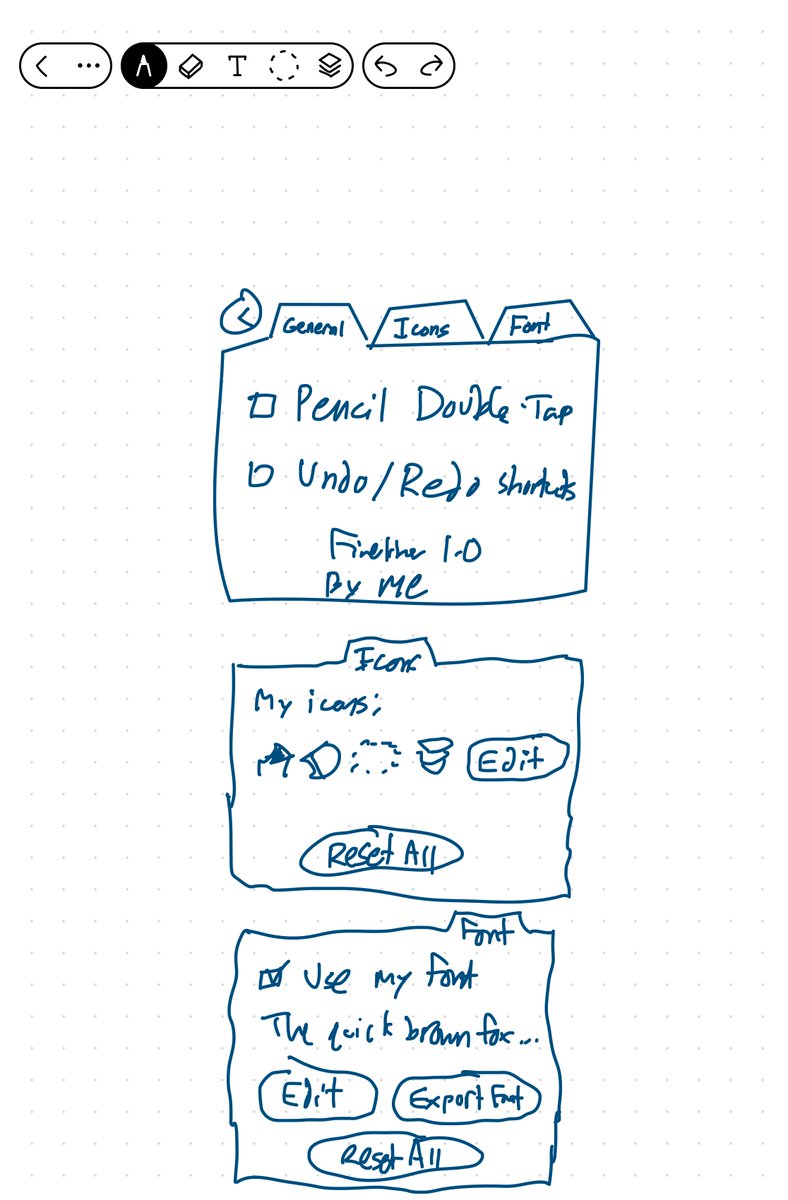
Auto-shape recognition in Fineliner:
Draw any shape, line, curve, or squiggle, but at the end of the stroke, don't lift up your pen/finger — just hold it there.
It'll autocorrect into a shape. And you can then drag to adjust its size before lifting up.
This is literally how I made the first version of the Fineliner settings screen. I drew this, screenshotted it, and told Claude to build it like this.
It got remarkably close on its first try. I only did minor corrections.
No sé si será unpopular opinion, pero el segmento en el que Danhausen hace que vuelva el Demon Bálor, mientras está siendo ahogado por Gunther, me ha parecido absoluto cine. #SmackDown
AI now finds bugs that survived decades of human review, and writes code that looks right but isn’t. Tests can’t keep up.
LeanCIL: formal verification for .NET
Proofs about compiled C# and F# (any dotnet lang), for every input, checked by @leanprover
https://t.co/qcWvHxJLT4
We lost one of the greats of stage and screen today. And, in my book, a tremendous friend and man. I learned so much from him. I will miss you, Patrick Stewart, all of my days. @mang0ld