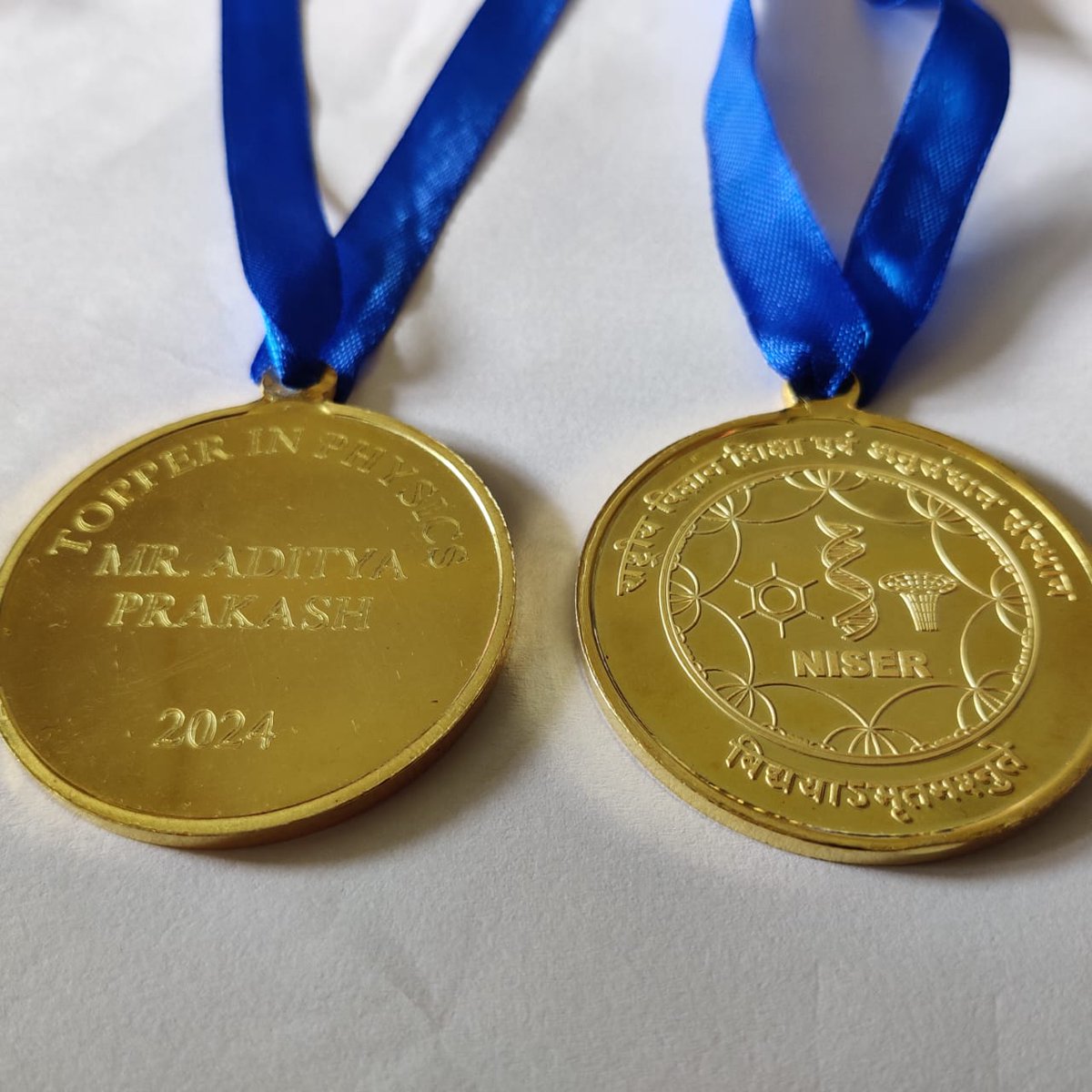
This year, Mr. Aditya Prakash from the School of Physical Sciences has been awarded the Sarat Chandra-Annapurna Maharana Award in Physics for achieving the highest academic performance in his graduating class, with an impressive CGPA of 9.38.
3Blue1Brown’s new video explains why every LLM is actually a compression machine.
everyone describes pre-training as “next token prediction” but that’s just the surface-level objective.
in reality it is a means to making the most efficient text compressor.
prediction and compression are two sides of the same coin.
when you train the model to predict the next token you’re not just teaching it to guess the next word but how to best encode the human knowledge it sees.
better compression
means better abstraction
means better reasoning
at some point, compression stops looking like storage or a database (as some like to call it on X)
and looks like an approximation of understanding.
Google DeepMind CEO:
"The gap between people who use AI and people who don't will be the largest skill divide in human history"
Demis Hassabis spent 50 minutes at Stanford saying things most CEOs would never say publicly
this is exactly the kind of conversation people pay $250,000 to be in the room for
if you want to stay competitive, understanding AI is no longer optional
I wrote a full guide on Claude features 99% of people don't know exist
watch this video, then read the article below
those two things alone put you ahead of most people using AI right now
the engineer who built Claude Code just dropped a 28-minute video on how to write prompts that actually work
I've seen $300 courses that don't cover what he shows in the first 10 minutes
CLAUDE.md files, memory shortcuts, parallel sessions, prompting patterns
all in one video and completely free
works whether you're a developer, a beginner, or someone who's been using Claude for months
based on this, I put together 18 things you can copy and use in Claude today
full guide in the article below
This 2 hour Stanford lecture will teach you more about how LLMs like ChatGPT & Claude are built than most people working at top AI companies learn in their entire careers.
Bookmark this & give 2 hours today, no matter what. It'll be the most productive thing you do this week.
Then the stress test:
“Write 10 questions that separate someone who understands this from someone just memorizing it.”
He spent 6 hours answering them. Every time he slipped up, he’d ask:
“Break down exactly why I’m wrong and what concept I’m missing.”
In 1983, Richard Feynman gave a 1-hour masterclass on imagination and physics.
He broke down:
• Fire
• Atoms
• Motion
• Energy
• Magnetism
But underneath it, he revealed how to think like a scientist
12 lessons from Feynman’s masterclass:
1. Imagination beats knowledge
C.N. Yang has passed, age 103.
Yang was awarded the Nobel prize at 35, for parity violation (shared with T.D. Lee). But his greatest contribution was probably Yang-Mills theory, now referred to as gauge theory. When I was a student the former designation was as common as the latter.
Freeman Dyson called Yang "the pre-eminent stylist of 20th-century physics".
"Dr. Yang's sense of mathematical beauty turns his least important calculations into miniature works of art, and turns his deeper speculations into masterpieces."
Dyson believed only Albert Einstein and Paul Dirac exceeded Yang as stylists in physics.
Introducing NotebookLM for arXiv papers 🚀
Transform dense AI research into an engaging conversation
With context across thousands of related papers, it captures motivations, draws connections to SOTA, and explains key insights like a professor who's read the entire field
What if we could finally simulate some of the most complex molecules out there? 🚀✨
Today, some essential molecules remain a mystery, because the information required to simulate them precisely grows faster than classical computers could ever compute. 🌀🧮
That’s where quantum computing comes in. ⚛️🖥️ Yet, we must first build and scale quantum computers powerful enough to run the algorithm…
📝 In our latest resource estimation, we show that cat qubits could simulate two of quantum chemistry’s benchmark problems, P450 and FeMoco, with far fewer physical qubits than other superconducting architectures. 🐈
🔍 Fewer qubits doesn’t just mean more efficient machines, it could make impactful, large-scale quantum chemistry applications a reality sooner.
🎨 See our infographic below for an explainer.
✍️ Read our latest blogpost for a deep-dive: 👉 https://t.co/2dfqSVItNO
And this is just the start… we expect to bring down this estimate even further soon. 👀 Stay tuned!
#QuantumComputing #QuantumChemistry #Innovation #CatQubits
selective amplification is crucial. A huge shout-out to Dr. Debamalya Dutta from IIT Gandhinagar , Prof. Arko Roy from IIT Mandi, and Prof. Kush Saha from NISER for their valuable contribution and guidance. Thank you for making this journey such a resonant one!
Check out our work (also part of my master thesis) "Frequency-selective amplification of nonlinear response in strongly correlated bosons", where we propose a protocol to selectively enhance the non-linear response in strongly correlated systems.
Link: https://t.co/tIO6yZMqhB
precise and less noisy. 🎶 In the long run, this opens doors to quantum sensors, amplifiers, and simulators that exploit the hidden rhythms of strongly interacting particles. 🎶 Potential applications in quantum simulators, precision sensing, and quantum signal filtering, where
like turning up just the bass in a song. 🎶 This gives a new way to control crowds of quantum particles, making their collective motion loud and clear without chaos. 🎶 The ability to “whisper at the right pitch” rather than shout could help us build quantum devices that are more
Key highlights from our new work: Imagine a dance floor full of bosons — when you play the perfect beat, the crowd suddenly moves in sync and the floor shakes harder than ever. Our research shows how tuning the frequency of a drive can selectively amplify nonlinear effects,
Perplexity usage in India growing like 🔥
Keep it coming! Excited to keep improving the product and serve more people’s daily questions. The adoption is clear proof that search has changed forever.
When colored in blue, this ARPES image of a superconductor looks like the blue people from Avatar. A movie involving room temperature superconductors (so I've been told). My collaborators should supplement DFT with conspiracy theory.
What's a gravitational wave? Anything that distorts the shape of spacetime, but preserves its volume.
What's matter/energy/momentum? Anything that distorts the volume of spacetime, but preserves its shape.
A 🧵 on the Ricci decomposition theorem, as applied to gravity. (1/13)
Have you browsed the May 2025 issue of
@NaturePhotonics?
It has a very nice cover image of quantum #vortex generation on an integrated #nanophotonic circuit:
https://t.co/rhM5OXEWwr