A Chinese tracking device was discovered in 🇬🇧 Prime Minister's official car. The bug is believed to have been found in a sealed part of the vehicle imported from China.
Its discovery during a sweep first emerged in 2023, sparking fears that Beijing was aggressively spying on ministers in the then-Conservative government.
Now it has been revealed that the device was in fact found in the Prime Minister's car the previous year.
Charles Parton, of think-tank the Council on Geostrategy, told the Commons Business and Trade Committee: “The prime minister's car in 2022 was emanating data to China through the cellular module.”
This device is thought to have allowed it to communicate to others over mobile networks.
It is not clear which of the three Tory prime ministers that year — Boris Johnson, Liz Truss or Rishi Sunak — was being targeted.
Questioned by MPs about this, Parton — who served as a diplomat for almost 40 years, including more than 20 in China, Hong Kong and Taiwan – added: “A very senior member of the government who certainly knows whose car it was told me.”
The part of the car containing the geolocating device had been installed by the vehicle's manufacturer, reports at the time said.
Parton's claim came during a discussion about cellular modules, which he warned are 'in everything' including planes, cars and even smart doorbells.
“The Chinese aim to get a monopoly in the manufacture of cellular modules, and they're doing pretty well at that already,” he told MPs.
“If the Chinese wish to shut off all your vehicles, because they've all got cellular modules, it wouldn't be difficult.”
Security officials have since dismantled government vehicles used by ministers and diplomats while looking for tracking devices.
Electronic vehicle parts are said to be embedded with SIM cards before being sent to manufacturers as sealed units, with these capable of sending data back to state-owned suppliers in China.
It is understood the Prime Minister's car is run by the Metropolitan Police.
https://t.co/zqsk3m8RXd
Our statement on the UK government’s demand that all content on all devices sold or used in the country be scanned, on the presumption of nudity, using a dystopian combination of age verification and content scanning. This proposal will not safeguard children. It endangers us all.
https://t.co/VdWe9uhi8p
MSSQL has always been a favorite target. Now it ships its own egress channel.
@gershsec's latest research breaks down how SQL Server 2025's native AI features enable exfil, NTLM coercion, and C2 transport, all functioning as intended.
Read more 👇 https://t.co/ugDN4IcZXW
Microsoft: PowerShell is simple and easy to use.
Actual PowerShell command: Remove-MgIdentityAuthenticationEventFlowAsOnGraphAPretributeCollectionExternalUserSelfServiceSignUpAttributeIdentityUserFlowAttributeByRef
No, this isn't a joke. This was noted by @NathanMcNulty
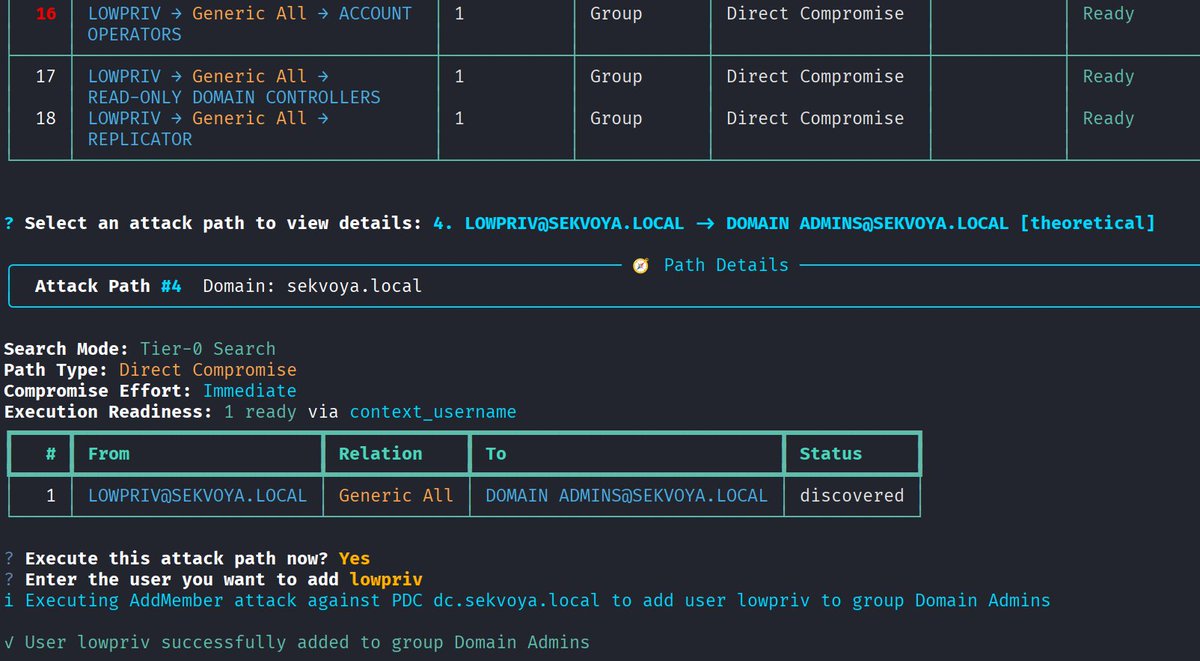
During pentests we often have to deal with tasks that can be automated. Some of the best tools for this are ADScan and ADPulse.
ADScan performs both enumeration and attack and is capable of analyzing BloodHound data to guide you through the pentest. It works with and without AD creds and can compromise some labs in just 3-5 minutes
https://t.co/r6qq1YRvOP
@three_cube@_aircorridor #pentesting #redteam
Anyone else having issues paying their maintenance (scam) fee from @ISC2 ? Been trying for a month and always fails and their support solutions is to pay over the phone.
Seriously, 2026 and we still think it's secure to give credit card details over the phone ?
#isc2#cissp
New NetExec module: mssql_cbt🔥
Relaying to MSSQL can be a hidden gem when you are out of options. The only protection against relaying to MSSQL is to enforce Channel Binding Tokens (CBT). Thanks to @Defte_, NetExec now has a module that checks whether this CBT is required.
🔴 File Upload Bypass Cheat Sheet (Extension Splitting)
Credit @therceman
If you're testing file upload functionality, this is pure gold 🔥
Attackers don’t just upload shell.php… they play with encoding, null bytes, separators, and edge-case parsing tricks to bypass filters.
💡 Common tricks:
• Double extensions (.php.png)
• Encoded characters (%0a, %00, %23)
• Unicode bypasses
• Special chars & separators
• Tabs / Newlines injection
🎯 Lesson:
If your validation relies ONLY on extension checks → it's already broken.
🧠 Think like an attacker. Validate like a defender.
#bugbounty #cybersecurity #pentesting #infosec #websecurity #ethicalhacking #redteam
Bypassing #EU#AgeVerification using their own infrastructure.
I've ported the Android app logic to a Chrome extension - stripping out the pesky step of handing over biometric data which they can leak... and pass verification instantly.
Step 1: Install the extension
Step 2: Register an identity (just once)
Step 3: Continue using the web as normal
The extension detects the QR code, generates a cryptographically identical payload and tells the verifier I'm over 18, which it "fully trusts".
This isn't a bug... it's a fundamental design flaw they can't solve without irrevocably tying a key to you personally; which then allows tracking/monitoring.
Of course, I could skip the enrolment process entirely and hard-code the credentials into the extension... and the verifier would never know.