As part of our efforts to pace the frontier, we’re committed to supporting independent assessments with deep levels of access across training, evaluation, and deployment.
That access should enable third party assessors to challenge our assumptions, identify risks we may have missed, and reach their own conclusions about the effectiveness of our safeguards.
We’re outlining four priority areas for deeper assessment, alongside principles for rigorous, secure, and independent work:
https://t.co/z2b15zsqzO
Super informational read linked here. Curious to hear everyones' thoughts regarding the matter.
Have any inquiries related to the discussion? Feel free to send them in the DM's!
People outside the AI labs should have a real say in how this technology develops, and a clear way to judge if it's happening safely.
Standards should help prevent the concentration of power, including by making sure new companies and open-model companies can compete.
They should also help countries and companies compare evidence and learn from failures.
We think the US should lead this effort. Here is our proposal:
https://t.co/2FT9a2m4l0
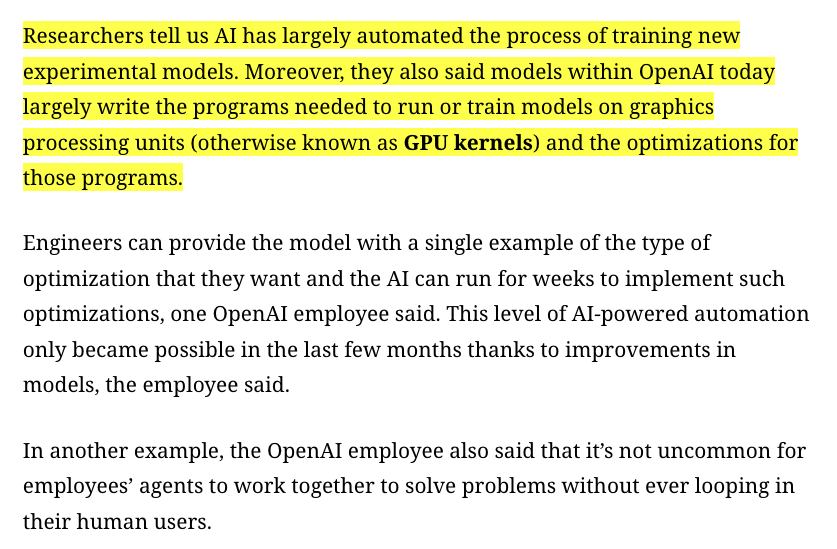
OPENAI HAS LARGELY AUTOMATED TRAINING OF NEW EXPERIMENTAL AI MODELS
OpenAI’s internal AI models can now handle much of the process of building and training experimental models, including writing GPU kernels and optimizing the code used to run them.
Researchers can reportedly give an AI a single example of the optimization they want, then let it work for weeks implementing and testing similar improvements.
OpenAI employees also say internal agents increasingly collaborate with each other to solve problems without involving their human users.
The capability has improved significantly in just the last few months, while OpenAI’s growing access to compute is allowing researchers to test ideas much faster. Employees said some experiments that previously could have taken years can now be carried out in about a week.
Source: The Information
OpenAI is close to solving the Hodge Conjecture, another of the seven Millennium Prize Problems, according to a person with knowledge of the work.
Read more: https://t.co/Km9sK0sMEy
We were working on the keynote today with @romainhuet and @sama and most of the fun was trying to figure out how to explain it all to you because there is so much good stuff in there that it's a bit ridiculous all in quick succession.
We'll have some things next week already to not keep you waiting so long, but very excited to show you all new things we've been working on and how it will all come together in the coming months.