The materials for the first class of my Stanford course 𝗧𝗵𝗲 𝗠𝗼𝗱𝗲𝗿𝗻 𝗦𝗼𝗳𝘁𝘄𝗮𝗿𝗲 𝗗𝗲𝘃𝗲𝗹𝗼𝗽𝗲𝗿 are officially on the course page.
This includes slides, completed code, and video demonstration of the exercise we worked through. Also week 1 assignment is on the course Github repo!
https://t.co/wTokHyVki7
AI research opportunity most builders are sleeping on:
You don’t need a PhD to contribute anymore.
What actually opens doors in 2026:
• reproduce a paper end-to-end
• write a clean eval, not a vibes demo
• ship a tiny open-source tool people reuse
• publish your failures + what broke
• talk to users before you “do research”
Labs hire proof.
Founders fund leverage.
Communities amplify clarity.
If you’re a builder: pick one paper this week.
Reproduce it.
Post the repo + what you learned.
That’s the new research resume.
I’m excited to finally announce the newest edition my Stanford course 𝗧𝗵𝗲 𝗠𝗼𝗱𝗲𝗿𝗻 𝗦𝗼𝗳𝘁𝘄𝗮𝗿𝗲 𝗗𝗲𝘃𝗲𝗹𝗼𝗽𝗲𝗿. It has been 9 months in the making.
Last November, with the release of Claude Opus 4.5, coding agents experienced a step function improvement in capability. We all felt it. The LLMs were more powerful, could reason for longer, solve harder tasks.
This year’s iteration of my course reflects the 2026 metamorphosis of software engineering.
My core belief is simple: AI-native developers of the LLM era are going to become the most important members of any software organization. I have designed my course to train this next generation of engineers.
𝗪𝗵𝗮𝘁’𝘀 𝗱𝗶𝗳𝗳𝗲𝗿𝗲𝗻𝘁 𝘁𝗵𝗶𝘀 𝘁𝗶𝗺𝗲 𝗮𝗿𝗼𝘂𝗻𝗱
First, 85% of my Fall 2025 class material is being thrown out. The Fall 2026 syllabus reflects the core capabilities AI-native engineers must have: agent skills, advanced context engineering, MCP portals, agent-ready codebase principles, agentic code review, security, parallelizing background agents, software factories, and more.
Second, I am going to teach my students how to have software taste. Every student will be required to ship pull requests to production-grade, real-world codebases. The course is collaborating with the top open-source AI repos who will offer support and mentorship to students on how to meaningfully contribute to their projects.
This has never been done before in any university course so I am incredibly grateful to our OSS Partners: @browserbase, @HeyGen, @CopilotKit, @semgrep, @OpenHandsDev, @milvusio, @marimo_io, Pi, @crewAIInc, @warpdotdev, @vercel, @cmux, @arizeai, @UnslothAI, and @anyscalecompute.
𝗪𝗵𝗮𝘁’𝘀 𝘀𝘁𝗮𝘆𝗶𝗻𝗴 𝘁𝗵𝗲 𝘀𝗮𝗺𝗲
I’m fortunate to again have AI software engineering leaders and founders as guest speakers to share their learnings from building top coding agent products. Thank you to @leerob from @cursor_ai, @bcherny of @claudeai code, @EnoReyes of @FactoryAI, @silasalberti of @cognition, @0xine of @semgrep, Rajesh Bhatia of @Cloudflare , @amasad of @Replit, and @eladgil.
All resources will be available online. All classes will be available to the public.
9/22 on Stanford campus. See you in class.
https://t.co/wTokHyUMsz
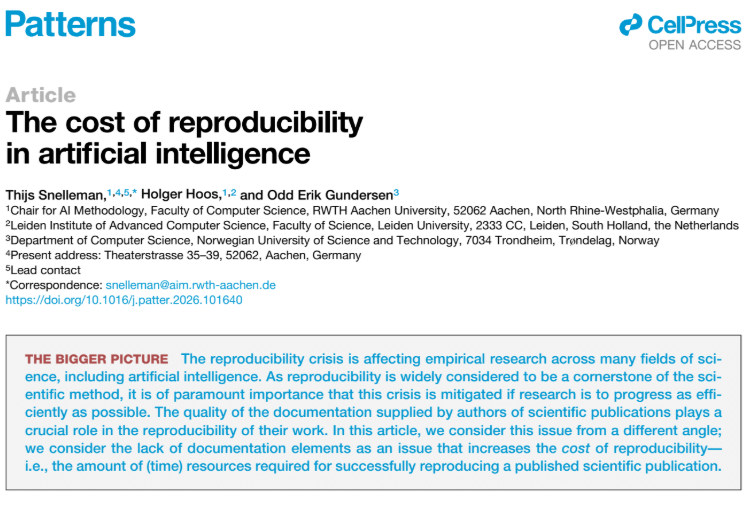
The cost of reproducibility in artificial intelligence.
Learn more in Patterns: https://t.co/H5bB19FiVa
Thijs Snelleman, Holger Hoos & Odd Erik Gundersen
@Patterns_CP
Hybrid quantum–classical computer systems act as a bridge to achieving quantum advantage, but they are not likely to scale well to the number of qubits required for use cases that are projected to eventually benefit most from quantum computing, such as molecular simulation and drug design, or protein or RNA folding https://t.co/LYAtCT7ICC
📣 We are organizing the first InterpScience Workshop @ NeurIPS 2026 in Sydney! The goal of the workshop is to build a more rigorous scientific foundation of LLM interpretability.
📝 Papers due: Aug 28
🌐 https://t.co/lWJOhgZLuI
✉️ [email protected]
[1/7]
@RShahzaddk Bhi ye tu normal mere area men pef k sab school mafia k trha km krty Han already pta ho ta k kon si team aye gi Kia checking kre gy or or fake enrollments tu bus ab normal hy even parents tak ko pta hota
The Space and Upper Atmosphere Research Commission (SUPARCO) announces a landmark advancement in Pakistan’s Manned Space Mission Program as two Astronaut Candidates, Khurram Daud and Muhammad Zeeshan Ali are set to depart for the People’s Republic of China to begin advanced astronaut training at the Astronaut Centre of China (ACC).
This is a significant step forward in Pakistan’s space exploration journey that positions the country in the community of a select group of nations actively engaged in human spaceflight programs. Under this collaboration, Pakistan is preparing for its first-ever participation in a mission to the China Space Station (CSS). The mission is currently planned for launch in late 2026, where a Pakistani astronaut will serve as a Payload Expert aboard the Shenzhen mission.
During mission aboard the ‘China Space Station (CSS)’, the Pakistani astronaut will conduct several scientific experiments in microgravity. These experiments span critical areas including material science, fluid physics, life/ bio science, and biotechnology, with potential applications for climate resilience, food security, and industrial innovation.
On the historical occasion, Honourable Prime Minister of Pakistan Mr. Muhammad Shehbaz Sharif commended the efforts of SUPARCO; a harbinger of deep space exploration. He also appreciated ironclad China-Pakistan brotherhood, yet another testimony of which is choosing Pakistan to be the first country for participation in Manned Space Mission.
🇨🇳👨🏻🚀🇵🇰Two Pakistani astronauts, Muhammad Zeeshan Ali and Khurram Daud, are selected to train in China.
After the training and assessments, one will travel to China's space station, becoming the first foreign astronaut to enter China Space Station.
@TrueUAE1@SHGaaaa2014 No doubt he has been paid by uae for while…. We can understand his situation but reality is micro state like uae think he can bully atomic state.. time has Changed and as Pakistani we respect every Muslim brother country but not the collaborator of Zionist…. Fuck off 🖕