The CHIPS Act funds the production of chips using leading-edge **transistors**
And now you can probably figure out why he thinks these companies needed transgender people to qualify.
We are truly living in the dumbest of times.
Come work with me!
I'm building a new US AI policy team at @coeff_giving and hiring generalist grantmakers + a chief of staff.
This new team will be proactively scanning the horizon, identifying gaps in the policy ecosystem, headhunting founders, and helping launch new organizations, while strengthening the democratic institutions that will have to steer through the transition to powerful AI systems.
Apply by July 23rd!
https://t.co/jASDyYVJGR
Breaking WaPo:
Multiple scientists who serve on an independent board established to guide the nation's nearly $9 billion basic science funding agency were just terminated from their positions by Trump. The National Science Board was established in 1950 to guide the governance of the National Science Foundation.
Venture capital invested in chips has fallen from 5% of total VC in 2010 to just over 1% today.
This should be unsurprising: given the incredibly long lead time from invention to commercialization, investors are just acting rationally.
The last major semiconductor innovation (FinFET) took 17 years from university research to production.
The CHIPS Act tried to address this with $11 billion for R&D, centered on a new institution called Natcast modeled on imec, the Belgian semiconductor research hub that has thrived for 40 years.
In under 2 years, Natcast recruited 200+ member companies, set up a research agenda, selected partners for prototyping & advanced packaging facilities, and designed an investment fund with strong private interest.
Commerce Secretary Lutnick shut it down in August 2025, accusing the program of cronyism. The replacement is a grant program demanding equity stakes, which is likely to repel industry participation.
China, Japan, and the EU are executing long-term semiconductor R&D plans with consistent funding across leadership transitions. In shutting down Natcast, we signaled that our industrial policy commitments are provisional.
New at Factory Settings, by Donna Dubinsky, who helped build Natcast from inside Commerce.
https://t.co/80ZVse8Upu
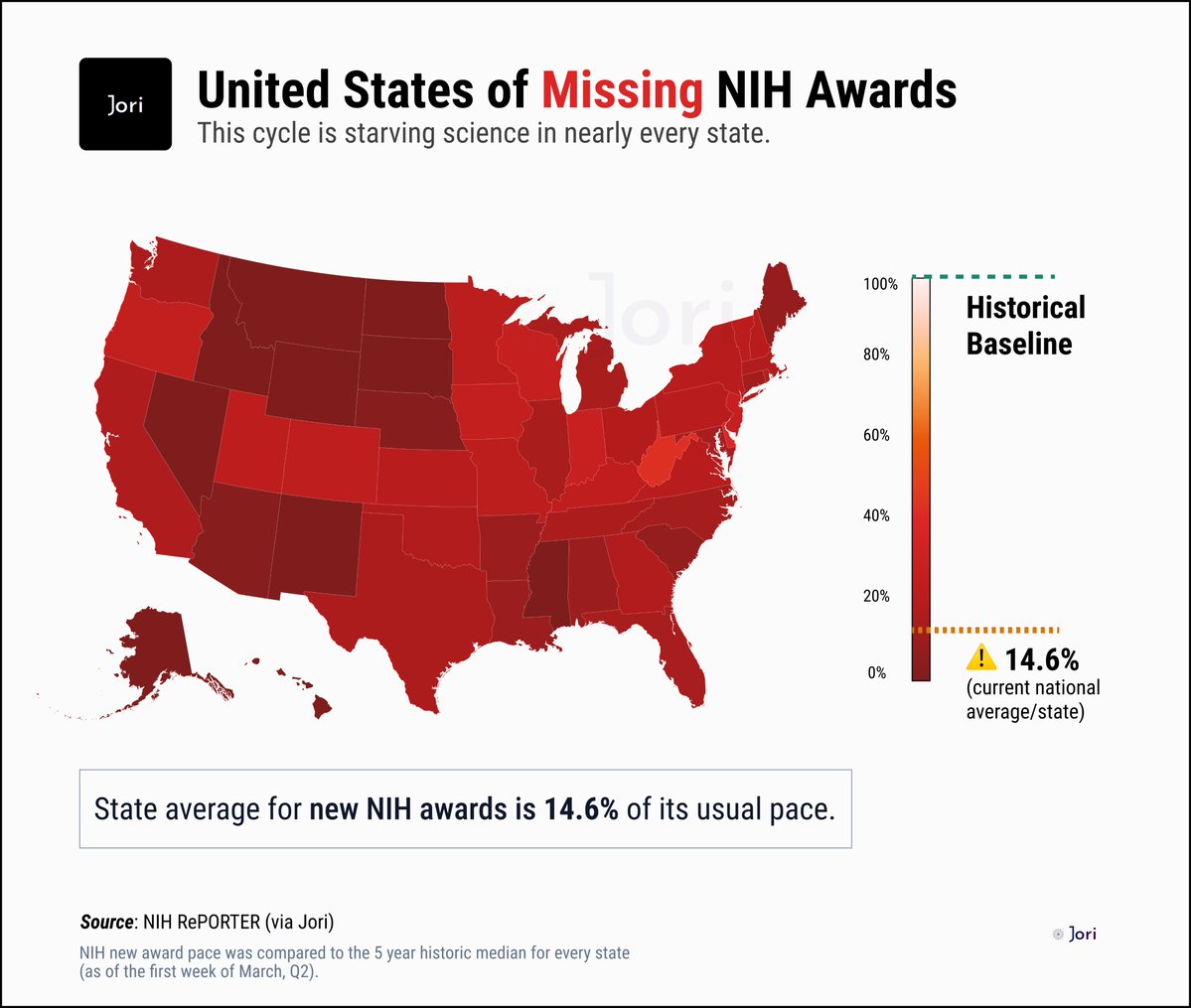
U.S. bioscience research is collapsing.
This is the map of a systemic rot.
NIH new award pace this year: 14.6% of normal.
If you wanted to stall science, you don't pick & choose states.
You just freeze the entire map.
In case you missed it:
▫️ ~95,000 scientists gone (@nytimes)
▪️ ~$2.4B in NIH research wiped out
▫️ ~$6B in economic loss (@DrCatharineY / PNAS)
This is what (predictably) follows next:
⇣ early-career scientists exit for good
⇣ breakthrough discoveries never made
⇣ trials that never open
⇣ labs that quietly shut down
⇣ global talent choosing other countries
⇣ the next decade of innovation erased before it starts
Sadly, you don’t "bounce back" from 14%
you just hollow out the system.
For a country that leads in science, this is the mo(u)rning after “National Science Appreciation Day”
==========
Source: NIH RePORTER via @Jori_health
Plot note: NIH new-award counts were compared to the 5-year historic median for every state (as of the first week of March, Q2).
==========
FT: China’s Salt Typhoon breached House staff email systems — including the Select Committee on the CCP.
This is at least the second time China-linked hackers have targeted the Select Committee in recent months.
Why this matters & what to do next👇
What if everyone using AI—from school districts to small businesses to local governments—could easily create and access nutrition labels for different AI models that clearly lay out information to help inform their safety, performance, and risks? That’s exactly what my bipartisan Resources for Evaluating and Documenting (READ) AI Models Act would do. It would help level the playing field so small and medium-sized developers as well as users can make informed, responsible choices about the models they create and rely on.
That’s what transparency is all about.
America is celebrating its AI software lead. But we're missing the bigger picture.
China has more robots in production than the rest of the world combined. Unitree is selling advanced humanoids for $5,900. China has entire "dark factories" factories that run with zero humans.
Jensen Huang says the “ChatGPT moment for general robotics” is coming. China is ready. Right now, the United States is not.
New WSJ piece with @AnneNeuberger on why the US needs to get serious about robotics, fast
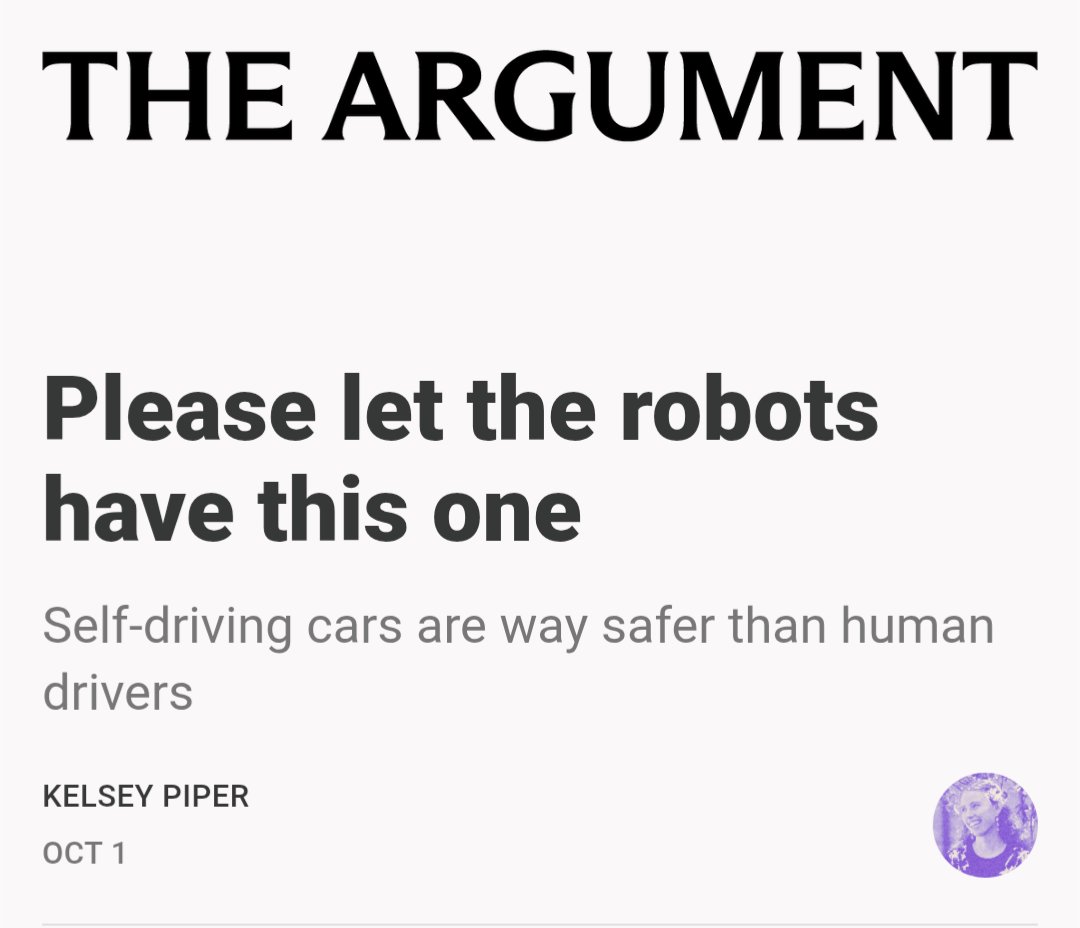
Many AI policy decisions are complicated. "Don't ban self-driving cars" is really not. Good new piece from @KelseyTuoc, with a lede that pulls no punches:
The more I dig into the details of the government's new stake in Intel, the more I fear this is a bad deal for the taxpayer:
1. Under Intel's original CHIPS grant, Intel was slated to receive a total of about $11 billion from the Commerce and Defense Departments. This was not a gift to Intel: In exchange for the grants, Intel committed to build fabs in Ohio, Arizona, New Mexico, and Oregon.
2. Over the course of 2025, Intel has repeatedly delayed its Ohio fabs and announced layoffs in Arizona and Oregon. In recent months was increasingly unclear whether Intel could actually deliver on its CHIPS commitments.
3. Under the CHIPS Act, if Intel failed to meet its commitments, the government could get the grant money back.
4. According to Intel's SEC filings on the government investment, in exchange for 9.9% of Intel, the government (a) agreed to disburse most of the remaining CHIPS money (about $6 billion from Commerce, and part of Intel's DoD grant), AND ALSO agreed to deem Intel as having complied with its grant obligations, e.g., to have completed most of the fabs. This despite the fact that several of the fabs are not, in fact competed. In exchange, Intel gave the government a 9.9% stake.
5. Basically, instead of the CHIPS Act money being tied to Intel actually building all the fabs, the money is now tied to the government buying into Intel. That is a different thing. The specific deal is also different from the concept of the government getting shares as part of a grant to build fabs. According to the SEC filing, there is less emphasis on fab building and more emphasis on government ownership.
6. I am not per-se opposed to the government equity in companies in narrow and well-defined circumstances. Bailouts, like the 2008-2009 financial crises. Or in where the government has a defined need and wants to seed start-ups to work on it. E.g., In-Q-Tel, although that is structured as a non-profit, not direct government investments. I also think if the government needs critical minerals, e.g, DoD's recent MP Materials deal, it isn't crazy to think about the government getting equity in narrow circumstances and subject to oversight.
7. That said, the actual Intel deal is a major change to CHIPS Act purposes and it is not clear whether converting an $11 billion grant for Intel to build fabs into an $11 billion government purchase of Intel shares will actually help Intel turn, or whether it will advance U.S. national semiconductor interests. It might, but there is also a lot of downside risk.
8. Of course, maybe Intel has made private commitments to keep building fabs. But if so, that is an argument for more oversight--taxpayers should know what we are getting!
9. I have a forthcoming Lawfare essay on the legality of this. I think it probably is legal, albeit contrary to the spirit of the CHIPS Act.
10. Bottom line: if Congress wants oversight over government equity in private companies, Congress needs to do something about it.
Most people think “indirect costs” for government-funded scientific research have grown out of control (some universities charge >60% rates).
In response, the Trump admin tried to cap them at 15%.
But this whole debate rests on a false premise:
While ***negotiated indirect cost rates*** have gone up over time, ***effective indirect cost rates*** — the overhead costs the government actually ends up paying for — have not.
Here’s what the data shows…
⚠️TSUNAMI WATCH in effect for the California coast. Estimated time of arrival as early as 12:15 AM on July 30. People along the coast: Stand by for further updates. #KnowYourZone at https://t.co/Dm0UehpMVM #CAwx#Tsunami