We’re expanding our partnership with @SpaceX, and will be scaling up on GB200 capacity in Colossus 2 throughout June.
Appreciate @elonmusk and the team helping us find good homes for the Claudes.
How I built with Claude 👇
1. Prompt: "Build a storytelling website where each scroll section reveals a new chapter with fluid color transitions"
2. Use Three.js for the painted texture background that reacts to cursor
3. Prompt: "Add GSAP ScrollTrigger so each section animates in as a cinematic scene"
4. Use Lenis.js for that buttery smooth scroll that premium sites have
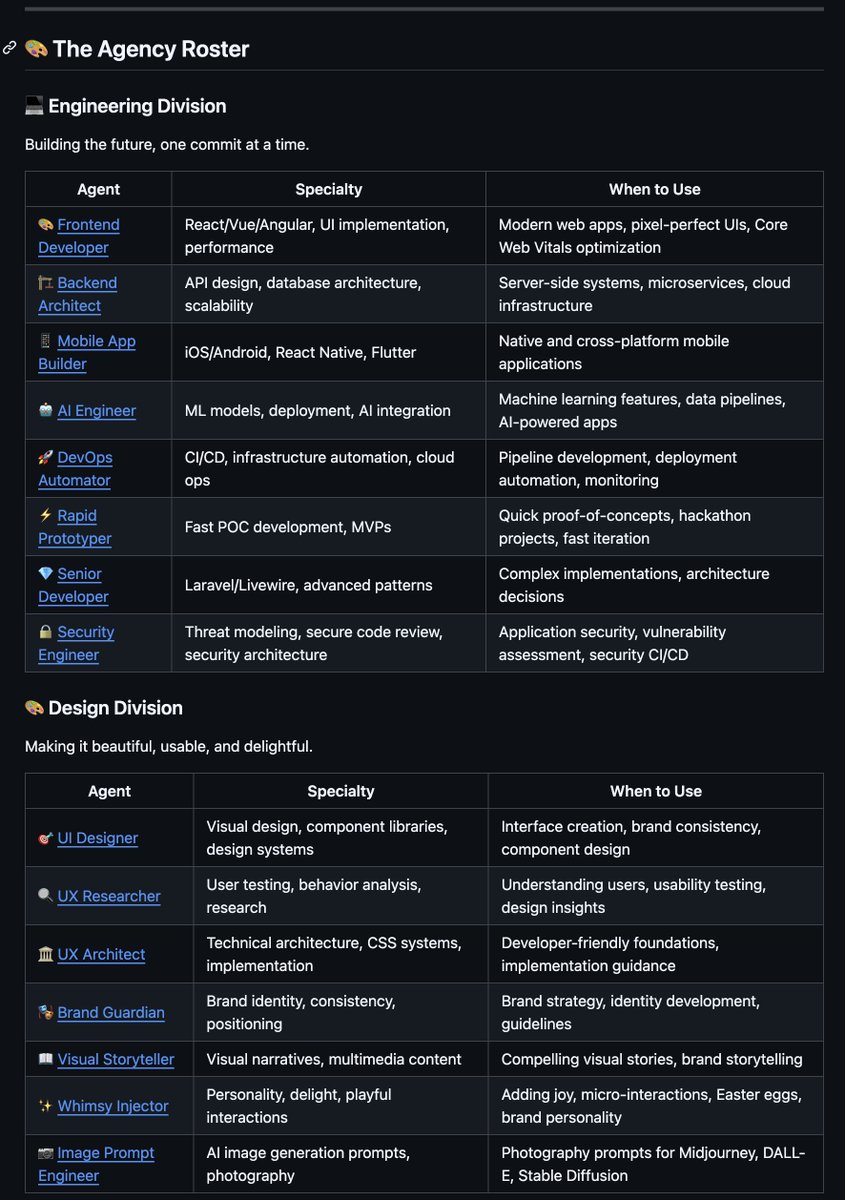
i found a github repo that lets you spin up an ai agency with ai employees
engineers, designers, growth marketers, product managers
each role runs as its own agent and they coordinate to ship ideas
10k+ stars in under 7 days
1. engineering (7 agents)
frontend, backend, mobile, ai, devops, prototyping, senior development
2. design (7)
ui/ux, research, architecture, branding, visual storytelling, image generation
3. marketing (8)
growth hacking, content, twitter, tiktok, instagram, reddit, app store
4. product (3)
sprint prioritization, trend research, feedback synthesis
5. project management (5)
production, coordination, operations, experimentation
6. testing (7)
qa, performance analysis, api testing, quality verification
7. support (6)
customer service, analytics, finance, legal, executive reporting
8. spatial computing (6)
xr, visionos, webxr, metal, vision pro
9. specialized (6)
multi agent orchestration, data analytics, sales, distribution
what i like about this approach is the framing
instead of one big ai agent trying to do everything, you structure it more like a company. specialized agents, clear responsibilities, workflows between them
im curious to see what this actually feels like in practice and if its any good (do your own research)
https://t.co/plSvZIaDpr
but as always will share what i learn in public and on @startupideaspod
one thing is for certain and it reminds me
the future belongs to those who tinker with software like this
I accidentally discovered how to compress a month of research into 3 hours.
A founder at a YC company showed me his Claude setup. I thought he was just fast. Then I watched him build an entire go-to-market strategy for a market he'd never worked in before.
Here's exactly what he did:
First: he didn't ask Claude to "research the market."
He fed it 8 competitor landing pages, 3 earnings call transcripts, 12 customer reviews, and a Reddit thread of complaints.
Then he asked one question:
"What does every successful player in this market understand that their customers never say out loud?"
Not "summarize these." Not "analyze the competition."
The unspoken insight. The thing that takes founders 2 years of customer calls to figure out.
But the next part is what broke my brain.
He followed up with:
"Now show me the 3 assumptions this entire market is built on, and what would have to be true for each one to be wrong."
In 15 minutes he had the attack surface of an entire industry.
The blind spots. The fragile consensus. The opening nobody was talking about.
Most founders spend 6 months doing customer discovery just to find one of those.
Then he did something I've never seen before.
He asked:
"Write 5 questions a world-class investor would ask to destroy this business idea, then answer each one using only the evidence in these documents."
He spent the next 2 hours stress-testing every assumption. Every weak answer triggered a follow-up:
"What's the strongest version of this argument and where does it still break?"
By hour 3, he had a strategy deck that felt like it came from someone who'd spent a decade in the space.
The tool didn't change. The questions did.
Most people treat Claude like a faster Google.
These founders are using it like a thinking partner who has read everything and has no ego about being wrong.
The difference between 3 hours and 3 months isn't the amount of information.
It's knowing which questions actually matter.
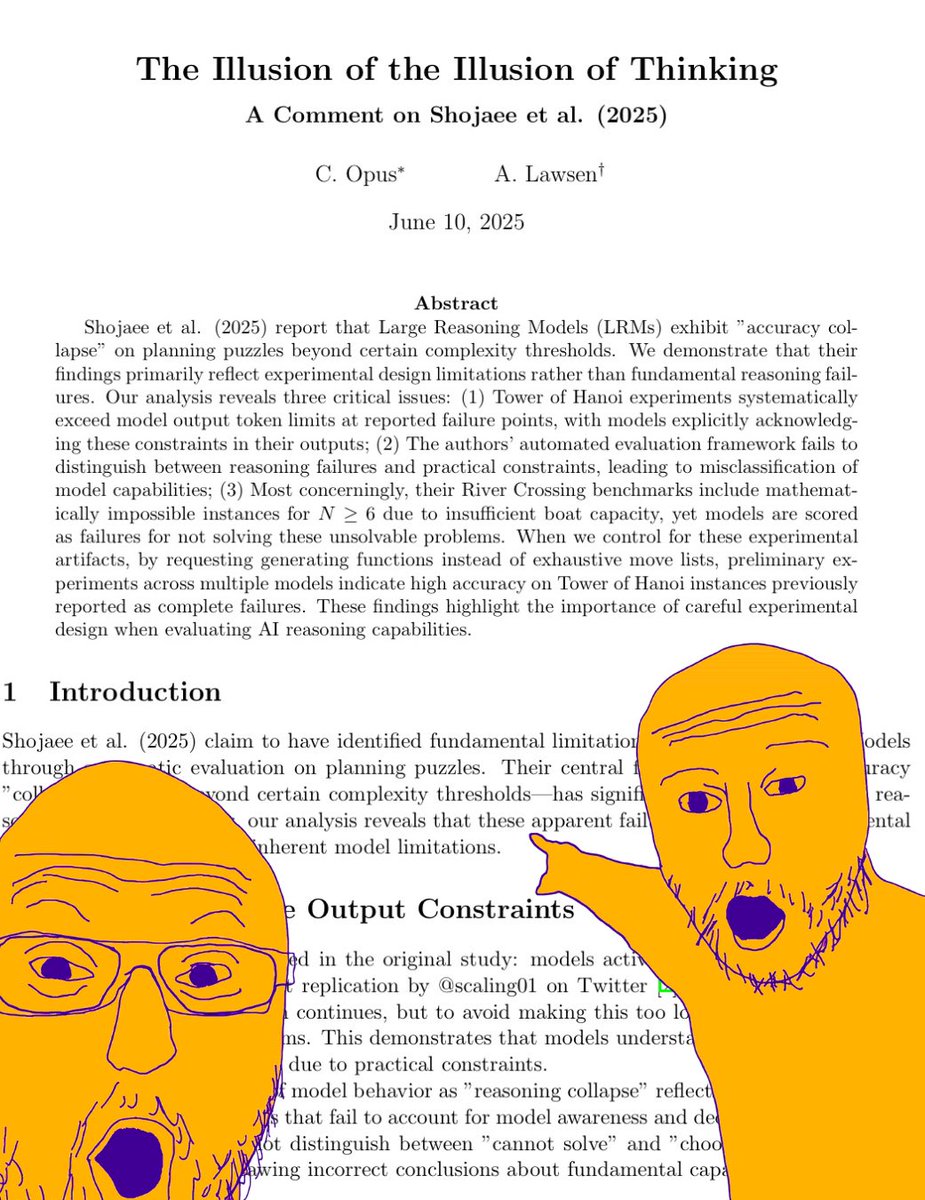
bro sh*t just got so real. Claude Opus published a response paper to Apple’s paper, criticizing their experiment design, putting models under token limit constraints, and having them solve unsolvable problems.
@RuiCarrilho5 Against the Gods: The Remarkable Story of Risk - Peter Bernstein
Gödel, Escher, Bach: an Eternal Golden Braid - Douglas Hofstadter
War-Making and State-Making as Organized Crime - Charles Tilly
The Evolution of Cooperation - Robert Axelrod
Space and Place - Yi Fu Tuan
Phenomenology of Perception - M. Merleau Ponty
The Art of Doing Science and Engineering - Richard Hamming
Theory of Games & Economic Behavior - Morgenstern & Von Neumann
Symposium, Parmenides, Timaeus, Meno, Republic - Plato
Nicomachean Ethics, Metaphysics, Categories, De Anima - Aristotle
Being and Time - Martin Heidegger