$META will invest about $10B to build its first data center in Canada, a 1GW facility in Sturgeon County, Alberta, largely powered by natural gas. The project is expected to need 3,000 construction workers and create 300 full-time jobs.
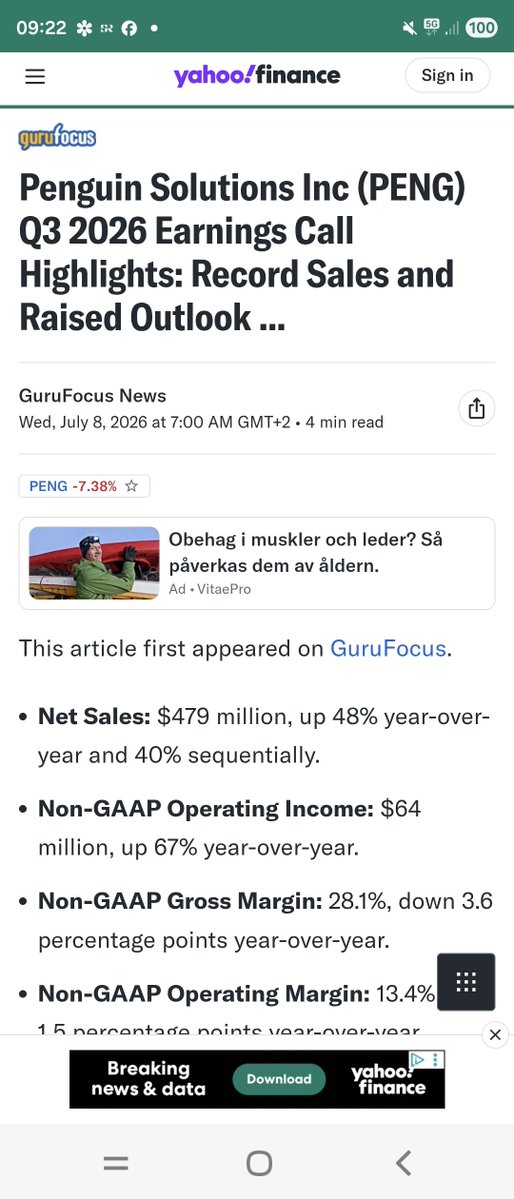
$PENG earnings blowout is critical evidence confirming that the AI super cycle is shifting from a speculative infrastructure build to a sustainable deployment and optimization phase.
Ayar Labs is the CPO connection that could take $SIVE from $1B to $5 to $7.5B market cap on its own.
I'll explain.
Ayar Labs makes a product called the SuperNova. It is a light source module that powers their optical engine inside AI datacenters. Every single SuperNova unit contains Sivers laser arrays inside it.
Think of it like this. Ayar makes the lamp. $SIVE makes the bulb that goes inside every single lamp they ship.
Now here is where it gets interesting.
Some Wall Street CPO models assume only a few dozen external light sources per rack.
$JBL already built a single box housing 64 SuperNova modules. That is 64 Sivers laser modules inside one box that fits in a server rack.
Then at Computex 2026 Ayar and Wiwynn demonstrated a rack-scale AI architecture supporting up to 512 SuperNova light source assemblies per rack.
If these rack-scale architectures move into hyperscale production, analysts may need to revisit their assumptions around external light source density entirely.
Now the math on how we get to $5 to $7.5B.
Assuming approximately $60 to $65 of Sivers laser content per SuperNova assembly, large scale deployment could translate into hundreds of millions of dollars of annual laser revenue over time.
If Ayar alone ultimately generated roughly $500M of annual revenue for Sivers, and the market valued that business at 10 to 15 times sales, that implies a potential valuation of approximately $5 to $7.5B.
This is one scenario showing how powerful the Ayar relationship could become if CPO adoption reaches scale.
$SIVE sits at roughly $1B today.
From one connection. Not $GFS. Not $AAPL. Not $POET.
Just Ayar.
When I first started investing in robotics, I searched X and YouTube for Humanoid Robotics experts and @GoingBallistic5’s content kept popping up
Scott is an encyclopedia on all facets of the space and has been an instrumental player in the space for 40+ years. Follow him unless you’re afraid of learning too much
The $MU memory cycle is over and the bubble is popping.
At least that's what the market is pricing after a 25% crash in two weeks. There's just one problem: the "bubble" is sold out for the next two years.
Two weeks ago $MU printed one of the greatest quarters in semiconductor history: $41B in revenue, up 345% YoY, 85% margins, and guidance for $50B next quarter. The stock made new ATHs at 1259... then gave back 300 points on cycle fears.
But this isn't the old Micron; 16 take or pay contracts with binding price floors and $22B in customer deposits mean customers pay whether they take delivery or not. Management says margins at FLOOR pricing would still exceed past peak margins. Bears are trading the 2018 playbook against a company that rewrote the rules.
The chart is now backtesting the exact zone that launched the last leg. 966 was the breakout level; $MU sits just under it at 938 with monthly support at 810 below. Reclaim 966 and hold, and 1100 comes fast. Thru 1100 and the ATH retest at 1259 is in play. Break 1259 and the 1500 melt up thesis is fully alive again.
HBM4 Is the Inflection
$MU was just approved as an HBM4 supplier for $NVDA's Vera Rubin platform with shipments starting this half. HBM4 revenue already crossed $1B and the ramp is moving 2x faster than HBM3E did. Micron now sees the HBM market topping $100B by 2027 (a year earlier than projected). First wafers from its new $9.3B Japan fab came off the line on July 4, and fresh supply deals with Ford and GM keep widening the demand base.
Trade Ideas
$MU above 966
Swing Trade: MU 8/21 1500C
Day Trade: MU 7/10 1000C
The market is pricing the death of the old memory cycle. It hasn't noticed the new one has a floor under it. When it does, the reclaim will be violent.
$IREN at @RaiseSummit
Kent Draper: 3 layers of AI compute
1. Physical Infrastructure
2. Compute
3. Software & Services
Layers 1 and 2 are the key foundation, without those, your ceiling is capped.
I have been pounding the table on the superior model of a bottom-up approach.
@kentpdraper confirms that @IREN_Ltd sees it the same.
Having a strong foundation of land, power, grid connections, substations, owned GPUs, network core buildings, and storage, will unlock the amount of GPU hours that can be monetized up the stack.
It's very simple: with an abundance of physical infrastructure and chips — software is the layer that can be added when needed.
The foundation of the thesis rests on physical assets and power being scarce, and those are the limiting factors in your ability to grow faster than peers.
$AAPL and $AVGO announced a $30B+ multiyear deal for custom silicon and wireless technology used across Apple products.
The deal includes more than 15B U.S.-made chips and a $1.5B Broadcom investment to expand its Colorado facility.
AI infra/neocloud selloff summarized:
> Bloomberg floated the idea of $META selling excess compute
> Retail sells off neocloud & AI infra
(Names like $NBIS, $IREN, $CIFR, $WULF, and many others take a huge hit)
> Institutions start buying tech & AI stocks at the fastest pace since last October
(Most definitely because they realize $META has absolutely zero excess compute)
> $META & Bloomberg does damage control and starts to change their narrative
IMO, in the coming days:
> We start to bottom out
> Institutions got in at lows
> And retail regrets selling
Goldman Sachs forecast $1T of hyperscaler capex in 2027.
Around 40-50% of that spend will go towards memory.
And you're worried about 20% drawdowns in memory names from $MU to Samsung to SK Hynix to $SNDK?
Mainly driven by broad deleveraging as seen in Korea recently.
You just need to look at Samsung becoming the most profitable company worldwide with their earnings this week.
Also, I would not be surprised seeing the $1T current forecast revise upwards closer to $1.5T as 2026 progresses.
Penguin Solutions ($PENG) is moving into the “production phase” of AI.
Yesterday’s results weren't just record-breaking (Revenue +48% YoY, EPS +79% YoY).
They proved that the company is becoming the backbone of Agentic AI.
Key takeaways from the earnings call:
🔹 PMA is key: The team is pushing hard on their Photonic Memory Appliance (PMA) with Celestial AI - a massive long-term bet on the future of data center memory.
🔹 Conservatism = Opportunity: Management is playing it safe, yet they’re still guiding for ~30% growth in 2027. Any major contract win is pure upside.
🔹 Inventory as a Moat: Stockpiling nearly $500M in inventory isn't a mistake—it’s a strategic hedge to guarantee supply while others scramble.
I just published a full deep dive analyzing the earnings call - breaking down their valuation, their inventory strategy, and why the market might be underestimating their platform potential.
Read the full analysis on my Substack (link in comments).
Let me know what you think!
Analyst Target Hike: TeraWulf $WULF
Morgan Stanley raised its price target on TeraWulf to $72 from $66.50, while maintaining its Overweight rating.
Analyst Stephen Byrd continues to see upside in the stock, with the higher target reflecting increased confidence in TeraWulf’s outlook.
$PENG
The biggest takeaway?
The Integrated Memory segment literally exploded - memory revenues more than DOUBLED year-over-year, skyrocketing to $275.1 million!
Why does this matter so much for the Sovereign AI boom?
As CEO Kash Shaikh pointed out: as AI workloads shift toward complex inference and autonomous AI agents, memory - not just raw processing power -has become the ultimate performance bottleneck.
Days like today it’s hard not to wish you sold stocks like $WULF at $29 and bought back at $20. No matter what you see people post here, it’s near impossible to time the market like that. If I’ve learned anything it’s to hold the stocks you have high conviction in, no matter how up and down the journey is.
I firmly believe $WULF is a $40+ stock because of the execution of the team and the assets they hold.
Turns out that Bloomberg piece was all BS as expected
so game on for $CRWV
Comments within clearly state:
"Meta is still hungry for even more computing power, the spokesperson said. It is still moving forward with plans for expensive new data centers and recently inked major computing deals with $CRWV CoreWeave Inc., Alphabet Inc.’s Google and Oracle Corp., among others."
https://t.co/TV9glifmBo
@SemiAnalysis_ Only banger you are going to get is from the @SECGov when they prosecute you shilling false info, coordination with ETF provider, selling information behind pay walls that differs from your actual statements on X. Welcome to the real world.
$WULF CEO @PaulBPrager full Bloomberg interview today on the Anthropic data center agreement:
He called TeraWulf’s new 20-year deal with Anthropic “The best in class lease in the space right now.”
Just Bloomberg and $META doing damage control after crashing the market with Meta Compute framing:
Spokesperson: "Meta is still hungry for even more computing power.
It is still moving forward with plans for expensive new data centers and recently inked major computing deals with $CRVW, Google, $ORCL, and others."
Just dropped that in with the Meta Muse announcement, and evenn threw in the "expensive" framing with DCs to signal capex.
But little late given we're likely seeing a lot of margin liquidation cascades and heavy losses from media framing earlier.
The United States 🇺🇸, Japan 🇯🇵, and South Korea 🇰🇷 just signed a new pact around working together to accelerate
Small Modular Nuclear Reactor Development