We'll be spending a lot more time trying to understand the outputs of language models. A few thoughts, tips & tricks:
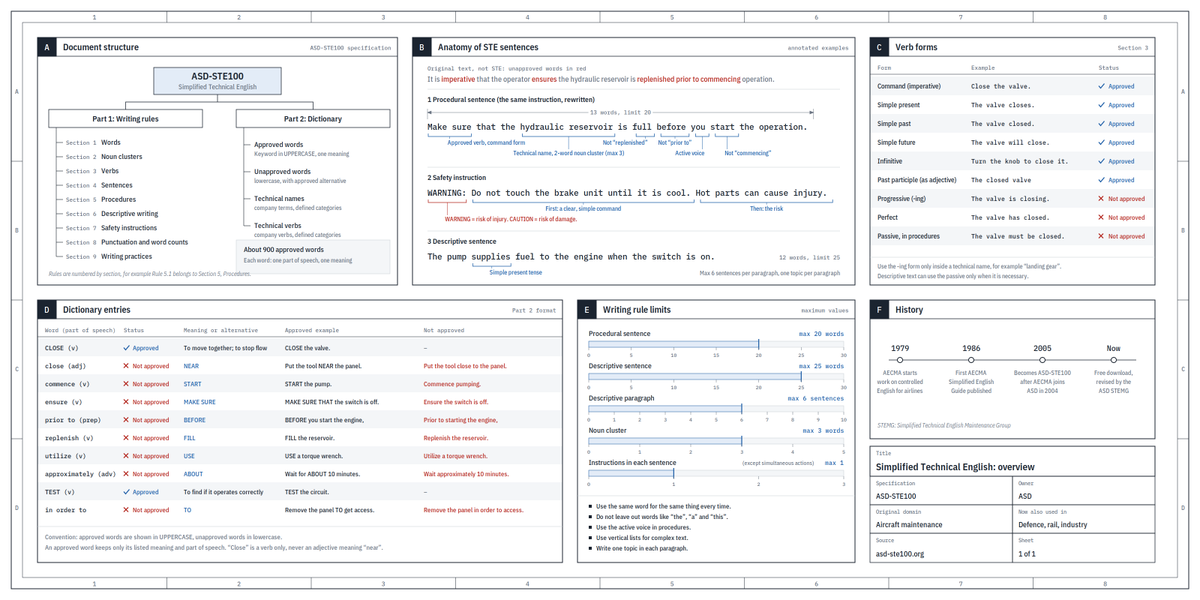
Writing. Something I've had success with: Ask your LLM to explain something in ASD-STE100, it's a controlled language specification originally developed for aerospace maintenance documentation. LLMs well-versed in this language and it comes with heavy constraints on clean writing style that I often find a lot more readable. Sometimes I've tried to soften it a bit e.g. ask for "80% of the way to ASD-STE100" because the spec is quite stringent. But even better:
Diagrams / images. Instead of writing, ask your LLM to create a diagram. These can be a lot easier to process, parse, and understand. But even better:
Web pages. Ask for output "in HTML" to get a beautiful, interactive webpage. LLMs are getting really good at frontend and can create beautiful experiences, animations, etc. But even better:
Explainer videos. The output format I am most bullish on is fully custom / bespoke explainer videos generated on any arbitrary topic. Experiment with things like "Create a 3b1b style video explainer on X. Use my ElevenLabs API key for audio narration". (you'd need an API key for the latter or you can ask your LLM to find you decent free alternatives that use your local compute). This is actually starting to work!
In summary:
- As LLMs get better, they will do more and more of the legwork autonomously, and a lot more of our work will rise up the abstractions into oversight and understanding.
- Luckily, LLMs can help here too because as intelligence and code are increasingly abundant, you can ask for large, custom, discardable software artifacts (e.g. web apps, video explainers) that would have never made sense to create before. Push the boundaries here and you'll be surprised.
SITUATION DETECTED: Z․ai says GLM-5.3’s Infra Agent helped build the production inference stack for GLM-5.3-Flash in under two weeks and roughly tripled end-to-end serving throughput. They are calling it an early form of recursive self-improvement.
Google Brain founder Andrew Ng:
"Prompting will be dead in 6 months
Agent harnesses built with loops and graphs will replace it"
Agent → Harness → Feedback → Loops → Graphs → Self-Improving Systems
In this 1-hour Stanford lecture, he explains what the best engineers are building instead and how you can start today
Prompt → Run → Verify → Improve
The first 20 minutes teach what most $1,500 courses try to sell you
For free
Bookmark and watch it today
Then read the guide below on building an agent harness that improves itself
BREAKING: Anthropic released Skills for Claude.
Most ecom brands will use them like fancy prompts.
I built them into an operating system that helps run my ai affiliate campaigns 👇
Here’s the difference:
A prompt is something you retype every week. A skill is a module Claude already knows. You call it by name, point it at a brand, and it runs.
Built on Opus 4.8, so it handles the longer, multi-step work a real content engine actually needs.
Here's what's in the system right now:
AI UGC modules:
→ brand-rulebook, authority-figure, hook-library
→ script-writer, persona-roster, account-warmer
→ caption-seo, comment-to-dm, compliance-check
→ campaign-tracker, winner-finder
And here's what makes it a system, not a folder of prompts:
We call one module, point it at a brand, and it runs. Reads the data, does the job, returns the fix.
winner-finder → last 7 days → scale the hooks that hit 10K views. One call. Done.
No retyping the prompt. No re-explaining the brand. No copy paste from twenty docs. The same locked persona, the same compliance lines, the same hook library, every single time.
The shift nobody has priced in yet:
A prompt works once. A skill works every time, the same way, forever.
That is the line between using Claude and building with it.
Knowing how to use Claude like a C-Suite employee is enabling small brands to scale like the big boys.
Want the full AI UGC operating system, every module plus how to wire it? It's free:
1️⃣ Comment "METHOD" below 💬
2️⃣ Add me
3️⃣ Like this post 👍
Then it will auto send. (Make sure you are following)
stop asking Claude one question and thinking you understand the topic. you don't.
Stanford proved a better way. it's called STORM. peer reviewed. 25% more organized output. open source.
the trick: don't ask one question. ask five. from five different experts.
>the practitioner: what do they know that academics miss?
>the skeptic: what's the strongest counterargument?
>the economist: who profits from the current narrative?
>the historian: what pattern has played out before?
>the academic: what does the evidence actually say?
4 prompts. 5 minutes. no software. no GitHub. just paste into Claude.
single prompts give you what everyone already knows.
STORM gives you what nobody else found.
this article has all 4 prompts ready to copy. pick your hardest topic. paste prompt 1. you'll know more in 5 minutes than people who spent days reading.
Andrej Karpathy: "90% of Claude's mistakes come from missing context, not a weak model."
41% mistake rate without a CLAUDE.md. 11% with the 4-rule baseline. 3% with the 12-rule version below
here are the 12 rules senior engineers settled on:
1. think before coding: state assumptions, don't guess. the model can't read your mind, stop hoping it will
2. simplicity first: minimum code, no speculative abstractions. the moment you let Claude add "for future flexibility," you've added 200 lines you'll delete next quarter
3. surgical changes: touch only what you must. don't let it improve adjacent code, that's how PRs blow up
4. goal-driven execution: define success criteria upfront, loop until verified. without them Claude either loops forever or stops too early
5. use the model only for judgment calls: classification, drafting, summarization, extraction. NOT routing, retries, status-code handling, deterministic transforms. if code can answer, code answers
6. token budgets are not advisory: per-task 4000, per-session 30000. by message 40 of a long debug, Claude is re-suggesting fixes you rejected at message 5
7. surface conflicts, don't average them: two patterns in the codebase? pick one. Claude blending them is how errors get swallowed twice
8. read before you write: read exports, callers, shared utilities. Claude will happily add a duplicate function next to an identical one it never read
9. tests verify intent, not just behavior: a test that can't fail when business logic changes is wrong. all 12 of Claude's tests can pass while the function returns a constant
10. checkpoint every significant step: Claude finished steps 5 and 6 on top of a broken state from step 4. nobody noticed for an hour
11. match the codebase conventions: class components? don't fork to hooks silently. testing patterns assumed componentDidMount, hooks broke them without surfacing
12. fail loud: "completed successfully" with 14% of records silently skipped is the worst class of bug. surface uncertainty, don't hide it
what actually compounds instead of the next framework:
- the CLAUDE.md file as institutional memory across sessions
- eval-driven changes, not vibe-driven
- checkpoints over speed
- explicit conflicts over silent blending
- discipline over framework, every time
- one repo, one rules file, no exceptions
you don't need a better AI
you need better context engineering
complete playbook below ↓
OpenClaw 2026.4.24 🦞
☎️ Voice calls can now reach the full agent
🧠 DeepSeek V4 Flash + Pro join the team
🖱️ Browser automation got coordinate clicks + better recovery
🔧 Telegram, Slack, MCP, sessions, and TTS fixes
More reach. Less duct tape.
https://t.co/Oa9G9WpO84
Judging by my tl there is a growing gap in understanding of AI capability.
The first issue I think is around recency and tier of use. I think a lot of people tried the free tier of ChatGPT somewhere last year and allowed it to inform their views on AI a little too much. This is a group of reactions laughing at various quirks of the models, hallucinations, etc. Yes I also saw the viral videos of OpenAI's Advanced Voice mode fumbling simple queries like "should I drive or walk to the carwash". The thing is that these free and old/deprecated models don't reflect the capability in the latest round of state of the art agentic models of this year, especially OpenAI Codex and Claude Code.
But that brings me to the second issue. Even if people paid $200/month to use the state of the art models, a lot of the capabilities are relatively "peaky" in highly technical areas. Typical queries around search, writing, advice, etc. are *not* the domain that has made the most noticeable and dramatic strides in capability. Partly, this is due to the technical details of reinforcement learning and its use of verifiable rewards. But partly, it's also because these use cases are not sufficiently prioritized by the companies in their hillclimbing because they don't lead to as much $$$ value. The goldmines are elsewhere, and the focus comes along.
So that brings me to the second group of people, who *both* 1) pay for and use the state of the art frontier agentic models (OpenAI Codex / Claude Code) and 2) do so professionally in technical domains like programming, math and research. This group of people is subject to the highest amount of "AI Psychosis" because the recent improvements in these domains as of this year have been nothing short of staggering. When you hand a computer terminal to one of these models, you can now watch them melt programming problems that you'd normally expect to take days/weeks of work. It's this second group of people that assigns a much greater gravity to the capabilities, their slope, and various cyber-related repercussions.
TLDR the people in these two groups are speaking past each other. It really is simultaneously the case that OpenAI's free and I think slightly orphaned (?) "Advanced Voice Mode" will fumble the dumbest questions in your Instagram's reels and *at the same time*, OpenAI's highest-tier and paid Codex model will go off for 1 hour to coherently restructure an entire code base, or find and exploit vulnerabilities in computer systems. This part really works and has made dramatic strides because 2 properties: 1) these domains offer explicit reward functions that are verifiable meaning they are easily amenable to reinforcement learning training (e.g. unit tests passed yes or no, in contrast to writing, which is much harder to explicitly judge), but also 2) they are a lot more valuable in b2b settings, meaning that the biggest fraction of the team is focused on improving them. So here we are.
NEW: Andrej Karpathy described a knowledge system that gets smarter the longer it runs.
Someone built the whole thing inside @obsdmd. Free. Forever.
358 GitHub stars. 23 wiki pages from one research session. 2 of them now rank on Google page one.
→ /wiki ingest turns any URL, PDF, or note into a structured wiki page instantly
→ Every new page auto-cross-references everything already in your vault
→ /autoresearch runs autonomous research loops you set depth, AI does the rest
→ /save converts any Claude conversation into a permanent wiki page
Your 50th source doesn't create 50 isolated notes.
It creates 500 cross-referenced connections.
Every note app fails the same way. Notes go in. Connections never get made. Six months later: digital graveyard.
This kills that problem entirely. AI maintains it so you don't have to.
100% Open Source. MIT License.
link https://t.co/jcfcqETMMs
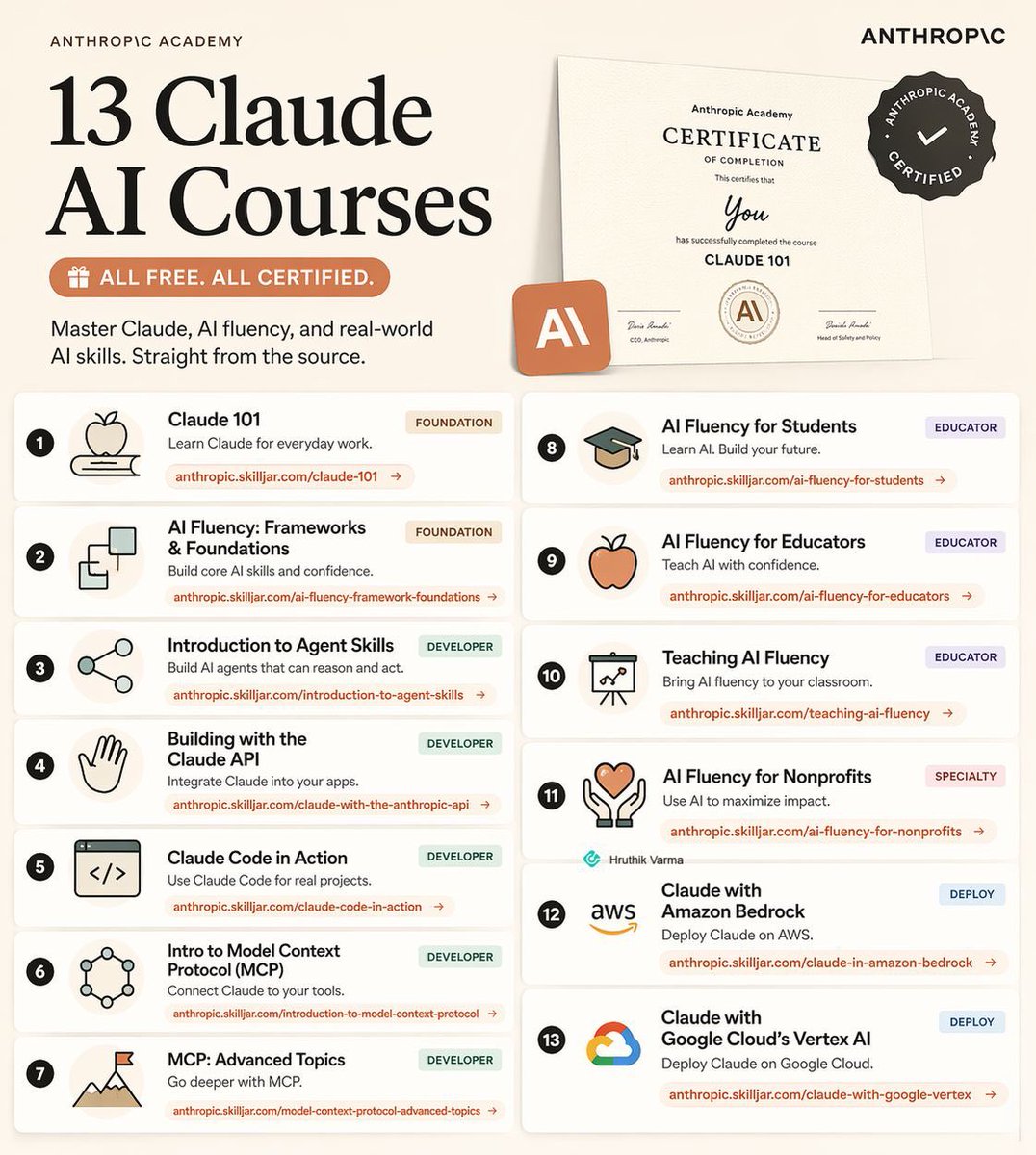
Claude just dropped 13 free AI courses (with certificates).
No $500 course needed.
No “guru” required.
Just real skills, straight from Anthropic.
Here’s the full list:
1. Claude 101
https://t.co/9bQ7NlWwmL
2. AI Fluency: Frameworks & Foundations
https://t.co/2H6Wr4eOWN
3. Introduction to Agent Skills
https://t.co/qozyrdLwyV
4. Building with the Claude API
https://t.co/60bwB2FFQ0
5. Claude Code in Action
https://t.co/88VdISzLIi
6. Introduction to Model Context Protocol
https://t.co/EQrdwEQZdQ
7. MCP: Advanced Topics
https://t.co/3pDv4Bpdgk
8. AI Fluency for Students
https://t.co/nLWu1PbxVa
9. AI Fluency for Educators
https://t.co/kRz3G2gMOp
10. Teaching AI Fluency
https://t.co/8MLctE9O4L
11. AI Fluency for Nonprofits
https://t.co/qGuWQiV5lI
12. Claude with Amazon Bedrock
https://t.co/HCPSbQ72nv
13. Claude with Google Vertex AI
https://t.co/0NKyFoZ1a6
If you go through even half of these, you’ll be ahead of 95% of people using AI.
Most people won’t.
Because they’re still watching random YouTube videos, buying overpriced courses, or “learning AI” without actually building.
Don’t be that person.
Do this instead:
1. Bookmark this post (you’ll come back)
2. Pick 1 course and start today
3. Share it with someone who needs this
👇Comment "Course" for more resources.
Free. Practical. No excuses.
Instead of watching an hour of Netflix, watch this 30-minute speech by the Head of Anthropic’s Coding Agents research team. It will teach you more about vibe coding than 100 paid courses.
This 30-min workshop by the creator of Claude Code will teach you more about vibe-coding than 100 YouTube video guides.
Bookmark it & give it 30 minutes today. This video will change the way you use Claude forever.
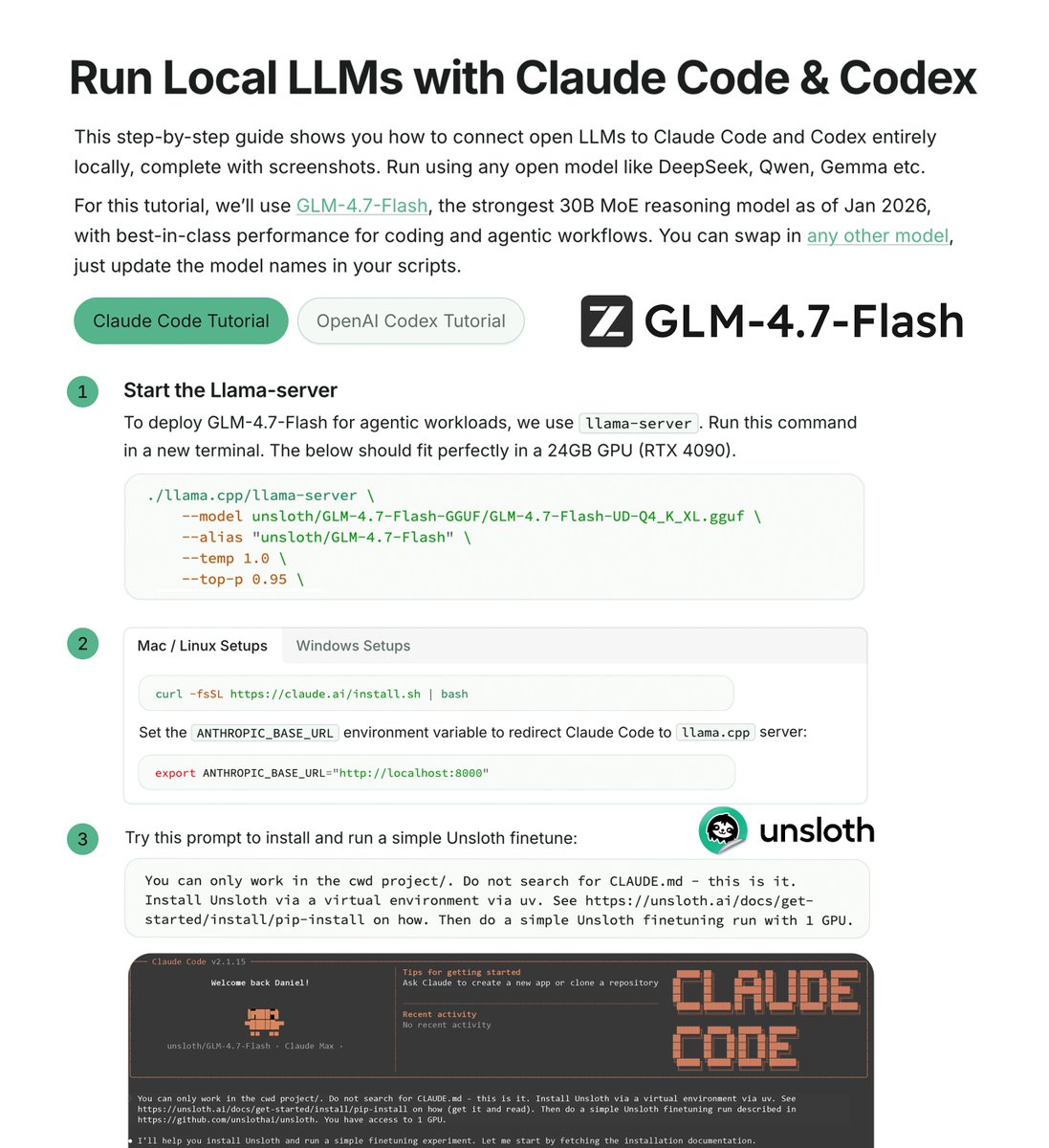
We successfully trained an LLM without human intervention using Claude Code.
We made a guide on how to do this with local LLMs via Claude Code and OpenAI Codex.
Connect GLM-4.7-Flash to your server and start agentic coding locally!
Guide: https://t.co/NXNX35i50r
I feel this way most weeks tbh. Sometimes I start approaching a problem manually, and have to remind myself “claude can probably do this”. Recently we were debugging a memory leak in Claude Code, and I started approaching it the old fashioned way: connecting a profiler, using the app, pausing the profiler, manually looking through heap allocations. My coworker was looking at the same issue, and just asked Claude to make a heap dump, then read the dump to look for retained objects that probably shouldn’t be there; Claude 1-shotted it and put up a PR. The same thing happens most weeks.
In a way, newer coworkers and even new grads that don’t make all sorts of assumptions about what the model can and can’t do — legacy memories formed when using old models — are able to use the model most effectively. It takes significant mental work to re-adjust to what the model can do every month or two, as models continue to become better and better at coding and engineering.
The last month was my first month as an engineer that I didn’t open an IDE at all. Opus 4.5 wrote around 200 PRs, every single line. Software engineering is radically changing, and the hardest part even for early adopters and practitioners like us is to continue to re-adjust our expectations. And this is *still* just the beginning.
I've never felt this much behind as a programmer. The profession is being dramatically refactored as the bits contributed by the programmer are increasingly sparse and between. I have a sense that I could be 10X more powerful if I just properly string together what has become available over the last ~year and a failure to claim the boost feels decidedly like skill issue. There's a new programmable layer of abstraction to master (in addition to the usual layers below) involving agents, subagents, their prompts, contexts, memory, modes, permissions, tools, plugins, skills, hooks, MCP, LSP, slash commands, workflows, IDE integrations, and a need to build an all-encompassing mental model for strengths and pitfalls of fundamentally stochastic, fallible, unintelligible and changing entities suddenly intermingled with what used to be good old fashioned engineering. Clearly some powerful alien tool was handed around except it comes with no manual and everyone has to figure out how to hold it and operate it, while the resulting magnitude 9 earthquake is rocking the profession. Roll up your sleeves to not fall behind.