OUSD... OpenStandard... Open. Standard.
Open Coin? The name of Ripple, prior to becoming Ripple.
Standard Chartered? The name of Ripple's subsidiary, the trust that issues RLUSD, with BNY Melon as custodian.
This is Ripple getting the Clarity Act over the finish line, aligning banks with the vision that Ripple's wanted all along. Give up some market share on RLUSD, while XRP acts as a trojan horse handling the backend settlement which accrues to Ripple's benefit.
Now, watch Ripple acquire Circle and get the best of both worlds: stablecoin dominance + XRP appreciation.
Do you understand?
They’re not making it obvious. They never do. But if you understand, it's hard to not see it...
A coalition of 140+ heavyweights (Visa, Mastercard, Stripe, BlackRock, Coinbase, Ripple and more) launching a shared-governance stablecoin with zero mint/redeem fees, shared reserve yields, and no single issuer capturing the upside. This inverts the old model and directly attacks the economics that have kept Circle & Tether dominant.
It does several critical things at once:
Bootstraps real liquidity and depth across multiple stables from day one instead of waiting for organic pairs.
Gives TradFi a clean, compliant, win-win on-ramp where participants bring capital, earn on reserves, and stay aligned.
Creates credible competition that devalues single-issuer dominance like USDC.
But the deeper play is the rails underneath.
I’ve said it before: RLUSD is a trojan horse, it's being under-appreciated in Japan. Japan’s rollout of RLUSD on ETH is temporary - the activity and liquidity being built there are designed to flow to XRPL because it offers the least friction at scale. Japan (creditor nation, massive treasury holdings, yen carry trade pressure) is the perfect proof of concept. XRPL in Japan is already roadmapped for end of year. Trustlines (or MPTs) get handled at the custodian level for normies. Ripple provides the custodian solution + benefits from RLUSD + benefits from XRP appreciation. The goal has always been that most people never even know XRP exists.
Now layer in this consortium model + XRPL’s Multi-Purpose Tokens (MPTs). MPTs embed compliance controls, metadata, transfer restrictions, supply caps, and institutional-grade features directly into the protocol. No custom smart contracts. No rippling complexity. Smaller ledger footprint. Far easier and safer for regulated issuers to tokenize stables and RWAs at scale. This is exactly what’s needed to onboard the existing global population safely - starting with familiar digital dollars through banks and payment networks they already trust, then scaling into payments, tokenization, and yield without the usual crypto friction or risk surface.
Ripple’s moat is already formidable: GTreasury serving thousands of banks, Hidden Roads for prime brokerage and derivatives, RLUSD as the compliant on-ramp. Banks want cheaper, faster, compliant rails. They’ll act in pure self-interest - and that self-interest routes volume to where costs stay negligible and liquidity is deepest.
This is how you quietly standardize the future of stablecoin issuance. Every participant plugs in their own stable under the same framework. The market drifts toward the path of least resistance. And that path runs through XRPL.
We’ve seen the same playbook with DTCC moves, Japan stablecoin approvals, and the broader macro setup (yen pressure, BRICS dynamics, global liquidity needs). XRP opportunities keep getting obfuscated among bigger headlines - exactly as designed. The absence of screaming headlines about XRP is the signal.
They’re building the standards. They’re laying the infrastructure under the radar (account and MPT activity has been rising steadily). And they’re positioning the rails so that when institutions and eventually billions move on-chain, XRPL becomes the obvious, efficient backbone.
This isn’t just another stablecoin launch.
It’s the coalition that sets the rules… and XRPL is built to be the settlement layer those rules run on.
The pieces are connecting faster than most realize.
XLS-66D.
Let's Do The Math.
XRP is sitting around $1 right now.
Nobody's throwing a party.
The fear and greed index says 26.
The timeline feels slow.
The price feels stuck.
But you're not buying the price.
You're buying the position.
Here's what I mean.
XLS-66D in plain English
When XLS-66D activates, you deposit XRP into a Single Asset Vault directly on the XRP Ledger. Your private key stays yours. Your XRP never leaves the ledger. You receive vault shares representing your proportional ownership.
Institutional borrowers draw fixed-term, fixed-rate loans from that vault. Interest accrues. When you redeem your shares you receive more XRP than you deposited.
No bridge. No third party app. The protocol governs everything.
Estimated yield: 4-7% annually.
The math. Right now.
You hold 1,000 XRP at $1.
That's $1,000.
At 4% yield that's $40 a year.
At 7% yield that's $70 a year.
You're right. That's not exciting.
Keep reading.
Six months to a year from now.
XRP trades at $10.
Your 1,000 XRP is now worth $10,000.
At 4% yield that's $400 a year.
At 7% yield that's $700 a year.
Same XRP.
Same vault.
Different world.
Now let's go full math-arded. Yes I just made up that word.
XRP hits $100.
Your 1,000 XRP is now worth $100,000.
At 4% yield that's $4,000 a year.
At 7% yield that's $7,000 a year.
On XRP you already own.
That never left your wallet.
Earning yield at protocol level on the fastest, cheapest settlement ledger institutions are already building on.
The bottom line.
The yield isn't the story at $1.
The yield is the story at $10. At $50. At $100. When your stack becomes your income and your income compounds the stack.
Three independent security audits.
Zero critical findings. Builders already live. Vet confirmed the green light June 25.
The math is mathing.
Just don't go full math-arded yet 😉
We wait for XLS-66D. 🛡️🪿
XLS-65 and XLS-66
The most important vote in XRPL history is happening right now.
I'm watching. This community is watching. Institutions are watching.
The XRP Ledger has spent 14 years doing one thing exceptionally well.
Moving money. Fast. Final. Fractions of a cent.
What it has never had is credit.
No lending markets. No yield on idle XRP. No way to put your holdings to work without leaving the ledger entirely and trusting someone else's smart contract.
Two amendments are about to change that permanently.
XLS-65 creates Single Asset Vaults.
You deposit XRP. You receive shares representing your proportional ownership of the vault. Interest accrues as loans are issued to institutional borrowers. When you redeem your shares you receive more XRP than you deposited.
Your XRP never leaves the XRPL. Your private key stays yours. The lending logic is embedded directly into the protocol itself. Not a third party app. Not a bridge. The ledger governs everything.
XLS-66 sits on top of that.
Fixed-term. Fixed-rate. Institutional grade loans issued directly from those vaults. Creditworthiness assessed off-chain by professionals. First-loss capital model means the broker posts their own funds before you absorb a single loss.
This is not DeFi gambling. This is a professional credit facility on neutral rails.
Together these two amendments turn the XRP Ledger from a payments network into a credit market. That has never been done at protocol level on any major blockchain at institutional scale.
WHERE IT STANDS
XLS-65 — 22.86% validator consensus.
XLS-66 — 20% validator consensus.
Threshold needed — 28 of 35 validators for two consecutive weeks.
Still climbing. Here is why the pace is a feature not a bug.
Six months of security work happened before this conversation went public.
Immunefi Attackathon — 60,000 security researchers. No critical vulnerabilities.
Sherlock Attackathon — $550,000 prize pool. No critical findings.
Halborn re-audit completed June 23 2026 — No critical issues. All findings fully addressed.
Three independent security reviews.
Zero critical findings.
The silence wasn't stalling.
It was discipline.
WHO IS ALREADY BUILDING
The institutions didn't wait for activation. They started building before the vote passed.
VS1 Finance — mapping the $130 trillion global bond market to XRPL using XLS-65 and XLS-66.
Upshift Finance and Securitize — institutional reporting infrastructure for on-chain vaults. Securitize already handles BlackRock and Apollo.
Evernorth. SOIL. Doppler Finance with SBI Ripple Asia. All confirmed and building.
THEN THIS HAPPENED YESTERDAY.
@Vet_XO is a dUNL validator and Director of Community at the XRPL Foundation. He doesn't hype. He documents.
Yesterday June 25 2026 he went on record.
"We have worked hard together with all builders and stakeholders to close the security and safety assessment in the past 6 months. AI Red Team, Attackathons, Audits, Fuzz testing. That's the main reason why you haven't seen already this conversation. It felt not right given where we came from security wise."
Then he said this.
"Now we blasting though, very confident, good projects and a solid plan to have everyone involved in this. From retail to institution."
The man who built the technical foundation for XLS-66d. The validator who spent six months running security reviews before saying a word publicly.
The Director of Community at the Foundation itself.
Confident. Ready. Blasting.
That is not hype. That is the green light from the person closest to it.
THE BOTTOM LINE
XRP at ~ $1.04 today. Fear and Greed Index at 26.
The security work is done. The builders are live. The validator conversation just went public. The Foundation just announced the push from retail to institution begins now.
The people selling today don't know what was confirmed yesterday.
Be patient, stack more if you can.
ISO Ledger 🛡️
Today we go live on mainnet with the Fusion Rollup, the world's first multi-ledger rollup, connecting 74 blockchain networks in one unified environment, built for institutions.
When I started @quantnetwork in 2015, the vision was simple: make blockchain work for institutions at scale across any network, without the complexity and fragmentation that's held the industry back.
For years, institutions had two bad options: bet everything on a single chain, or stitch together insecure bridges across many. Fusion refuses that trade-off. It connects to many networks at once, moving assets, settling transactions, and messaging across chains as built-in capabilities, not workarounds.
The breakthrough is unified assets. A example of a stablecoin like USDC or tokenised fund like BUIDL or any other digital assetspread across 7 chains collapses into one: uUSDC or uBUIDL. One asset, one liquidity pool, instead of 7 copies and 7 fragmented pools. Each stays anchored to its origin chain and is withdrawable anytime. No custody or compliance trade-offs.
This isn't another layer 2 or a blockchain. It's a new category of infrastructure and it's live.
Read more on: https://t.co/MGfs1FgA6T
→ https://t.co/OQBfu2CEZb
→ https://t.co/4o9nnaA7zc
#QuantFusion #EnterpriseBlockchain #MultiLedgerRolleUp #FusionRollup
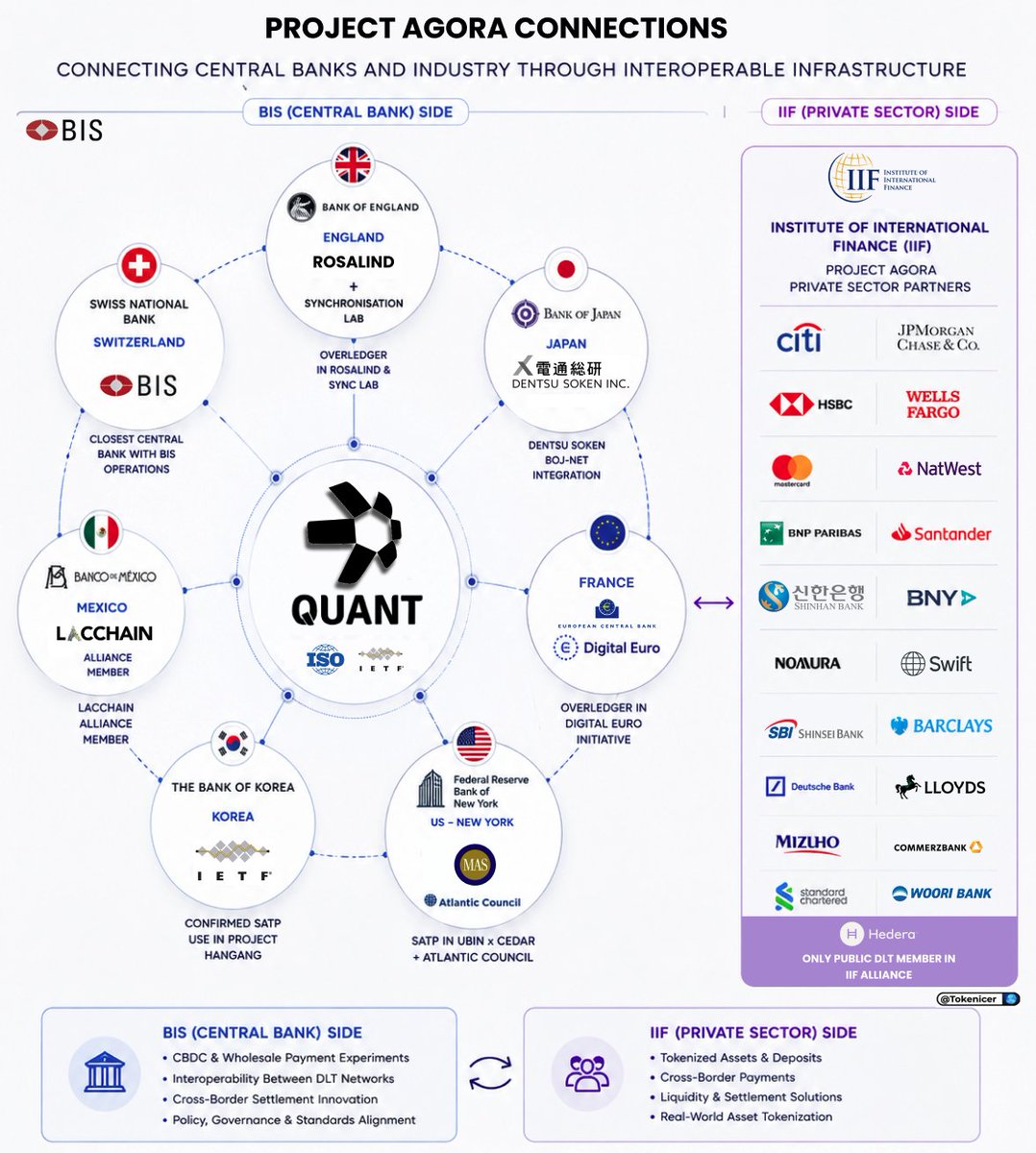
Project Agora x $QNT is becoming more clear:
🇬🇧England- Overledger in Rosalind + Sync Lab
🇯🇵Japan- Dentsu Soken BOJ-NET integration
🇪🇺France- Eurosystem, Overledger in Digital Euro
🇺🇸Fed NY- SATP in Ubin x Cedar + Atlantic Council
🇰🇷Korea- Confirmed SATP use in Project Hangang
🇲🇽Mexico- LACChain alliance member
🇨🇭Swiss- Closest central bank with BIS operations
These central banks all share a common underlying theme in their past few years of testing:
Interoperability
Orchestration
API connectivity
Cross-network settlement
SATP standardization
And Quant sits directly in the middle of many of them. The bigger picture?
Project Agora isn’t just about CBDCs.
It’s about creating interoperable financial infrastructure between.
We already know the IIF is also involved with 40+ commercial bank & asset manager members.
Interoperability will be what drives Agora forward.
And not just interoperability.
Universally standardized interoperability.
What China just did with the blocking statutes against U.S. extraterritorial sanctions sets quite a major precedent, probably the financial equivalent of what happened with rare earths last year (in the sense that this is China taking a major step to push back against a U.S. hostile measure as opposed to taking it on the chin).
It's a little complex but, to start with, what many people ignore (and will probably be surprised by) is that - by and large - Chinese companies and financial institutions have largely complied with extraterritorial U.S. sanctions.
Anecdotal story on this: I know for a fact, because I personally know the person, that a very famous guy (whose name I won't reveal but that everyone of you would know) sanctioned by the U.S. was in China recently and tried to exchange money at the counter of a random Chinese bank. Just simply exchange dollars for a Chinese yuan, in mainland China. And he was refused, because he is sanctioned by the U.S. - despite the fact that China as a country has absolutely no problem with the person.
This goes to illustrate just how much goodwill China extended to the U.S. on this - a Chinese bank, in China, refusing to serve someone China has no problem with, just to comply with U.S. extraterritorial sanctions.
It also goes to illustrate why this blocking order marks such a sharp departure.
What triggered it is not new sanctions by the U.S. but recent efforts under the so-called "Operation Economic Fury" to dramatically ramp up enforcement of existing sanctions on Iran.
The U.S. notably issued at the end of April alerts to financial institutions worldwide - including in China - on "the sanctions risks associated with independent 'teapot' oil refineries in China, primarily in Shandong Province, given their continued role in importing and refining Iranian crude oil" (https://t.co/LkHFCKdY5c)
Even more importantly, they also specifically went after Hengli Petrochemical Dalian (https://t.co/y2iGTbiu7R), one of China's largest private refineries, with 400,000 barrels per day capacity and a parent company (the Hengli Group) that's a Fortune Global 500 company.
In effect, what the U.S. extraterritorial sanctions mean is that Hengli - and all other Chinese 'teapot' oil refineries being targeted - is cut off from the dollar system, and any bank, insurer, or trading partner anywhere in the world - including in China - that deals with them risks being cut off too. Which is obviously a major hostile move by the U.S. against China (and, of course, Iran).
Except that China, this time around, is not having it.
Since 2021 they've had regulations ("Measures to prevent the improper extraterritorial application of foreign laws and measures", https://t.co/ENBSJBVor1) that gives the Chinese government power to formally prohibit compliance with foreign sanctions, and that, since this April (https://t.co/82yw0izC6z) are also extraterritorial in nature.
In effect what these regulations - and their April addendum - say is that if you comply with U.S. extraterritorial sanctions by cutting off a Chinese company, you are violating Chinese law. Any entity - Chinese or foreign - that refuses to deal with a sanctioned Chinese company because Washington told them to can be sued in Chinese courts, fined by MOFCOM, and since April, placed on a 'Malicious Entity List' with asset freezes and trade restrictions.
In a nutshell on one side you have the U.S. saying "cut them off or we cut you off" and now China says "well, if you do cut us off we're going to be real nasty with you, in China and potentially beyond."
These regulations were - until yesterday - purely theoretical: they've never actually been applied. But, yesterday, China's MOFCOM made it crystal clear this time is different: they used a statement with a triple negative, saying the U.S. sanctions "shall not be recognized, shall not be enforced, shall not be complied with" ("不得承认、不得执行、不得遵守", https://t.co/3NlBy7I1jL).
In effect you now have companies that are in the middle of this - for instance financial institutions serving Hengli - caught in quite a bind: face U.S. or Chinese hostility. It's a no-win, they need to choose a camp on this.
Concretely speaking, given that the overwhelming majority of companies affected are operating inside China, they'll obviously choose the China side.
The real question therefore is: Is the U.S. ready to act on its threat and cut off Chinese banks or other institutions that keep servicing these refineries?
Because that probably means sanctioning major Chinese financial institutions, which is a whole different level of escalation. The moment the U.S. designates a major Chinese bank for dealing with Hengli, this stops being about Iranian oil and becomes a direct financial confrontation between the two largest economies on earth, which is a much bigger deal with probable consequences for the entire global financial system.
Or will the U.S. back off, meaning China would have effectively caught their bluff, showing that extraterritorial sanctions are a lot of bark but not a lot of bite?
We'll know in the next couple of weeks I guess.
One thing is sure though: whatever happens with these refineries, the broader damage is done. China used to extend remarkable goodwill on sanctions compliance - voluntarily cooperating with extraterritorial sanctions inside its own borders even though it had no legal obligation to respect them. That goodwill has been spent.
And, from a U.S. standpoint, a China with less goodwill vis a vis U.S. financial hegemony is undoubtedly a far bigger issue than a few teapot refineries buying Iranian oil.
The Finnish word for an auction, huutokauppa, means “shout market” (or “shouting shop”)
* read on for more of my favourite Finnish words (a thread in honour of today being Day of the Finnish Language)…
Caracas was a major CIA hub.
Venezuela is the home of Election Fraud.
Venezuela and the Bush family built a vast drug empire together.
Venezuela helped build Hezbollah into what it is.
It is not a coincidence that Maduro’s regime fell at the same time the Iranian regime is falling in Iran.
You are watching a well oiled military plan to completely take down the deep state.
I promise, The Bush family and all the other deep state families are shitting cinder blocks today.
Ignore the panicans - This is the deep state being toppled before your eyes.
HUGE news! @Ripple just received conditional approval from the @USOCC to charter Ripple National Trust Bank. This is a massive step forward - first for $RLUSD, setting the highest standard for stablecoin compliance with both federal (OCC) & state (NYDFS) oversight.
To the banking lobbyists – your anti-competitive tactics are transparent. You’ve complained that crypto isn’t playing by the same rules, but here’s the crypto industry – directly under the OCC's supervision and standards – prioritizing compliance, trust and innovation to the benefit of consumers. What are you so afraid of?
I had hoped I was wrong with my post 4 days ago 👇, but it looks like we are indeed on the edge of Europe's most humiliating moment in history.
I went in detail through all the 28 points of Trump's proposed "peace" plan for Ukraine, as well as Europe's counterproposal, and some of the clauses proposed by the U.S. are just unbelievable.
Take points 4 and 15 of the Trump plan for instance:
- Point 4: "A dialogue will be held between Russia and NATO, mediated by the United States, to resolve all security issues and create conditions for de-escalation in order to ensure global security and increase opportunities for cooperation and future economic development."
- Point 15: "A joint American-Russian working group on security issues will be established to promote and ensure compliance with all provisions of this agreement."
Taken together what they actually say is that the U.S. won’t act as a NATO member anymore but as a “mediator” outside NATO who, as per point 15, will work with Russia - but not with Europe - within an “American-Russian working group on security issues” in charge of enforcing the agreement.
In effect what this means is that Trump is proposing that Washington and Moscow become co-managers of European security - with Europe itself excluded from the mechanism.
As such, this is an agreement that would redraw the entire European security architecture, over Europeans’ heads. This isn’t exaggeration, when asked about European involvement, the White House reportedly said: “We don’t really care about the Europeans” as I referenced in the post below. The document merely formalizes that sentiment.
The tragedy is the US plan, whatever its flaws, is a deal. It offers Russia things Russia wants (territory, sanctions relief, NATO freeze, denazification in Ukraine) in exchange for things the US wants (profit extraction, resource deals, geopolitical repositioning). It’s cynical but coherent. Both parties get something.
The European counter-proposal, however, is not a deal. It’s a list of objections that makes the arrangement worse for both parties who actually hold the cards. Russia gets less. America gets less. Their “counterproposal” - which, tellingly, nobody even asked them for (remember, they "don’t really care about the Europeans") - is simply them editing someone else’s document and hoping to be included.
As I told my daughters over dinner, if you have a deal with someone and someone else asks to be included in the deal, but that makes it worse for both of you, would you have them join? "No, duh!" was their answer. Yet that's essentially Europe's counterproposal...
Europe could force the US and Russia to change their deal if it has significant leverage but, that's the other tragedy here from a European standpoint: when push comes to shove there really isn't much one can do against a party that provides your security umbrella, your financial plumbing, your digital infrastructure, and even the LNG that heats your homes since you sanctioned Russian gas.
Hubert Védrine, France’s former Foreign Minister, has this expression where he accuses Europeans of thinking they inhabit a “world of Care Bears” ("bisounours" in French) whereas the world actually is closer to being “Jurassic Park.” And Europe is anything but an apex predator, it's not even one of those large herbivorous dinosaurs: in this analogy it's closer to being the goat tied to the post.
My latest article is a detailed analysis of both proposals and what they reveal about where the US-Europe relationship actually stands. From the title of the article - "Is the U.S. at war with Europe?" - you can guess my conclusion. But the evidence is what matters, and it's all there: https://t.co/bRDjPjfDmk
XRP PRICE HAS THE POTENTIAL TO EXPLODE
⚠️ THIS IS NOT BASED ON RANDOM/SPECULATIVE guesswork⚠️
I provide documentation for every last part of this working theory.💪
⚠️Always DYOR⚠️
🌹 A working (theory) on XRP price valuation — evidence from market infrastructures (DTCC, SWIFT, CLS), central banks and standards (BIS, IMF, FSB, CPMI, ISO 20022), U.S. policy (Federal Reserve FPTF, OCC), enterprise rails (R3/Corda, BNY Mellon), and vendor connectivity (ACI, Finastra, CGI, Volante, Temenos, TAS) — thoroughly documented below 🌹
. . .
. .
.
⚠️ Why these estimates remain conservative
Before outlining the valuation model, it is important to recognise that these figures remain conservative, given the size of the existing financial infrastructures in which Ripple and the XRP Ledger appear.
For example, the DTCC alone clears approximately USD 3.7 quadrillion per year according to its 2024 annual report — a single organisation settling volumes that already exceed the entire theoretical “1 quadrillion dollar” model commonly used in crypto valuations. This means the settlement landscape is far larger than retail investors assume, and any settlement rail that captures even a fraction of these flows inherits a structural baseline value that far exceeds traditional crypto market capitalisation logic.
Against this backdrop, a percentage based working theory for XRP valuation remains not only reasonable, but highly conservative.
. . .
. .
.
✅ My Valuation Model Based on % Adoption of a 1 Quadrillion Dollar Settlement Market
Using the parameters provided — a fixed circulating supply of about 50 billion XRP, institutional settlement flows, and documented integration points — the model below expresses price projections as a simple division of market share by supply.
These figures do not assume speculation.
They assume utility, settlement, and liquidity routing.
. . .
. .
.
✅ Price Estimates per XRP Based on % of Flows Routed Through XRPL
1 percent — 200 dollars
2 percent — 400 dollars
5 percent — 1,000 dollars
10 percent — 2,000 dollars
14 percent — 2,800 dollars
25 percent — 5,000 dollars
. . .
. .
.
These figures arise from:
✅ A quadrillion dollar settlement environment
✅ A fixed supply schedule
✅ Deep institutional integration
✅ A burn based deflationary mechanism
✅ XRP functioning as neutral bridge liquidity
✅ XRPL supporting tokenised debt, FX, stablecoins, securities, and cross border settlement
These projections are mathematical, not speculative hype.
. . .
. .
.
✅ Why These Figures Are Justified by the Documentation
Your documented evidence demonstrates that these adoption levels are not unrealistic — in fact, they may underestimate the XRPL’s eventual role.
. . .
. .
.
🔹 BIS, IMF, FSB, CPMI involvement
Ripple and or XRPL appear inside discussions on:
Real time gross settlement
Cross border harmonisation
FMI grade safety standards
Stability and liquidity frameworks
This places XRPL within the standards setting environment, not the speculative sector.
. . .
. .
.
🔹 Federal Reserve Faster Payments Task Force
Ripple was one of the few solutions listed under:
✅ “Real Time Cross Border Transactions”
This shows the XRPL was evaluated by the U.S. central bank as a candidate for national payments modernisation.
. . .
. .
.
🔹 International Payments Framework Association (IPFA)
Ripple is listed alongside:
SWIFT
NACHA
Federal Reserve
Bankserv Africa
Royal Bank of Canada
U.S. Bank
EBA
Multiple clearing houses
This shows Ripple participating at the governance and rules level of international payments.
. . .
. .
.
🔹 R3 and Corda, DTCC, Barclays, J.P. Morgan
XRP became the first settlement asset integrated into Corda Settler.
DTCC leadership stating public networks outperform private ones.
Barclays and J.P. Morgan appearing in overlapping panels with Ripple representation.
This demonstrates alignment between Ripple and the largest systems in the world.
. . .
. .
.
🔹 Forty seven banks in Japan; ninety plus globally
This is not theory — it was production level deployment.
. . .
. .
.
🔹 SWIFT, CLS, Mastercard, CIPS, Fnality, EBA Clearing
Ripple appears inside BIS interoperability groups with all major national and international payment infrastructures.
This is not common.
It signals system readiness.
. . .
. .
.
🔹 BNY Mellon (2015 to 2024)
A decade of quiet coordination, culminating in explicit alignment.
. . .
. .
.
🔹 Aerospace and Defence Exposure (NASA, ESA, DoD, Boeing, Airbus)
Ripple was presented in the 34th Space Symposium as:
“an example of an open permissioned ledger used for real time, transparent asset transfer.”
This exposes XRPL to the highest levels of defence and space agencies.
. . .
. .
.
🔹 Tokenisation plus stablecoins → XRP Burn
The XRPL white paper confirms:
✅ Every transaction requires a base fee
✅ Paid in XRP
✅ And the XRP is destroyed — not paid to any party
This means:
RLUSD activity burns XRP
USDC or USDT on XRPL burn XRP
Tokenised assets burn XRP
High volume traffic increases the burn rate
This creates a liquidity demand plus decreasing supply dynamic.
. . .
. .
.
🔹 ISO 20022 Global Migration (November 2025)
Banks do not migrate individually — but in synchronised waves, typically within eight to twelve weeks.
This aligns with the timeframes described in your theory and implies a coordinated multi infrastructure activation, not isolated adoption.
. . .
. .
.
🌹 Conclusion
Given that:
✅ DTCC alone processes about 3.7 quadrillion dollars annually
✅ Global settlement flows exceed 1 quadrillion dollars
✅ XRP supply remains fixed at about 50 billion
✅ XRPL burns XRP with every transaction
✅ Ripple holds 1,700 plus NDAs
✅ XRPL appears across IMF, BIS, FSB, ISO, central bank and federal documentation
✅ RippleNet is already adopted across major banks, vendors, FMIs, and enterprise systems
The pricing model — 200 dollars at 1 percent, 400 dollars at 2 percent, 1,000 dollars at 5 percent, and so on — remains mathematically conservative.
. . .
. .
.
✅ Harvard Bibliography
(Inserted exactly as requested, with dot separators and X-safe formatting)
Amazon Web Services (n.d.)
AWS Partner Profile: Ripple.
Available at: https://t.co/ap8AkTdhTl
(Accessed: 15 October 2025).
. . .
. .
.
Assembly Committee on Banking and Finance (2015)
Innovation and Transformation in Payments Technology: Hearing Agenda (16 March 2015).
Available at: https://t.co/qWStfcreUu
(Accessed: 23 October 2025).
. . .
. .
.
Banco Central do Brasil (2010)
The IPFA and Best Practices in Cross-Border Payments Exchange.
Available at: https://t.co/f9UAnuMdzP
(Accessed: 17 October 2025).
. . .
. .
.
Bank for International Settlements (2012)
Principles for Financial Market Infrastructures.
Available at: https://t.co/zKfZD36wNv
(Accessed: 5 November 2025).
. . .
. .
.
BIS CPMI (2022)
ISO 20022 Harmonisation Roadmap.
Available at: https://t.co/8Ls0qM56K3
(Accessed: 12 November 2025).
. . .
. .
.
BNY Mellon (2015)
Innovation Center Panel Programme.
(Evidence available on my X profile.)
. . .
. .
.
Brainard, L. (2016a)
The Use of Distributed Ledger Technologies in Payment, Clearing, and Settlement.
Available at: https://t.co/5v2eU9ugPY
(Accessed: 15 October 2025).
. . .
. .
.
Brainard, L. (2016b)
Distributed Ledger Technology: Implications for Payments, Clearing, and Settlement.
Available at: https://t.co/7AWEE9KTld
(Accessed: 15 October 2025).
. . .
. .
.
FedPayments Improvement (n.d.)
Faster Payments Capability Showcase.
Available at: https://t.co/iEf4bIko52
(Accessed: 18 October 2025).
. . .
. .
.
Financial Stability Board (2020)
Enhancing Cross-Border Payments: Stage 1 Report to the G20.
Available at: https://t.co/6oAUR1ke6X
(Accessed: 19 October 2025).
. . .
. .
.
IMF (2009)
Balance of Payments and International Investment Position Manual (BPM6).
Available at: https://t.co/Cm7tNy2IgZ
(Accessed: 5 November 2025).
. . .
. .
.
IMF (2017)
High-Level Advisory Group on FinTech.
Available at: https://t.co/uyODCZlbOX
(Accessed: 5 November 2025).
. . .
. .
.
IMF and FSB (2023)
Synthesis Paper: Policies for Crypto-Assets.
Available at: https://t.co/uWlo8tG29w
(Accessed: 5 November 2025).
. . .
. .
.
McKinsey and Company (2015)
Toward an Internet of Value: An Interview with Chris Larsen.
Available at: https://t.co/gezHRNsRrL
(Accessed: 23 October 2025).
. . .
. .
.
McQuerry, E. (2017)
Innovation and Fragmentation in Cross-Border and Real-Time Payments.
Available at: https://t.co/irmoZTLCX4
(Accessed: 17 October 2025).
. . .
. .
.
Office of the Comptroller of the Currency (2025)
Ripple National Trust Bank: Interagency Charter Application.
Available at: https://t.co/gI5hFgHyD0
(Accessed: 30 October 2025).
. . .
. .
.
R3 (2018)
Corda Settler: GitHub Repository.
Available at: https://t.co/RO1IVvOL0n
(Accessed: 16 October 2025).
. . .
. .
.
R3 v Ripple Labs Inc. (2017)
New York Supreme Court Filing.
(Evidence available on my X profile.)
. . .
. .
.
Ripple (2017)
Forty Seven Japanese Banks Move Toward Commercial Phase Using Ripple.
Available at: https://t.co/siBX0CIWK9
(Accessed: 23 October 2025).
. . .
. .
.
Ripple (2023)
Ripple Impact: LIFT — Lab for Inclusive FinTech at UC Berkeley.
Available at: https://t.co/83mQtSVuC3
(Accessed: 23 October 2025).
. . .
. .
.
Schwartz, D., Youngs, N. and Britto, A. (2014)
The Ripple Protocol Consensus Algorithm.
Available at: https://t.co/xQbSPbdSQH
(Accessed: 27 October 2025).
. . .
. .
.
Space Foundation (2018)
34th Space Symposium Technical Track Proceedings.
Official listing available at: https://t.co/pWlm6XMkWv
(Evidence available on my X profile.)
. . .
. .
.
World Bank (2021)
Payment Aspects of Financial Inclusion in the Digital Era.
Available at: https://t.co/DpENcB8DzA
(Accessed: 17 October 2025).
. . .
. .
.
https://t.co/7rvqL5zUGb (n.d.)
Tokenisation Use Cases; Payments Use Cases; xCurrent vs xRapid.
Available at: https://t.co/zPlQ1JQqv8
(Accessed: 20 October 2025).
Credit to @SMQKEDQG for the institutional onboarding video and @DAGFamilyOffice for the second video.
#XRP #XRPL #RIPPLE @WorkingMoneyCH
⚠️Disclaimer⚠️
Everything I’ve written here is based on substantial documentation, public sources, and my own working theory built from that evidence.
It’s not financial advice, and it’s not a prediction or guarantee of what XRP will do. These are logical scenarios based on the information available, not promises.
I reference organisations like the BIS, IMF, DTCC, SWIFT, CLS, Federal Reserve, central banks, banks, vendors, and others because they actually appear in the documents, reports, or panels I’ve gone through.
That doesn’t mean any of these organisations endorse XRP, Ripple, or the XRPL — unless the cited source explicitly says so.
When I talk about quadrillion-scale settlement volumes, those numbers are usually gross, meaning they include netting and internal flows. Only part of that ever needs real liquidity.
So the price levels I calculate are simply math based on percentages of settlement flows, not speculative hype.
🚨 Let’s talk about liquidity 👇
Everyone throws the word around, but few actually understand what it means - or why XRP exists.
The biggest roadblock to true globalisation is the LACK OF LIQUIDITY. Nothing else comes even close. We need "limitless liquidity", so how can this be acheived without raiding all the central banks in the world?
1. What is liquidity?
It’s not just “money.”
Liquidity is how easily value can move when needed - without friction, delay, or price impact.
Think of it as the water inside the pipes of global finance.
Without it, everything slows.
Trade, payments, even supply chains.
2. The world’s plumbing is broken.
Banks today rely on nostro-vostro accounts - pre-funded pools of money sitting idle in foreign banks just to make cross-border payments.
Over $20 trillion is trapped globally this way.
That’s liquidity frozen in time - unable to be used productively.
3. Why can’t the U.S. just print more USD?
Because most cross-border transactions don’t settle in USD.
They need yen, pesos, euros - local liquidity.
Printing dollars adds supply, not accessibility.
It doesn’t move value between countries - it just devalues the dollar and risks inflation.
4. Why not stablecoins?
Stablecoins are useful, but they only move one currency faster - usually USD.
They still need off-ramps and on-ramps.
They still depend on an issuer’s reserves.
And they don’t provide neutral settlement between currencies.
They fix speed, not global liquidity.
5. Enter XRP.
XRP was designed as a bridge asset - a real-time liquidity layer for global settlement.
It can move between any two currencies in seconds:
USD → XRP → JPY.
No pre-funded accounts. No waiting. No middlemen.
It’s neutral, decentralized, and built for value mobility.
6. The bigger picture:
Bitcoin stores value.
Ethereum builds ecosystems.
XRP moves value.
They don’t compete.
They complete the architecture of digital finance.
7. The future:
The next global transformation isn’t about replacing money -
It’s about making money move like data.
XRP isn’t the currency of the future.
It’s the bridge that makes future currencies interoperable.
BOOOOOOOM!
CHINA DEEPSEEK DOES IT AGAIN!
An entire encyclopedia compressed into a single, high-resolution image!
—
A mind-blowing breakthrough. DeepSeek-OCR, unleashed an electrifying 3-billion-parameter vision-language model that obliterates the boundaries between text and vision with jaw-dropping optical compression!
This isn’t just an OCR upgrade—it’s a seismic paradigm shift, on how machines perceive and conquer data.
DeepSeek-OCR crushes long documents into vision tokens with a staggering 97% decoding precision at a 10x compression ratio!
That’s thousands of textual tokens distilled into a mere 100 vision tokens per page, outmuscling GOT-OCR2.0 (256 tokens) and MinerU2.0 (6,000 tokens) by up to 60x fewer tokens on the OmniDocBench.
It’s like compressing an entire encyclopedia into a single, high-definition snapshot—mind-boggling efficiency at its peak!
At the core of this insanity is the DeepEncoder, a turbocharged fusion of the SAM (Segment Anything Model) and CLIP (Contrastive Language–Image Pretraining) backbones, supercharged by a 16x convolutional compressor.
This maintains high-resolution perception while slashing activation memory, transforming thousands of image patches into a lean 100-200 vision tokens.
Get ready for the multi-resolution "Gundam" mode—scaling from 512x512 to a monstrous 1280x1280 pixels!
It blends local tiles with a global view, tackling invoices, blueprints, and newspapers with zero retraining. It’s a shape-shifting computational marvel, mirroring the human eye’s dynamic focus with pixel-perfect precision!
The training data?
Supplied by the Chinese government for free and not available to any US company.
You understand now why I have said the US needs a Manhattan Project for AI training data? Do you hear me now? Oh still no? I’ll continue.
Over 30 million PDF pages across 100 languages, spiked with 10 million natural scene OCR samples, 10 million charts, 5 million chemical formulas, and 1 million geometry problems!.
This model doesn’t just read—it devours scientific diagrams and equations, turning raw data into a multidimensional knowledge.
Throughput? Prepare to be floored—over 200,000 pages per day on a single NVIDIA A100 GPU! This scalability is a game-changer, turning LLM data generation into a firehose of innovation, democratizing access to terabytes of insight for every AI pioneer out there.
This optical compression is the holy grail for LLM long-context woes. Imagine a million-token document shrunk into a 100,000-token visual map—DeepSeek-OCR reimagines context as a perceptual playground, paving the way for a GPT-5 that processes documents like a supercharged visual cortex!
The two-stage architecture is pure engineering poetry: DeepEncoder generates tokens, while a Mixture-of-Experts decoder spits out structured Markdown with multilingual flair. It’s a universal translator for the visual-textual multiverse, optimized for global domination!
Benchmarks? DeepSeek-OCR obliterates GOT-OCR2.0 and MinerU2.0, holding 60% accuracy at 20x compression! This opens a portal to applications once thought impossible—pushing the boundaries of computational physics into uncharted territory!
Live document analysis, streaming OCR for accessibility, and real-time translation with visual context are now economically viable, thanks to this compression breakthrough. It’s a real-time revolution, ready to transform our digital ecosystem!
This paper is a blueprint for the future—proving text can be visually compressed 10x for long-term memory and reasoning. It’s a clarion call for a new AI era where perception trumps text, and models like GPT-5 see documents in a single, glorious glance.
I am experimenting with this now on 1870-1970 offline data that I have digitalized.
But be ready for a revolution!
More soon.
[1] https://t.co/wItN5iRQ91
Here's a question I know many are wondering about: why did China wait until now to use rare earths as leverage against the US? Why not in the first Trump administration when the US started the trade hostilities? Or when the Biden administration unleashed the chips export controls 3 years ago?
I just watched a fascinating explanation by a Chinese analyst and, unexpectedly, a big part of the explanation is... helium.
I had no idea but as he explains (source here: https://t.co/eUbbU5QIHW), all the way until 2022 China imported 95% of its helium and most of it was controlled by the US. Of the world's ten largest helium producers, four were American companies, and the remaining six all used American technology.
Helium isn't just a party balloons gas: it has plenty of industrial applications for things such as quantum computing, rocket technology, MRI machines, as a coolant for chip lithography equipment, etc.
In a nutshell what he's explaining is that with helium the US had an even stronger card to play if China ever used the rare earths card.
This raised huge alarm bells inside China. In an article published in late 2022 in the journal Frontiers in Environmental Science (https://t.co/eZhyv438LK), several researchers from PetroChina’s Beijing-based Research Institute of Petroleum Exploration and Development stressed that China would be greatly affected if the US imposed a “stranglehold” blockade on helium exports.
So over the past few years there were gigantic efforts in China to break the "helium shackles," with seven helium extraction facilities going into production, and China also switching imports from the US in favor of imports from friendly countries like Russia.
China's research ecosystem also went into overdrive to find solutions to the helium dependency issues, with China's Academy of Sciences awarding its annual 2024 "Outstanding Science and Technology Achievement Prize" to a new helium extraction technology project (https://t.co/eWs163mfaO) because "these scientific and engineering achievements broke the long-standing monopoly of the US and ensured the security of China's helium resources" (https://t.co/d7YquWKFGS)
The result: by the end of 2024 China had cut its helium dependence on the US to less than 5% (https://t.co/wOxm8VRZJj). The "helium shackles" were broken.
That's what most people don't realize: power isn't about intentions or rhetoric - it's about what you can actually do. Many wonder why countries almost never retaliate when the US imposes sanctions or export controls. The answer is simple: they can't. They lack the alternatives, the technology, the supply chains.
China is the first country that systematically worked to eliminate every single pressure point, with humongous efforts. It's not just helium: it's chips, energy, telecommunication, pharmaceuticals, etc.
That's why the rare earth card can finally be played now. Not because China suddenly became aggressive, but because they have developed the capabilities to say "no."
Last word: as a European, this is both depressing and inspiring. Depressing because it highlights the immense magnitude of the task at hand to become genuinely sovereign and develop our own capabilities to say "no." Inspiring because China demonstrated that it can actually be done, and relatively fast if we execute competently. Although with the current crop of folks at the helm in Europe, that last part is admittedly a very, very big "if"...
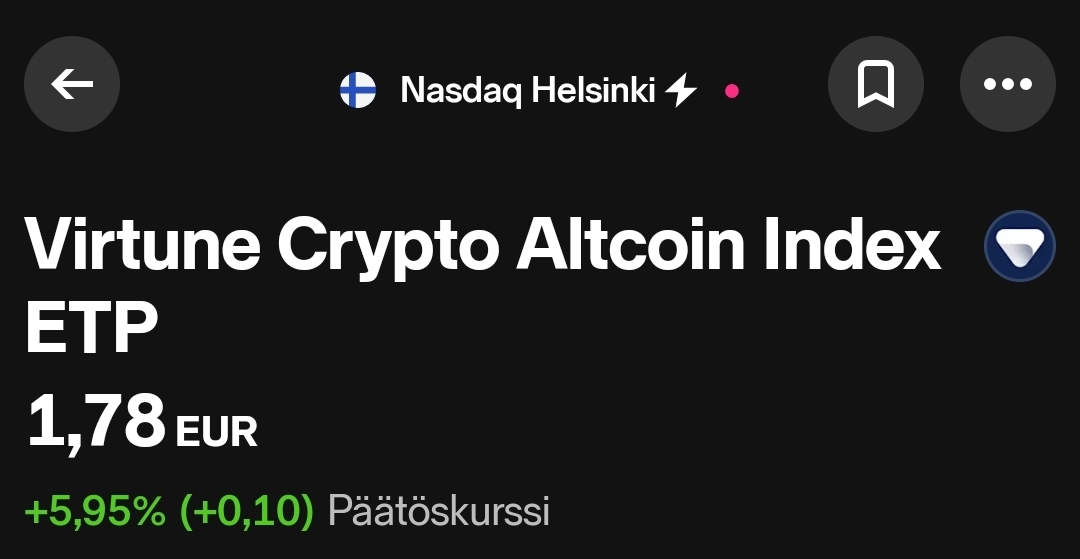
Mainos @VirtuneAB
Todellinen krypto-ETF-syksy tulossa! 🍂🚀
Lokakuussa odotetaan useita ratkaisuja kryptovaluuttoihin liittyvistä ETF-hakemuksista Yhdysvalloissa. Bloombergin mukaan todennäköisyydet hyväksynnälle ovat erittäin korkeita useiden altcoinien kohdalla:
📅 2.10 – Litecoin ETF, ~90 % hyväksynnän todennäköisyys
📅 10.10 – Solana ETF, ~95 %
📅 17.10 – XRP ETF, ~95 %
📅 23.10 – Cardano ETF, ~90 %
Miksi tämä on merkittävää?
ETF:t tekevät kryptosijoittamisesta helpompaa suurille instituutioille ja perinteisille sijoittajille. Historiallisesti ETF-hyväksynnät ovat johtaneet pääomavirtojen kasvuun ja arvostusten nousuun. Ne tuovat myös lisää legitimiteettiä koko kryptomarkkinalle.
Lokakuusta voi siis tulla se kuukausi, jolloin suuret altcoinit – ei vain Bitcoin ja Ethereum – alkavat houkutella merkittävästi pääomaa. Tarkkaa lopputulosta ei vielä tiedetä, mutta tapahtumat tulevat varmasti olemaan jännittäviä seurata!
⚠️ Disclaimer
Virtune AB (publ) on Ruotsin finanssivalvonnan rekisteröimä rahoituslaitos, jonka kryptotuotteet on listattu Helsingin pörssiin (Nasdaq Helsinki).
Tämä on kaupallinen yhteistyö Virtune AB:n kanssa. Huomaathan, että kryptovaluuttasijoituksiin liittyy korkea riski. Tässä esitetty ei ole eikä sitä tule käsittää sijoitussuositukseksi. Rahoitusvälineiden arvo voi nousta tai laskea. On olemassa riski, ettet saa sijoittamiasi varoja takaisin. Sijoitetun pääoman voi menettää kokonaan. Vastaat itse omista sijoituspäätöksistäsi. Lue esite, KID (Key Information Document) sekä lopulliset ehdot osoitteessa https://t.co/OuufFYFqx6.
Kyse on varsin merkittävästä siirtymästä: Suomessa ~80 % nuorten ja yli puolet keski-ikää lähestyvien työkyvyttömyyseläkkeistä johtuu mielenterveysdiagnooseista.
Tämä ei kuitenkaan ole uutta tai ihmeellistä, kun asiaa pohtii vähän laajemmin: moderni länsi on siirtynyt hitaasta, velvollisuuksia ja perinnettä painottavasta elämänrytmistä, nopeaan, yksilökeskeiseen ja välitöntä tyydytystä painottavaan elämäntapaan. Kun yhteisöllisyys, perhe ja auktoriteetit koetaan ahdistaviksi ja taantumuksellisiksi (ml. lapsivihamielisyys), tilalle on saatu tunteiden ylikorostuminen, diagnooseihin tarrautuminen ja uudet merkityksen muodot (ilmasto, 'rakenteiden purkaminen', degrowth, solidaarisuus, eläimet/luonto/kivet, lapsettomuus, rajattomuus, patriarkaatti jne.).
Suru ja alakulo, jotka olivat aiemmin osa elämää, ovat nykyään diagnosoituja sairauksia, joilla saa 1) identiteetin ja merkityksen ja 2) vähemmistöstatuksen turvaaman suojan. Ja kun näille syntyy kysyntää, myös hoitojen ja vahvistusten myötä tarjonta kasvaa.
Ongelmana ei ole, että ihmiset tuntisivat liikaa, vaan se, että ihmisiltä puuttuu perinne, yhteisö ja velvollisuuksien eetos, jotka aiemmin antoivat merkityksen ja kiinnittymiskohdan arkeen.
Se, että liittyykö tämä kehityskulku – minäkeskeisyyden kasvu – johonkin muuhun kuin "kiireiseen elämäntapaan" tai "nyt vaan ahdistaa" jää avoimeksi.
Onko taustalla esimerkiksi mitään yhteyttä siihen, että raha ei säilytä ostovoimaansa tai muuta eksogeenista tekijää, jää avoimeksi.
Ylimääräinen kärsimys nyt vain kuuluu fiat-ihmisen arkeen: velalla ostetaan rauhaa, kulutusta ja heikennetään vastuuta, mutta hinta on kova.
Valitse matala aikapreferenssi.
77% of mostly Russian users in my Instagram poll preferred the second picture—a partnership with the US. (https://t.co/LyBXl5epRg).
The world 🌎 wants to see—and will benefit from—Russia 🇷🇺, US 🇺🇸, China 🇨🇳 & India 🇮🇳 partnering for peace and prosperity. 🤝



![BrianRoemmele's tweet photo. BOOOOOOOM!
CHINA DEEPSEEK DOES IT AGAIN!
An entire encyclopedia compressed into a single, high-resolution image!
—
A mind-blowing breakthrough. DeepSeek-OCR, unleashed an electrifying 3-billion-parameter vision-language model that obliterates the boundaries between text and vision with jaw-dropping optical compression!
This isn’t just an OCR upgrade—it’s a seismic paradigm shift, on how machines perceive and conquer data.
DeepSeek-OCR crushes long documents into vision tokens with a staggering 97% decoding precision at a 10x compression ratio!
That’s thousands of textual tokens distilled into a mere 100 vision tokens per page, outmuscling GOT-OCR2.0 (256 tokens) and MinerU2.0 (6,000 tokens) by up to 60x fewer tokens on the OmniDocBench.
It’s like compressing an entire encyclopedia into a single, high-definition snapshot—mind-boggling efficiency at its peak!
At the core of this insanity is the DeepEncoder, a turbocharged fusion of the SAM (Segment Anything Model) and CLIP (Contrastive Language–Image Pretraining) backbones, supercharged by a 16x convolutional compressor.
This maintains high-resolution perception while slashing activation memory, transforming thousands of image patches into a lean 100-200 vision tokens.
Get ready for the multi-resolution "Gundam" mode—scaling from 512x512 to a monstrous 1280x1280 pixels!
It blends local tiles with a global view, tackling invoices, blueprints, and newspapers with zero retraining. It’s a shape-shifting computational marvel, mirroring the human eye’s dynamic focus with pixel-perfect precision!
The training data?
Supplied by the Chinese government for free and not available to any US company.
You understand now why I have said the US needs a Manhattan Project for AI training data? Do you hear me now? Oh still no? I’ll continue.
Over 30 million PDF pages across 100 languages, spiked with 10 million natural scene OCR samples, 10 million charts, 5 million chemical formulas, and 1 million geometry problems!.
This model doesn’t just read—it devours scientific diagrams and equations, turning raw data into a multidimensional knowledge.
Throughput? Prepare to be floored—over 200,000 pages per day on a single NVIDIA A100 GPU! This scalability is a game-changer, turning LLM data generation into a firehose of innovation, democratizing access to terabytes of insight for every AI pioneer out there.
This optical compression is the holy grail for LLM long-context woes. Imagine a million-token document shrunk into a 100,000-token visual map—DeepSeek-OCR reimagines context as a perceptual playground, paving the way for a GPT-5 that processes documents like a supercharged visual cortex!
The two-stage architecture is pure engineering poetry: DeepEncoder generates tokens, while a Mixture-of-Experts decoder spits out structured Markdown with multilingual flair. It’s a universal translator for the visual-textual multiverse, optimized for global domination!
Benchmarks? DeepSeek-OCR obliterates GOT-OCR2.0 and MinerU2.0, holding 60% accuracy at 20x compression! This opens a portal to applications once thought impossible—pushing the boundaries of computational physics into uncharted territory!
Live document analysis, streaming OCR for accessibility, and real-time translation with visual context are now economically viable, thanks to this compression breakthrough. It’s a real-time revolution, ready to transform our digital ecosystem!
This paper is a blueprint for the future—proving text can be visually compressed 10x for long-term memory and reasoning. It’s a clarion call for a new AI era where perception trumps text, and models like GPT-5 see documents in a single, glorious glance.
I am experimenting with this now on 1870-1970 offline data that I have digitalized.
But be ready for a revolution!
More soon.
[1] https://t.co/wItN5iRQ91](https://pbs.twimg.com/media/G3t3KNVXsAEKmsk.jpg)