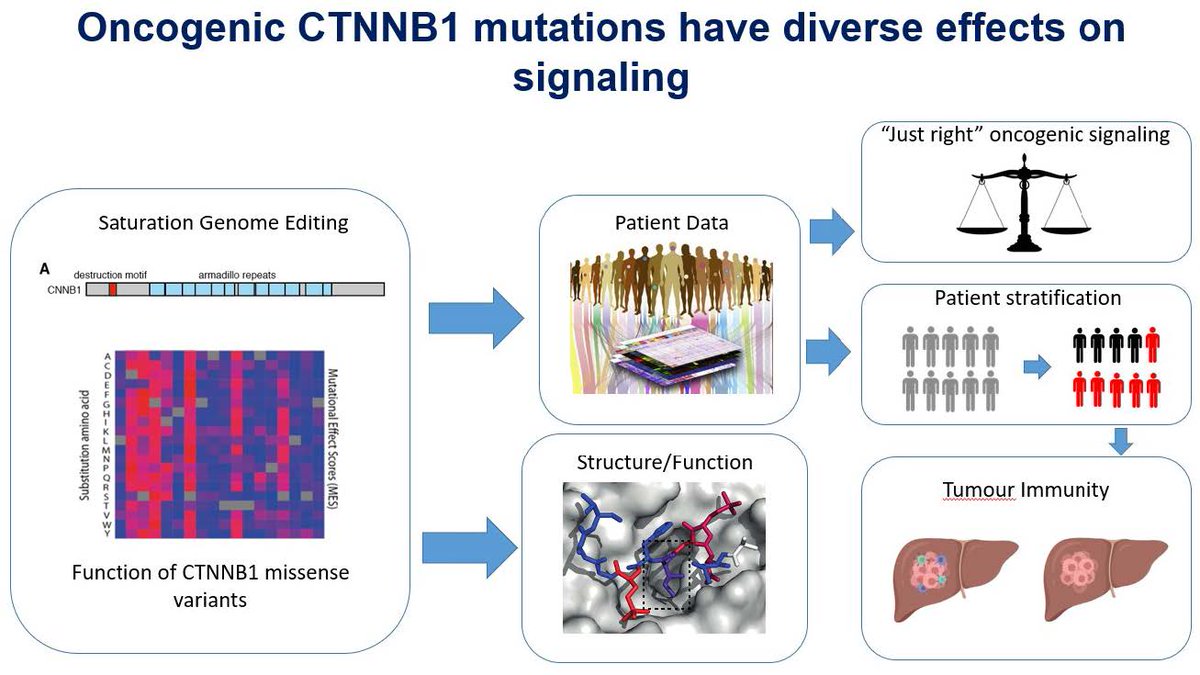
Today in @NatureGenet, we report a saturation genome editing study that systematically dissects the degron of β-Catenin: one of the most frequently mutated regions of the cancer genome. Collab with @kiddevonline and @DeryaDOzdemir, among many others
https://t.co/ZWiRwpwgpH
Out now. A collaboration with Sofia Lövestam, Masato Hasegawa and Sjors Scheres. We report that tau filaments extracted from the brains of individuals with Alzheimer’s disease and corticobasal degeneration breed true in the brains of wild-type mice. https://t.co/hAgJiZhBFY
Incredibly excited to report today on the determinants of toxicity to systemic therapy in cancer patients. Led by many including Alex Guo, Feiyang Huang, Saksham Mohan, River Walser, and the fearless @ZiadBakouny. Co-led by Wes Tansey and Jian Carrot-Zhang https://t.co/axflh9pMRS
Our latest, out today in Cell Chemical Biology:
“Oncogene activation mechanism determines the limits of targeted protein degradation”
https://t.co/qO0huDTPgW
We're hiring a Postdoctoral Research Associate at @MRC_MBU Cambridge
Join our @ARIA_research Precision Mitochondria project with Bitrobius Genetics to develop novel technologies for mitochondrial DNA delivery and genome engineering
🔗 https://t.co/ISoi2qEhBR
Please share! 🙏
This reveals a synthesis‑dependent ceiling on degradation, with implications for:
• interpreting preclinical degrader data
• resistance mechanisms
• genotype‑guided therapy design
🔬 New lab preprint: How does the mode of oncogene activation shape PROTAC efficacy?
Led by Evelina Gudauskaite, we ask whether stabilising mutations vs transcriptional upregulation have distinct consequences for targeted protein degradation.
https://t.co/vH8Dcud4yg.
Using a controlled cellular system (dTAG + TetOn3G), we found:
✅ Stabilising mutations don’t limit PROTAC action—degradation resets protein levels to the same baseline.
❌ Increased transcription raises target protein levels both pre‑ and post‑treatment.
Beautiful new UK Wnt paper out now in @NatureGenet by Peter Hohenstein @AndrewWoodLab and Derya Ozdemir @UniLeidenNews@EdinburghUni@kocuniversity characterising the molecular/functional impact of numerous CTNNB1 mutational variants in human cancer.
https://t.co/SH4wwOmOJv
Major new direction in the @stark_lab: hacking human cell biology with pathogen effectors (eORFs) - amazing collaboration with @mike_tilapia lab. Huge congrats to first authors Tomas & He & all co-authors! Check out the pre-print on @biorxivpreprint https://t.co/deg699JIWi
1/ Happy to share important work done with my co-author Andrew Khalil in the labs of Rudolf Jaenisch @WhiteheadInst@MITBiology@MIT and Dave Mooney @Harvard@wyssinstitute trying to assess and fix the major problem of transgene silencing in human ESC/iPSC based work
The big one is finally out!! In this paper, we set out to provide insight into the fundamental question;
How do the individual cells from complex tissues regulate their proteomes?
Brief summary of our findings 👇
https://t.co/4dRXpGJTGn
Nice write up on the @MRCMouseNetwork website, highlighting the awesome work of first author Gillian Taylor, is available here: https://t.co/NWKh4XWDZV
Our manuscript characterising tissue-specific consequences of tagged protein fusions in CRISPR-engineered mice is now online @PLOSGenetics. https://t.co/walorzG7qO. Thanks again to all coauthors, reviewers and editors for a smooth publication process.
Happy to share our latest work and first manuscript from the Degron Tagging Cluster @MRCMouseNetwork. If you work with protein tags, particularly in tissue biology models, this should be of interest.
https://t.co/0FaWILmgUx