Excited to share our latest preprint with @JShendure, led by Aidan Keith. We wanted to know which, where and how TFs open chromatin when they are newly expressed in a given cell state, using CRISPRa and single cell multiome. 1/7 https://t.co/SOQSpkGjc4
AlphaGenome 2 is live! A step change in performance and new capabilities over AG1! @adamgayoso's thread covers the key results.
Manuscript: https://t.co/exVx6kxCxY
Blog: https://t.co/YkuyxDHs0D
API: https://t.co/I7zaZobbLx
A few notes under the hood & what's next:
🚀 NTv3, new release!
Excited to release updated Nucleotide Transformer models, with better genome function prediction across 15 species, gene annotation in mammals, plants and insects, and regulatory sequence design 🧬
Revised preprint and details 👇
Stellar lineup at the AITHYRA Next generation AI for Biomedical Science workshop -- next Monday 2 Nov at the IMBA lecture hall in Vienna Biocenter. No registration is required.
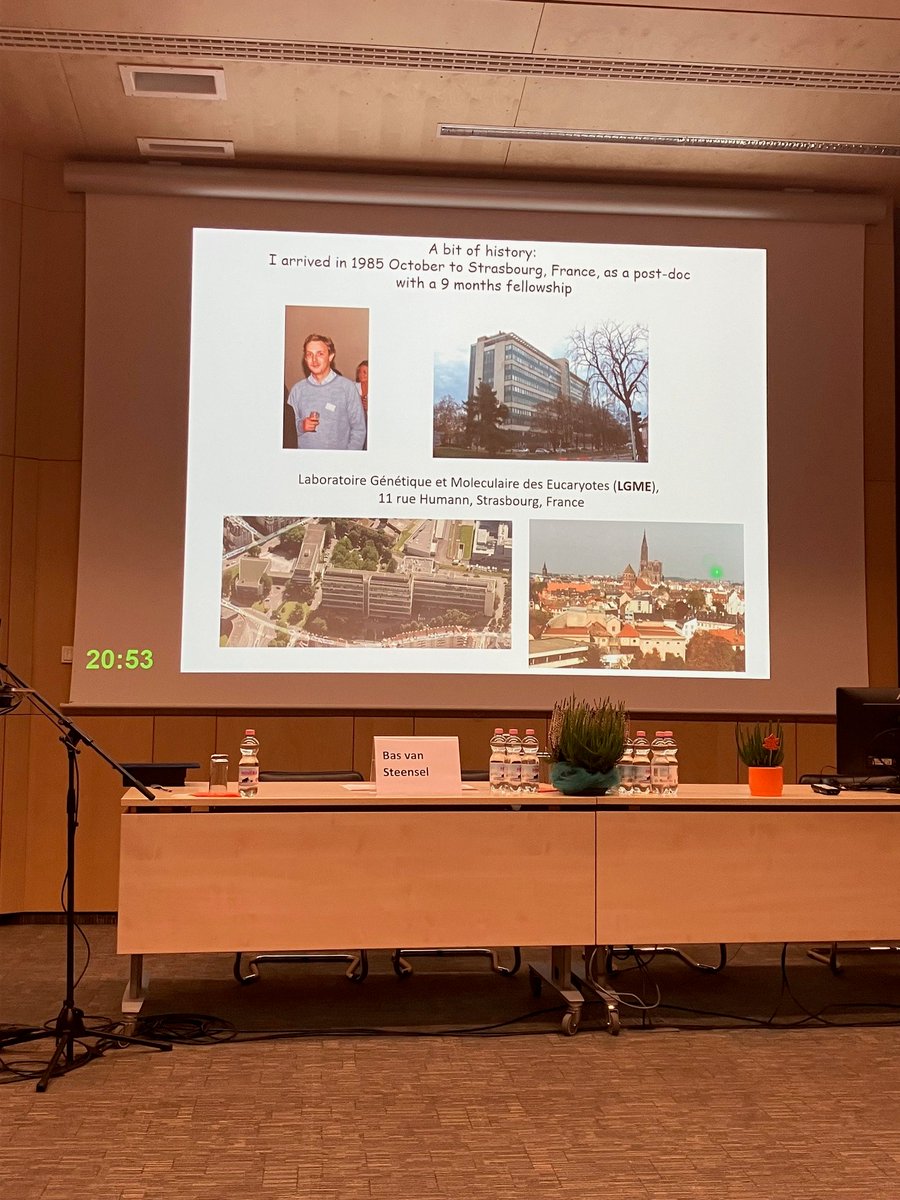
It was a special privilege to witness the Career Lecture of Prof Laszlo Tora at the 6thDanube Epigenetics Meeting and FEBS Advanced Lecture Course in Budapest this week.
For over 40 years, Laszlo has been one of the most accomplished and prolific Hungarian scientist abroad. His lab at the CNRS has led the world in the golden age the discovery and biochemical characterization of transcription coactivator complexes and general transcription factors. His lab discovered the TATA-box binding protein, and TFIID component TBP, the SAGA complex and other GCN5-containing complexes, multiple activation domains in the estrogen receptor, among others. In recent work they pioneered the model of co-translational folding and assembly of TFIID and other complexes, which solved the long-standing problem in the field of how insoluble, aggregation-prone proteins can assemble into soluble functional complexes.
A remarkable feature of his Career Lecture was that Laszlo paid much gratitude both forwards and backwards. Forward to the many accomplished trainees and young scientists who worked in his lab, and backward to the giants who trained him, including the late Pierre Chambon and István Financsek.
Congratulation on an inspiring career, Laszlo, and thank you for the many insights, both professional and human!
Shoutout the Ferenc Muller for the introduction!
@FEBSnews@LaszloTora@ferencmueller@bulutkarslioglu@MariekeOudelaar
Are weak TF motifs important? @ZeitlingerLab use deep learning to systematically map low-affinity pioneer binding sites in mESCs and show that they cooperate with strong motifs to open chromatin. Preview w/ @gracecbower: https://t.co/V3mmqmeJPG Paper: https://t.co/lEZnhrCZiI
This paper from the Stark lab introduces BARe-seq, extending MPRAs by preserving the distribution of transcriptional output across individual plasmids rather than aggregating, allowing them to decompose mean expression into burst size and burst frequency.
https://t.co/toW5Q5qrZf
Pierre Chambon was one of the driving architects of modern molecular biology, whose scientific vision transformed the understanding of gene regulation in eukaryotic cells. His passing in May 2026 represents the loss of an extraordinary scientist. https://t.co/1YmUWNOBpE
It is clear that people are using AI to review papers and grants. Often as a tool, not as an off the bottle answer for review (though some do). One of the signs of this is the detail of the negative comments and the errors, often minor and irrelevant to the conclusions.🧵
Excited to release AlphaGenome Atlas 🧬 We used AlphaGenome to predict the regulatory impact of all 9B possible SNVs in the human genome. We collaborated with amazing scientists to analyze and apply it, and developed a portal to browse the genome using this new lens 🔬
🌐 Portal: https://t.co/Hq3ZLGXB7M
📖 Blog: https://t.co/cF4TsZkhwj
📄 Preprint: https://t.co/aIhrGELqr8
🧵 1/6
Excited to see PISA officially out! This was a very fruitful collaboration between my lab and @anshulkundaje, bringing together deep learning models and the biology of gene regulation in a visual way. Grateful to everyone who contributed! 🙏
Excited to attend the EMBL Transcription and Chromatin meeting #EMBLtranscript@EMBLEvents
Come to see my poster #287 if you are interested in genetic screening and high-throughput functional protein tagging.
@TedChen1999CN@NatureGenet Amazing work! Congrats and thanks to all authors. You make a decade-old dream come true! Tissue-specific enhancer design in mammals. https://t.co/7YE6rsdRYd
🚀 Thrilled to share that our work is now published in @NatureGenet on the de novo design of tissue-specific mammalian enhancers that function in vivo in mouse embryos.
https://t.co/NlgSqpkKAv
The IMP lab of Alexander Stark used AI to design enhancers—DNA switches controlling gene activity—for specific mouse tissues: the first from-scratch design in a mammal.
News: https://t.co/Bdn6OiLLL7
Paper: https://t.co/Pc1dZo4ySb
@dominic_grun@ReynaERosales Congrats and thanks @dominic_grun and all authors for this wonderful collaboration. Single-allele-resolved functional genomics from bulk experiments + insights into the DNA-sequence-encoding of transcriptional burst kinetics by enhancers and promoters! https://t.co/hCpVYre2W2
New preprint from a wonderful collaboration with
@AlexanderStark8 led by Franzisake Lorbeer and
@ReynaERosales. We developed BARe-seq to ask what in the DNA controls transcriptional bursting - key findings for anyone working on transcription or cis-regulatory elements. See 🧵.
In our newest study from @HippenmeyerLab@ISTAustria we quantitatively assessed emergence and development of cortical projection neuron lineages in self-organizing organoid system side-by-side in vivo cerebral cortex development.
https://t.co/GaTZdSW4l4