🚨 TOMORROW: How Should the United States Counter the CRINK Axis? | Thursday, June 11 at 2:00 PM ET
The recent Xi-Kim summit has deepened ties between China and North Korea, with ripple effects across the CRINK countries (China, Russia, Iran, North Korea) and regional security.
@CSISGeopolitics host Will Todman is joined by @CSIS@VictorDCha, @MSnegovaya, @TheBushCenter Igor Khrestin, and @JosephKimNK to dig into CRINK's key vulnerabilities and the U.S. policy options for a special crossover between the State of Play and The Impossible State.
The conversation draws on the Bush Institute's recent report on CRINK and what growing alignment among these authoritarian actors means going forward.
🎧 Join us live: https://t.co/KEmMdbUefX
📢 IN 2 DAYS | The Strategic Value of China to Korea
Join us at @CSIS for an in‑person conference featuring leading scholars and former policymakers examining:
• China’s strategic value to South Korea
• Korea’s role in a potential Taiwan contingency
• China’s record on North Korea
📅 May 13, 2026
⏰ 9:00 AM–1:30 PM ET (lunch provided)
🔗 RSVP: https://t.co/UKgdPDL1A7
🎙️ Featured speakers include:
@VictorDCha · @sydseiler · @RushDoshi · @MarkCancian · @AndrewIYeo · @patricia_m_kim · @snydersas · @junghpak1 · @augama · @bostonsunny · @sungminchohi · @Henrietta_Ivy · Joseph Yun · Mark Lambert
🌍 “A World Where Trade Has Become a Weapon?”
@csis@victordcha recently joined Kim Jiyoon’s Knowledge Play to discuss his new book "China’s Weaponization of Trade" (@ColumbiaUP). Their conversation explores how economic tools are increasingly used as instruments of geopolitics in today’s global order.
📺 Watch here: https://t.co/glYnn8NDee
Can Sports Diplomacy Open a Door on the Korean Peninsula?
@CSIS@VictorDCha & @AndySauLim argue that sports diplomacy has always been an important tool of inter-Korean diplomacy, and the upcoming football match between North Korea’s Naegohyang Women’s Football Club and South Korea's Suwon FC Women in South Korea offers an opportunity for diplomatic breakthrough.
Thread ⬇️ (1/10)
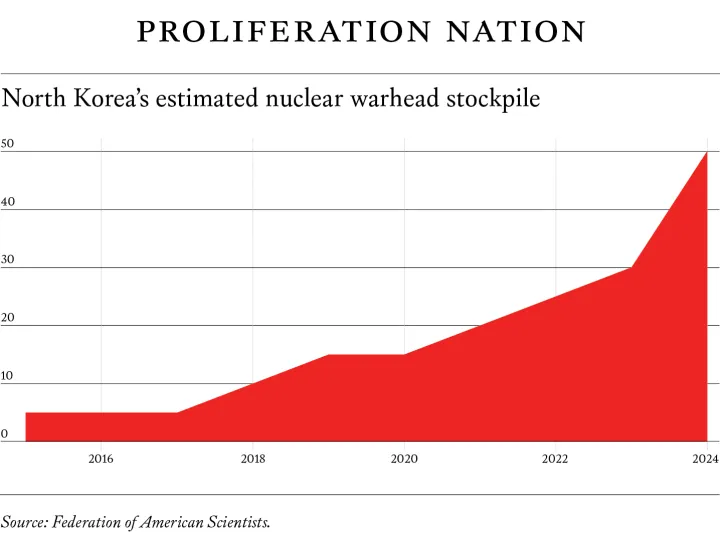
After three decades of the same denuclearization framework, North Korea's arsenal has only grown.
@CSIS's @VictorDCha argues it's time to stop pretending the old framework can work and instead build a "cold peace."
A mega thread...(1/12) ⬇️
https://t.co/MwBITAWuXx
NEW: After three decades of the same denuclearization framework, North Korea's arsenal has only grown. @CSIS@VictorDCha argues it's time to stop pretending the old framework can work and instead build a "cold peace."
Read here: https://t.co/MwBITAWuXx
Recent @CSIS satellite imagery from this month shows the completion of a building at Yongbyon that is widely believed to be a new uranium enrichment plant for producing weapons-grade material for nuclear weapons, according to the @iaeaorg.
Read here: https://t.co/PcO2TzoGbF
(12/12) The least bad choice
This new strategy is likely to prompt objections on the grounds that it de facto accepts North Korea’s status as a nuclear state.
Critics will charge that after decades of insisting on denuclearization up front, the United States would be making major concessions without meaningful reciprocation from Pyongyang.
What the United States faces in reality, however, is the need for an interim solution to protect U.S. homeland security and prevent nuclear escalation in the Indo-Pacific.
A cold peace is hardly an ideal solution, but it could bring much-needed stability to an increasingly dangerous relationship.
FIN.
We encourage you to read the full essay by @VictorDCha on @ForeignAffairs
https://t.co/sqxwhXxJ3D
(11/12) Priority 4: Weaken North Korea's ties with China and Russia
The United States needs to find some way to compel Beijing, Moscow, and Pyongyang to invest less in their relationships with each other.
Athough Washington may not be able to fully break these alliances apart, it can create some friction between them.
- It could offer positive inducements to North Korea or Russia, such as lifting sanctions, or amplify disinformation to generate distrust among the three countries.
- Or counterintuitively, the United States could try to trigger traditional North Korean fears of being entrapped by great powers by designating the Pyongyang-Moscow alliance as an enemy of NATO and European Union countries because of its contribution to Putin’s war in Ukraine.
(10/12) Priority 3: Reduce the risks of nuclear first use
- Russian President Vladimir Putin has declared that he would use nuclear weapons first in any conflict
- China is embarking on a massive nuclear buildup that is likely to exceed 1,000 warheads by 2030.
- North Korea has also adopted a more offensive posture.
Although North Korea doesn’t publicize its nuclear doctrine, a @CSIS study of nuclear-related statements from the state news agency from 1998 to 2023 found a shift from a focus on defense (such as nuclear weapons to maintain deterrence) to offense (using them for tactical strikes during a war).
What should the U.S. do?
- It must develop direct communication channels to avoid accidental escalation that could trigger a nightmare scenario.
- To lower the risk of escalation, the United States could reaffirm its pledge to not use nuclear weapons first, which it made at the six-party talks.
- Washington and its allies could also focus on what is known as deterrence by denial
By signaling strong allied retaliatory capabilities while downplaying offensive threats that could trigger a “use or lose” mindset in Pyongyang, the United States and its allies could deter North Korea without provoking it.
(9/12) Priority 2: Reduce the number of adversaries
The United States faces a dizzying array of challenges from China, Russia, and Iran (and its proxies, including Hamas, Hezbollah, and the Houthis).
U.S. defenses are stretched especially thin because of the war with Iran, and U.S. officials are moving some Patriot missiles, high-altitude antimissile systems, and drones stationed in South Korea to the Middle East to compensate.
Restarting talks with the goal of establishing a cold peace will more immediately serve U.S. interests.
Data collected by @CSIS shows that periods of U.S.–North Korean dialogue correlate with fewer missile launches, nuclear tests, and military provocations.
(8/12) Priority 1: Protecting the U.S. homeland
This is the most pressing priority.
Over the last 30 years, North Korea’s ability to target the United States has evolved from remote possibility to real danger.
The range of North Korean ICBMs extends to the continental United States.
North Korea already has enough launchers and missiles to overwhelm U.S. defenses.
As North Korea equips its ICBMs with decoy warheads to evade missile defenses or with multiple miniaturized nuclear warheads to overwhelm the system, the odds that the United States will be able to shield itself grow even worse.
This is why starting conversations with North Korea to set limits on further testing, deployment, or proliferation of ballistic missiles and production of nuclear materials is necessary now, even if denuclearization remains a long-term goal.
(7/12) What else can the United States do?
Instead of making denuclearization a prerequisite for any negotiation, the United States should open conversations with Pyongyang on arms control agreements, limits on nuclear testing and missile production, crisis management mechanisms, and bans on the transfer of nuclear weapons or technology to others.
It should also strengthen deterrence and defense with regional allies to gain their support for this new strategy.
(6/12) What can the United States do?
The United States should not renounce denuclearization, but policymakers must acknowledge that it is now a distant objective.
Instead, Washington needs to shift the logic of its strategy from disarming North Korea’s nukes to achieving immediate goals that will make the United States more secure against those weapons.
1) Protecting the U.S. homeland
2) Reducing the number of U.S. adversaries
3) Minimizing the chances that North Korea would launch nuclear weapons first
4) Weakening the ties between China, Russia and North Korea
(5/12) The U.S. cannot continue the same approach
Doing so will only make its failures more acute. Nor can it stand aside and do nothing because North Korea’s nuclear arsenal is increasingly able to target the U.S. homeland and a stronger North Korea can flex its military power to help U.S. adversaries, as it is doing by supporting Russia in Ukraine.
The challenge is now even more daunting than in the past: with plentiful trade in energy and food with China and Russia, and combat experience and weapons technology from the Ukraine war, North Korea is in a much stronger position than it was in 2019, the last time U.S. President Donald Trump and Kim met to negotiate.
(4/12) U.S. policy mantra for the past 7 admins
“With denuclearization, all things are possible. Without denuclearization, nothing is possible.”
Washington’s strategy has been to offer incremental incentives, such as food and energy aid, to North Korea, in exchange for similarly scaled nuclear concessions—for example, a temporary freeze on operating reactors and a declaration of its nuclear inventory.
And the United States has relied on economic sanctions to bring North Korea to the negotiating table and to pressure it to comply with nonproliferation agreements.
The size and sophistication of North Korea’s nuclear arsenal today shows that these approaches have failed.
The one-dimensional focus on nonproliferation has also hamstrung the United States in other areas of importance in which it could negotiate, such as reducing the size of North Korea’s conventional military or improving human rights.
(3/12) What Kim Jong Un wants
Develop a modern nuclear weapons arsenal the size of that of France or the United Kingdom, each of which has over 200 nuclear weapons, and he is well on his way.
In return for North Korea’s provision of thousands of combat troops, millions of rounds of ammunition, and hundreds of ballistic missiles in support of Russia’s war in Ukraine, Moscow is helping Pyongyang surmount the technology hurdles that prevent Kim from building the nuclear arsenal of his dreams.
(2/12) The scene setter
In the 1990s, North Korea barely had enough fissile material to build one or two crude bombs.
Three and a half decades later, North Korea has blown past even the most pessimistic predictions of its nuclear development.
- It has amassed 50 nuclear bombs and stockpiled enough plutonium and highly enriched uranium to build 40 to 50 more.
- It has developed nearly 20 different delivery systems, including long-range intercontinental ballistic missiles (ICBMs) that can reach targets in the United States.
- It is actively pursuing ballistic missiles that can be launched from nuclear submarines, whose range and ability to evade detection improve North Korea’s ability to strike back even if the United States attacks first.
- Pyongyang has tested its nuclear weapons six times and its various delivery systems more than 300 times.