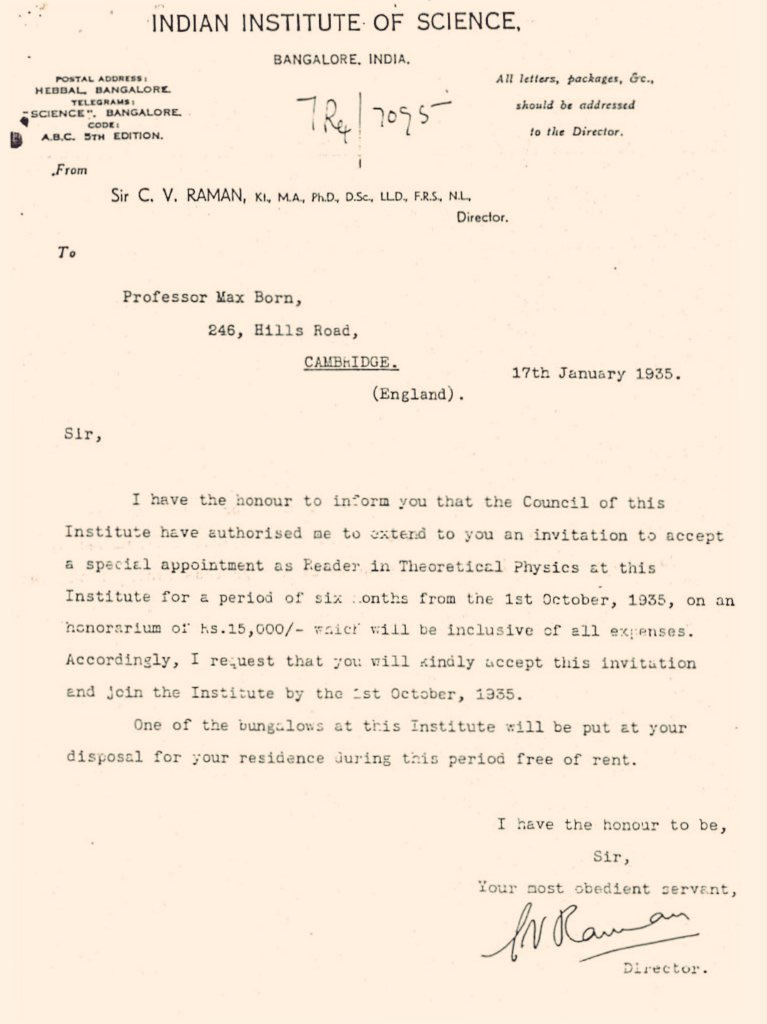
Letter by Sir Chandrasekhara Venkata Raman to Physicist Max Born Inviting Him to IISC Bangalore as Reader In Theoretical Physics at Honorarium of Rs 15000 /-
c. 17th Jan, 1935.
(Photo - IISC Archives)
Meet Ashoke Sen,
a Bengali-medium schoolboy from Kolkata who applied to only two American PhD programs because those two let him skip the application fee up front.
He took his BSc at Presidency College in 1975, then a master’s at IIT Kanpur. Stony Brook accepted him, then he joined.
On 22 October 2026 he gave the Oskar Klein Memorial Lecture at Stockholm University, “Gravity from strings and strings from gravity.” The Klein medal comes with that lecture, first Indian physicist to receive the Klein Medal. He also won the inaugural 2012 Fundamental Physics Prize, one of nine, and the 2014 Dirac Medal.
During his PhD, almost three years went by with nothing moving but his plan was ordinary. He read lots of books and review articles, went sightseeing with friends, then hoped it would work out. Something began to click near the end.
“90% of the time I am stuck!” ~ Ashoke Sen
Long stretches of nothing moving are normal in hard work.
The Office of the Principal Scientific Adviser to the Government of India congratulates Dr. Ashoke Sen, @ictstifr-Infosys Madhava Chair Professor, Bengaluru, on receiving the Oskar Klein Medal for 2026. He is the first Indian physicist to receive this prestigious honour.
Prof. Sen is globally recognised for his pioneering contributions to string theory, particularly his work on S-duality, the precision counting of black hole entropy and string field theory. His research has played a significant role in advancing modern string theory and deepening our understanding of fundamental physics.
Jointly awarded by @Stockholm_Uni and the Nobel Committee for Physics of the Royal Swedish Academy of Sciences, the Oskar Klein Medal recognises distinguished contributions to physics. This recognition adds to Prof. Sen’s distinguished achievements, which include the Breakthrough Prize in Fundamental Physics (2012), the Dirac Medal (2014), the Padma Shri (2001) and the Padma Bhushan (2013).
@onlycm97 Rajasthanis know what they’re proud of , we just don’t need to announce it every five minutes
Having pride in your language is fine but acting like it makes you superior to everyone else is embarrassing.A language is not a trophy to wave around while looking down on others