How does one learn about the physical properties of an unknown object? A physicist would conduct an experiment, and so does Astra. This is what Astra does when prompted “find center of mass position”. 1/3
Why are we still dragging 100-pound trash bins through freezing rain, snow and 6 AM dark like it's the 19th century?
Meet Curbie, an autonomous robot built by Revere Robotics that is finally killing off this miserable weekly chore. It automatically hauls your waste bin to the curb on collection day and brings it right back, completely unsupervised.
The genius is that it works with what you already have. Instead of forcing you to buy expensive proprietary gear, it couples directly onto the existing steel axle of your current municipal bin.
Packed with high-torque brushless motors and heavy-duty winter autonomy, it is specifically engineered to muscle heavy loads through deep snowdrifts and icy public sidewalks.
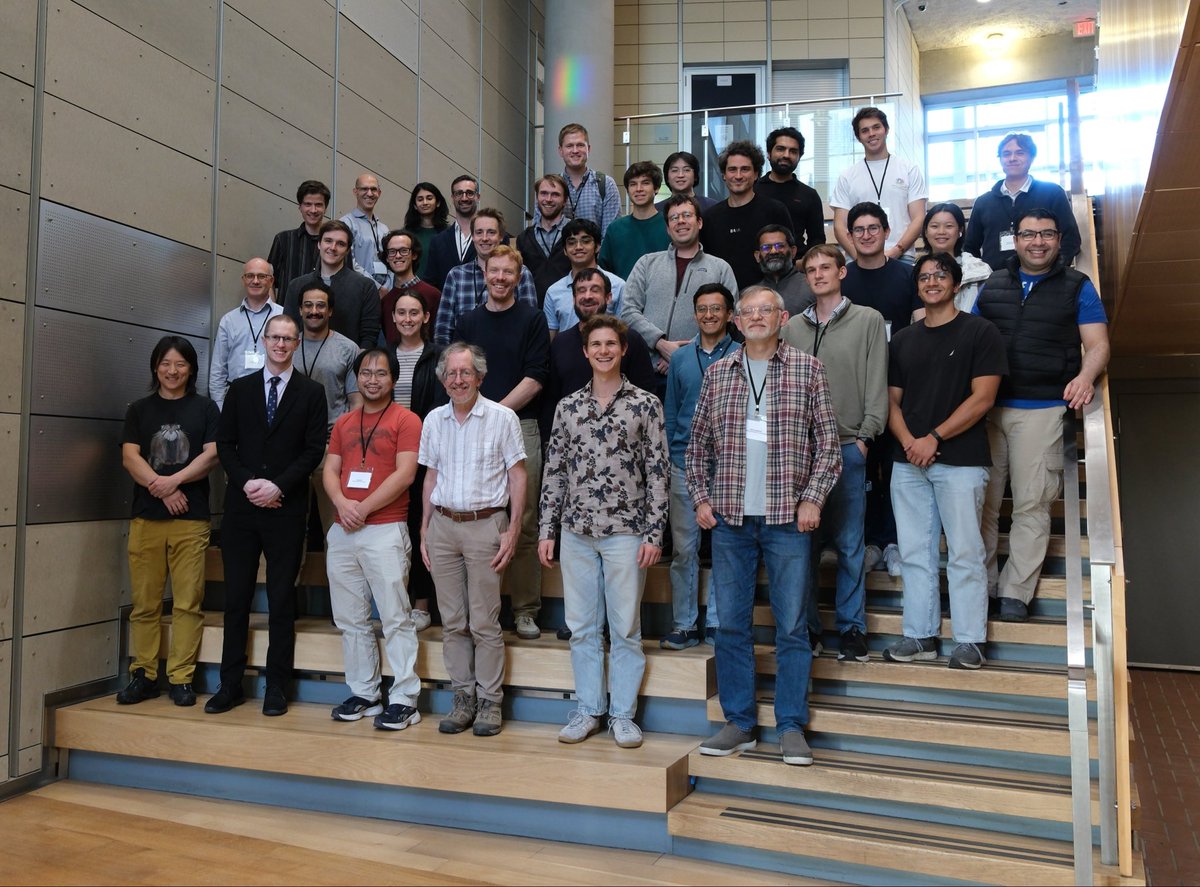
The first Formalization of Physics workshop took place at CMU, really glad to be part of it! Thanks to organizers Prof Sergei Cherkis, Mike Douglas, @XiYin137 , and James Halverson who made this workshop possible! Also thanks to @ICARMath for hosting!
We gave Claude and GPT a phone video of a robot wiping. In an hour, each built a full-dynamics digital twin.
Introducing RoboSimStudio 🤖: an open and interactive toolkit for Agentic Robotics, enabling Fable, Astra and Argon AI agents to model sponges 🧽, cables 🧵 and cloth 👔.
The era of System One Vision Model is here! Introducing VFlash: parsing the visual world in parallel at unmatched speeds for Physical AI.
Most embodied prediction tasks like object localization, robot trajectory planning, and dense 3D motion are fixed-length float vectors. For example, a bounding box is always 6 tokens, a 10-waypoint robot arm trajectory is 54: we know these beforehand. Instead of decoding one token at a time, we can output the entire geometric shape in one go.
VFlash enables up to 12x faster action decoding and a 5.1x overall robot inference speedup on edge GPUs like the Jetson Thor and DGX Spark. What’s surprising is that it ends up even more accurate than the VLM backbone, with up to 61% lower 3D trajectory error. The intuition is that VFlash avoids the cascading errors of autoregressive decoding, where every coordinate is written in ink and every later point loses the chance to backspace.
Everything that moves will be autonomous, and everything autonomous will need to think on its own chip. The next inference revolution is physical reasoning at the speed of reflex.
And as always, it’s open paper, open source! Link in thread:
The question of taste and purpose in theoretical physics comes up frequently, and clarity about it is increasingly important. In my view theoretical physics is a hierarchy consisting of four logical layers: philosophy, paradigm, technical framework, and mathematics. Examples: Philosophy -- determinism vs irreducible probability, realism vs operationalism, roles of observers and measurement. Paradigm -- locality and causality, statistical ensembles and thermodynamic limit, the proposition that gravity is quantum. Technical framework -- Wightman vs effective field theory, renormalization group, string theory. Mathematics -- Hilbert spaces, representation theory, PDE. Consequential and tasteful work tends to bridge the layers and exert upward pressure: technical or mathematical work ought to clarify, challenge, or reshape the paradigm or philosophical commitments.
We hacked Feetech servo firmware to make SO-ARM robots more accurate.
Before-and-after tests:
SO-101: ~35 → ~10 mm error
SO-102: ~25 → ~0–2 mm in this test
Repo: https://t.co/wF1f5sRm75
#robotics#soarm
We present PhysAg3D! 🚀 From a single image, it generates physically interactive 3D assets ready for Embodied AI simulation.
Bridging 3D generation & Agentic models, it delivers image-aligned fidelity with rich physical interactions (articulated joints, soft bodies, etc.).
Can you believe these are open-loop rollouts?
Excited to introduce CARD 🃏 — Contact-Anchored Retargeting for Dexterous Manipulation.
Almost every method today is limited to kinematics alone as the 𝐢𝐧𝐭𝐞𝐫𝐟𝐚𝐜𝐞 between the human and the robot. With CARD, we track real world contact and forces alongside kinematics to perform unprecedented dexterous tasks through tactile reactive replay!
CARD is scalable:
📹 Multiple input sources
🤖 Multiple robot hands
⚡ needs no object models, no simulator, 10 Hz
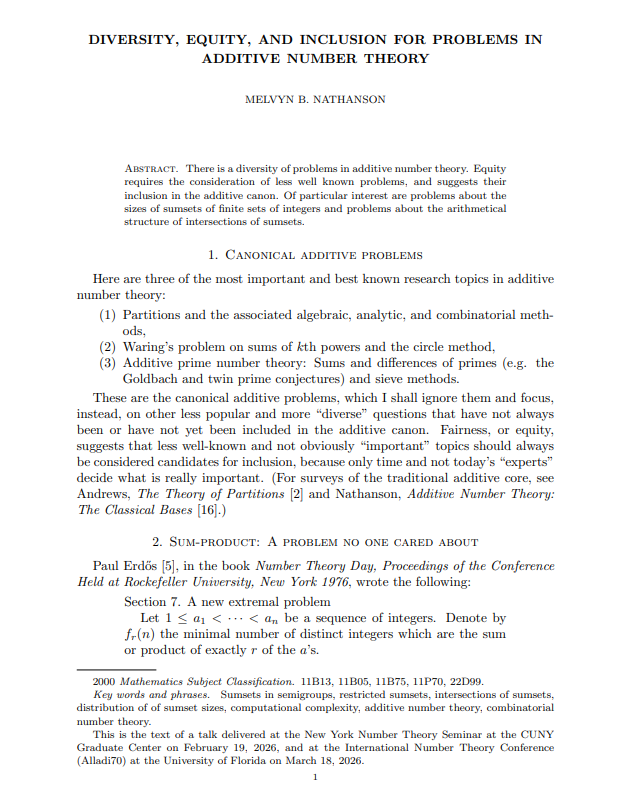
FIELDS MEDALIST TESTED IF HE'S OBSOLETE
timothy gowers took an open problem from a new paper on additive combinatorics and handed it to chatgpt 5.5 pro.
no fancy prompts. no setup. just the problem statement.
the model thought for 17 minutes. then wrote a complete latex preprint in two.
it took a bound that had been exponential for decades and brought it down to polynomial. the construction was something nobody had tried on this class of problems before.
gowers asked isaac rajagopal to review the work. rajagopal wrote the paper the model was improving on.
his verdict: the key idea is "completely original" and "quite ingenious." "the sort of idea i would be very proud to come up with after a week or two of pondering."
the model spent 17 minutes on it.
then gowers pushed further. gave it the harder generalized version. under an hour, a stronger result. exponential to polynomial again.
gowers on his own mathematical contribution to the whole thing: "zero. i didn't even do anything clever with the prompts."
the result is a solid chapter in a combinatorics phd. publishable mathematics that a graduate student would spend months producing.
a fields medalist. one of the best combinatorialists alive. sitting there copy-pasting prompts while a model does doctoral-level research in front of him.
his conclusion: "the lower bound for contributing to mathematics will now be to prove something that llms can't prove."
he gives the profession until 2029 before it's "transformed out of all recognition."
seventeen minutes. zero human math. a result that takes months by hand.
this was may 2026. five months ago. the model that did it is already outdated.
link to the paper in the comments
Introducing DreamFAR, a world model trained from scratch using only robot data, without internet pretraining. It supports:
🎮 Real-time teleoperation
⏱️ Minutes of long-horizon rollout
🧩 Generalization across 1,000+ tasks
https://t.co/A1ifHlj69O
🧵 (1/8)
Vision foundation models like DINO and SigLip now power much of robot learning.
But they are built for RGB. What about depth?
Introducing DeFM: a foundation model for depth images, built for robotics.
🌐 https://t.co/KzloKyRZyF
Weights, code, and demo are out today 🧵
RoboJev: people are watching thousands of videos to label task success.
Now, you can grade robot data faster than you make it. 48x cheaper and 28x faster than 6 Astra.
27B parameters, open weights.