Drawing2CAD🖌️
Transformer-based AI model that converts *vector* drawings (SVGs) to a DeepCAD sequence. The use of vector input over raster (image) inputs results in ~7% higher accuracy
As AI agents begin to take action in the real world, it's critical we develop new ethical frameworks to ensure they're aligned with broad principles – like our well-being and societal norms.
We're exploring these challenges and next steps in our new comment published in @Nature → https://t.co/mbCCTrGk5F
On @lexfridman’s podcast, our CEO @DemisHassabis explains why he sees AGI as the ultimate tool to answer humanity's deepest questions – from the definition of life to the nature of reality itself. 🪐
Listen in on their conversation now. ↓
https://t.co/DYlegRlLXh
Today, we're introducing AlphaEarth Foundations from @GoogleDeepMind , an AI model that functions like a virtual satellite which helps scientists make informed decisions on critical issues like food security, deforestation, and water resources. AlphaEarth Foundations provides a powerful new lens for understanding our planet by solving two major challenges: data overload and inconsistent information.
1️⃣ It combines information from dozens of sources to analyze the world's land and coastal waters in 10x10 meter squares, allowing for remarkable precision while tracking changes over time.
2️⃣ The system's key innovation is creating a highly compact summary for each square. These summaries require 16x less storage than those produced by other AI systems and enables scientists to create detailed, consistent maps of our planet, on-demand.
AlphaEarth Foundations represents a significant step forward in understanding the state and dynamics of our changing planet. 🌎🌎🌎
Scaling up RL is all the rage right now, I had a chat with a friend about it yesterday. I'm fairly certain RL will continue to yield more intermediate gains, but I also don't expect it to be the full story. RL is basically "hey this happened to go well (/poorly), let me slightly increase (/decrease) the probability of every action I took for the future". You get a lot more leverage from verifier functions than explicit supervision, this is great. But first, it looks suspicious asymptotically - once the tasks grow to be minutes/hours of interaction long, you're really going to do all that work just to learn a single scalar outcome at the very end, to directly weight the gradient? Beyond asymptotics and second, this doesn't feel like the human mechanism of improvement for majority of intelligence tasks. There's significantly more bits of supervision we extract per rollout via a review/reflect stage along the lines of "what went well? what didn't go so well? what should I try next time?" etc. and the lessons from this stage feel explicit, like a new string to be added to the system prompt for the future, optionally to be distilled into weights (/intuition) later a bit like sleep. In English, we say something becomes "second nature" via this process, and we're missing learning paradigms like this. The new Memory feature is maybe a primordial version of this in ChatGPT, though it is only used for customization not problem solving. Notice that there is no equivalent of this for e.g. Atari RL because there are no LLMs and no in-context learning in those domains.
Example algorithm: given a task, do a few rollouts, stuff them all into one context window (along with the reward in each case), use a meta-prompt to review/reflect on what went well or not to obtain string "lesson", to be added to system prompt (or more generally modify the current lessons database). Many blanks to fill in, many tweaks possible, not obvious.
Example of lesson: we know LLMs can't super easily see letters due to tokenization and can't super easily count inside the residual stream, hence 'r' in 'strawberry' being famously difficult. Claude system prompt had a "quick fix" patch - a string was added along the lines of "If the user asks you to count letters, first separate them by commas and increment an explicit counter each time and do the task like that". This string is the "lesson", explicitly instructing the model how to complete the counting task, except the question is how this might fall out from agentic practice, instead of it being hard-coded by an engineer, how can this be generalized, and how lessons can be distilled over time to not bloat context windows indefinitely.
TLDR: RL will lead to more gains because when done well, it is a lot more leveraged, bitter-lesson-pilled, and superior to SFT. It doesn't feel like the full story, especially as rollout lengths continue to expand. There are more S curves to find beyond, possibly specific to LLMs and without analogues in game/robotics-like environments, which is exciting.
Nice - my AI startup school talk is now up! Chapters:
0:00 Imo fair to say that software is changing quite fundamentally again. LLMs are a new kind of computer, and you program them *in English*. Hence I think they are well deserving of a major version upgrade in terms of software.
6:06 LLMs have properties of utilities, of fabs, and of operating systems => New LLM OS, fabbed by labs, and distributed like utilities (for now). Many historical analogies apply - imo we are computing circa ~1960s.
14:39 LLM psychology: LLMs = "people spirits", stochastic simulations of people, where the simulator is an autoregressive Transformer. Since they are trained on human data, they have a kind of emergent psychology, and are simultaneously superhuman in some ways, but also fallible in many others. Given this, how do we productively work with them hand in hand?
Switching gears to opportunities...
18:16 LLMs are "people spirits" => can build partially autonomous products.
29:05 LLMs are programmed in English => make software highly accessible! (yes, vibe coding)
33:36 LLMs are new primary consumer/manipulator of digital information (adding to GUIs/humans and APIs/programs) => Build for agents!
Thank you again for the invite @ycombinator and congrats again on an awesome events! I'll post some links/references in the reply.
Introducing V-JEPA 2, a new world model with state-of-the-art performance in visual understanding and prediction.
V-JEPA 2 can enable zero-shot planning in robots—allowing them to plan and execute tasks in unfamiliar environments.
Download V-JEPA 2 and read our research paper ➡️ https://t.co/E61VLtKgZT
Agentic Document Extraction just got much faster! From previous 135sec median processing time down to 8sec. Extracts not just text but diagrams, charts, and form fields from PDFs to give LLM-ready output. Please see the video for details and some application ideas.
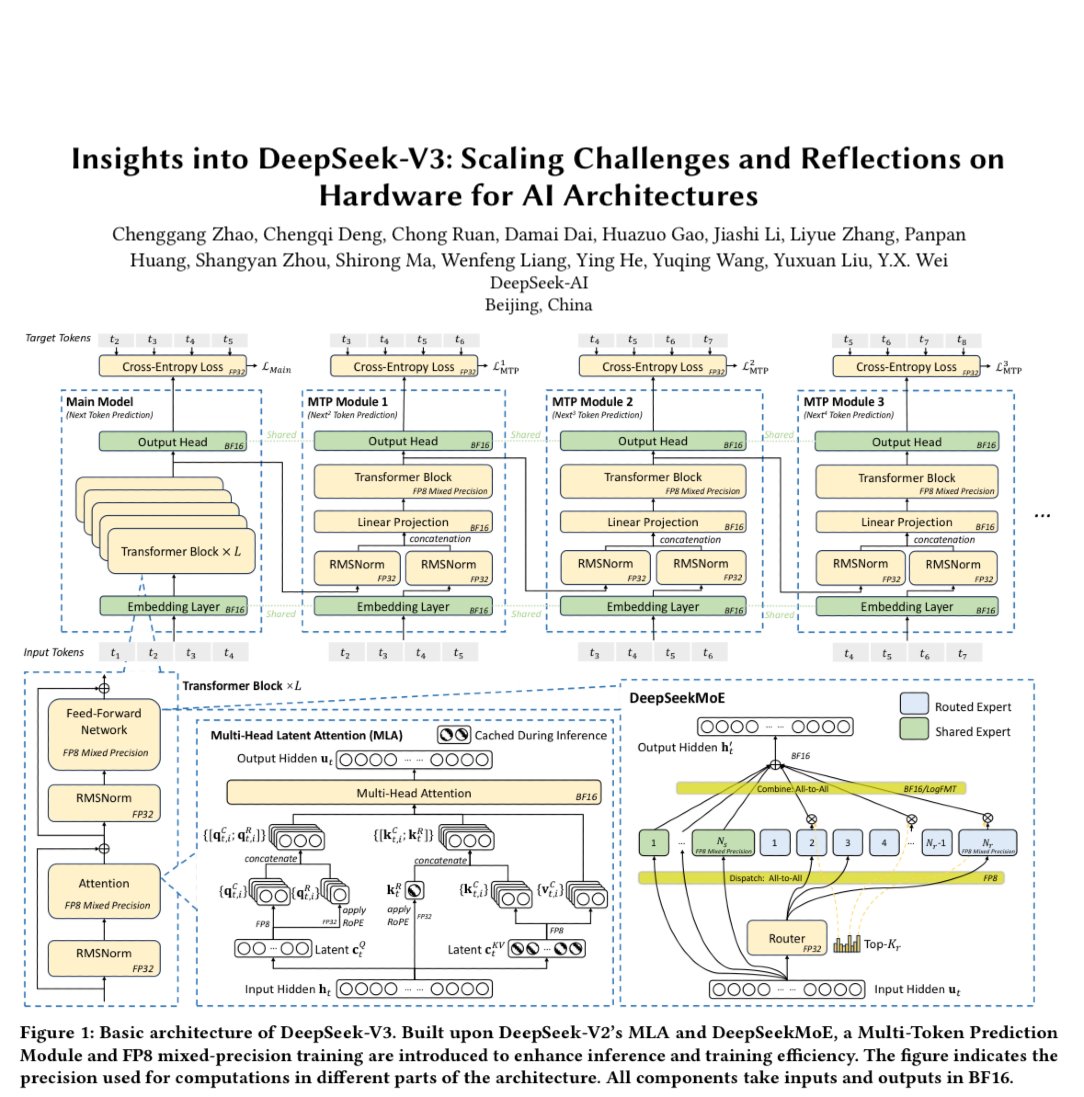
DeepSeek just dropped the single best end-to-end paper on large model training.
It covers
— Software (MLA, training in FP8, DeepEP, LogFMT)
— Hardware (Multi-Rail Fat Tree, Ethernet RoCE switches)
— Mix (IBGDA, 3FS filesystem)
DeepSeek's engineering depth is insane. Must read.
DeepSeek just dropped the single best end-to-end paper on large model training.
It covers
— Software (MLA, training in FP8, DeepEP, LogFMT)
— Hardware (Multi-Rail Fat Tree, Ethernet RoCE switches)
— Mix (IBGDA, 3FS filesystem)
DeepSeek's engineering depth is insane. Must read.
"Chatting" with LLM feels like using an 80s computer terminal. The GUI hasn't been invented, yet but imo some properties of it can start to be predicted.
1 it will be visual (like GUIs of the past) because vision (pictures, charts, animations, not so much reading) is the 10-lane highway into brain. It's the highest input information bandwidth and ~1/3 of brain compute is dedicated to it.
2 it will be generative an input-conditional, i.e. the GUI is generated on-demand, specifically for your prompt, and everything is present and reconfigured with the immediate purpose in mind.
3 a little bit more of an open question - the degree of procedural. On one end of the axis you can imagine one big diffusion model dreaming up the entire output canvas. On the other, a page filled with (procedural) React components or so (think: images, charts, animations, diagrams, ...). I'd guess a mix, with the latter as the primary skeleton.
But I'm placing my bets now that some fluid, magical, ephemeral, interactive 2D canvas (GUI) written from scratch and just for you is the limit as capability goes to \infty. And I think it has already slowly started (e.g. think: code blocks / highlighting, latex blocks, markdown e.g. bold, italic, lists, tables, even emoji, and maybe more ambitiously the Artifacts tab, with Mermaid charts or fuller apps), though it's all kind of very early and primitive.
Shoutout to Iron Man in particular (and to some extent Start Trek / Minority Report) as popular science AI/UI portrayals barking up this tree.
"Chatting" with LLM feels like using an 80s computer terminal. The GUI hasn't been invented, yet but imo some properties of it can start to be predicted.
1 it will be visual (like GUIs of the past) because vision (pictures, charts, animations, not so much reading) is the 10-lane highway into brain. It's the highest input information bandwidth and ~1/3 of brain compute is dedicated to it.
2 it will be generative an input-conditional, i.e. the GUI is generated on-demand, specifically for your prompt, and everything is present and reconfigured with the immediate purpose in mind.
3 a little bit more of an open question - the degree of procedural. On one end of the axis you can imagine one big diffusion model dreaming up the entire output canvas. On the other, a page filled with (procedural) React components or so (think: images, charts, animations, diagrams, ...). I'd guess a mix, with the latter as the primary skeleton.
But I'm placing my bets now that some fluid, magical, ephemeral, interactive 2D canvas (GUI) written from scratch and just for you is the limit as capability goes to \infty. And I think it has already slowly started (e.g. think: code blocks / highlighting, latex blocks, markdown e.g. bold, italic, lists, tables, even emoji, and maybe more ambitiously the Artifacts tab, with Mermaid charts or fuller apps), though it's all kind of very early and primitive.
Shoutout to Iron Man in particular (and to some extent Start Trek / Minority Report) as popular science AI/UI portrayals barking up this tree.
There's a new paper circulating looking in detail at LMArena leaderboard: "The Leaderboard Illusion"
https://t.co/tVMrx68zwa
I first became a bit suspicious when at one point a while back, a Gemini model scored #1 way above the second best, but when I tried to switch for a few days it was worse than what I was used to. Conversely as an example, around the same time Claude 3.5 was a top tier model in my personal use but it ranked very low on the arena. I heard similar sentiments both online and in person. And there were a number of other relatively random models, often suspiciously small, with little to no real-world knowledge as far as I know, yet they ranked quite high too.
"When the data and the anecdotes disagree, the anecdotes are usually right." (Jeff Bezos on a recent pod, though I share the same experience personally). I think these teams have placed different amount of internal focus and decision making around LM Arena scores specifically. And unfortunately they are not getting better models overall but better LM Arena models, whatever that is. Possibly something with a lot of nested lists, bullet points and emoji.
It's quite likely that LM Arena (and LLM providers) can continue to iterate and improve within this paradigm, but in addition I also have a new candidate in mind to potentially join the ranks of "top tier eval". It is the @openrouter LLM rankings:
https://t.co/N1NCZyVCv3
Basically, OpenRouter allows people/companies to quickly switch APIs between LLM providers. All of them have real use cases (not toy problems or puzzles), they have their own private evals, and all of them have an incentive to get their choices right, so by choosing one LLM over another they are directly voting for some combo of capability+cost. I don't think OpenRouter is there just yet in both the quantity and diversity of use, but something of this kind I think has great potential to grow into a very nice, very difficult to game eval.
Project IDX is now part of Firebase Studio 🪄
Announced at #GoogleCloudNext, Firebase Studio has all the functionality of Project IDX, plus additional new AI tools and integrations with @Firebase.
Learn more about building full-stack AI apps → https://t.co/MQPTjzqt9h