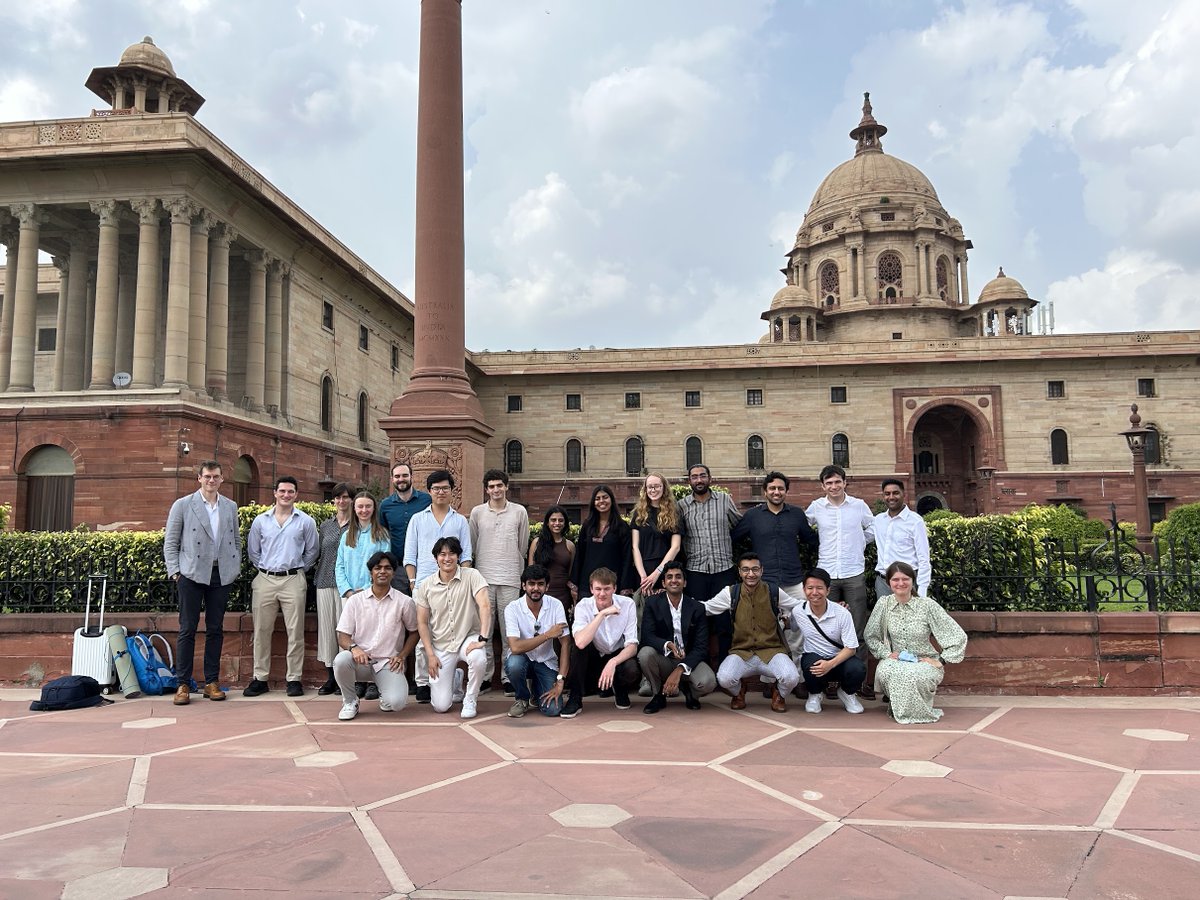
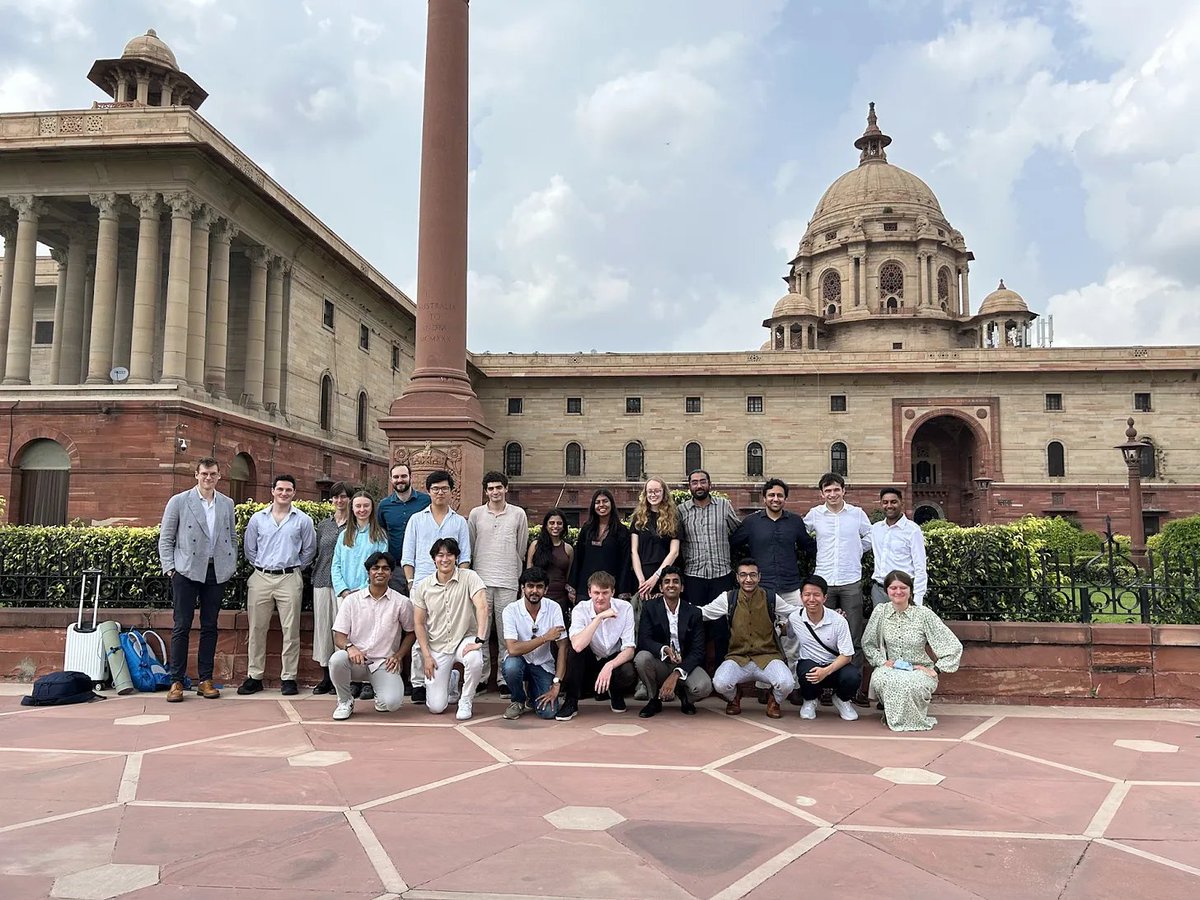
Last week I led a trip for 20 friends across India w/@SparshAgarwall and @arjunssoin
We explored Delhi, Bangalore and Darjeeling, meeting people doing cool things across Indian politics, tech and civil society
Was especially fun intro'ing first-time visitors to India!
🧵1/
New paper on data as a driver of automation and growth: https://t.co/WgVBhQJVJG
One of my favorite lines from the Nicomachean Ethics goes ‘for the things we need to learn before we do them, we learn by doing them’. The world is complex and messy… ‘men become builders by building and lyreplayers by playing the lyre’. How did AI systems become taxi drivers? How will they become office workers?
One view is that they’ll gain those skills by training on high quality data. But where will that data come from? What kinds of data will the economy accumulate? How quickly? Who gains and who loses? And if we train AI systems on tons of data so it becomes superhuman at every job, what will be left for us to do?
My brother @alteredshrey & I grew up playing Age of Empires on a Windows PC.
Today, Microsoft signed a deal with us at @AltCarbonIndia to remove 36,920 tons of CO₂ from the atmosphere.
This will be Microsoft’s first Enhanced Rock Weathering deal in Asia.
It's crazy to be reminded we’re only a <3 year-old startup from India. We’ve dreamt about partnering with a company like Microsoft on their net zero commitments from the day we started the company. They are after all the pioneers and market leaders.
We're just getting started. The deal also provides @msPartner the opportunity to purchase additional volumes from us after successful delivery and verification milestones.
I can’t be more excited about India’s climate charter and the velocity at which we’re building @AltCarbonIndia to lead the way globally. Himalayan ambitions are forged with stellar partners, and having someone like Microsoft in our portfolio cements the kind of work we want to do.
At @IFP, we’ve spent the past 3 years thinking about all the different ways the US government & philanthropy fund R&D.
Until now, R&D funders haven’t had a systematic way to match the innovation problem to the right funding tool.
We built THE ATLAS OF INNOVATION to fill that gap.
https://t.co/XZshJ7pr1f
Alongside @UChi_MSA, we’ve boiled down thousands of hours of research into a handful of questions covering how much the R&D funder knows about:
- the problem they want to solve
- the solution it should have
- the team that should build the solution
Why the Atlas matters:
The US government spends close to $200 billion every year on R&D. And after the Anthropic and OpenAI IPOs, there will be hundreds of billions of dollars in new philanthropic giving.
Choosing the correct funding approach to the social problems they’re trying to solve will mean the difference between success and failure.
For example, NSF research grants have helped seed breakthroughs from MRI machines to search engines, but grants aren’t built to deliver the kind of industrial speed and scale that a project like Operation Warp Speed required.
Picking the wrong funding approach can leave programs behind schedule, over budget, or without anything to show for all the money they spent.
How we built the Atlas:
1. We began by creating a matrix of dozens of considerations that a thoughtful policymaker or funder would ideally weigh before deciding how to fund a project.
2. We looked at every major funding approach, from grants to R&D tax credits to advance market commitments, analyzing when they work well and when they fail to meet the mission.
3. We spent months deep in the weeds of contract theory and incentive design, looking at historical examples and the state-of-the-art research in innovation economics.
4. We then worked to turn that research into a tool that time-strapped policymakers and philanthropic funders could rely on at the start of an innovation funding cycle.
5. Three years later, we are launching just that: a new (and visually stunning) website to help funders decide how to best incentivize innovation. And all they have to know… is what they currently know about their innovation goal! The Atlas takes care of the rest.
How to navigate the Atlas:
Answer questions about your goal to find the funding approach aligned with the information you have.
Each funding mechanism has its purpose for particular technologies and specific moments in development.
There shouldn’t be an ARPA for every field, just like we don’t need a prize or AMC for every innovation. The Atlas helps you navigate those tradeoffs.
I met @SparshAgarwall and @alteredshrey 2.5 yrs ago when Alt was just getting off the ground. The speed at which they’ve gotten this far has been truly incredible
The Age of AI demands planetary-scale Carbon Dioxide removal.
@AltCarbonIndia is using volcanic rock dust to geochemically pull carbon out of the atmosphere — and we just proved it works at scale. The world's largest issuance of carbon credits through Enhanced Rock Weathering.
~10,000 tonnes of CO₂ removed. Enough to offset a small AI data centre.
India has a history of scientific breakthroughs that stun the world — across medicine, space exploration, energy, & financial inclusion.🇮🇳
Climate Change is the most significant existential threat to our species. It demands Himalayan Ambitions.
We're moving mountains to make that happen. Literally.
In 1939, Jawaharlal Nehru visited Rabindranath Tagore to ask if Jana Gana Mana could become India's national anthem. A statistician was in the room.
That statistician, P.C. Mahalanobis, would go on to build the system that let a newly independent nation of 350 million people see itself clearly for the first time.
In 1950, nobody knew what the average Indian ate. Or earned. Or whether they had work. Policy ran on guesswork.
Mahalanobis changed that.
He built the National Sample Survey, which knocked on thousands of doors and asked, item by item: what did you eat last month? Rice, dal, cooking oil, fuel, clothing.
Harold Hotelling, then among the foremost statisticians in the world, wrote that no sampling technique developed anywhere could "compare in accuracy" with what Mahalanobis had built.
This is the story of how India built, then lost, and is slowly rebuilding the infrastructure of national self-knowledge.
Issue 4: The Making of Indian Statistics, written by @jainhiya_ , designed & built by @AltCarbonIndia
https://t.co/MdIvN1hXhC
📣 We just raised our $45M Series B from @TCVTech and @firstharmonic, with participation from @BainCapVC, @firstround, and @AlkeonCapital.
Sales is the most expensive function in most companies — and one of the hardest. Hundreds of accounts, different context, different stakeholders, different dynamics, and a different path to close. No one can do that perfectly. Critical things get missed.
So we gave every account its own AI agent — working 24/7, maintaining full context, progressing it through the funnel, and guiding reps and leaders on what to do next.
The greatest privilege has been building alongside companies like @Samsara@tryramp@ironclad_inc and @attentiveHQ — enterprises with thousands of sellers who are already living in the future.
There are only two unbounded upside problems out there: building and selling. Every company sells. and @useactively is building the system they'll all run on. We’re excited to pull every revenue team into the future we know is inevitable.
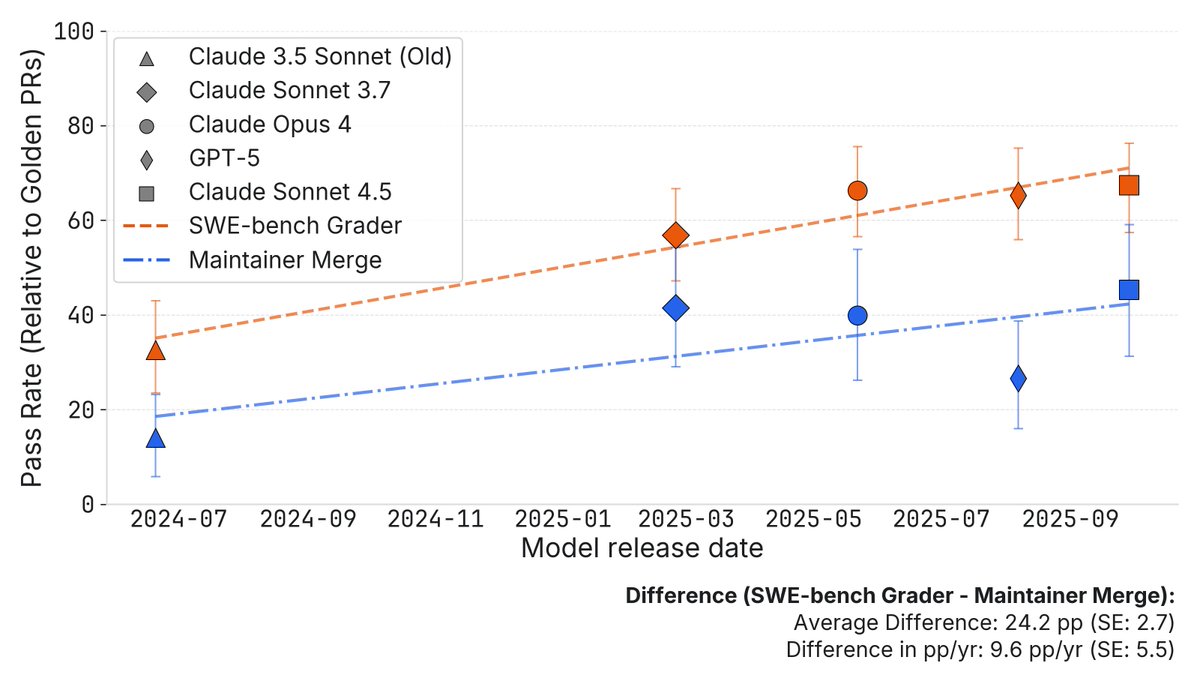
How do benchmarks map to real-world capabilities? To study this, we hired 4 maintainers of repos used in SWE-bench Verified to review agent code.
Of agent PRs that passed SWE-bench’s grader, maintainers would merge ~half. This holds accounting for noise in maintainer decisions.
Think it's worth saying a bit more about the breadth of Tyler Cowen's accomplishments.
Each one of these alone would be enough to make most people's careers:
1. Marginal Revolution is the most successful econ blog of all time
2. Emergent Ventures has given grants to ~1,000 ambitious young people
3. Fast Grants awarded $50 million for COVID research
4. The Great Stagnation and other Cowen books continue to be influential
5. Conversations with Tyler has been one the best long-form interview podcasts for years
6. Between the e-learning platform (Marginal Revolution University) and the textbook (Modern Principles of Economics), he's one of the leading economics educators of his generation
7. GMU econ and Mercatus are vibrant intellectual communities and they wouldn't be what they are without Tyler
The list could go on and on (his work with Derek Parfit, his culinary contributions, etc).
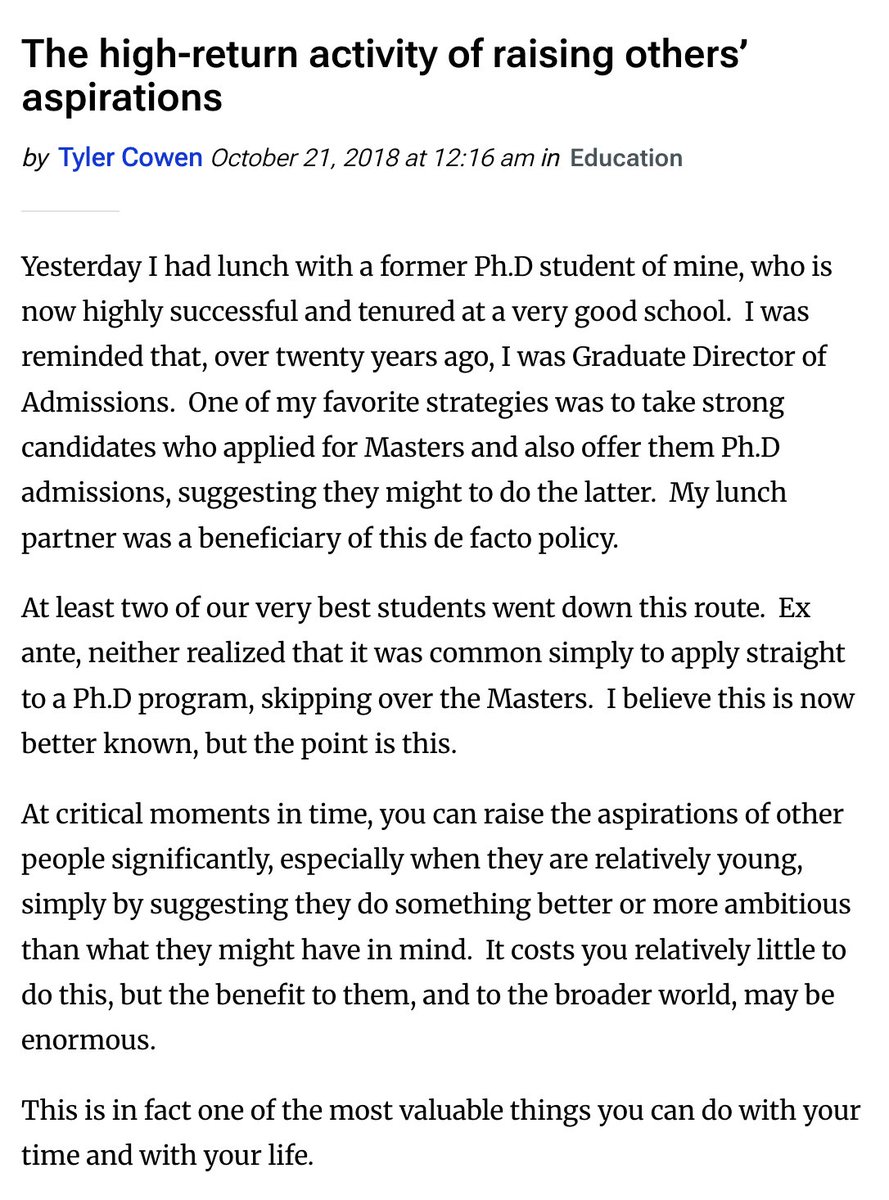
But most of all, Tyler is a mensch. One of the most important things he does is "raise the aspirations of others."
He did that for me, and for countless others.
idk about china not existing counterfactual, but conditional on china existing, india wants/needs tech transfer from china in solar/manufacturing/ev etc that it can't get from other countries. in contrast, india doesn't hold major portions of supply chains that china wants...
this is very clear from numerous conversations with execs across industries + govt officials and opposition, etc...
One surprising part of our travels was the asymmetry: China loomed large in the minds of Indian elites, but most Chinese barely gave a second thought to India's rise
Was a blast traveling with Charles and friends around Asia!
New piece with @arjun_ramani3 on our trip to India & China:
> India's elite obsession with China
> Meeting Rahul Gandhi & communist MPs
> A world of "two and a half internets"
> Chinese AI researchers who wake up and scroll twitter
https://t.co/9Xvm6t4Afs