agent reads a new bug, builds a repro, writes an eBPF shield that blocks just that path, then a human approves. its a rewrite of tetragon
catch from the readme: its pre-release, prod needs a patched kernel + TPM 2.0
from @OpenAI and @Cisco. would u let it near prod?
openai and cisco just open sourced a thing where AI agents write tiny security fixes straight into a running linux kernel. no reboot, no waiting on the patch
its called shirudo and honestly the most interesting line is in the readme, not the launch post
@tongyx361 with full async the sample was made by a policy thats a few steps old by the time u train on it. how stale do u let it get before dropping it, and is there importance weighting or just a cutoff
@satyanadella outcome per dollar is the right number but almost nobody publishes it. per token pricing hides it, a model that thinks 3x longer looks cheap per token and costs more per answer
would love to see MAI share cost per solved task
@ArnavChavan6@thinkymachines oh got it, so one drafter covers any loop count. thats actually the nice part, nobody has to retrain it when they change how many passes they run
does accept rate hold up on long outputs too or mostly short ones
@vllm_project@AntLingAGI@huggingface@ModelScope2022 honestly the 5.5B active isnt the part i'd look at. 35 of the 42 layers are linear KDA, only 7 keep a real kv cache, thats why 256K context is cheap to serve
how does vllm handle that mixed state with prefix caching? does the linear state get cached too
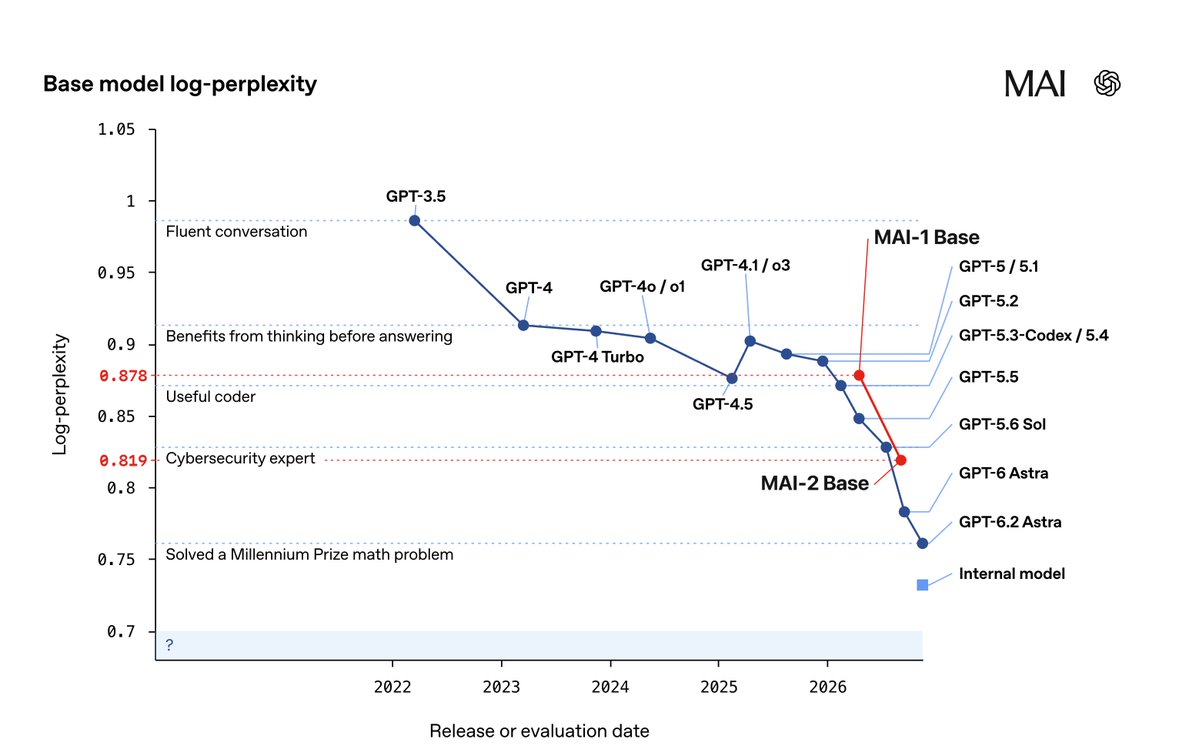
basically its how surprised the model is by text it hasnt seen. lower = better guesser
catch is in @merettm's own post: reasoning and post training add smarts without moving this number. and its scored on openai's private code, nobody else can check
whats a limit like that worth
openai just showed the number they quietly use to track how smart their models are
gpt-3.5 ~0.99. gpt-4 ~0.91. an unnamed newer one ~0.76, right around when it started cracking open maths problems
now they want every lab to agree on a line nobody crosses
the us cleared almost 880k nvidia and amd AI chips for china between december and may
tencent, alibaba, baidu and byd are all on the pentagon's military list. and congress now calls two firms in nvidia's forms suspected smuggling fronts
who actually signed off on this
ok but supporting it is the easy part. openai actually showed its curve, and said itself that it gives competitors a clearer picture of where they stand
if every lab saying "we support this" posted its own number this week, id believe the coordination bit a lot more
We fully support OpenAI's transparency initiative. Thanks to @merettm@markchen90@gdb@sama for leading the way.
We all got into this field to build safe AGI that is genuinely good for humanity. One of the hardest parts of AI safety is coordination, and this is a step in the right direction. Many more steps like this will be needed to deliver safe, contained, and aligned AGI in the next few years.
We're committed to sharing our pre-training progress on a common held-out evaluation set. With OpenAI's permission, we report MAI-2 Base on their evaluation set. Its log-perplexity is 0.819, putting it in the same ballpark as the GPT-5.6 Sol base model. Our model uses the same tokenizer as OpenAI, so the numbers are directly comparable.
In the future, to be able to compare across labs we might need to report bits-per-byte (BPB) rather than perplexity since different labs use different tokenizers. We will also need different evaluation datasets - the fact we have access to OpenAI's evaluation dataset is a special case.
Safety and alignment is now the mission. It's the absolute number one most important focus for our industry. And it begins with small, practical steps like these towards better coordination on pacing.
@GuiBibeau shared how tho? one cached system prompt the 4 all reuse, or can they actually read each others context? if its the second thats the more interesting part than the 200 tks imo
@SemiAnalysis_ the chart id actually want is tok/s per turn across a long agent session. turn 1 with a 100 token prompt is the easy case, turn 40 at 300k context is where it either holds or falls off a cliff
does AgentX plot that slope or just report p99
@n_deshpande_@DavidDAfrica oh so it shuts both, makes sense. the board only works if the same prefix comes out a tiny bit different depending on who u got batched with
anyone actually running batch invariant mode in prod tho, or is the speed hit still too big
@zhenzhangzz ah ok so stacking just costs u context, fair. 512 is nothing next to a long window anyway
does it hold up at 3 or 4 skills stacked or do they start stepping on each other
what the lean check tells u: it compiles, and it proves mathlib's own statement of RH (@leanprover confirmed that part). so it says THAT its true, not why
a 12 yr human proof dropped the same day and ppl found problems in it within hours
would u trust a proof nobody can read?
the riemann hypothesis has been open since 1859 and it might actually be done now. weird part is no human can read the proof
its 17 million lines of lean code, worked out by an anthropic mathematician with claude. the computer says its correct
a month ago the best forecasters had this at 2035. tao said 2050 or something
if the experts missed a millennium problem by a decade, i'm not trusting any "safe for the next 10 yrs" jobs list on linkedin either tbh
Predictions made last MONTH (post Navier-Stokes) about when the Riemann Hypotheses would be solved:
Metaculus: May 2035
LEAP Superforecasters: 10% chance of additional Millennium problem being solved in 2026.
Terrance Tao: “some combination of humans and AIs in 2050 or something"