@Azimbayev product side view: the agent is the easy part. the hard part is admitting most steps in the old process only exist because analysts never had enough hours.
my pick for "redesign first": the morning. every name gets a look every day, not when someone finds a free slot
Run 500 strategies. Keep the best one
You didn't find an edge you found noise
A Sharpe of 2.7 across 500 tries deflates to ~0.3. Not significant
How many did you try before this one?
@choffstein The 2.9bp is the tell. At that fee the value isnt really the methodology its distribution. The formula is cheap to copy; being wired into $182B of mandates isn't. So does the 10x multiple hold if the methodology itself gets cheaper to produce, or does it compress toward the fee?
@awealthofcs On the labor market question it's not that AI can't do the work. It's that almost nothing reaches production. 95% of enterprise pilots never ship. The capability is here; the deployment isn't. Jobs move when AI is trusted inside the workflow, not when it's demoed
An LLM backtest on public stocks is broken by default - the model already knows the future
Show it "Costco, Q3 2018" and it remembers how the quarter ended
Two locks against hindsight:
→ obfuscate the identity
→ block post-trade data
How do you handle it?
@jposhaughnessy Burning patience might be the most underrated edge in investing. Everyone optimizes for the next quarter. The hard part was never finding the right idea it's sitting through the gap between being right and being proven right
@sytaylor@Visa@OpenAI That last line is the whole game. In commerce, proving what the agent did is enough - did it stay in the limits. In allocation, staying in the mandate was never the hard part. You have to prove why it decided. Provable action and provable reasoning are different problems
@patrick_oshag Agree we're early. But what's holding AI back in the enterprise was never compute - it's trust. 95% of GenAI pilots never reach production. In allocation you don't need a bigger model, you need reasoning you can actually audit. That's the part no one's solved yet
I'm the CPO. I'll share the build here — architecture, what works, what breaks.
If you're a fund, allocator, or into agentic systems — follow along.
Paper + more: https://t.co/ezp63iWoLY
Indices have had two eras: rule-based (S&P, 1980s) and smart beta (factor ETFs, 2000s).
We think a third is starting: agentic indices — portfolios built and revised by AI agents that reason, not just follow rules.
Here's what we're building at Altbridge
Where we start: custom agentic indices for banks and sovereign wealth funds. Mandate-constrained, fixed-fee.
Not a hedge fund — we build the methodology, the client holds the index. ETFs later
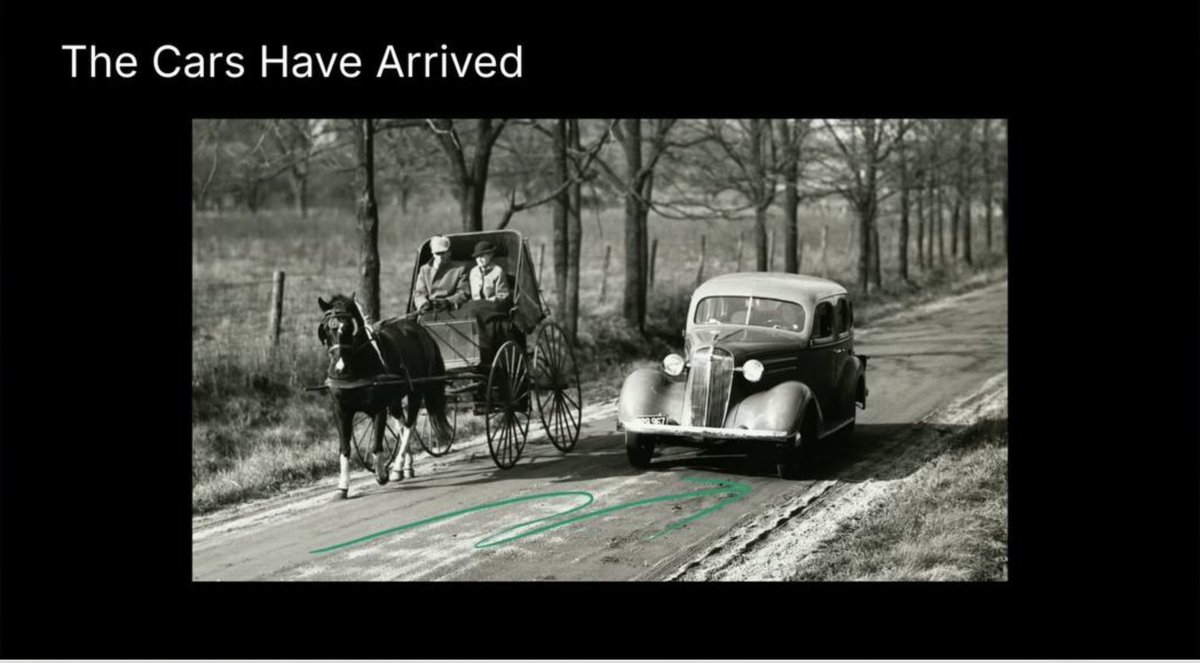
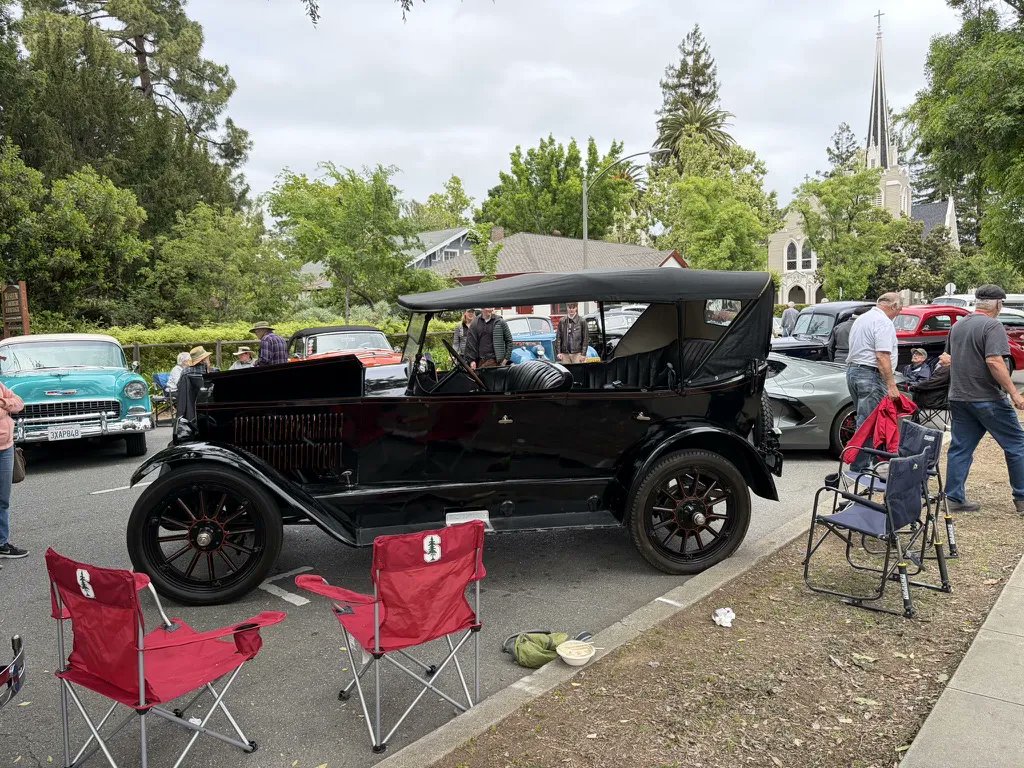
Spent yesterday walking through a classic car show in Palo Alto. Couldn't stop thinking about the @sequoia Ascent keynote by @gradypb , @sonyatweetybird , and @Konstantine — the slides "The Cars Have Arrived" and "How & What to Build Has Changed."
The first automobiles looked like horse-drawn carriages with engines bolted on. Same shape. Same silhouette. Just no horse.
ChatGPT, Cursor, Lovable, Claude, Perplexity — these are the early cars. Powerful, exciting, imperfect, and still surrounded by “horses” in the form of old workflows, old software, and old organizational habits.
The companies that defined the automobile era weren't the ones who built better carriages. They were the ones who asked: what does this technology actually want to be?
The question is: what will the Tesla, Porsche, or Ferrari of AI-native companies look like?
Most exciting time to build.
Every time I meet David M Rubenstein, it's a great conversation.
He liked the idea of Fully Autonomous Investing — high signal, coming from him. I love Peer-to-Peer Conversations, and David is one of the best interviewers I know. At some point, I think it could make for a great recorded conversation.
Until then, back to building. Grateful to The @OneCarlyle for hosting, and to @MilkenInstitute for the energy that runs through the whole week.
Met one of my long-time heroes at Milken.
Huge thanks to Raj Ganguly and the @BCapitalGroup team for the invitation. Few firms in venture combine B Capital's global reach, conviction, and operating depth — and few evenings in this industry are as worth showing up for.
The highlight was time with Howard Morgan. For anyone building at the intersection of math, technology, and markets, Howard's career is foundational reading:
• Machine #50 on the ARPANET in 1972 — among the first hundred or so people online, anywhere
• Tenured at Wharton and the Moore School; PhD in operations research, Cornell
• Co-founded Renaissance Technologies LLC with Jim Simons in 1982. Jim ran the science; Howard was President. Medallion became the best-performing fund of all time — 40%+ net annual returns for three decades
• Co-founded Idealab with Bill Gross
• Co-founded First Round Capital with Josh Kopelman in 2004 — the first true professional seed fund. Early backer of Uber, Square, Roblox
• Returned in 2017 to chair B Capital — today $9B+ AUM across 9 offices
A story worth retelling:
When Howard and Josh started First Round in 2004, Jim Simons came in as a major LP — a quiet vote of confidence from one founder in another, 22 years after they had bet on each other to launch RenTech. An early First Round fund returned ~50x. By one account, Jim made about as much money from his First Round LP stake as Howard made from his RenTech LP stake.
> Two legends, betting on each other across four decades.
At Altbridge, we're building the next chapter of that idea — a fully autonomous, AI-native investment firm.
Ken Griffin is describing the copilot era at Citadel.
The next one is fully autonomous — agents that analyze, allocate, and learn from every trade.
That's the Self-Driving Portfolio. https://t.co/DMzj4WvpsJ