I like the idea of having a theme each year. One big thing to focus on for the next couple of months.
This year's focus for me is Speed.
The inspiration comes from @elonmusk. Whether it means digging a hole in the company parking lot to start The Boring Company that day instead of waiting two weeks or manually moving twitter's servers himself during the holidays.
His speed of moving is an inspiration!
I'm generally one to carefully evaluate all options, read the email draft a 100 times, read the article before posting a 1000 times and then iterating again till it feels perfect.
Going to consciously focus on iterating faster than I'm comfortable with to see where it leads.
Going faster might mean more mistakes, but that's okay. You can learn and iterate faster on the mistakes too.
The small ones don't matter anyways.
🎉 I’m very excited to share that @PrefectIO is acquiring @dagster!
For years, Prefect and Dagster have raised the bar for each other and our category. That competition produced two exceptional products and two of the strongest open-source communities in the data ecosystem. Today, we’re bringing them together under one profitable company with the scale and financial strength to invest for the long term.
Dagster and Dagster+ will continue as distinct products and brands, supported by many of the same people who built them. We’re committed to continued investment in both products and communities, and existing and new customers can keep using them exactly as they do today. The modern orchestration category has a new center of gravity.
Our ambition extends far beyond consolidating today’s market. The next generation of automation starts with a fundamental question: how do you automate software that is, itself, autonomous?
Agentic orchestration requires both a clear definition of what should be achieved and a runtime capable of following paths that can’t be known in advance. Prefect’s new portfolio gives us a fantastic foundation for that work:
🎯 Dagster brings declarative outcomes and lineage
🚦 Prefect brings flexible, durable execution
🔐 FastMCP brings governed access to the tools and data agents use
We’ll draw on all three as we build a new platform for autonomous software.
We’re combining two of the best orchestration teams in the world at exactly the moment the problem is becoming much bigger. I can’t wait for you to see what we’re building next.
Happy engineering!
Read more here: https://t.co/Xx0zvhoUB9
@valawakened That’s from @waitbutwhy’s post on How to pick your life partner. Fantastic read.
The core takeaway for me was : Optimise for the average Wednesday (applicable to life in general)
https://t.co/1CNRaQQTmB
An Indian scientist at Harvard discovered ATP (Adenosine Triphosphate). Then he helped create the first chemotherapy drug and the first tetracycline antibiotic. Harvard still refused him tenure. A bowling alley would not let him bowl. He died at 53, without an obituary.
His medicines save tens of millions of lives every year. Most American doctors who prescribe them have no idea what his name was. His name was Yellapragada Subbarow (Subba Rao).
He was born in 1895 in Bhimavaram, India. His father was a Sanskrit scholar who died from tropical sprue. Tropical sprue is an acquired malabsorptive disorder found in tropical regions, characterized by chronic diarrhea, weight loss, and severe nutritional deficiencies. It is most commonly associated with deficiencies in vitamin B12 and folic acid, resulting in anemia, fatigue, and glossitis. The same disease killed two of his brothers. As a child, Subbarow watched them fade away and decided he would spend his life fighting disease.
He failed his school exams twice. Passed on the third attempt. His future father-in-law paid for his medical school books. Subbarow married his daughter and repaid the debt. In October 1922, he arrived in Boston with borrowed money and broken English. He was 27. He entered Harvard Medical School and joined the biochemistry PhD program.
He began working under a senior researcher named Cyrus Fiske. Long hours. Little pay. But he was at Harvard, and he did not care. In 1925, they developed the Fiske-SubbaRow assay, a method for measuring phosphorus in body fluids. It is still used today in kidney failure testing, vitamin D testing, and prostate cancer work. It became one of the most cited methods in biochemistry history.
Then they found something even bigger in 1926 - ATP - Adenosine triphosphate. The energy molecule that powers every cell in every living thing on Earth. That discovery changed biochemistry. It also proved that the 1922 Nobel laureate had been wrong about how muscles worked. Muscles did not run on glycogen. They ran on ATP.
Subbarow earned his PhD in 1930. He stayed at Harvard for another decade. Paper after paper. Discovery after discovery. And every year, Harvard refused to promote him. The biochemistry department had never given tenure to a foreigner. They were not going to begin with an Indian.
His colleagues took him fishing. Played tennis with him. Came to dinner at his home. Then voted against him year after year. Outside the laboratory, he met the same wall. He bought an airplane and learned to fly because he loved flying. Once, he tried to go bowling. The local alley refused him entry. The sign said it was “open only to the Caucasian race.”
Then Fiske turned against him. The senior researcher began blocking Subbarow’s discoveries out of jealousy. Some of Subbarow’s work had to be rediscovered years later by other scientists because Fiske kept his findings hidden.
May 1940. Harvard denied him tenure for the last time. After 17 years of groundbreaking work, he walked away. Lederle Laboratories in New York hired him as Associate Director of Research. By the end of the year, he was Director. In the next eight years, he changed medicine. He developed diethylcarbamazine, an oral medicine that killed the tropical worms crippling American soldiers in the Pacific. The World Health Organization still uses it.
He isolated folic acid from liver and worked out how to produce it on a large scale. Today, folic acid in pregnancy prevents birth defects in tens of millions of pregnancies every year. The same family of diseases that killed his father and brothers became preventable because of him.
Then Dr. Sidney Farber called from Boston with an idea: maybe a drug that blocked folic acid in cancer cells could kill childhood leukemia. Subbarow’s team created the drug. They called it Aminopterin. In December 1947, Farber gave it to an eight-year-old boy dying from leukemia. Within weeks, the cancer cells began to disappear.
It was the first chemotherapy drug in history. The first time anyone had put cancer into remission using a pill. Subbarow’s team later refined it into Amethopterin, now known as methotrexate. It became a gold standard treatment for leukemia, lymphoma, breast cancer, and lung cancer. Then rheumatoid arthritis, psoriasis, and Crohn’s disease. The World Health Organization lists it as an essential medicine. Tens of millions of people use it every year.
In 1948, his lab produced Aureomycin. The first tetracycline antibiotic - a broad-spectrum one that killed typhus, cholera, pneumonia, and many bacteria that penicillin could not touch. It opened the door to the whole tetracycline family: doxycycline, minocycline, and drugs still used today against plague, malaria, anthrax, and drug-resistant infections.
He was 53 years old. He had created medicines that would save tens of millions of lives. August 8, 1948. Yellapragada Subbarow suffered a heart attack at his home in New York and died. No American newspaper gave him a front-page obituary. No university held a memorial. The Nobel Committee never honoured him. His own colleague George Hitchings later won a 1988 Nobel Prize for work built directly on Subbarow’s foundation. Subbarow was not even nominated.
In 1950, Argosy magazine published a feature about him titled “Miracle Man of the Miracle Drugs.” It began with a line that still hits hard. “You’ve probably never heard of Dr. Yellapragada Subbarow. Yet because he lived, you may be alive and are well today. Because he lived, you may live longer.”
Most Americans had not heard of him in 1950. Most still have not. Harvard has never officially honoured him. American medical schools mostly do not teach his name. The Nobel Committee that honoured Hitchings for work built on his foundation never corrected the record. Every methotrexate prescription written today remains silent about the man behind it.
India remembers. The government issued a postage stamp for his 100th birthday. His childhood home became a museum. Indian medical schools teach his name. But the country that denied him tenure, refused to let him bowl, and allowed him to die unknown - the same country that uses his drugs every day - still mostly does not know him.
Here is the truth. If someone you know has ever taken methotrexate for cancer or an autoimmune disease. If someone you love has taken folic acid during pregnancy. If you have ever been prescribed doxycycline for an infection. That was him. Yellapragada Subbarow. Born 1895. Died 1948. Saved tens of millions of lives, while a country he loved barely knows what it owes him.
Please remember his name and let your near and dear know about this little-known scientific legend born on this soil but never got the true recognition that he deserved. A story you need to know. A story all of us need to know. #Medicine #Unknownlegends @centerofright@KiranKS
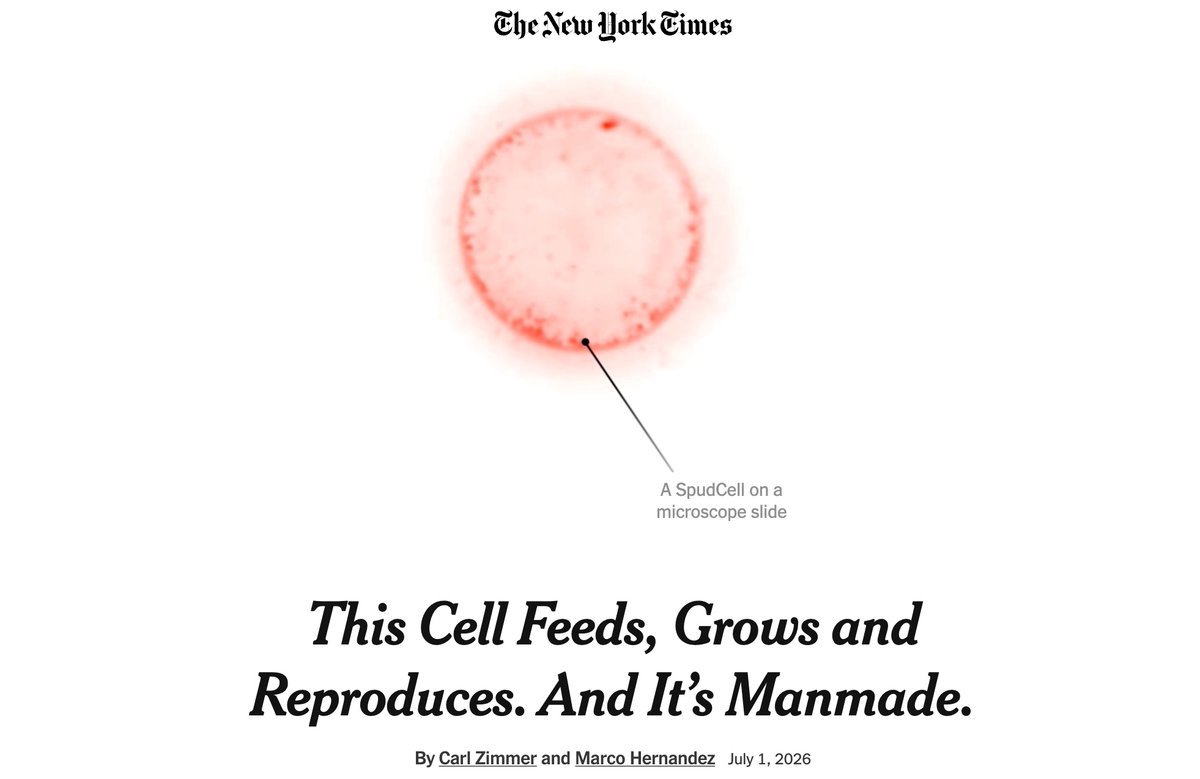
Spudcell is a monumental step in pushing the frontier of Biotechnology.
Incredible work by the team at @Bioticorg and a huge shout out to @JedryszekJan for his role in bringing this to life over the past year as part of his Fellowship @osvllc
Why we made @Bioticorg. I believe biology today stands roughly where construction and civil engineering stood 300 years ago. That needs to change. A Thread 🧵
@jerryliu@rabois Congratulations on the launch!
Seems to address one of the core blockers of effectiveness i.e time tracking (as frictionlessly as possible).
Also see below: The Effective Executive (1966) Peter Drucker
Finally got around to setting up Hermes agent and seemed to work well on a tiny research task on health papers, until it got distracted and started writing python scripts to train a new AI model
This was with Deepseek V4 Flash
Excellent news.
This could very well be a landmark judgement in India that hopefully leads to making footpaths mandatory across the country.
@walkingproject
i have been a big article and essay enjoyer for 7 years.
i have probably read more than 10,000+ essays online
below is a thread of my favourite essays or articles of all time (that i remember)
pls drop your favourite ones below.
"A loonshot is something nobody has dared to do before. A goal so ambitious that you don’t even know if its possible."
-- naman pushp of airbound (substack, 2022)
i am 23 now. i have one skill, it's the ability to tell stories. i want to talk about indians building on research.
@paulg's Maker v/s Manager is very apt here.
AI agents are taking over increasingly larger chunks of deep work, and the core value provided by humans shifts from makers to managers (managing AI agents)
Working 100 hours a week is characteristic of jobs where you “work” very little, but need to always be on call (think: investment bankers). Fields that require deep creative work or technical precision usually get 4 productive hours each day. Agents moved SWE from (2) to (1)
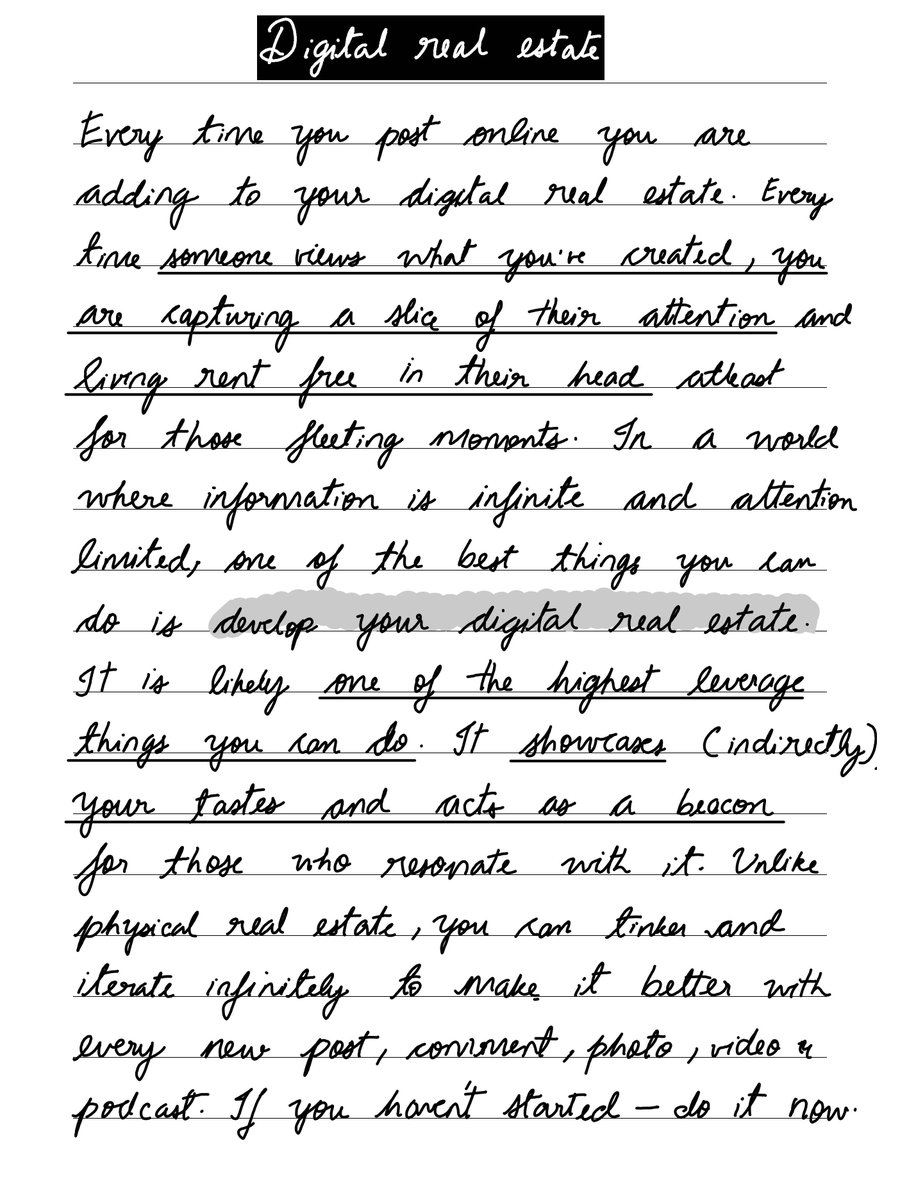
A tweet. A blog post. A YouTube video. A comment on someone else's work.
Each one is a tiny property you build on digital land.
The internet runs on attention.
Every time someone reads your words, watches your video, or pauses on your photo, you capture a slice of their most limited resource. You live in their head. Seconds, maybe minutes. If your work is good, you stay longer.
Unlike the physical kind, you can build it **for free**.
A single post costs nothing but time. A hosted blog costs $5 a month. A YouTube channel costs nothing but the camera in your pocket. The barrier to entry is zero.
So what?
Every post is a signal. It says: "This is what I care about. This is how I think." The people who resonate will find you.
And it works while you rest.
Real estate generates rent.
Digital real estate generates attention, trust, and opportunity without your ongoing effort.
The essay you wrote once can change a stranger's mind years later. A book written centuries ago can change the course of your life today. What you publish now could reach someone decades from now, long after you've moved on.
Physical buildings degrade over time. But your blog post from 2019 can still bring you clients today. A YouTube video made years ago can go viral again in 2026. Your worst work becomes your best work's foundation.
The best time to start publishing online was 20 years ago. The second best time is now.
The cost of entry is zero. The returns compound forever.
This is the time of year when a lot of investment firms welcome interns. While our work is geared toward institutional investors, a lot of it can be useful for learning about markets and the investment process. Here are a handful of reports and how they can guide interns:
Giampaolo Tomassetti spent 12 years inside the Mahabharata and painted it like he lived it. The book is called Mahabharata: Indian Art Series.
I keep it on my coffee table. Every time I flip through it, I’m reminded what happens when someone gives a decade of their life to a single idea.
Great opportunity to build something useful and get funding for it in the next 90 days.
Submission deadline is August 17th
Live finals September 25, 2026
This is the Build with Gemini XPRIZE.
$2,000,000 in prizes. 90 days. Pick a problem worth solving. Build a profitable business with AI.
Grand prize: $500K in cash.