¿Cómo se relacionan la contaminación con la desigualdad en Colombia? Mi estudio con @jccardenas1965 y @doblementecono1, publicado esta semana en @PNASNews, revela cómo en años recientes se ha transformado la desigualdad ambiental en el país.
🔗https://t.co/sCvvTri0wJ
🧵(1/7):
Interested in single cell genomics but need help getting started? Check out my lab's Single Cell Genomics Day on April 25. Talks will feature recent exciting computational and experimental advances and will be live-streamed at https://t.co/zG98gkckMU. Please RT/spread the word!
Today, 2025-03-04 18:00 CET, Benjamin Rombaut will speak about Harpy, a spatial proteomics tool, as well as other tools from the Saeys lab!
Find the zoom link here: https://t.co/f3SFRH0i8u !
Our #bionformatics#dataviz#Rstats package scatterbar for visualizing cell-type proportions in spot-resolution #spatialtranscriptomics data is now published!
Paper: https://t.co/fpwD5OHmXR
Software: https://t.co/MyuNTz0crb
Tutorials: https://t.co/rILmm3ez3d
🥳#AcademicTwitter
¡También tenemos proyectos enfocados en análisis bioinformáticos de genomas humanos completos y variación estructural en población mexicana y otras poblaciones! ¡Revisa la página de nuestro laboratorio @LIIGH_UNAM para ver nuestras líneas de investigación!
We have something special for you while you wait for the second season!
Wanna know more about what goes into building productive and welcoming research environments? Join us in this LIVE episode with the founding members of @LIIGH_UNAM!
https://t.co/wJgYWdRvZz
Checkout our article on quality of life disparities among Mexican people lupus
Congratulations to the @LupusRgmx team, in particular @Annhled6 and @D_o_m_i_n_g_o
Thanks to all the patients that made this possible @LUPUS_MX@CetluLupusMex@LupusMorelos
https://t.co/5Ja6NpwVaI
LIIGH investigator @cgonzagaj and @lcgejunam student Luis Fernandez-Luna in collaboration with investigators from @PNRIGenetics and @bcmhouston just published a new article cataloguing and analyzing highly similar repeated sequences in the human genome @HGGAdvances Read it here👇🏽
A serial omics analysis of wound healing in humans (d0, d1, d7, d30)🔬🧬➡️
I'm not aware of another human study that runs serial scRNAseq and spatial transcriptomics in the same individuals❗️
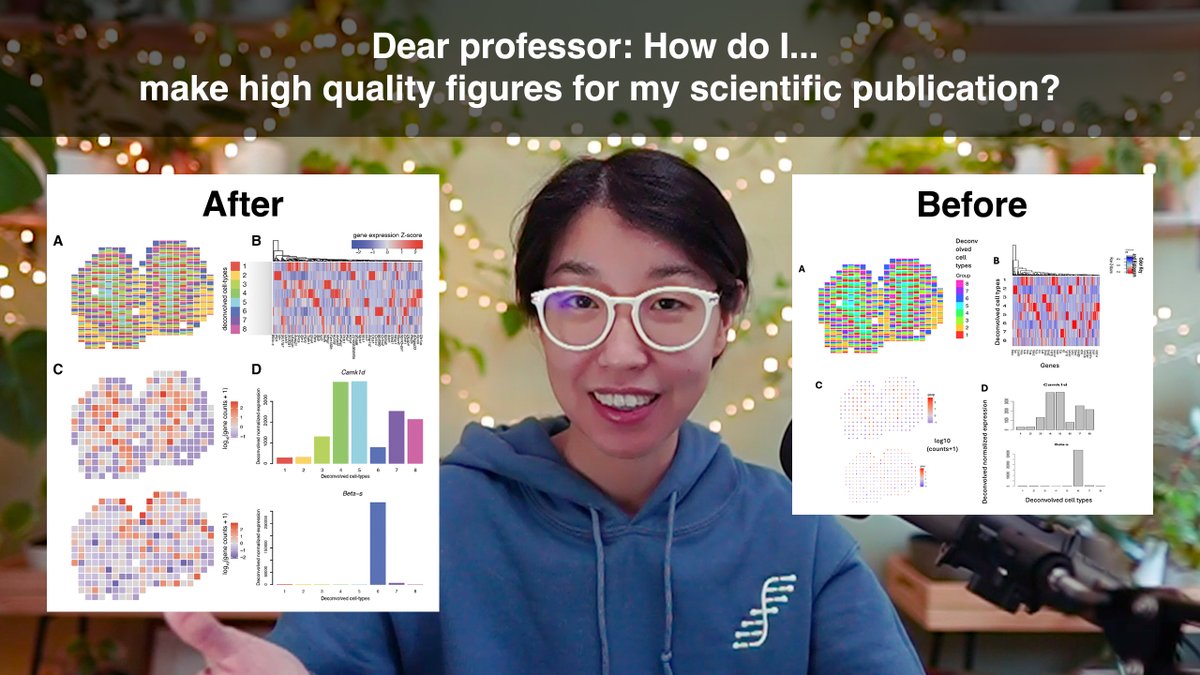
In this student-requested video, I demo the process of making a high quality publication-ready figure (from making a mockup to enhancing visual similarity in Illustrator) and narrate my general process.
Follow along 📽️: https://t.co/4uLZFkzDBA
#phdlife#AcademicTwitter#dataviz
NiCo is out! Our new algorithm for spatial transcriptome data analysis predicts the crosstalk of cell types co-localized in tissue niches and sheds light on the downstream effects of cell-cell interactions by inferring covarying gene programs.
https://t.co/zobyeydQeS
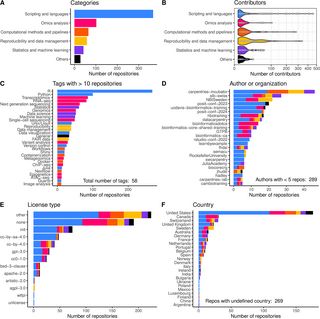
Using https://t.co/UtllGqKEsS to find, compare and re-use online materials for training and education https://t.co/OPqZ1zasJX 🧬🖥️🧪
12 nextflow tutorials, 267(!) for #Rstats, 104 for Python, long tail for Docker, imaging, RNA/ATAC/etc-seq, more.
We often think of an "equilibrium" as something standing still, like a scale in perfect balance.
But many equilibria are dynamic, like a flowing river which is never changing—yet never standing still.
These dynamic equilibria are nicely described by so-called "detailed balance"
Big thanks to @myriam_vidalv for her interest in the work we are doing to increase awareness about #RareDiseases and improve access to diagnoses & therapies for patients in Mexico @ReMexER1 & Latin America @CEPCAL_LATAM! Read the article @ScienceMagazine!
https://t.co/HneL0Lvk09
I am really happy to see the #preprint of our work studying #acral#melanoma tumours from 🇲🇽 Mexican patients out today! This has been a ~8 year-long work involving many colleagues from Mexico and abroad. Some of our findings here below.... ⬇️ (1/12)
@lcolladotor i think it depends on the application. we have seen in some situations, especially when referring to identifying rare populations, that keeping 2k highly variable genes give poorer results than 5K for example. theres also a clear computational tradeoff
Tip de R: si tienes que trabajar con bases de datos muy grandes, puedes acelerar el cálculo usando todos los procesadores de tu computador con tan sólo un par de líneas, usando {purrr} y {furrr} #Rstats