Preparing humanity for an interplanetary future.
Though skeptical initialing about such a future, the passion and commitment of @isro, @nasa, @elonmusk and @JeffBezos motivated 5 of us (@Axlamdax and four students from @bennettuniv) to build this: https://t.co/BvQ4XFheel
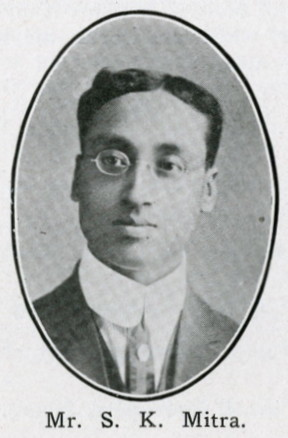
Next in who after the Bibha Series? He was the man who taught the world that the sky has a ceiling. Sisir Kumar Mitra (1890-1963) was the Ghost who turned the atmosphere into a mirror. Working from a lab in Calcutta, he mapped the invisible layers of ions that allow our voice to travel across the globe. He wrote the 'Gita' of the upper atmosphere, a book so powerful it was used by NASA & every radio scientist on Earth for decades. He was a student of Marie Curie & a peer of Raman, yet today he is a Ghost in his own land. He is the titan who built the foundation for the Space Age... the man who proved that to reach the stars, we first have to understand the air.
Born in 1890 in Calcutta, S.K. Mitra was a contemporary of C.V. Raman & J.C. Bose. He did not just study in India; he went to the Sorbonne in Paris & worked directly under Marie Curie. He brought that Experimental Fire back to Calcutta.
In 1923, he established the 1st Wireless & Radio Physics lab in India. While others were focusing on the ground, Mitra was obsessed with the Ionosphere, the layer of our atmosphere that allows radio waves to travel around the curve of the Earth. He did for the atmosphere what Mendeleev did for the elements.
He was the 1st to realize that the Ionosphere had multiple layers (the D, E, & F layers). He conducted the 1st successful Ionospheric Sounding in India, proving how the sun’s radiation creates a ceiling of ions.
In 1947, he published The Upper Atmosphere. This book was so comprehensive & advanced that for 30 yrs, it was known globally as the "Holy book of Ionospheric Physics." Every time we use a GPS/listen to a long-range radio/look at a satellite weather report, we are using the Mitra Logic. He mapped the invisible highway that all modern communication travels on.
He was a man of Systemic Genius. He did not just want to find a particle; he wanted to build a department. He founded the Institute of Radio Physics & Electronics in Calcutta, the 1st of its kind in the East. He was a Ghost because he worked on Mediums rather than Objects. People understand a rocket, but they do not understand the Ionosphere that the rocket has to pass through.
To his family, he was a giant of academia, a man who lived for his students. They saw the Teacher, but the world forgot the Visionary who predicted the Space Age decades before the 1st satellite was launched.
Many international peers believed he deserved a Nobel Prize for mapping the Ionosphere, but like many in this series, he was an Outsider whose brilliance was captured in a textbook rather than a trophy room.
Remember the difference between a Buddha (the enlightened one) and a buddhu (a fool): Buddhus do not know that they are buddhu, while Buddhas know that they are buddhu. In light of that, today should be celebrated as the most important day of the year! 😊
Are we diagnosing the root causes of the U.S. healthcare crisis correctly, @chamath? Read the first portion of your latest Substack piece, and it seems that the health challenges in the U.S. may not be solvable through technological fixes alone:
https://t.co/Ug5WBHeo4M
𝗥𝗜𝗦 𝗥𝗼𝘂𝗻𝗱𝘁𝗮𝗯𝗹𝗲 𝗗𝗶𝘀𝗰𝘂𝘀𝘀𝗶𝗼𝗻 𝗼𝗻 𝗙𝘂𝘁𝘂𝗿𝗲 𝗼𝗳 𝗦𝗗𝗚𝘀 𝗹 𝗙𝘂𝘁𝘂𝗿𝗲 𝗼𝗳 𝗦𝗗𝗚𝘀
The Theme 𝘍𝘶𝘵𝘶𝘳𝘦 𝘰𝘧 𝘚𝘋𝘎𝘴 focused on reimagining sustainable development pathways in an increasingly fragmented and uncertain global landscape. The session underlined that the future of SDGs will depend on adaptive frameworks, stronger cooperation, and a shift towards more inclusive and resilient development paradigms.
The session was chaired by Prof Pami Dua, Member, Economic Advisory Council to Prime Minister (@EACtoPM) and Distinguished Fellow, RIS. It brought together rich insights from experts including, Prof Sandhya Seshadri Iyer (@SandhyaSIyer2), Professor, School of Development Studies, Tata Institute for Social Sciences (TISS) (@TISSpeak), Mumbai; Ms Anita Prakash (@AnitaPrakashIND), Founder, Research Lab Asia; Former Director, Economic Research Institute for ASEAN and East Asia (ERIA); Dr Rajan Sudesh Ratna (@RajanRatna), Ex-Deputy Head and Senior Economic Affairs Officer, United Nations ESCAP-SSWA; Dr Nicolas J.A. Buchoud (@cerclegranparis), Global Solutions Initiative, Berlin and Adjunct Senior Fellow, RIS (Online); Prof Gladys Lechini (@GladysLechini), University of Rosario (@UNRoficial), Argentina and Prof Sanjeev Kumar (@Axlamdax), Dean, School of Liberal Arts, Bennett University (@bennettuniv), Uttar Pradesh
A key insight that emerged was that the SDGs cannot be confined to the 2030 timeline and must evolve in response to emerging global realities. Speakers emphasised that rising inequalities, climate risks, and ongoing vulnerabilities require long-term, flexible approaches, particularly for developing countries. The Global South was identified as a crucial driver in shaping future development narratives through stronger South-South cooperation, policymaking, and leadership in global forums.
Discussions highlighted the weakening of multilateralism and the declining effectiveness of global partnerships, alongside growing concerns around inadequate financing and declining investments in key development sectors.
The session also emphasised the importance of redefining development beyond GDP, incorporating well-being, sustainability, and resilience into measurement frameworks. The role of initiatives such as Lifestyle for Environment (LiFE), digital transformation, and emerging technologies like AI was recognised as transformative, while also posing new governance and ethical challenges.
Speakers further stressed that future pathways must be grounded in local realities while enabling global collaboration, calling for innovation in governance and institutional frameworks. The discussion further highlighted that moving beyond 2030 will require not just extending existing goals, but fundamentally rethinking development paradigms through equity, cooperation, and collective global action.
@MEAIndia@aparnaray_ifs@SKSharma_World@sabya_saha@DakshinNews@AIC_aseanindia@cmec_ris@fitm14@fisd19@kanishkrohilla2@TanwarTushti
#FutureOfSDGs #SDGs #SustainableDevelopment #SDGAgenda2030 #PolicyDialogue #GlobalSouth #InternationalDevelopment #Sustainability #LiFE #WellBeing #BeyondGDP #Resilience #SouthSouthCooperation #SSC #DevelopmentCooperation #InclusiveGrowth
I would like to sincerely thank Mr. Vineet Jain (@vineetjaintimes), Chancellor, @bennettuniv for his support and for always keeping his eyes on how India and the world can move with the times and embrace the opportunities of the future.
Preparing humanity for an interplanetary future.
Though skeptical initialing about such a future, the passion and commitment of @isro, @nasa, @elonmusk and @JeffBezos motivated 5 of us (@Axlamdax and four students from @bennettuniv) to build this: https://t.co/BvQ4XFheel
Amazing piece.
"Can we live so tolerantly with the strangeness, even evil, in our own minds? Without finding a scapegoat or aiming to banish it entirely?
What does it take to live like that, @parul_sehgal?
Toni Morrison Was a Master of the Unthinkable https://t.co/tp6YfgLzCQ
that evolved into the modern numerals 1, 2, 3, and so on—the form of the number six is understood as symbolizing pregnancy: a state of being filled with unmanifested potential.
It's quite amazing that Prof. Tao zeroes on only six and not any other number. In the Indian semiotics of numbers (that I am currently working on)—particularly in how the Indian imagination settled on the distinctive shapes +
Deeply saddening; only those untouched by the intense beauty that an honest pursuit of knowledge bestows would ever descend into the kind of lies and prevarication Sacks did. Lies and manipulations hollow us out incapacitating our ability to truly enjoy this life.
@_ADeshpande@MonashUni@AshokaUniv@EconAtAshoka Does this not run counter to the foundational dictum of causal inference—no variation → no identification → no causal inference? No variation in a child’s caste; thus, one can’t identify a causal effect for such a var. using standard causal inference method. Am I missing sth?
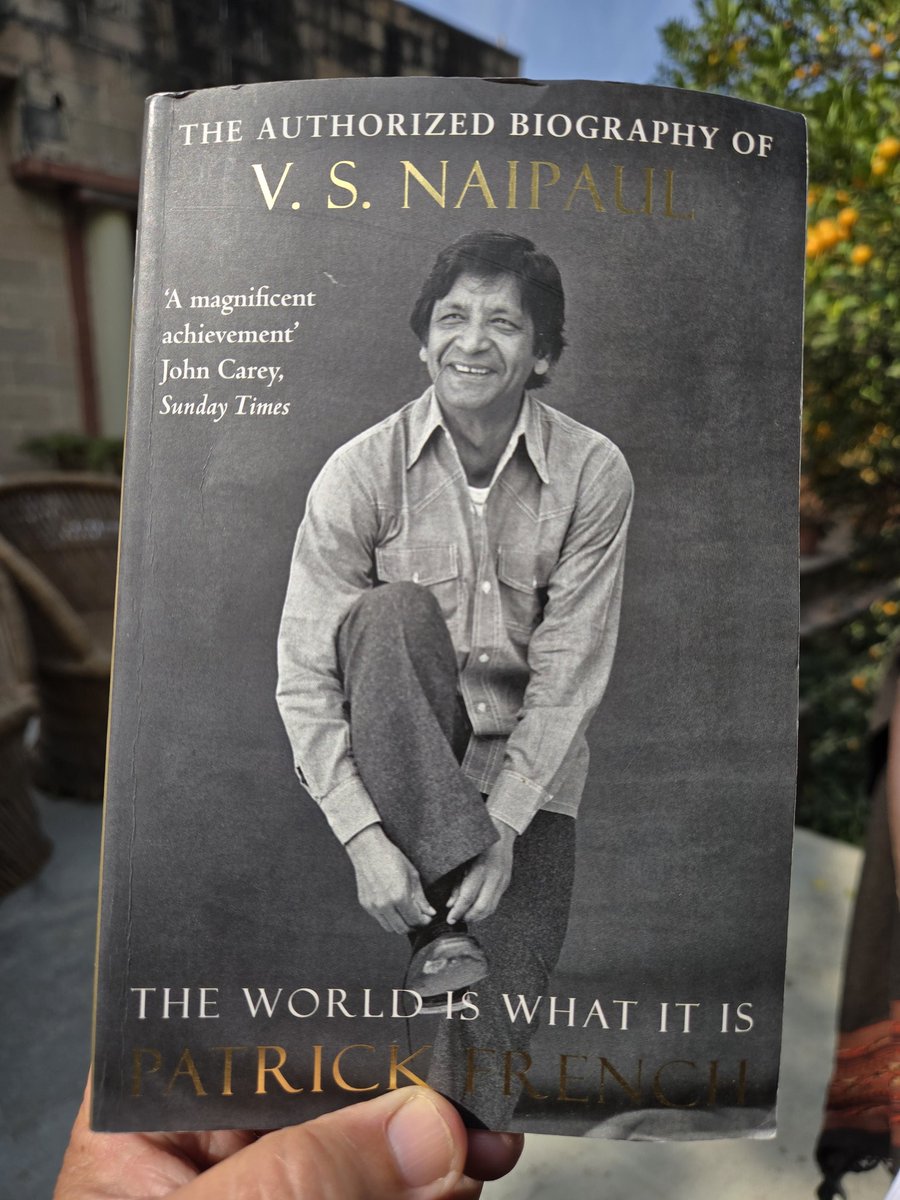
Only book besides the biography of Vincent van Gogh that has made me tearful is Naipaul’s Between Father and Son: Family Letters. Those letters should be required reading for any aspiring writer. Only someone utterly committed to truth would permit the biography French wrote.
I never read my friend Patrick French's biography of VS Naipaul when it first was published. I'm belatedly reading it now for @EmpirePodUK episode on Naipaul that we will be recording this week- the finale of our Writers on Empire series. What a masterpiece it is! And how tragic it is that Patrick is gone & I cannot ring him & tell him how much I'm loving it. And worse still: how many more masterworks like this have we lost with his early death? How I miss him!
A shallow grasp of opportunity cost, coupled with cursory exposure to the humanities, often makes it difficult to distinguish between a meaningful passion and a consuming hyper-costly obsession!
Sometimes, the most economical route to #Mars starts with a simple counterfactual: Imagine if #Ramanujan had never stumbled upon Loney’s trigonometry—how much brilliance would the world have missed? @elonmusk
https://t.co/oKbXFXYiRi