Chamath was given a simple choice, 100 shares of Anthropic, 100 shares of OpenAI, 100 shares of SpaceX, pick one stack (Save this).
He picked SpaceX without hesitation, and his reasoning is worth unpacking fully because it cuts to the heart of how the best investors think about technology bets.
His take on OpenAI and Anthropic was actually generous.
He acknowledged that Anthropic is the superior enterprise product, his own fund uses it as their foundational model and that ChatGPT has built one of the most powerful consumer brands in the history of technology.
But the case for SpaceX is built on something completely different, it is not one business, but rather a platform for multiple businesses that compound off each other.
Starlink generated $11.4 billion in revenue in 2025, growing roughly 50% year over year, and represented 61% of SpaceX's total $18.7 billion in revenue.
The EBITDA margin on the connectivity segment hit 63%, compared to 38–39% for the largest traditional telecom companies on earth.
Subscriber count went from 2.3 million in 2023 to over 10.3 million by Q1 2026, spanning more than 160 countries, and revenue is projected to reach $15.5 billion in 2026.
@chamath core insight is that the global communications infrastructure is profoundly broken and he is right.
Roughly 2.6 billion people globally still lack reliable internet access, and even in developed markets, rural connectivity is patchy, expensive, and controlled by legacy monopolies with no incentive to upgrade.
Starlink is a replacement cycle for an entire layer of global infrastructure that has barely changed in 30 years.
Every maritime vessel, every commercial aircraft, every military unit, every rural hospital, every developing-world government that wants connectivity now has one viable option that didn't exist five years ago.
The maritime and aviation segments alone carry ARPUs of $250 to $25,000 per month per customer, orders of magnitude above the consumer subscription.
But Chamath's most interesting point is what he called embedded optionality, the idea that SpaceX's business model doesn't stop at earth.
SpaceX now has the only fully reusable heavy lift rocket system in the world with Starship, and it is the only company currently capable of launching the next generation of Starlink V3 satellites that carry roughly 10 times more capacity than the current constellation.
Every new market SpaceX opens on earth, direct to cell with T-Mobile, enterprise contracts, government agreements becomes a template that can theoretically be replicated the moment humans establish a permanent presence elsewhere.
A Starlink equivalent for a lunar base, a Mars colony, or an orbital station is the same product with a different launch address.
Anthropic and OpenAI are betting on winning a model race where the finish line keeps moving while SpaceX is betting on owning the physical infrastructure layer of the next era of human civilization, on earth and eventually beyond it.
One of those bets has a floor and the other doesn't and that is why Chamath picked @elonmusk's SpaceX.
Milk Road remains bullish on SpaceX and the infrastructure layer it is building around Starlink, Starship, and global connectivity.
If you’ve been thinking about joining Milk Road Pro, lock in the current price using the link below before prices go up next week.
Hot tip: Create a Grok Bot that's trained on my 500+ podcasts episodes and newsletter posts.
Treat it as your product/strategy/growth/career advisor.
Ask it:
+ How do I find my first 1,000 users?
+ How do I get promoted?
+ What are some non-obvious growth ideas?
+ What are some great PM interview questions?
+ How do I deliver hard feedback?
This may quickly become the best way to consume my content.
Prompt:
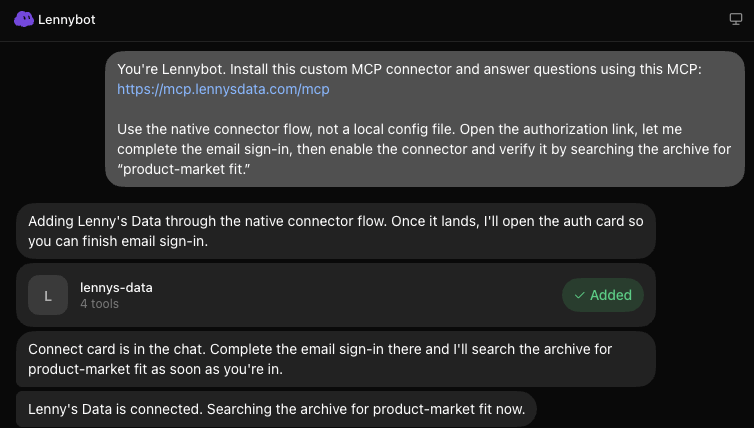
You're Lennybot. Install this custom MCP connector and answer questions using this MCP: https://t.co/HBFUQ09aqs
Use the native connector flow, not a local config file. Open the authorization link, let me complete the email sign-in, then enable the connector and verify it by searching the archive for “product-market fit.”
At midnight on February 6th, earlier this year, the doorbell to our apartment rang. The doorbell was followed by a pounding on the door. I answered the door and a security person in our building handed me his phone. It was my oldest daughter Eloise. She had found my 26-year-old daughter unconscious on the floor of her apartment and had called 911. The EMT team was already there, but they did not know what was wrong with Lucy or to which hospital they would take her.
I threw on some clothes and jumped in an Uber heading east toward Brooklyn. (Lucy lived alone in Williamsburg.) On the way, I learned that they were taking her to Elmhurst, a City trauma hospital in Queens. I arrived about five minutes after the ambulance to join Eloise, Lucy’s mom, and a friend, and waited to learn what was wrong.
After about 15 minutes, I asked a nurse where she was. I looked over his shoulder to his computer. Next to her name, it said “non-responsive.” I walked into the emergency room and wandered around looking for her until I found her unconscious on a gurney surrounded by several doctors and nurses.
By about 2:30am with the results from a CAT scan, Lucy’s doctors had determined that she had a massive brain hemorrhage and would need an emergency hemicraniectomy to release the pressure on her brain and remove the blood from the hemorrhage. I called our wonderful friend and family doctor Eddie Fisher and explained what was going on. He woke up Josh Bederson, Chairman of Neurosurgery at Mount Sinai, to find out more about Zach Hickman, the neurosurgeon on call that night. Dr. Bederson said Hickman was an excellent surgeon, which was comforting as we had no choice.
The surgery to save Lucy’s life began around 3:15am and finished around 5:30am. It was successful.
The following day, I joined Lucy in an ambulance while she was being transferred to Mount Sinai on Madison Avenue. Later that day, we determined from Lucy’s Oura ring that her hemorrhage had occurred around 9am, which meant that more than 19 hours had passed from the time of the hemorrhage to the completion of the surgery to release the pressure on her brain (I only wish @ouraring had an alert for this kind of a medical event. Imagine it could call a family member if the wearer doesn’t cancel the alert).
I later learned that the standard of care is not to do surgery to save a patient with a large brain bleed if more than five hours have passed since the hemorrhage. Even when the surgery is done, I was told that the likely outcome for the patient is a few months in a nursing home and death from pneumonia.
When I met Lucy’s doctors, I did my best to inspire them: “Let’s see what can be accomplished if we give her the best care possible and we invest unlimited resources to restore her to life.” And I promised that whatever we learned we would make available to everyone.
Dr. Chris Kellner, her neurosurgeon, and Dr. David Putrino, Director of Rehabilitation Innovation for the Mount Sinai Health System have led Lucy’s care team since that day. Words cannot describe the remarkable and compassionate care that she has received beginning with the EMT team and then from nurses, doctors, therapists, and the army of people who have worked to save her and return her to life. To this day, we have a daily Zoom where we discuss her progress and make adjustments to her care. While her care and oversight have been incredible, the learnings for the Mount Sinai team have also been elucidating and will assist in the care of many others.
Lucy began in a bad place. She was in a coma for several weeks and then awoke not being able to breathe on her own, unable to walk, see or speak.
Over the last six months, she has recovered her cognition – she understands everything including her circumstance – is able to walk a hundred or more steps at a time with assistance, is making progress with sounds, vowels and consonants and the beginnings of speech, but she remains unable to see.
Each day, she makes a little progress, and daily progress compounds. Every day I tell her that she just needs to make a little progress and it won’t be long before she is back.
We remain optimistic that Lucy will return to normal function. It will likely take years, but I believe it is only a matter of time, hard work, and technological progress, along with some, and perhaps a lot, of divine intervention.
Many people have been praying for Lucy and we are incredibly grateful for the prayers and remarkable support she has received. Lucy’s friends have been with her every day since the beginning, and their presence and friendship have saved her life and helped to rebuild and maintain her spirit. And on a very positive note, Lucy’s challenge has brought together our entire modern family who have all been incredibly devoted to her care and recovery.
Lucy's vision and other faculties may require some form of brain computer interface, work that is underway at Neuralink, Precision Neuroscience, Science, Synchron, Nudge, and other companies in the space.
If you are going to have a devastating brain injury, now is the best time in history for that to happen. We are living in a world when you can be confident that the blind will soon see again. We are going to do everything we can to help make that happen, including by assisting existing companies in the space.
With respect to our promise to make Lucy’s care available to others, we have made good progress. In May, a real estate colleague made me aware of a 93% vacant, brand new, 400,000 square foot Class A+ purpose-built biotech facility on West End Avenue between 65th and 66th Streets that missed the market and was available for sale. The Pershing Square Foundation acquired the building 60 days later.
We also put under contract an adjoining 130,000 square foot building at 320 West 66th Street that is currently being used by Saturday Night Live for studio space. The building has 35-foot ceilings with massive column-free spaces that can be converted into superb rehabilitation facilities. We will close on the SNL building in December.
We are also acquiring an adjoining vacant lot with additional air rights. With just the existing zoning rights, we can add a 150,000 square feet for a total of 680,000 square feet, a lab footprint larger than Rockefeller University, and that’s without including the potential for an upzoning that would allow for substantially more buildable area on the site’s 3.4 acres with spectacular views of the Hudson.
Our goal is to build the world’s greatest brain research, rehabilitation, recovery, human optimization, and longevity institute. We have named it The Ackman Oxman Institute or the AOI for lack of a better name, but also to reinforce the point that Neri and I and our family are all-in on the mission.
The AOI will be patient-centric. It will not be an academic research institute that produces lots of papers, a Nobel Prize winner or two, but little if any results for patients. We will be laser-focused on cures, treatments, devices, rehabilitation and exercise equipment, and targeted and basic research with a goal of massively accelerating the time from idea to innovation to production to helping a patient.
While the AOI will be a non-profit, it will have highly commercial instincts. The AOI will have its own venture funding and will work to develop innovations to create companies that we will seed, assist, and spinout to ensure technologies, treatments, techniques, and drugs get to patients as promptly as possible.
On one 3.4 acre campus in what is still the greatest city in the world, we will do neurosurgery, neuroscience, rehabilitation, nutrition, BCI and device development, human trials, hyperbaric oxygen treatments, and life extension programs, and we will mandate and incentivize collaboration among the teams with no silos, politics, bureaucracy, or any other constraint that is inconsistent with the mission.
Mount Sinai will be an important partner and deservedly so, but it won’t be our only hospital or medical school partner as we don’t believe any institution has a monopoly on the best ideas or the best talent. We don’t believe in exclusive relationships because that is not in the best interest of patients.
Five years ago, we considered launching a brain institute inspired by Neri’s mom who sadly died from Alzheimer’s. We couldn’t make the math work as the real estate was too expensive and we believed it would be too difficult to recruit the best talent from universities to our effort.
Since then, the real estate became available at a 70% discount, universities became a much less attractive place to work due to politics outweighing meritocracy, protests that disrupt learning, the curse of antisemitism, and a decline in funding. Fortunately, during the same time, I made sufficient personal economic progress to make the AOI possible.
The advance of AI in the last few years will also enable us to greatly accelerate our mission. AI still has a lot to learn about human intelligence and the brain, and the AOI should be at the forefront of the interplay between the brain and AI.
Today, I am making a public filing disclosing a gift from Neri and me of ~$400 million or 10,000,000 shares of Pershing Square Inc. (PS) to the AOI. It is very early days for Pershing Square so these shares are intended to anchor the long-term work of the AOI as the shares compound over time while generating what we expect will be a growing stream of quarterly dividends to fund the Institute.
We will also be announcing an additional gift of similar and potentially greater size which won’t be in the form of Pershing Square stock to provide the AOI with the short- and intermediate-term runway necessary to enable it to achieve its goal of becoming a self-sustaining institute, which reinvests all of its revenues, royalties, and the economic rewards of company formation to advance the fields of brain health and human longevity.
Neri and I have chosen to anchor the funding of the AOI to maintain vision alignment and limit the need for the organization to focus on fundraising. We expect the AOI to be the best-resourced brain, rehab, recovery, and longevity institute in the world.
We are grateful to have been able to form a board which includes Dean Kamen (our generation’s Thomas Edison), George Yancopoulus (CEO of Regeneron), James Rothman (Nobel Laureate), Bernardo Sabatini (neuroscientist), Chris Kellner (neurosurgeon), Olivia Flatto (CEO Pershing Square Foundation), Neri Oxman, and myself.
We have recently identified a CEO who we expect to announce by October along with other key hires, and are beginning searches for a Chief Scientific Officer, a Chief AI/Technology Officer, a Chief Operating Officer, a Chief Financial Officer, and other key leadership roles.
If you find what we are building compelling and want to be part of the leadership team that creates and builds the AOI from a standing start, please send an email to: [email protected] with a short note as to why you believe you can help. Please include your best three ideas for the AOI along with a summary of your background and your most important accomplishments.
We promise strict confidentiality to those expressing interest in working with us.
We have learned from Lucy that the brain can recover from even catastrophic injury. There is so much more work to be done as the mind is a terrible thing to waste.
For details from my Pershing Square SEC filing see:
https://t.co/gZKafCw6Ia
A lot of people on X are new to the markets. So I'll make this as simple and harsh as possible.
The economy is not going up. It is not going down. It is doing both at the same time. This is called a "K-shaped
economy" and almost nobody talking about affordability on your timeline understands what it actually means.
If you own assets, stocks and real estate, you are on the upper arm of the K. Your wealth has compounded aggressively since 2020. The S&P is at all-time highs. Home prices are up 50% since the pandemic. Your 401k is the best it has ever been.
If you do NOT own assets, you are on the lower arm. Rent is higher. Groceries cost more. A home that cost 2.2x the median income in 1960 now costs 5 to 7x. You are working harder and falling further behind, and it is not your imagination.
The top 10% of Americans own 93% of all stocks. The bottom 50% own 1%. The top 10% hold 68% of total wealth. The bottom 50% hold 2.5%. This is not an opinion. This is Federal Reserve data.
When the S&P goes up 25% in a year, the people who own stocks get 25% wealthier. The people who don't own stocks get nothing. That is the K. Same economy.
Two completely different outcomes based on one thing: whether you owned assets before the run started.
This is why your timeline is split in half. Half the people saying the economy has never been better. The other half saying they can't afford to live. Both are telling the truth. They are just on different arms of the K.
How long does this last?
The honest answer is that it has been going on for decades. The Richmond Fed traced this pattern back 30 years. It happened after 2001. It happened after 2008. It happened after COVID. Each time the gap widened and never fully closed before the next shock hit.
The last time wealth concentration looked like this was the Gilded Age, 1870 to 1900. That lasted 30 years before structural reform changed anything.
What does this mean for you?
The K-shaped economy is not a reason to panic. It is a reason to understand where you sit and what you can control.
The people on the upper arm did not get lucky. They owned assets. That is the entire difference.
Change your life and start small. No matter how small your account balance is. I only started with $10K, twenty years ago. This is your time to retire your whole family. They are counting on you.
If you’re a $SPCX investor, you’ve have to bookmark and watch this video entirely. There’s a lot of bears cases against SpaceX but Ron Baron seems to be the biggest bull on SpaceX and has sacrificed $3 billion of his personal net worth to stay all in: "We've made our clients maybe $15 billion - I gave up $3 billion of my own profit to keep those shares - I don't want Elon to think about us as someone he gave stock to who sold it the first chance they got. in 56 years there hasn't been a single company that I've seen like SpaceX. not one. the economy doubles every 10 years. Elon thinks that instead of doubling, we're about to grow 10 times every 10 years. the head of Anthropic was trained by Elon. the head of ChatGPT was trained by Elon. we sold capacity in that facility to Anthropic for $1.25 billion a month for the next year and a half. $15 billion a year. then Google comes along and says we need compute also. Elon says okay, I'll show you what I have left for $900 million a month. it all came from George Soros. he had a bad year in 76 or 77, and his fund advisor said why don't you have some other people manage money for you. I was one of his six favorite analysts. he gave each of us $5 million"
"If you are relying on AI to write for you and to generate ideas for you, you are putting yourself at sea level"
Silicon Valley's go-to comms strategist Lulu on why templates and AI writing rob you of being better
"When you use a template, you are giving up on the possibility that you could be better. And I say this sometimes about AI writing, AI is a wonderful tool, I use it all the time"
"But if you are relying on AI to write for you, you're putting yourself at the level of anyone else in the population who wants to pay fractions of a cent for a token to get similar output from the same shared brain. So if you are far below average, you should do that, because average is better than you. But if you believe you can be even a little bit better than average, you would be robbing yourself"
"Ralph Waldo Emerson calls it a form of suicide, because in imitating others, which is what a template is, you are killing your own ideas. What are we if not a unique combination of beliefs, ideas, feelings?"
"If you take that and you mute it, you are killing a really sacred part of yourself. So using templates is robbing yourself of the possibility that you could ever be better than the last thing, and that's a shame"
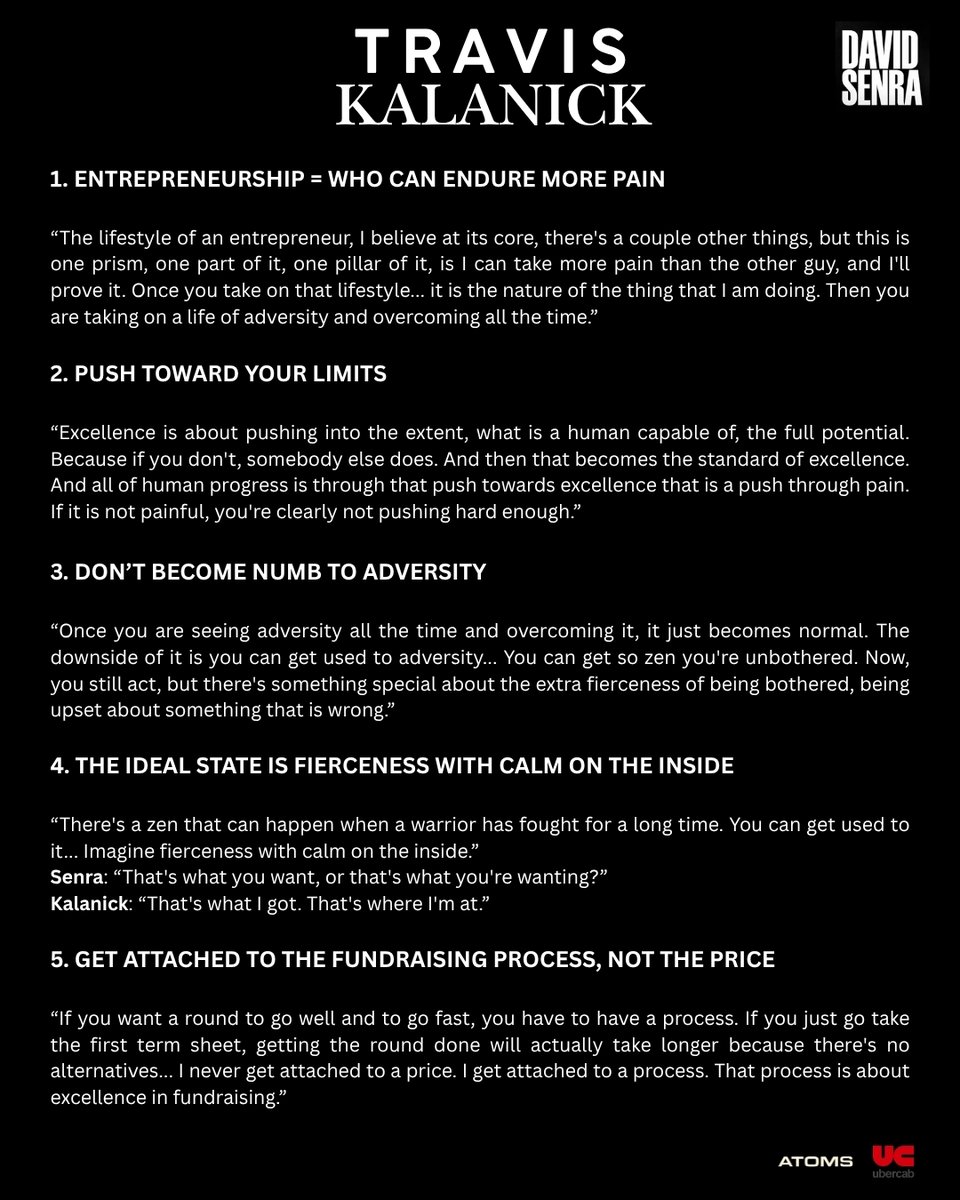
18 lessons from Travis Kalanick (@travisk) on building companies, adversity, raising capital, competing at scale, & pushing toward the edge of what’s possible.
I was a bricklayer.
It was how I paid the bills when I first moved to America. Even the biggest title in bodybuilding, Mr. Olympia, only paid a thousand dollars back then.
It makes me proud that in March, the winner of our Arnold Classic and our Arnold Classic UK took home more than a million dollars. He can focus on bodybuilding.
But in our day, that wasn’t an option. Some guys were teachers. Some sold insurance. Franco and I laid bricks.
We put an ad in the paper and sold ourselves as European craftsmen. We figured if people heard the accents, they would picture old-world masonry instead of two bodybuilders with a wheelbarrow.
It worked.
The phone rang. And then we had to go out and actually do the job, which was the part nobody could fake. Luckily, Franco knew what he was doing.
The work was simple. Mix the mortar. Set the brick. Tap it level. Scrape the edge. Then do it again. And again. Nobody claps for you. There is no crowd, no music, no trophy. There is just the next brick sitting there waiting for you.
You can still find some of the walls we built in Venice.
That’s where my lesson today comes from.
One brick doesn’t look like anything. Ten bricks don’t look like anything. A hundred bricks, you’re starting to see something, but it doesn’t impress anyone.
You just keep laying bricks until the job is done.
And you know what happens after four or five hours on a wall?
You are so damn tired, or you feel so great that you stop measuring.
You are not standing back every ten minutes asking how far from finished it is. You are covered in mortar, your hands are raw, you’re schvitzing, and you are happy. The work took the question away from you.
That is the part nobody tells you about hard work: It doesn’t just build the wall. It terminates the voice that keeps asking when the wall will be done.
Robinhood CEO @vladtenev believes $HOOD has several paths to becoming 10X larger:
“I see multiple vectors where the company can grow 10X, and we’re pursuing them in parallel.”
One is tokenization, expanding stock ownership to 120+ countries.
Our full conversation below
Jensen is back in the house!!
Jensen and Nvidia have been phenomenal partners. I'm excited to be working closely together as we massively scale up this year
I’ve traded stocks for more than 20 years.
It took me 7–10 years to become consistently profitable—and there was no single breakthrough.
My progress came from eliminating one costly mistake after another.
Here are 24 lessons I wish I had known at 20: 🧵
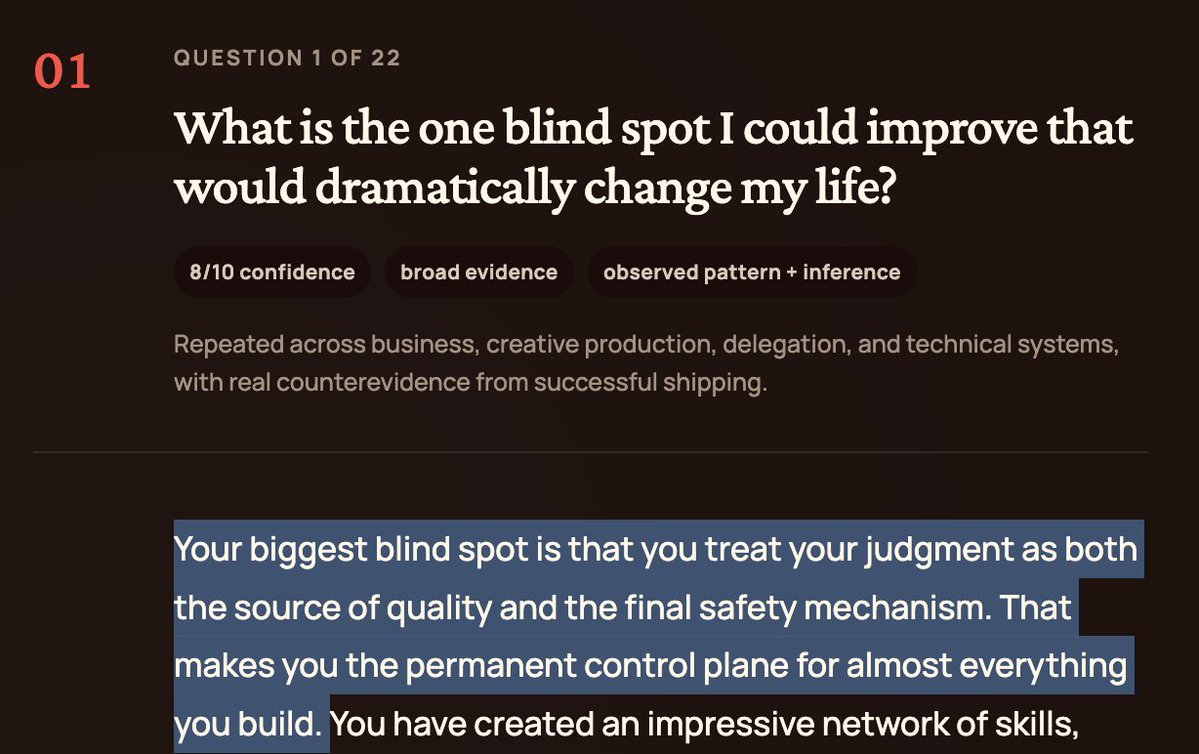
This is a really cool prompt from @kevinrose that asks AI to reflect on all your past threads together and give you a list of insights that you may not know about yourself.
To try it just tell ChatGPT or Claude to:
"Make an html report based on https://t.co/37hjVB0C93"
But is it telling me to stop using my judgment and give in to the slop? :)
Thanks @bentossell for surfacing this.
I'm working on so many projects right now that it's hard to keep track of, especially with agents building things. It's hard to keep track of as I don't have time to add these to kanban or lists.
How are you tracking all these major and subprojects that agents are working on?