History rarely names its infrastructures while they’re being built.
Gold was just metal until it became money.
TCP/IP was just plumbing until it became the internet. Bitcoin may be next.
The Movement to Anchor Stablecoins on Bitcoin 🔗 https://t.co/N2QIFg0CTj
@darkside2030 in the Bitcoin vs everything else debate, worth actually understanding what Bitcoin solved. Byzantine generals problem. double spend. difficulty adjustment. proof of work. halving. each one matters. together they’re unreplicated
@dmweisberger The most powerful argument for Bitcoin is watching the most powerful banker in the world lose his composure over stablecoins.
"Mad is Bad" is a perfect frame. Tip o' the hat to Artie. Appreciate the actual clarity here Dave
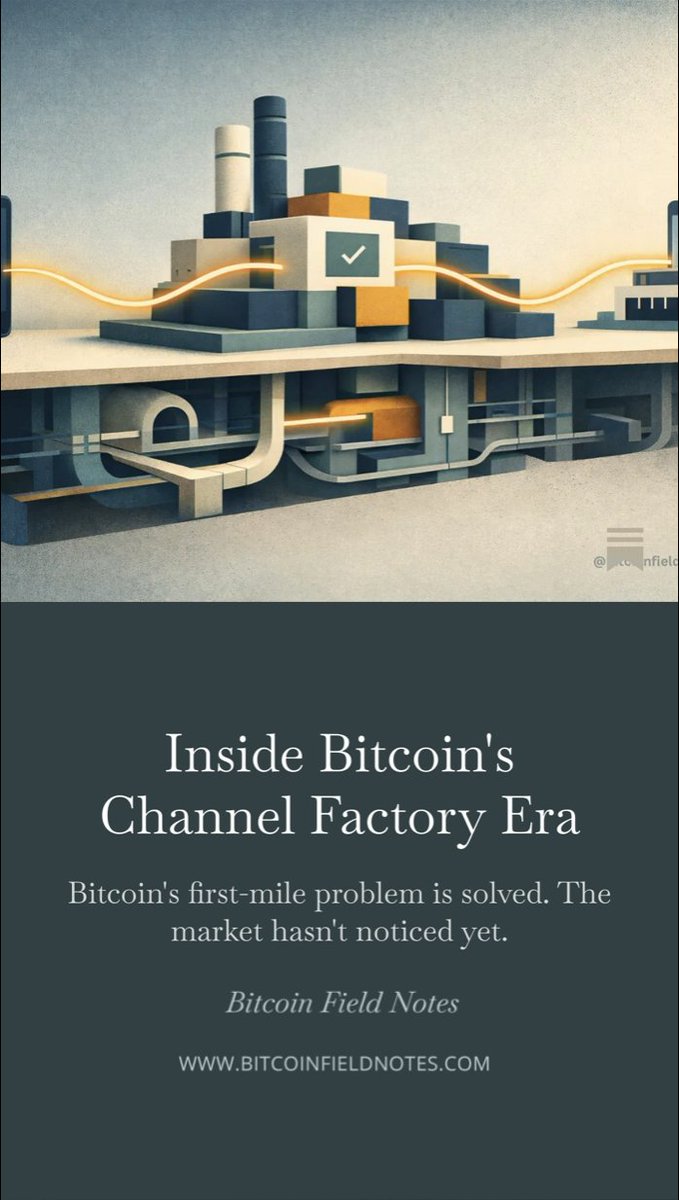
Lightning has had a first-mile problem. Using it meant understanding channels and inbound liquidity before you could move a single sat. For years, that was the bottleneck.
In 2026, the bottleneck is gone.
Ark, from developer Burak Keceli, replaces bilateral channels with a shared coordinator. One on-chain transaction onboards hundreds of users at once.
Spark, from Lightspark, took a different path: statechains with "leaves" that let a single UTXO be subdivided and transferred off-chain. Fast finality. Native stablecoin support. USDT on Spark is already live.
Ark and Spark aren't competing highways. They're both on-ramps to Lightning. Breez wrapped both in an SDK developers can actually ship on. Block's Spiral team built LDK, the open-source toolkit behind Cash App's Lightning experience.
Lightning's first-mile problem is solved. The app ecosystem on top of it is just getting started.
Full piece: https://t.co/r8fwiWaJrl
@DocumentingBTC
Another take: The "digital cash vs digital capital" debate assumes these are opposites. Maybe Bitcoin becomes cash *because* it first becomes trusted capital. Bugiri suggests they're sequential. @brindonmwiine just showed the receipts.
https://t.co/AuD3HxTSVN
And yes, the real war is between Bitcoin and the system it's replacing
The Bitcoin whitepaper described peer-to-peer cash.
Here’s Bugiri, Uganda, showing what that actually means.
A school development project born from the Bitcoin community, paid for almost entirely in sats.
Bitcoin economies don’t need permission. They need people willing to build.
@brindonmwiine@geyserfund@BitcoinBeach@BitcoinEkasi
The Bitcoin whitepaper described peer-to-peer cash.
Here’s Bugiri, Uganda, showing what that actually means.
A school development project born from the Bitcoin community, paid for almost entirely in sats.
Bitcoin economies don’t need permission. They need people willing to build.
@brindonmwiine@geyserfund@BitcoinBeach@BitcoinEkasi
A Bitcoin school exists in rural Bugiri that should not be possible.
100+ children. 4 classroom blocks. 22 staff.
Paid for almost entirely in sats.
The story starts with 34 strangers and a single plane ticket in May 2023. I opened a @geyserfund campaign asking 5.9M sats for a flight to @BTCPrague. Thirty-four people sent it in. I got on the plane.
At the Circular Economies booth in Prague, I was challenged: bring Bitcoin home. Use it for the things money is actually for. Not slogans.
I went back to Uganda looking for the place that test would land hardest. I found it in Bugiri.
An orphanage called @orphansofuganda . 77 children. No electricity. No plates. No toothbrushes.
The only school within 10 kilometres — Starlight Elementary — was about to close after a district inspector flagged it below ministry standard.
We did not buy the school first. We signed an MOU. Administered it for 18 months. Earned the right to be trusted with it. Then acquired the title.
Four classroom blocks went up. Every load of cement was paid for in Bitcoin. Every tile. Every can of paint.
The older students who plastered and sanded and carried were paid in sats for their hours on site.
A muralist(@dennis_kasagga) moved onto the campus and stayed.
By February 2026, the school was open.
Three videos compress the journey 👇
THE PITCH: the campaign video that started it all:
https://t.co/0fb2C4ELsz
BEFORE: watch the small boy who introduces himself as "Mr. Bitcoin" and defines it on camera as "the
digital currency":
https://t.co/ncW1E8QdTH
AFTER: the same campus today: https://t.co/FrT0CcaLSo
The long version:
https://t.co/MIcL7rkrZL
@Bitcoinbeach@BitcoinBeachBR@Trezor@TrezorAcademy@geyserfund@BitcoinEkasi there is no Starlight without you.
Fed Chair Kevin Warsh for the win in 2025:
Interviewer: "Charlie Munger attacked Bitcoin. He called it evil, in part because it would begin to undermine the Fed's ability to manage the economy."
Warsh's reply: "Or it could provide market discipline, or it could tell the world things need to be fixed... Bitcoin does not make me nervous. I see it as an important asset that can help policymakers discern right from wrong in decision-making. It is not a substitute for the dollar. I believe it can often serve as an excellent overseer of policymaking."
@HansonHash So well said. This is exactly what Andreas was calling "neutrality" back in 2013:
“Neutrality in Bitcoin means being able to adopt Bitcoin in any culture, any language, any religion, any geography, but also any political or economic system.”
What if Bitcoin's adoption plays out the same way TCP/IP's did?
Andreas drew the parallel in 2013, to a nearly empty room.
Today, almost every battle and every opportunity he described has played out.
Full transcript, video, and four quotes that aged remarkably well: