I absolutely loved Cliff’s recent podcast conversation.
Back in 2022, when I first invested in Carvana, I went through one of the hardest emotional periods of my investing life.
I’m sure many others who had a significant portion of their net worth tied up in $CVNA felt the same way.
Every day, I kept posting:
“No, Carvana is not as bad as you think! You're all trapped in your biases. You're missing the essence of the business, it’s not just about what the financials say on the surface!”
I remember how angry I used to get reading completely irrational and fact-free comments from haters.
It felt so pointless to respond with logic, and since I wasn’t good at writing, all I could do was vent. Many of those posts still exist, and I go back to read them from time to time for fun.
And yes, there are still some haters out there—but now I just feel sorry for them.
At one point, Carvana was over 90% of my portfolio. Even now, it's still around 50%. I’ve since diversified—not because I lost conviction, but because I’ve reached a place of financial security and no longer need to take on black swan risk. Thankfully, the businesses I diversified into have also performed incredibly well.
These days, I don’t feel the need to post much on X. Carvana has given me the freedom to live on my own terms. I’m simply enjoying the magic of compounding.
And just like Carvana became a better company through that time of pain, it taught me how to live my life, what true freedom, happiness, and Stoic philosophy is.
I don’t know if @CliffordSosin remembers me, but we exchanged a few messages during that difficult time. His words meant a lot to me.
So thank you, Cliff—for your kindness. I wish you continued happiness in all that you do.
Cliff Sosin has run one of the most interesting portfolios in public markets—nearly $2B concentrated in just a few companies, which he always knows better than anyone.
Over many years, I’ve enjoyed conversations with him on a million topics, and finally convinced him to talk about investing with me for everyone to hear.
We start talking about investing overall, and then spend a large part of the conversation hearing his side of the Carvana investing story—one for the ages.
Enjoy
Timestamps
0:32 Early Career & Discovering Investing
1:49 Starting the Firm
7:23 Defining a Good Business
12:31 Contained vs. Uncontained Businesses
15:30 Mental Models & Market Insights
30:13 The Role of ESG in Investing
34:26 The Carvana Investment Story
41:01 The Complexity of Car Transactions
46:43 Economies of Scale and Trust
49:40 Management Insights
59:07 Operational Issues & Market Challenges
1:19:17 The Role of Word of Mouth in Carvana's Growth
1:20:28 Identifying Early Adopters
1:27:19 The Apollo Deal and Debt Restructuring
1:28:23 Personal Reflections on Investment Decision
1:34:21 The Psychological Toll of Investment
1:45:16 Future Investment Strategies and AI
1:54:51 The Kindest Thing Anyone Has Ever Done For Cliff
@SagaPartners I’ve been following your past letters for quite some time now, and every letters to be truly exceptional.
Thank you for sharing your insights.
@GabGrowth I think TikTok Shop is not competitive in the long term. Its users are predominantly women in 2~30 ages, and the items purchased are primarily specific products tailored to their tastes (cosmetics, clothing, etc.)
The biggest lesson I’ve learned investing in Carvana since 2022.
In the end, investing works only when there is a gap between price and value.
The size of that gap differs by stock, and $CVNA is one of the clearest examples I’ve seen.
It shows, in real time, how human cognition and crowd conformity create mispricing and how a small group of investors captures long-term excess returns as that gap gradually closes.
People prefer short messages, simple narratives.
When information is long and complex, most people do one of two things:
1. ignore it, or
2. look for someone else to think for it.
CVNA strongly attracts the second type.
“ABS? Securitization? Drivetime? Bridgecrest? Too complex.
but this company’s growth and profitability look too strong relative to peers, so it must be fraud.”
People who outsource their thinking are easy to synchronize into a crowd, because narratives are cognitively comfortable:
“He’s a famous short seller, he was right before.”
“Remember Enron?”
“This is fraud.”
“Related-party transactions? Suspicious.”
Human perception and judgment are shaped by evolutionary design.
This is less about willpower and more about default cognitive wiring.
People struggle with rigorous deduction and naturally gravitate toward pattern matching from past cases.
That is exactly where opportunity comes from.
That is what CVNA has gone through for the last four years. (Actually not 4 years, but more than 8 years, same topic, but none of them success)
The claim has always been started the same:
“Someone finally found proof it’s a fraud.”
But what happened in the end?
While that conformity cycle repeated,
What is truly important?
How many vehicles does Carvana actually sell?
What is the growth rate?
How did the business perform?
How did growth and operating results evolve?
Those are what actually matters.
Of course, if someone insists past 4 years car sales, EBITDA, real customer themselves are fabricated, there is no meaningful discussion left.
They should simply short it with full size.
I recently read @mjmauboussin 'Who Is on the Other Side?' and found it deeply resonant.
On the other side of my investing are often people who cannot process informational complexity, who fill gaps in incomplete evidence with narrative certainty, and who miss what is truly fundamental.
Also on the other side are those who try to profit from shorting by exploiting complexity and uncertainty or those who are unaware of what they do not know, yet carry strong conviction anyway.
That dynamic is part of what gave me structural edge, and also the distance to watch endless meaningless arguments with both amusement and sympathy.
As Ernie said at the end of the earnings call :
“The march continues.”
So your logic is: someone took a plea 36 years ago, a major shareholder, his son is CEO. therefore the company is fraud?
Meanwhile the company has been public for nearly a decade, made it into the S&P 500, and has been owned by plenty of fundamental investor.
And you’re still shouting "I know something!! I know ! It is fraud!"
So who’s wrong everyone else but you?
Got it. You’re the genius. Go ahead, short it with your full net worth.
yes. 36 years ago.
And it wasn’t even the CEO; it was the CEO’s father.
So the real question is
: Does it really matter ?
Are you seriously saying that because someone committed fraud 36 years ago, this company must be a fraud today?
If that’s your logic, then fine—we have nothing to discuss. good luck
You can’t truly know carvana, same as other company just by running hundreds of them through a screening tool. Whether you should focus on net, operating income, FCF, or EBITDA depends on the nature of the business itself.
I’m not sure what you’re trying to prove with your '55x NTM,' but it's clear you're missing the actual essence of the business.
Again, while you spent the last five years calling it wrong, $CVNA up 100x
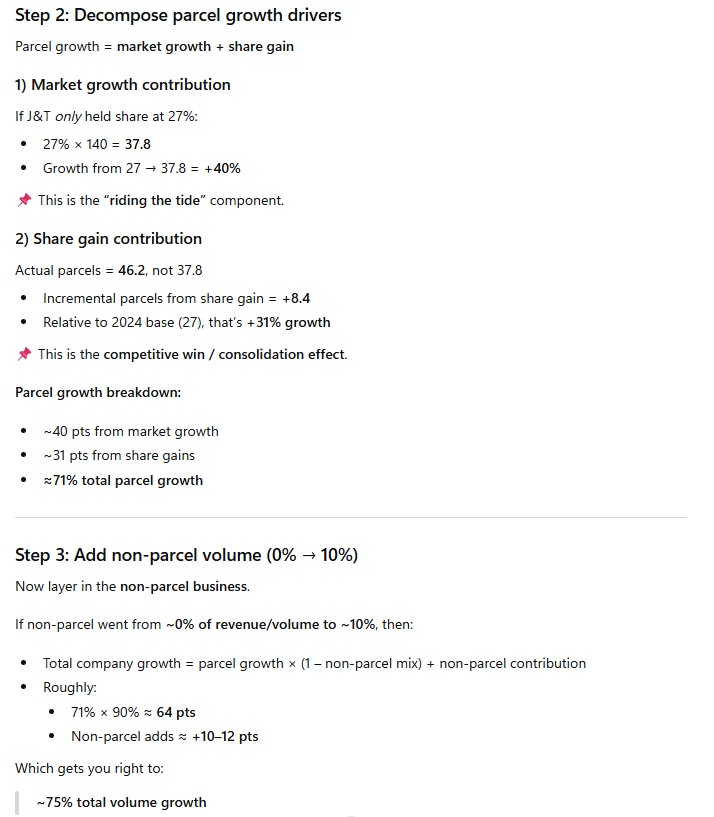
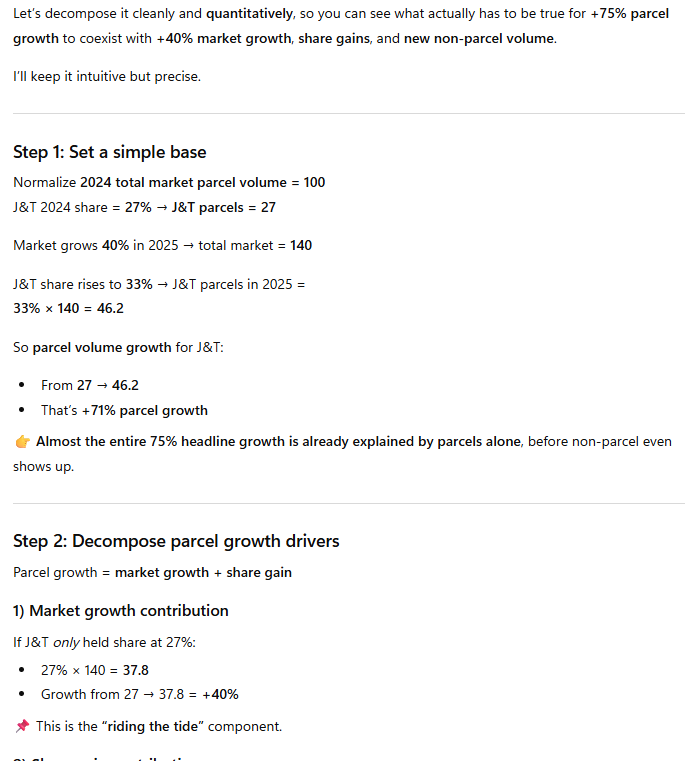
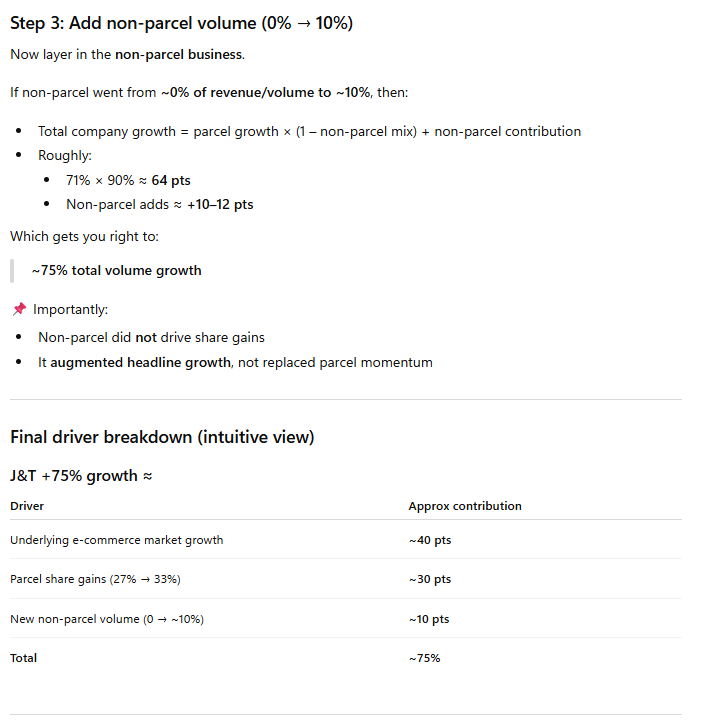
Just hammering this home. For simplicity's sake, let's use round numbers for 2025:
1) J&T Order Volume Grows: 75% y/y
2) Tiktok & Other Customers Grows: 40% y/y
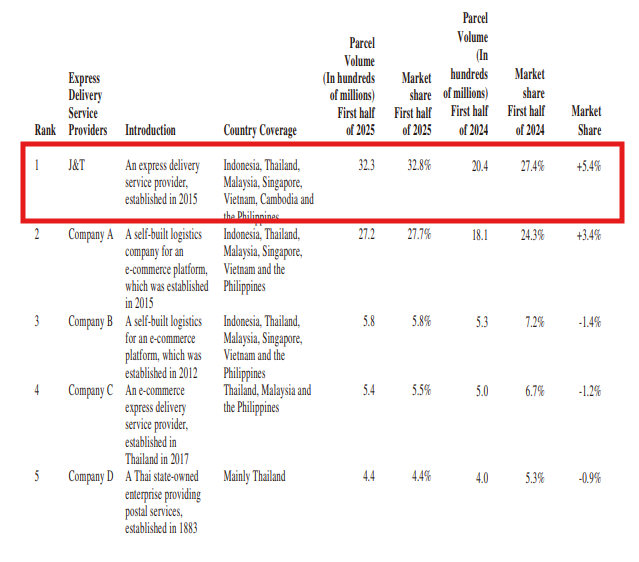
3) J&T Grows Market Share from 27% in 2024 > 33% in 2025 (disclosed in the 1H25 Report)
4) Non-platform % of revenue goes from 0% > 10% in 2025.
All the data-points line up.
Takeaway: It can be true that J&T grew 75% y/y, AND Tiktok is slowing to 40% y/y orders growth (and 30% y/y GMV).
- Market narrative of Tiktok competition increasing is likely wrong.
- Means that Shopee's recent spend is not a defensive move or coming from a weakened position.
- In fact, they're pressing harder, while competition is weak (That's just how they operate. They waited to grow Monee loans, until the digibanks started blowing up. That's why you see an inflection in loan growth 2 years ago. Compare that to when Indo digibank NPLs started blowing up, and you'll see the correlation).
Included pictures of the math (thanks ChatGPT). $SE $1519.HK
Other people's opinions? Are you referring to those on Twitter who've been shouting 'scam' for five years straight, just like you? If they've been wrong for the entire five years, I rather think it's time they took a look at themselves.
Corporate performance matters more than pointless arguments. If you're going to claim that performance is fraudulent too... Conspiracy offer no solutions.
@_kablaa @GothamResearch Well, that was a long, long, long load of rubbish. Right then, go ahead and short your entire fortune.
Not mouth, put your big money.
There has always been speculation about how @Carvana creates such differentiated results. The truth is simpler than many people realize - it's a vertically integrated business model built to create better customer experiences end to end. I appreciate @peterahigh digging into the details of our integrated systems and the tailwinds to come from AI.
Apple: https://t.co/qpgcZx6zSo
Spotify: https://t.co/e7HN7UQQ5H
YouTube: https://t.co/JqS18hgppF
I understand your perspective that envy is evil from an individual's point of view, but good from a societal one overall. And it's fair to say that society has progressed through this emotion of envy.
There's some truth to that for minor, lower-level advancements. But I don't believe that truly great progress starts from envy.
From a higher conceptual level, I think it's "creativity" that's driven real change and development. Envy could be one of the many factors that fuels that creativity.
I don't think the creators who've brought countless new things into the world were fundamentally rooted in envy.
Rather, I believe it's the dream of something new and the passion to make that creation a reality that's truly led society forward.
@IndraStocks For past years, we've been constantly seeing... similar... recurring... familiar scenery. It's probably a bias in human perception. After all, they'll see what they want to see.... It's just the same thing repeating over and over. But CVNA real company doesn't care.