Just claimed my Vault777 Founders Pass!
Early claimers get up to $10K bonus when the platform launches.
Your chance to secure access @UseVault777 is now, act fast:
https://t.co/8ENYgvKBZL
Why Leopold Aschenbrenner is betting big on these 6 stocks ?? :
1. $LITE (Lumentum)
Core product: EML lasers, OCS (Optical Circuit Switches), CPO lasers
$LITE Thesis: order book is SOLD OUT through 2028
→ $2B Nvidia investment + purchasing deal
→ OCS backlog >$400M, 150% CAGR to 2028
→ CPO: new multi-hundred-million $ order just landed
2. $COHR (Coherent)
Core product: 800G/1.6T transceivers, InP lasers, OCS, CPO
$COHR book-to-bill just hit 4x. Demand is obliterating supply.
→ $2B Nvidia deal for U.S. optics manufacturing
→ 10+ OCS customers, CPO mega-order just received
→ Supports SiPh, InP & VCSEL — hedged for types of Hyperscalers
3. $CRWV (CoreWeave)
Core product: GPU cloud for AI workloads (Nvidia H100/B200 clusters)
$CRWV just locked in a $21B deal with Meta through 2032.
→ 850MW active today → 1.7GW by end of 2026
→ $66.8B total backlog
→ First Nvidia Vera Rubin deployments included
4. $CORZ (Core Scientific)
Core product: AI/HPC data center hosting (high-density colocation)
$CORZ went from Bitcoin miner → AI infrastructure landlord.
→ 590MW contracted with $CRWV = $10B+ over 12 years
→ $2B in infra installed across 4 sites in 2025
→ $CRWV acquisition pending ($9B deal)
5. $APLD (Applied Digital)
Core product: AI data center campuses (long-term leases)
$APLD has $16B in contracted lease revenue across 600MW.
→ $11B, 15-yr deal with $CRWV (Polaris Forge 1)
→ $5B, 15-yr deal with undisclosed hyperscaler (Polaris Forge 2)
→ Revenue up 250% YoY last quarter
6. $BE (Bloom Energy)
Core product: Solid Oxide Fuel Cells (SOFCs) — behind-the-meter power for AI data centers, deployable in 90 days vs years for grid connections
Latest deals:
∙Oracle agreed to purchase up to 2.8GW of fuel-cell power from Bloom to supply AI data centers, with 1.2GW already contracted
∙$5B strategic partnership with Brookfield Asset Management to deploy SOFCs for AI infrastructure globally
∙$7.65B in data center contracts secured in a single 90-day window in early 2026
∙Total backlog ~$20B, up 65% YoY. Product backlog ~$6B, up 140% YoY.
📈2026 revenue guidance: 50%+ growth
∙Recently delivered a hyperscale AI factory order in 55 days against a 90-day commitment .
BREAKING: The AI trade may not be about chips.
It may be about power.
The US faces a projected ~50 GW data center power deficit through 2028.
Bitcoin miners like IREN, Core Scientific, TeraWulf, and others represent both the fastest and the cheapest way to bring power online.
These may be AI infrastructure companies hiding in plain sight.
Read the full thesis from @Modular_Capital, here: https://t.co/ZhlmowEdI1
This is WILD!
Bloom Energy just reported Q1 2026 earnings and the stock is up nearly 10% in after hours right now.
And the man with the most to gain is a 24 year old who got fired from OpenAI.
Leopold Aschenbrenner ran safety research at OpenAI until the company let him go.
He then wrote a 165-page essay arguing that AGI was arriving faster than any investor understood and that the people who would win were not the ones who owned the best AI model.
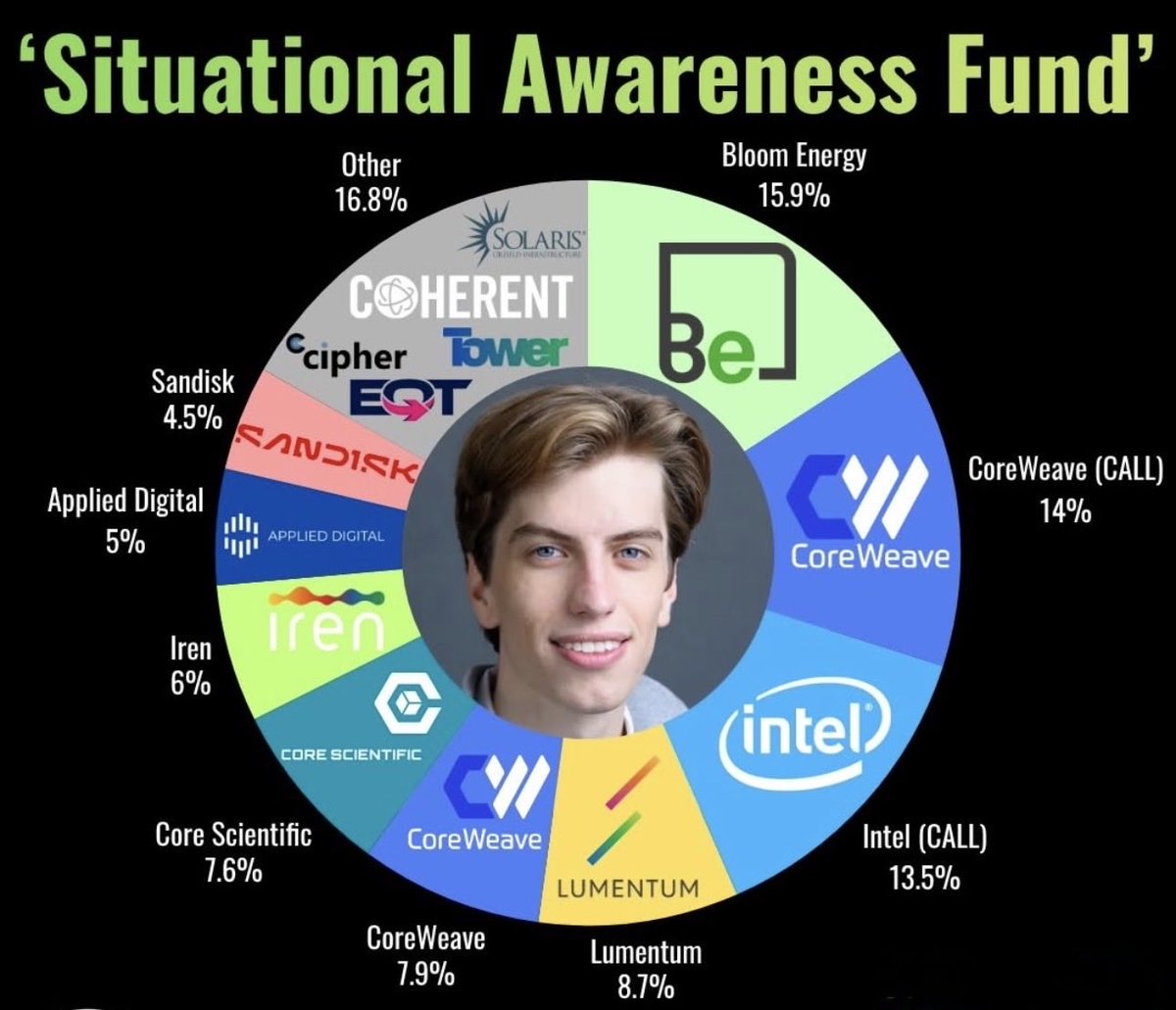
They were the ones who owned the electricity and that thesis became a hedge fund called Situational Awareness LP and he turned $225 million into $5.5 billion in under twelve months.
His largest single position is an $875 million stake in Bloom Energy and with tonight's 10% move, that position is now worth more than $2.2 billion and still climbing.
The catalyst is obvious in hindsight but almost no one saw it coming.
Bloom announced a 2.8 gigawatt fuel cell deal with Oracle, the largest on site power commitment in the history of enterprise computing.
Bloom delivered in 55 days against a 90-day commitment, Oracle gave Bloom a warrant for 3.53 million shares and the total backlog is now estimated at $20 billion.
His other major positions follow the same electricity-first logic.
$700 million in CoreWeave and a massive short on Infosys betting that AI coding agents destroy the outsourced IT business.
Intel call options printing multiples on a 53% run and a 10% activist stake in Core Scientific, a Bitcoin miner converting its power infrastructure into AI data center hosting.
The entire Wall Street AI trade was piled into model companies and chip companies.
Aschenbrenner looked at the same thesis and concluded the real bottleneck was whether the power grid could deliver enough electricity to run the models.
He was right, and the returns are public record.
One of our analysts at Milk Road called this exact play two months ago, took a massive position in Bloom Energy, and it is already up over 55%.
If you want access to the full thesis and what we are watching right now, go PRO. Link below.
🚨 GOOGLE BOUGHT YOUTUBE FOR $1.65 BILLION IN 2006. IT NOW GENERATES $50 BILLION IN REVENUE EVERY SINGLE YEAR.
And if you look deeper into Google's venture capital bets, the numbers get even more extreme.
- In 2006 Google paid $1.65 billion for YouTube. Everyone called it overpriced. YouTube had no revenue, no business model, and was drowning in copyright lawsuits. Today YouTube alone is worth an estimated $550 billion and makes $50 billion a year. Google turned a $1.65 billion purchase into a $550 billion asset.
- In 2013 Google put $258 million into Uber when it was still a small startup. By the time Uber went public that stake was worth over $5 billion, a 20x return.
In 2015 Google invested $1 billion into SpaceX. SpaceX is now valued at $350 billion. That $1 billion bet is now worth over $21 billion.
- In 2023 Google put $3 billion into Anthropic. And then google committed another $40 billion on top of that. Anthropic is currently valued at $380 billion with investors reportedly offering to fund a round at $800 billion. Google owns 14% of Anthropic. At $380 billion that stake is worth $53 billion.
At $800 billion it is worth $112 billion. They put in $3 billion.
Sequoia, Andreessen, every top VC firm on the planet would trade their entire portfolio for Google's top three bets alone.
$2.2 billion in perfectly timed oil trades over the last 30 days.
Three major announcements, Three oil crashes And every single time someone placed massive short positions minutes before the news went public.
1. On March 23, $500 million in oil shorts were placed 15 minutes before Trump announced he would delay attacks on Iran's energy infrastructure. Oil dropped 15%.
2. On April 7, $950 million in oil shorts appeared hours before Trump announced the US-Iran ceasefire. Oil crashed again.
3. On April 17, $760 million in shorts hit the market 20 minutes before Iran's Foreign Minister declared the strait open. 7,990 Brent crude futures contracts sold in a single minute. Oil fell to $81.
The first two times it was before Trump's announcements. This time it was before Iran's announcement.
The combined value of all three trades exceeds $2.2 billion.
Is this the best timed trade of 2026?
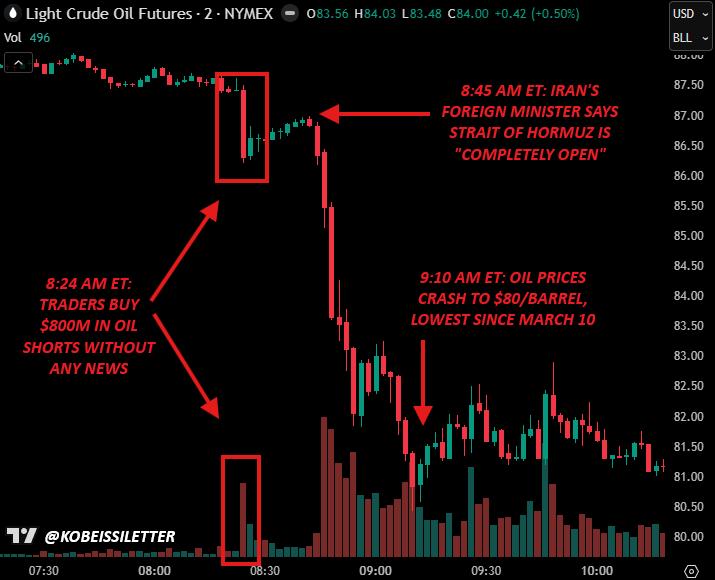
Yesterday, at 8:24 AM ET, oil traders bought nearly $800 MILLION worth of oil shorts.
Just 21 minutes later, Iran's Foreign Minister Araghchi said the "Strait of Hormuz is declared completely open."
By 9:10 AM ET, oil prices had collapsed to $80 per barrel and hit their lowest level since March 10th.
These same oil shorts made nearly $70 million in profit in less than one hour, according to our analysis.
Truly unusual.
TRUMP DIDN'T START THE IRAN WAR TO DESTROY IRAN. HE STARTED IT TO SAVE THE U.S. DOLLAR.
Before the first bomb dropped, the petrodollar was visibly falling apart, Fast.
Saudi Arabia publicly said for the first time since 1974 that it was open to settling oil in other currencies. Then the actions followed.
China and Saudi Arabia signed a 50 billion yuan currency swap. Saudi Arabia joined mBridge, the system built explicitly to bypass SWIFT and the dollar. The original 1974 petrodollar agreement was allowed to expire without renewal.
India was buying Russian oil settled in rupees and yuan. One fifth of all global oil trade was already settling outside the dollar by 2023.
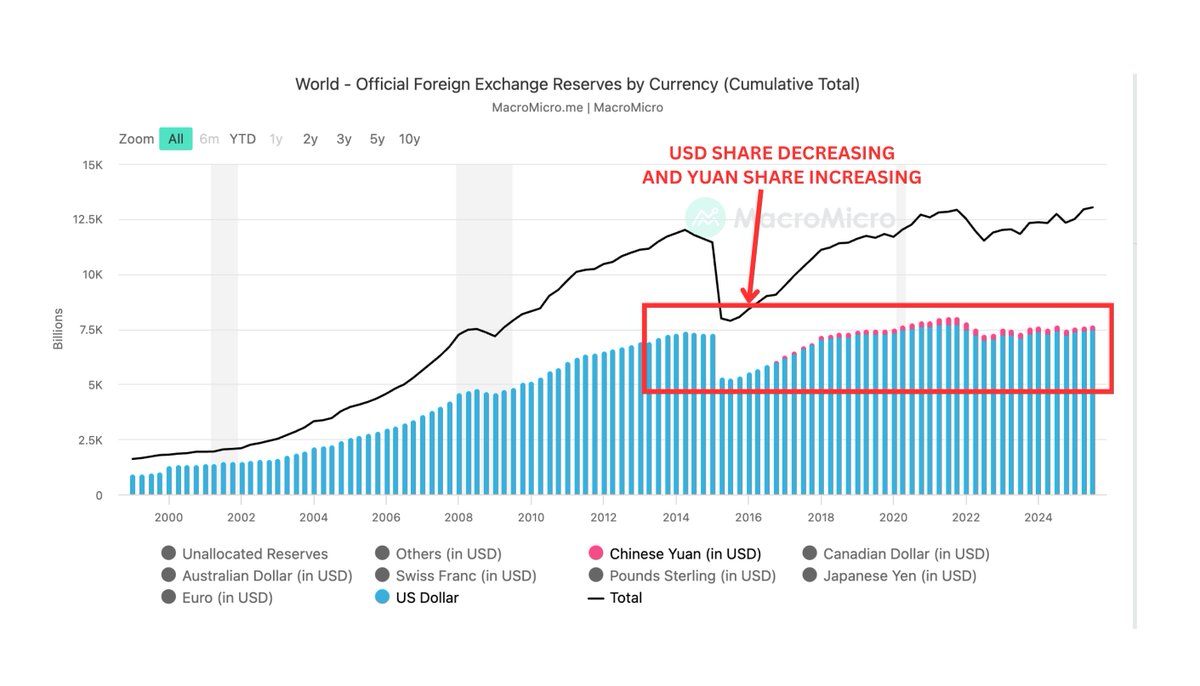
The dollar's share of global reserves had fallen to a 30 year low.
The petrodollar was dying already.
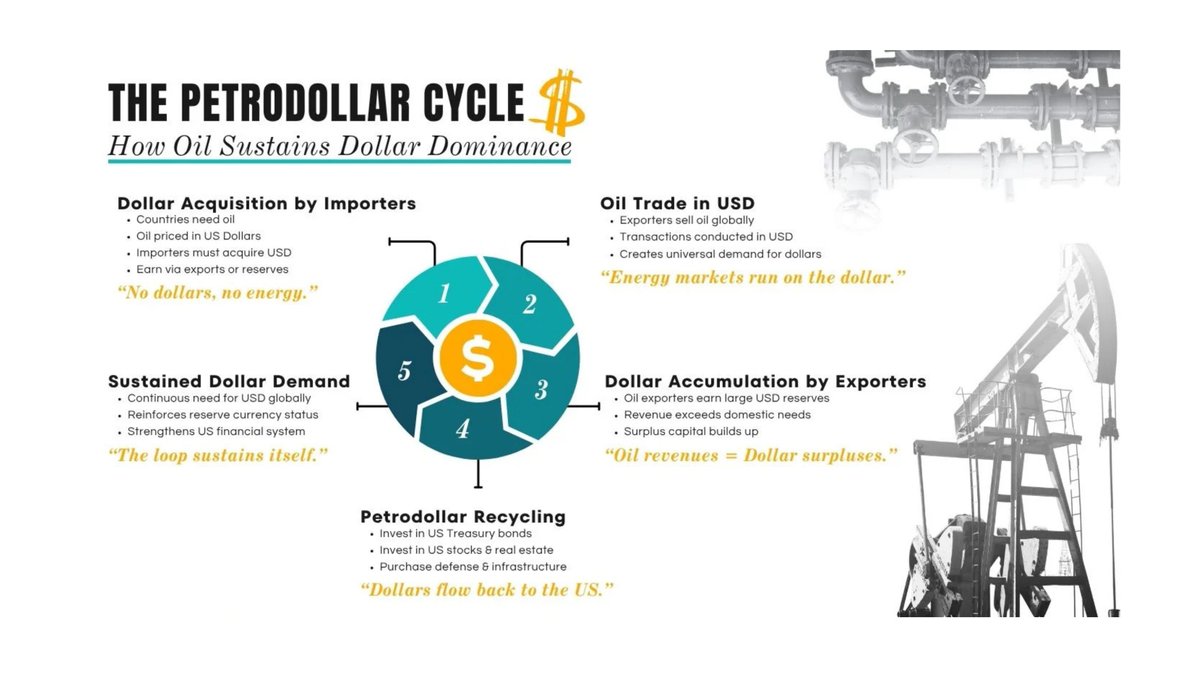
To understand why this matters you need to understand what the petrodollar actually is.
It is a protection deal.
In 1974, Kissinger flew to Riyadh and made a secret agreement with King Faisal. Saudi Arabia prices oil in dollars and recycles profits into US Treasuries. In return, America guarantees Saudi security.
Weapons, troops, and the promise that US military keeps the shipping lanes open. Every OPEC member followed within a year.
The arrangement gave Washington something extraordinary. A permanent buyer for its debt. The ability to borrow cheaply and run deficits indefinitely while maintaining the world's reserve currency.
For fifty years Gulf states believed this was a partnership. It was not. It was leverage. And when Gulf states started building their own exits, that leverage had to be demonstrated again.
On February 28, 2026, the demonstration began.
Iran closed the Strait of Hormuz. Kuwait has no bypass pipeline.
Qatar sends 93% of its LNG through it. Saudi Arabia exports 5.5 million barrels per day through it. Multiple Gulf energy companies declared force majeure simultaneously for the first time in history. Oil hit $120. R Refineries were shut.
The IEA called it the largest energy supply disruption in history.
And the same Gulf states that had been quietly building yuan settlement systems and joining Chinese financial infrastructure found themselves with their entire economic survival at stake and only one country capable of doing anything about it.
They went back to Washington and asked for help.
Saudi Arabia reversed its refusal to grant the US military base access. The UAE declared willingness to join a US coalition.
The GCC went to the UN and called for US-backed force to reopen the strait. Countries that had been distancing themselves from American dependence for two years were suddenly asking America to come back and protect them.
That is not a coincidence, That is the leverage being applied.
Now look at what happened to the dollar while all of this was happening.
DXY surged to a 10 month high. Gold collapsed 13 to 20%, its worst month since 2013. Investors sold alternative stores of value and bought dollars.
Every barrel of emergency oil released by the IEA was priced and settled in dollars. SWIFT data showed the dollar's share of global transactions at its highest level in years.
And Gulf states who had been accumulating yuan and building alternative payment systems ended up spending their crisis buying American weapons instead.
A $16.5 billion emergency arms package was approved during the war. The petrodollar recycling mechanism, dollars earned from oil flowing back into American defense industry, ran perfectly.
Now look at what Trump had been saying for years before the war.
He threatened BRICS nations with 100% tariffs if they backed any alternative to the dollar. He said directly that losing the world's reserve currency would be "like losing a war."
His National Security Strategy, published one month before the bombs fell, explicitly named preventing any power from controlling Middle Eastern oil chokepoints as a core US interest.
After the war started he posted publicly: "With a little more time, we can easily OPEN THE HORMUZ STRAIT, TAKE THE OIL, and MAKE A FORTUNE."
This is the part that should make every Gulf state rethink everything.
The system was sold to them as a partnership. America protects you. You price oil in dollars. Mutual benefit. But when Gulf states started building exits, a war appeared that destroyed their ability to use those exits and forced them back into dependence.
Gulf states spent two years building non dollar infrastructure.
Then a crisis arrived that made all of it irrelevant overnight and left them with no option except to ask Washington for protection. The dollar surged.
American weapons factories got new orders. And the countries trying to escape the system found themselves locked back inside it.
That is a reset. And the people who paid for it are the same ones who always pay, The Gulf.
The petrodollar was never a partnership.
It was always a system designed to make American power self financing. The Iran war did not threaten that system. It renewed it.
Most smart money tools tell you what happened.
This one tells you what's about to happen.
Built a Wyckoff phase classifier on top of #NansenCLI.
Scans 150 tokens across 8 chains every 5 minutes. Detects accumulation before the breakout.
Running live right now: https://t.co/boPWLHjVsY
@nansen_ai
Here's proof that the $Virtuals token is undervalued!
We are three months into 2026 and @virtuals_io have;
➥ Overhauled the core Virtuals website including an outline of the four major pillars of focus for the year. Agent Commerce Protocol (ACP), Butler, Capital Markets, and Robotics.
➥ Added the Pegasus and Titan launchpads to add to the existing Unicorn launchpad. This now provides a full suite of launch options catering to all types. Arguably the most comprehensive launch suite across crypto!
➥ Listed on @Aster_DEX Perpetuals allowing up to 75x leverage trading on the $Virtual token.
➥ Integrated @bankrbot to Butler and ACP.
➥ Partnered with @xmaquina, a major player across Robotics Capital Markets and provided participants with access to the $DEUS pre-sale. One of many robotics partnerships for the year to date!
➥ Launched Virtuals on @baseapp
➥ Held, supported, and/or sponsored multiple hackathon/ builder meeting type events including;
↠ Physical AI Hackathon in SF
↠ Agentic Commerce Hackathon with the likes of @CoinbaseDev and @googlecloud
↠ Traders House @consensus_hk week with @activ8lab
↠ ETH Denver
↠ Base Batches 003: Robotics
↠ Stanford Blockchain Accelerator (@StandfordSBA)
↠ Base Korea Builders Workshop (@daehan_base)
↠ Eth Robotics Club HACK2026 (@ethroboticsclub)
↠ Synthesis Hackathon (@synthesis_md)
➥ Partnered with @openmind_agi and @FabricFND and supported the $ROBO token launch. This matured into the first ever Titan launch on Virtuals with the $ROBO token being the highest launched on the protocol ($400m+).
➥ Launched Butler Pro, an enhanced version of the initial @Butler_Agent we have come to know and love on the timeline, in the DMs, as well as on the Virtuals ACP site.
➥ Become the standout user of x402, accounting for over 95%+ of usage this year.
➥ Integrated on @glider__, the automated onchain finance investment platform.
➥ Supported and contributed to the implementation of the @ethereumfndn ERC8004 standard. Integrating the standard into ACP and offering an automated integration to the standard for all ACP agents.
➥ Established an easy onboarding for @openclaw agents to plug into Virtuals ACP, creating a new flow of agents and builders across the ecosystem.
➥ Launched the 60-days launch mechanic which allows builders to 'experiment' with a crypto token but having an option to exit after 60 days with partial refunds provided to holders. A game-changing launch mechanic not seen before in the space.
➥ Strengthened the relationship with @base and having multiple interactions with @jessepollak on the timeline!
➥ Launched the AGDP(dot)io site, creating an incentivised mechanism for agents contributing to the growth of the protocol to really earn. Imagine Amazon for autonomous agents with rewards up to $1m per month! This pushed the total agent-to-agent revenue over $4m USD with over 2m jobs completed.
➥ Collaborated with @t54ai, a business building trust and risk infrastructure for the agentic economy, to strengthen the ACP offering.
➥ Invested over $1m on 30+ humanoid robots as part of the soon to be announced 'Eastworld' Robotics accelerator lab.
➥ Released ERC8183, a universal commerce layer for AI agents, in partnership with the Ethereum Foundations dAI team. A significant offering which has since been integrated via partnerships with;
↠ BNB (@BNBCHAIN)
↠ X Layer (@XLayerOfficial)
↠ Monad (@monad)
↠ XRP Ledger (@RippleXDev)
↠ World Chain (@world_chain_)
↠ Celo (@celo)
↠ Moonpay (@moonpay)
↠ Arbitrum (@arbitrum)
↠ Abstract (@AbstractChain)
↠ Mante (@Mantle_Official)
➥ Launched the Virtuals Degen Arena providing up to $100k a week to top agents who compete in trading competitions in the arena.
➥ Launched the Virtuals Console, providing an ultra easy, no-code, way to own an AI agent in seconds.
↛. If you've managed to get to this point, I can't imagine you are anything other than bullish on Virtuals.
What really is amazing is that there is MUCH more to come. Imagine where we are in another three months, and three months after that!?
10 people made 5.5 BNB each from Binance AI video challenge
3 people made $1M, $500K, and $250K from X Imagine 1.0 video challenge
Meanwhile, YouTube automation creators quietly make 3–5 figures monthly with AI
And most people are still sleeping on this
How to create AI videos step-by-step: 🧵
There's a framework from McKinsey that explains why crypto becomes essential for agentic commerce.
→ Level 0-2: agents helping you research, compare, and assemble purchases
→ Level 3-4: agents executing transactions within rules you set
→ Level 5: agents transacting directly with other agents, no human on either side
Levels 0-4 don't need new financial rails. A human identity sits behind every transaction: your card on file, your bank approval. The agent is just your proxy.
Level 5 is different.
Agents become independent economic actors. No human identity to inherit. They need rails that are instant, programmable, permissionless, and always on.
That's where blockchains come in. Built for autonomous software that needs to move money without human gatekeepers.
The challenge is fragmentation: 40+ chains, dozens of DEXs and bridges, each with different integration logic. That's the real bottleneck for any agent trying to operate onchain.
@lifiprotocol recently launched their API for Agentic Commerce, positioning it as a complete toolkit for anyone building autonomous workflows onchain.
It enables:
→ Single API handling routing, bridging, swapping, and settlement across every major chain
→ Maintains all underlying integrations so builders don't have to
→ Best execution across all available liquidity
→ Already powering 1,000+ businesses, including MetaMask, Phantom, Robinhood, Binance, Kraken
→ Recently shipped an MCP server, agent skills, and AI-first docs built specifically for autonomous agents
Like it or not, we're heading towards a fully agentic-dominated economy. If you're not positioning for that, what are you even doing?
In 1997, HTTP status code 402 was reserved for 'Payment Required'; a native payment layer built into the web itself
For almost 30 years, nobody could make it work
There was no digital cash and no settlement layer that could handle sub-cent transactions. The web defaulted to advertising and credit card checkout flows instead
Stablecoins and Layer 2s changed that. x402 finishes what HTTP 402 started; payment as native to the web as loading an image
Most people looking at agentic commerce see one maturity cycle, but there are two:
1) The retail narrative is approaching its peak; CT is buzzing, ecosystem maps are proliferating, every protocol is announcing x402 compatibility. That will correct
2) The institutional adoption curve is on a completely different trajectory. For this layer, the trough already happened in 2025
Stripe, Visa, AWS, Google, Coinbase, Circle and Cloudflare are shipping production infrastructure because their own internal analysis on projected agent transaction volume justify it
In our x402 report, we map the protocol architecture, the agentic stack, the institutional landscape, and assess where the value could accrue
The full report is in the next post below: