Be humble in preparation. Slay in execution.
Jocko Willink’s exact mindset:
Stay extremely humble while training. Assume you’re not ready, rehearse more, question everything.
But the moment it’s go time? Flip the switch and go full “I’m about to slay this right now.”
That mental shift is rare and powerful. Humility drives the preparation. Total confidence drives the win.
When was the last time you made that switch and absolutely crushed it?
Interviewed my almost 95 year old dad about his experience with his one month old Tesla Y. Here’s what he said both the good and the bad. Please show anyone on the fence about getting a Tesla Full a self Driving car or truck. It may change their mind.
Naval Ravikant: "You're going to die. It's all going to zero. What's there to stress about?"
"Stress is when your mind has two conflicting desires at once. You want to be liked, but you want to do something selfish. You don't want to go to work, but you want to make money. You have two conflicting desires, and that's stress."
Naval explains the difference between stress and anxiety:
"Anxiety is this pervasive, unidentifiable stress where you're stressed out all the time and you're not even sure why. The reason is you have so many unresolved problems that have piled up in your life, you can no longer identify what the problems are. There's this mountain of garbage in your mind. A little bit is poking out the top like an iceberg; that's anxiety. But underneath, there's a lot of unresolved things."
He shares his personal anxiety resolver:
"One big anxiety resolver for me is just ruminating on death. You're going to die. It's all going to zero. You cannot take anything with you. If you can keep that idea in front of you at all times, what's there to stress about?"
Naval reframes what "wasted time" really means:
"What is wasted time? Everything is wasted time in a sense because nothing matters in the ultimate. But in each moment, it's the only thing that matters. So if you're doing something you want to do and you're fully there for it it's not wasted time. If your mind is running away, wishing you were somewhere else, anticipating the future, regretting the past, that's wasted time. That's time you're not present for."
He concludes:
"People get worried about dying and no longer being here. But they don't realize that so much of their life is spent not being here in any case."
Mike Tyson dropped pure wisdom on JRE:
“You don’t have discipline? You ain’t nobody. Nothing.”
Then he hit the killer line Cus D’Amato taught him:
“Discipline is doing what you hate to do, but do it like you love it.”
Joe Rogan nailed the follow-up: master that and you can succeed at anything.
I’ve got plenty of things I know I should do that I straight-up dread. The days I force myself to attack them with energy instead of dragging my feet? Those are the days momentum actually shows up.
Talent and motivation are everywhere. Discipline is what separates the ones who actually make it from the ones who stay “almost there.” In a world full of distractions and easy dopamine, this mindset feels like a cheat code most people never unlock.
What’s one thing you hate doing but know you need to do and how do you trick yourself into loving the process?
Thank you. The important part is zeroing out taxes on the bottom half. Best way to put money in someone’s pocket is to not take it out in the first place. Bottom half is only 3% of total tax revenue. But it’s very meaningful to that person. Zero it out.
Hoy una industria entera dejó de tener sentido.
Un tío publicó en GitHub un repo que convierte cualquier foto en un mundo 3D explorable: meshes con físicas, splat del fondo, audio ambiente. Todo.
Una imagen entra. Un mundo sale. Cinco minutos.
La gente que se pasó diez años aprendiendo Blender lleva todo el día mirando esto en silencio.
Se llama image-blaster.
Gossip Goblin is arguably the best AI filmmaker in the world.
His new film THE PATCHWRIGHT is a masterpiece (10M+ views).
But nobody knows how he actually makes these.
Until now.
He let me share every step of the workflow with you 🧵👇
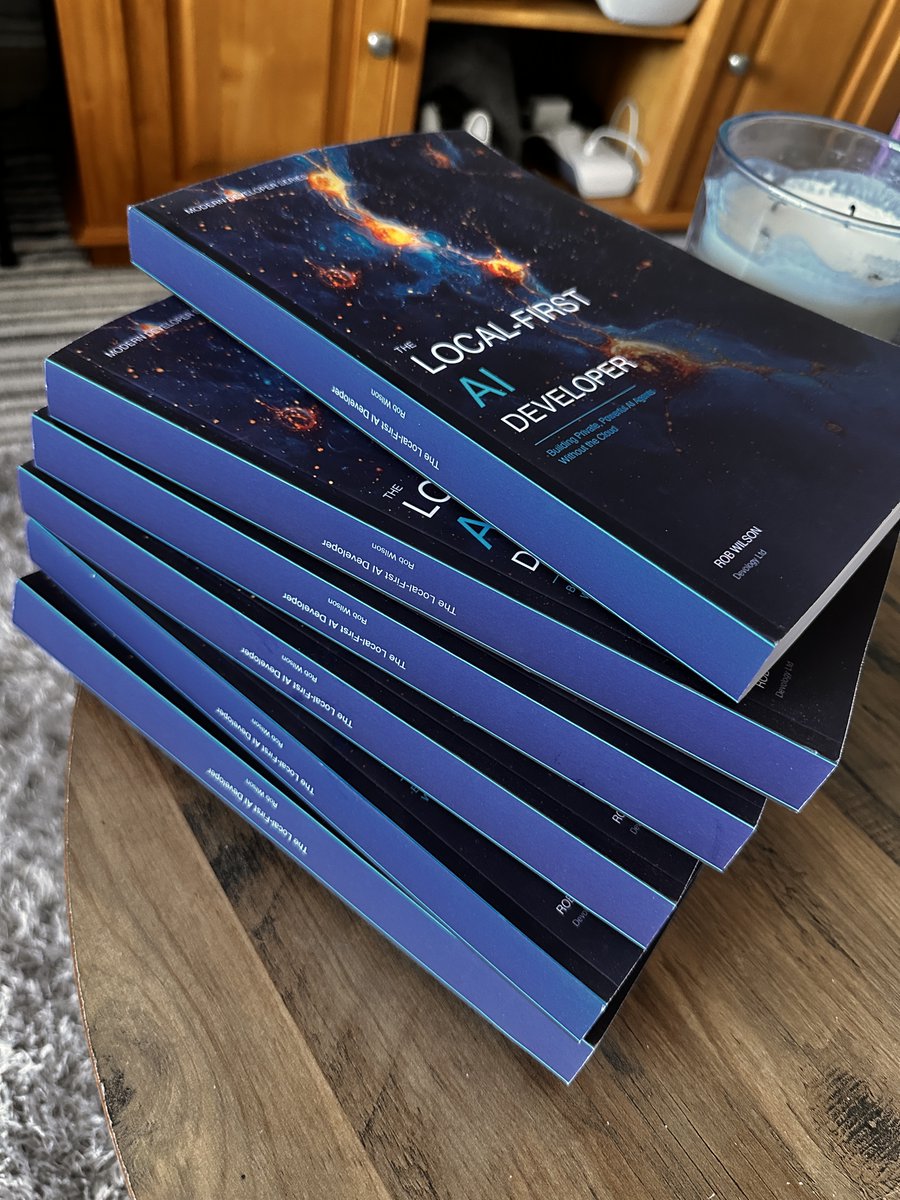
After playing with AI for a few months via OpenClaw I evolved to focus more on local AI, principally to save costs but other benefits included increasing privacy (protecting IP) and to have a fallback for when cloud models are simply broken.
I then decided to write a book to share my findings and it's just gone live on Amazon!!
I've kept it as cheap as possible - there are too many people trying to make money with AI rather than share genuine experiences to benefit others.
The only bit left is to fix Amazon accidentally merging another authors bio as mine!
This works really well btw, at the end of your query ask your LLM to "structure your response as HTML", then view the generated file in your browser. I've also had some success asking the LLM to present its output as slideshows, etc.
More generally, imo audio is the human-preferred input to AIs but vision (images/animations/video) is the preferred output from them. Around a ~third of our brains are a massively parallel processor dedicated to vision, it is the 10-lane superhighway of information into brain. As AI improves, I think we'll see a progression that takes advantage:
1) raw text (hard/effortful to read)
2) markdown (bold, italic, headings, tables, a bit easier on the eyes) <-- current default
3) HTML (still procedural with underlying code, but a lot more flexibility on the graphics, layout, even interactivity) <-- early but forming new good default
...4,5,6,...
n) interactive neural videos/simulations
Imo the extrapolation (though the technology doesn't exist just yet) ends in some kind of interactive videos generated directly by a diffusion neural net. Many open questions as to how exact/procedural "Software 1.0" artifacts (e.g. interactive simulations) may be woven together with neural artifacts (diffusion grids), but generally something in the direction of the recently viral https://t.co/z21CP5iQfu
There are also improvements necessary and pending at the input. Audio nor text nor video alone are not enough, e.g. I feel a need to point/gesture to things on the screen, similar to all the things you would do with a person physically next to you and your computer screen.
TLDR The input/output mind meld between humans and AIs is ongoing and there is a lot of work to do and significant progress to be made, way before jumping all the way into neuralink-esque BCIs and all that. For what's worth exploring at the current stage, hot tip try ask for HTML.
People talk, listen, watch, think, and collaborate at the same time, in real time. We've designed an AI that works with people the same way.
We share our approach, early results, and a quick look at our model in action.
https://t.co/AFJZ5kH7Ku
Elon Musk says steel killed carbon fiber on Starship at one-fiftieth the cost.
Carbon fiber was supposed to be the future of rocketry.
Lighter than aluminum. Stronger than steel. Trusted by every Formula 1 team.
SpaceX picked it for Starship.
"Particularly if you go for a high-strength specialized carbon fiber that can handle cryogenic oxygen, it's roughly 50 times the cost of steel."
Then progress stalled.
The autoclaves needed to cure the resin had to outsize every autoclave on Earth, and the team couldn't even produce a clean barrel section without wrinkles.
Musk, watching the Mars timeline slip:
"At this rate, we're never going to get to Mars. So we've got to think of something else."
So he asked the question nobody at SpaceX had asked: "What about steel?"
It became known as the **cryogenic stainless flip**.
Musk, who had already shipped Falcon 9 in aluminum-lithium, broke with the textbook.
"When you look at the material properties of stainless steel, full-hard, strain hardened stainless steel, at cryogenic temperature the strength to weight is actually similar to carbon fiber."
Starship ran on cryogenic methane and oxygen.
The airframe lived at temperatures that flipped steel ahead of carbon fiber.
"You could smoke a cigar while welding stainless steel."
After Musk made the call, steel weighed less than the carbon fiber version.
Fifty times cheaper in raw material. Twice the heat tolerance. Half the heat shield mass.
Musk, looking back:
"In retrospect, we should have started with steel in the beginning. It was dumb not to do steel."
What "obvious" material in your work is silently costing you the project?
If you're new here, @GeniusGTX is a gallery for the greatest minds in economics, psychology, and history. Follow along for more similar content.
P.S.
I've made a free playbook on how to use and create your own mental models.
This includes the same thinking strategies Feynman, Munger, and Musk built their careers on.
Ttrusted by 5,000+ founders and investors.
Grab your copy: https://t.co/u2q1uUm9vD
��� Elon Musk ( @elonmusk ), CEO of Tesla and SpaceX, on Dwarkesh Patel's ( @dwarkesh_sp ) podcast
Steve Jobs once told a room full of people:
"I don't give a F**k what the students want, the parents think, or anybody thinks. It's what I want. They don't know what they want till I tell them what they want."
Kevin looked Jobs in to the eye and said:
"Steve, you sound like such an a**hole."
Jobs did not flinch.
"Are you making money with me? Have we not been wildly successful? Then shut up and do what I say."
That was Steve Jobs. Not a nice guy. Not even a little.
But here is what that man learned from working with him. And it is the only success formula that actually holds up.
Kevin worked for Steve Jobs in the early 1990s, building educational software.
One day he walked into a meeting and told Jobs they needed to do market research on Oregon Trail. A massive title. Running in 110,000 school buildings across the country. An update would cost 12 to 15 million dollars.
He wanted to know what students wanted. What teachers wanted. What parents wanted.
Jobs stopped him cold.
He did not want surveys. Did not want focus groups. Did not want to know what anybody thought.
Because in his mind, none of that mattered.
What mattered was signal.
Here is the concept Jobs understood that almost nobody else did.
Every person alive is swimming in two things at all times.
Signal. And noise.
Signal is the three to five things that absolutely must get done today. Not next week. Not next month. Not someday. Today. The things that if done, move everything forward. The things your mission cannot survive without.
Noise is everything else.
The unnecessary meeting. The email that can wait. The social media scroll. The small talk. The market research nobody asked for. The decisions that feel urgent but are not. Everything that fills your hours without filling your purpose.
Jobs ran at 80% signal, 20% noise.
Every single day.
Kevin knew this because Jobs would email him at 2:30 in the morning and expect a response. Not because he was unreasonable. Because for Jobs, 2:30 in the morning was still signal hours. He was still working. Still moving. Still locked in.
The 18 hours he was awake were 18 hours of signal.
Kevin says the only person he has ever seen operate at a higher ratio than Jobs is Elon Musk.
Musk has almost no noise. Sixty seconds of every minute. Sixty minutes of every hour. Every waking hour pointed at whatever the signal is that day.
And the results, like Jobs, speak for themselves.
Jeff Bezos had his own version of this.
He would not make a single decision after 1pm.
Not because he was lazy. Because he understood that by afternoon, the noise had accumulated enough to cloud his judgment. His signal hours were in the morning. So that is when he decided things. And he protected those hours like they were sacred.
Because they were.
Here is the uncomfortable truth buried inside all of this.
Noise is not always bad things.
Sometimes noise is your family. Sometimes it is a friend calling to catch up. Sometimes it is a guitar sitting in the corner of the room. Sometimes it is rest.
The people running at 100% signal, Jobs, Musk, the geniuses of history, paid a real price for it socially. Relationships suffered. Normal life suffered. Warmth suffered.
Jobs himself was famously difficult to be around.
But here is the question worth sitting with:
Most people are not choosing between 100% signal and a balanced life.
Most people are choosing between 30% signal and 70% noise.
They are not sacrificing family time for focus. They are sacrificing focus for nothing. For scrolling. For distraction. For busy work that feels productive but produces nothing.
That is the real problem.
Kevin now tells every CEO he works with the same thing.
It does not matter if you run an S&P 500 company or you are three weeks into your first business.
The formula is the same.
Identify the three to five things that must get done today. Not tomorrow. Not eventually. Today.
Then protect those things with everything you have.
If you can spend 80% of your waking hours on signal, you are operating at the level of the most successful people who have ever lived.
If you drop to 50/50, signal and noise in equal measure, you will fail.
It is, Kevin says, that simple.
Jobs was not successful because he was a genius.
He was not successful because he was charismatic or visionary or ahead of his time, though he was all of those things.
He was successful because when he woke up every morning, he knew exactly what mattered.
And he refused, sometimes rudely, sometimes brutally, sometimes at the cost of every relationship in the room, to let anything else in.
Most people spend their whole lives reacting to noise and calling it work.
ANDREJ KARPATHY COULD HAVE CHARGED $2,000 FOR THIS COURSE.
He put it on YouTube.
The full training stack. Tokenization. Neural network internals. Hallucinations. Tool use. Reinforcement learning. RLHF. DeepSeek. AlphaGo.
3 hours of the most comprehensive LLM education that exists anywhere at any price.
Not how to use the tools.
How the entire system was built from the ground up and why it behaves the way it does.
The engineers who understand this build things the ones who only use the tools cannot even conceive of.
The gap between those two groups is not 3 hours.
It is everything those 3 hours quietly unlock for the rest of your career.
Yesterday, Andrej Karpathy gave a 30-minute Sequoia masterclass on agentic engineering.
This is the serious layer above vibe coding.
He explained:
- LLMs as ghosts
- The app that shouldn't exist
- Outsource thinking, not understanding
12 lessons that will blow your mind: 🧵
I automated my content engine and 2 hrs/day dropped to 10 min
[ what’s new in v2 ]:
- 9 platforms scraped while I sleep → 2,000+ topics/day
- a 5-signal scoring brain that filters down to the 10 that matter
- voice DNA writer.. same tone, different structure every time
- a self-learning loop that remembers every approve and decline
- profile DNA — knows exactly what goes viral on MY account
v1 was a brain with no body
v2 has eyes, a filter, and memory + fully automated
Here’s how to build it step-by-step ↓
[ The architecture]:
/content-engine
├── scrapers/ (9 platform scrapers)
├── extension/ (chrome ext for X, linkedin, reddit)
├── ai/
│ ├── https://t.co/JLmuw236QH (5-signal scoring brain)
│ ├── content_writer.py (voice DNA + structures)
│ ├── profile_analyzer.py (your positioning DNA)
│ └── sentiment_analyzer.py
├── publisher/ (export + time slot scheduling)
├── gui/dashboard.py (streamlit command center)
├── ingest_server.py (local server on localhost)
└── data/content_engine.db (everything stored locally)
let me walk you through each layer ↓
LAYER 1: Research engine
9 sources scanned 24/7 (X, reddit, YT, HN, github, trends + chrome ext for reddit and linkedin)
every post you scroll past gets tagged and stored locally
LAYER 2: Scoring brain
every topic scored on 5 signals:
- freshness (0.20)
- velocity (0.25)
- virality (0.25)
- relevance (0.20)
- uniqueness (0.10)
velocity 8+ → forced min score of 7. catches late bloomers that suddenly explode
2,000 topics → top 10 ranked
LAYER 3: Voice DNA writer
not one structure every time. system picks the format:
- short take
- tactical playbook
- QT contrast
- contrarian
- resource drop
- proof post
a voice guardian auto-rewrites anything that fails: lowercase ratio, no hashtags, no corporate words
LAYER 4: Dashboard Streamlit
dark theme. 5 tabs
review queue = tinder for content. swipe approve, swipe decline
LAYER 5: Publishing
no auto-posting. zero account risk
approve → pick a slot (8am / 12pm / 5pm) → exports a .txt → copy / paste / post
also auto-drafts a linkedin version of every approved tweet
LAYER 6: Self-learning loop
every click logged. weekly the system embeds your decline notes and re-tunes the scoring brain
month 1: you approve 30%
month 3: 70% pre-filtered
month 6: 10 min/day
LAYER 7: Profile DNA
analyzes your past tweets. tells you exactly which pillars, formats, and hooks perform best on YOUR account
the scoring brain uses it to prioritize what already works for you
daily run: open dashboard → 10 min reviewing → post 3x → close
total cost: ~$15/month
everything else: local, sqlite, no cloud, no subscription
unfortunately I couldn’t paste in long-form format initial description which was made before
but if this hits 2,000 likes I drop the full build guide with every prompt you need to ship it in claude code
reply "ENGINE" + RT and I'll DM you access to test it (follow me first so I can write)
save this so you don't lose it





![DeRonin_'s tweet photo. I automated my content engine and 2 hrs/day dropped to 10 min
[ what’s new in v2 ]:
- 9 platforms scraped while I sleep → 2,000+ topics/day
- a 5-signal scoring brain that filters down to the 10 that matter
- voice DNA writer.. same tone, different structure every time
- a self-learning loop that remembers every approve and decline
- profile DNA — knows exactly what goes viral on MY account
v1 was a brain with no body
v2 has eyes, a filter, and memory + fully automated
Here’s how to build it step-by-step ↓
[ The architecture]:
/content-engine
├── scrapers/ (9 platform scrapers)
├── extension/ (chrome ext for X, linkedin, reddit)
├── ai/
│ ├── https://t.co/JLmuw236QH (5-signal scoring brain)
│ ├── content_writer.py (voice DNA + structures)
│ ├── profile_analyzer.py (your positioning DNA)
│ └── sentiment_analyzer.py
├── publisher/ (export + time slot scheduling)
├── gui/dashboard.py (streamlit command center)
├── ingest_server.py (local server on localhost)
└── data/content_engine.db (everything stored locally)
let me walk you through each layer ↓
LAYER 1: Research engine
9 sources scanned 24/7 (X, reddit, YT, HN, github, trends + chrome ext for reddit and linkedin)
every post you scroll past gets tagged and stored locally
LAYER 2: Scoring brain
every topic scored on 5 signals:
- freshness (0.20)
- velocity (0.25)
- virality (0.25)
- relevance (0.20)
- uniqueness (0.10)
velocity 8+ → forced min score of 7. catches late bloomers that suddenly explode
2,000 topics → top 10 ranked
LAYER 3: Voice DNA writer
not one structure every time. system picks the format:
- short take
- tactical playbook
- QT contrast
- contrarian
- resource drop
- proof post
a voice guardian auto-rewrites anything that fails: lowercase ratio, no hashtags, no corporate words
LAYER 4: Dashboard Streamlit
dark theme. 5 tabs
review queue = tinder for content. swipe approve, swipe decline
LAYER 5: Publishing
no auto-posting. zero account risk
approve → pick a slot (8am / 12pm / 5pm) → exports a .txt → copy / paste / post
also auto-drafts a linkedin version of every approved tweet
LAYER 6: Self-learning loop
every click logged. weekly the system embeds your decline notes and re-tunes the scoring brain
month 1: you approve 30%
month 3: 70% pre-filtered
month 6: 10 min/day
LAYER 7: Profile DNA
analyzes your past tweets. tells you exactly which pillars, formats, and hooks perform best on YOUR account
the scoring brain uses it to prioritize what already works for you
daily run: open dashboard → 10 min reviewing → post 3x → close
total cost: ~$15/month
everything else: local, sqlite, no cloud, no subscription
unfortunately I couldn’t paste in long-form format initial description which was made before
but if this hits 2,000 likes I drop the full build guide with every prompt you need to ship it in claude code
reply "ENGINE" + RT and I'll DM you access to test it (follow me first so I can write)
save this so you don't lose it](https://pbs.twimg.com/media/HGw86mUWEAAyMFb.jpg)