Executive coaches to Silicon Valley leaders; taking companies from $500M→$1B+. AI-driven 360°s find blind spots; the Executive Smackdown™ creates Rockstars.
Letting a destructive team member slide doesn't just hurt your team -- it makes you look like a weak manager. New Short just went up -- watch: https://t.co/fs4L9r89AF
@EthanEvansVP The traits that read as confident at home can read as arrogant in a new culture, and nobody tells you which ones until it costs you a promotion.
Pleased to share my new @FastCompany article.
It explores why we see so few courageous leaders today, why #courage is an essential #leadership trait -- and how can all learn to become the kind of leader we all admire.
#Leadership#HR#SHRM#Management#Trust #PsychologicalSafety #Business
LINK: https://t.co/7GjKdOcwvO
A Markdown File is an Employee
@GarryTan (Garry Tan), President & CEO of Y Combinator, interviewed by @illscience (Anish Acharya) (The @a16z Show)
Summary: AI is not merely making employees faster. Garry Tan argues it lets founders encode every repeatable business process, turn organizational memory into software, and operate with context once trapped inside layers of management. The result is a new founder mode: tiny teams, hundreds of reusable skills, and companies that improve every time an agent makes a mistake. Incumbents may struggle to reorganize around that model. Startups have no excuse not to.
1. Trust The Territory, Not The Map. Tan left web programming in 2003 because mobile looked like the prestigious next wave, then turned down an early Palantir role to chase a Microsoft promotion. He estimates the second choice cost billions. Both mistakes came from working backward from status instead of looking at the territory: what he knew, who the exceptional people were, and where capability was obviously missing.
2. Earnestness Is Courage. When the crowd says the web is dead or an idea is uncool, maturity is not reflexive agreement. It is trusting direct experience strongly enough to keep building. Tan’s advice is “don’t LARP”: stop performing the role of a founder for investors and pursue the thing you understand before the map catches up.
3. Find The Intellectual Edge. The strongest founder obsessions do not run out after one conversation. You may reach the edge of what people have built, but you cannot find the edge of the questions. That depth is a useful filter: enduring companies often begin as unusually specific interests that look strange until the founder reveals how much territory remains.
4. Founders Need A Truth Network. YC’s deepest value is not merely capital or introductions. It is a group where a founder can say the best customer left, the best engineer quit, or a co-founder lost hope. At most startup events, one founder says they are “killing it” and the other returns the performance. Real support requires somewhere the performance can stop.
5. Become 400× Yourself. Vibe coding and agentic software mean a single founder can now carry the output of a former department. Tan says founders should be more ambitious because the game has changed. Copying a SaaS success from the last cycle underuses today’s leverage; the right question is what becomes possible when one capable person can multiply themselves hundreds of times.
6. SaaS Is A Wedge, Not A Moat. Tan is skeptical that pure per-seat SaaS remains durable over the next decade. It can still be an entry point, but lasting value must compound through proprietary data, network effects, workflow ownership, or a learning loop. If the product only rents access to a feature, an agent may absorb the feature before the company builds defensibility.
7. Build Trivial Things. The fastest way to develop AI intuition is to use every model on low-stakes projects. The output does not need to matter. The project is a chassis for learning where the technology works, where it breaks, and what changed since last week. Tan argues agency and taste grow through these repetitions, not through reading another forecast.
8. A Markdown File Is An Employee. Perform a business process well once, capture the interaction and judgment as a skill file, and put it on a schedule. The first version will be expensive and imperfect. But every future failure becomes a bug fix that lives forever, and the process can run as often as needed without forgetting how the last edge case was resolved.
9. Automate The Bottleneck. Tan’s engineering loop progressively encoded product thinking, implementation, testing, and browser-based QA. Each time his own attention became the limiting step, he taught the agent to handle that step too. Building an agentic company is less about one giant system than repeatedly finding the current bottleneck and turning it into software or a skill.
10. Memory Makes Founder Mode Scale. Organizations slow when the business becomes too large to fit in one person’s head. Agents can preserve meeting traces, retrieve ground truth, map dependencies, and surface conflicts without relying on opinions filtered through two management layers. That gives a founder something close to organizational clairvoyance: the ability to see the work rather than receive a summary of it.
11. Provenance Is The Control Plane. Hundreds of skill files create their own failure mode: stale or conflicting instructions. Tan’s answer is provenance, recency, and scheduled maintenance. The company needs to know where a fact came from, which instruction wins, and when the system last checked it. Agentic scale still needs governance; it simply makes governance explicit and executable.
12. Every Startup Must Reorganize. Tan imagines agents tracking dependencies, resolving routine conflicts, and carrying the coordination load that historically produced middle management. A company such as Microsoft may struggle to rebuild itself around that model. A startup can start there. His verdict is blunt: a startup can organize this way, and every startup must.
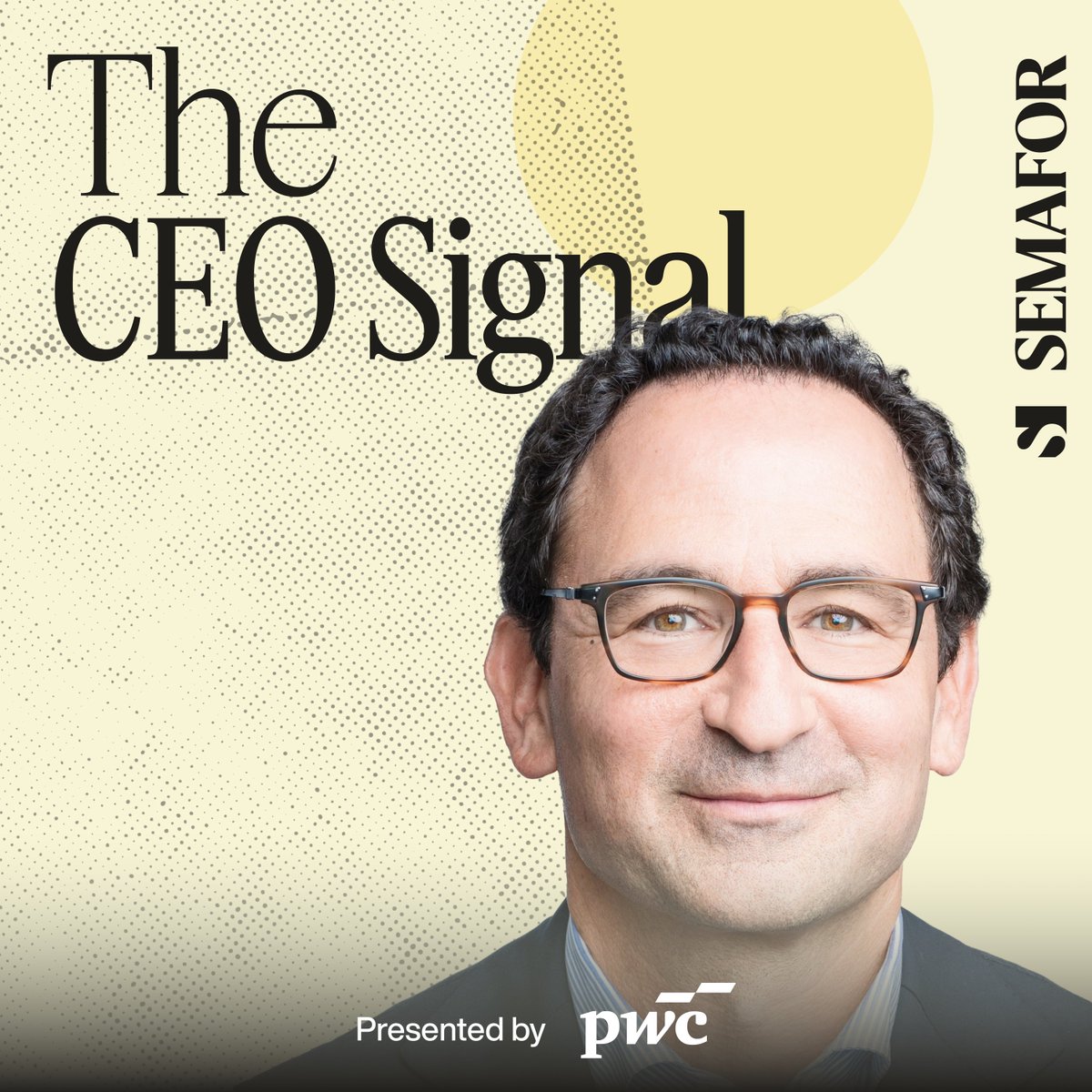
🟡 @blackstone makes big bets. Jon Gray says the risk is becoming too convinced you’re right.
“You keep pressing against what you’re doing to confirm that you haven’t just sort of fallen in love,” he says. Even when “the last five times you’ve done this has been great,” someone still needs to ask: “Are you sure?”
That tension matters as Blackstone goes big on AI infrastructure. The firm is investing behind a technology Gray believes could reshape entire business models, while trying to invest “through the lens that this may change.”
In the latest episode of The CEO Signal with @PennyPritzker and @Edgecliffe, Gray explains how Blackstone builds conviction without stopping the questions that could prove it wrong.
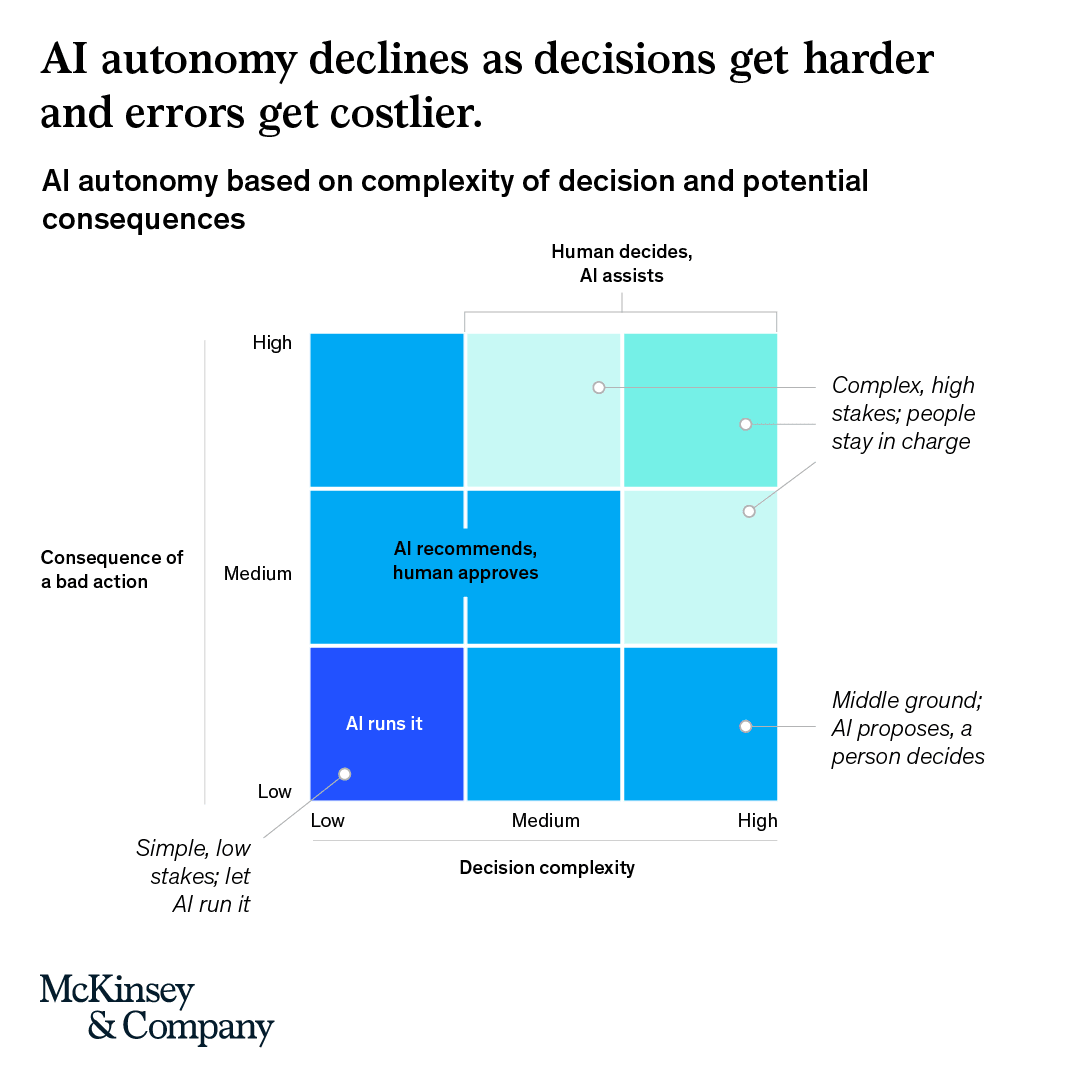
AI autonomy is a design decision, not just a technology decision. For public-sector agencies, the key is deciding early where AI can take the lead and where human judgment needs to stay in the loop—before those systems reach residents. https://t.co/amuoNV6SVZ
@Alfred_Lin Point two is the real test. Most leaders say they want a team that challenges them, then quietly hire for comfort instead once the discomfort is real.
@LeilaHormozi Certainty and decisiveness aren't the same thing. The fastest-moving leaders we coach are usually the ones most willing to say "I don't know yet" out loud.
AI can expand the information available to leaders, but it cannot decide what deserves confidence. As AI becomes more embedded in business, human judgment will be even more critical in determining how insights are evaluated, interpreted and applied. https://t.co/5Lf2hCJt74
What if AI isn't reducing workforce costs, but simply shifting them?
Gartner predicts that up to 30% of roles displaced by AI will be rehired by 2029, often at a premium.
Treating AI as a cost-cutting tool alone can undermine ROI; optimizing workforce costs is what drives sustainable value.
Uncover how AI is reshaping where and how those costs appear: https://t.co/PpR5nno5xZ