💉 Discover how the curious and collaborative nature of the Institute led to a breakthrough in the world of immuno-oncology with past Long-term Member Benjamin D. Greenbaum (@bengrbm): https://t.co/RbLf4YjEIR
Excited to share our new preprint "Ecological determinants of disease and immunity in myelodysplastic syndromes"! A brief account of an amazing collaboration...
1/n
First of many great collaborations with @AbdelWahablab and our lab's first foray into spatial transcriptomics: "Ecological determinants of disease and immunity in myelodysplastic syndromes". We wanted to get into this area for a long time but were drawn to this unique ecological niche by @dewolf_susan:
https://t.co/kUQCj6ZiFT
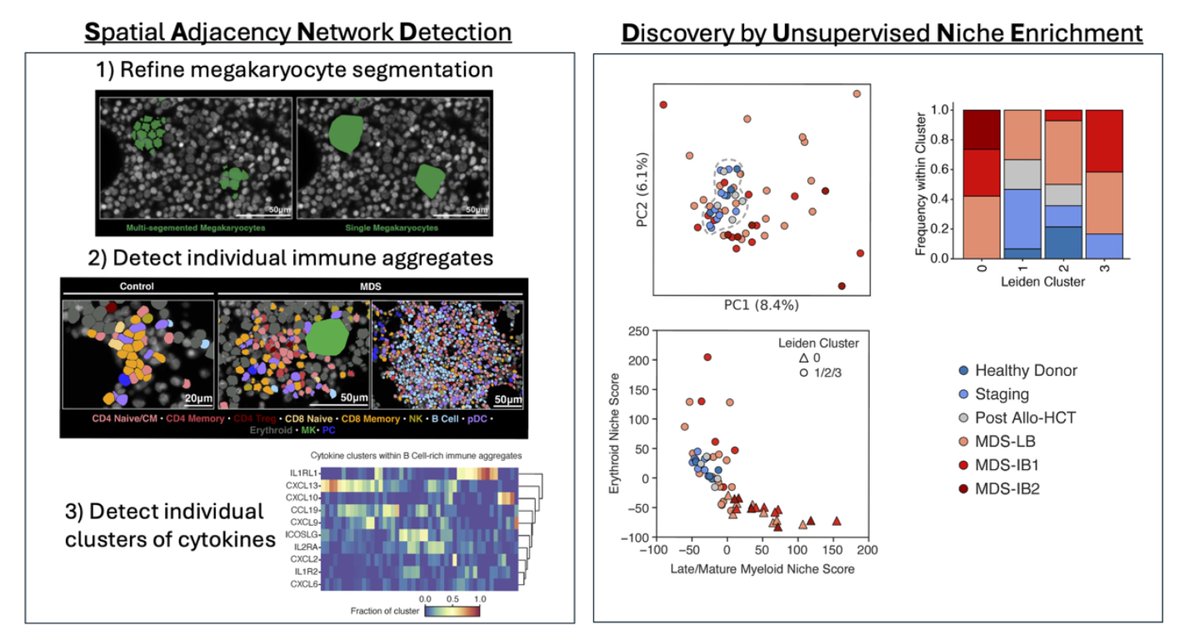
The bone marrow is both difficult to derive samples from and challenging to analyze due to its lack of organized architecture compared to solid tissue. With key technological advancements and heroic effort Susan, Rob Stanley MD PhD and Kimon Argyropoulos addressed the first challenge with Ronan Chaligné. To tackle the second, Beatrice Zhang, a brilliant PhD student I am fortunate to co-mentor with Omar, under the guidance of @stephen_martis (the first fellow in @MSKCancerCenter 's Theory Group) developed a suite of analytical methods. Stephen's background in theoretical ecology was essential to our approach. They developed a paired set of methods called SAND-DUNE. SAND (Spatial Adjacency Network Detection) allowed for profiling of unique cell aggregates with awareness of immune cell specific features, while DUNE (Discovery by Unsupervised Niche Enrichment), allowed for sample to sample comparison of niche enrichment. Using these tools, we identified how hematopoetic niche enrichment stratified disease stages.
If that was not enough, we paired our analysis with customized TCR and cancer cell specific probes to uncover the spatial distribution and phenotype of cancer cells and abundant T cell clones, revealing both that early immune activation, possibly against the shared neoantigens observed by Omar's lab, may indicate favorable response, and a specific mechanism by which cancer cells can modulate immune cells to facilitate escape.
This unique team science approach led by first authors Beatrice, Rob and Kimon led to a rich analytical characterization of the hard to see microenvironment. The overarching view shows how such an approach may be able to yield clinically actionable strategies with an interpretable backbone of ecological principles based on richly characterized hard data.
Excited to present the first pre-print from our group, an investigation the human bone marrow microenvironments in patients with myelodysplastic syndromes (MDS) and normal age-matched subjects using Xenium genotype-informed spatial transcriptomics:
https://t.co/5fS09Yl38G
Excited to share my latest research! Thanks to @andimscience and @bengrbm for giving me the opportunity to work on this project and for the mentorship along the way
How we discriminate between self and nonself is a central question in immunology and is particularly relevant in cancer immunology, where cells that start as self can acquire features visible to the immune system as they evolve.
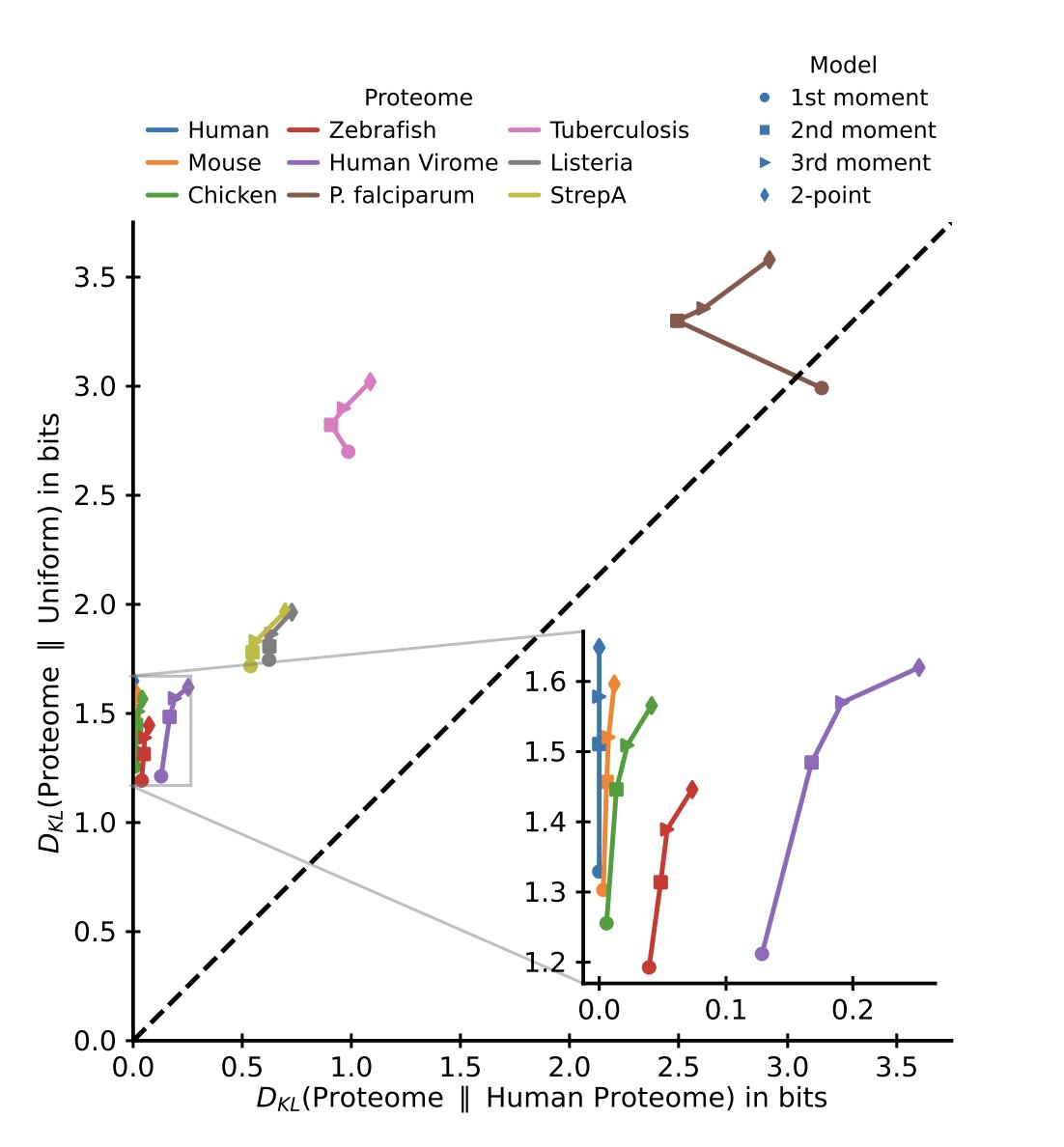
When approaching this problem from AI/ML the impulse is to train a classifier on molecules that the immune system senses as nonself versus those from the self proteome and learn their underlying differences. In our work "How different are self and nonself?" with @andimscience, our amazing Jonathan Levine, @wbialek and great colleagues, we show viruses and self proteins are basically using the same language model, so the usual impulse is subverted.
As a result, the immune system can train on self and learn sequences close to it, a kind of "overfitting". We show that in antigen databases, consistently, peptides the immune system senses are often only one mutation from self. A cancer neoantigen that is just one mutation from self is therefore not a strange antigen at all.
Proud to publish this work in PRX Life with the American Physical Society. This project was a great deal of fun, opened my thinking up on the central question of our lab...
👇👇👇
@MSKCancerCenter
How different are self and nonself? This is a central question in immunology.
In our latest work just published in @PRX_Life we demonstrate that at the peptide-level statistical differences between host and pathogen proteomes are minor
How we discriminate between self and nonself is a central question in immunology and is particularly relevant in cancer immunology, where cells that start as self can acquire features visible to the immune system as they evolve.
When approaching this problem from AI/ML the impulse is to train a classifier on molecules that the immune system senses as nonself versus those from the self proteome and learn their underlying differences. In our work "How different are self and nonself?" with @andimscience, our amazing Jonathan Levine, @wbialek and great colleagues, we show viruses and self proteins are basically using the same language model, so the usual impulse is subverted.
As a result, the immune system can train on self and learn sequences close to it, a kind of "overfitting". We show that in antigen databases, consistently, peptides the immune system senses are often only one mutation from self. A cancer neoantigen that is just one mutation from self is therefore not a strange antigen at all.
Proud to publish this work in PRX Life with the American Physical Society. This project was a great deal of fun, opened my thinking up on the central question of our lab...
👇👇👇
@MSKCancerCenter
A statistical physics framework that models peptidomes across species shows that self and nonself peptides are nearly one and the same, implying that the immune system benefits by targeting antigens near those represented in the organism’s own proteome.
https://t.co/5OLzHq8EbM
In @sciam's December 2025 cover story, MSK researchers including @TheVinodLab and @bengrbm, showcase how #mRNA-based vaccines can be personalized to target a patient’s unique tumor mutations.
This groundbreaking work is part of MSK's Olayan Center for Cancer Vaccines, which is pioneering science and transformative clinical trials to accelerate precision cancer vaccines as the next breakthrough cancer therapy. https://t.co/3A2uEyKvUL
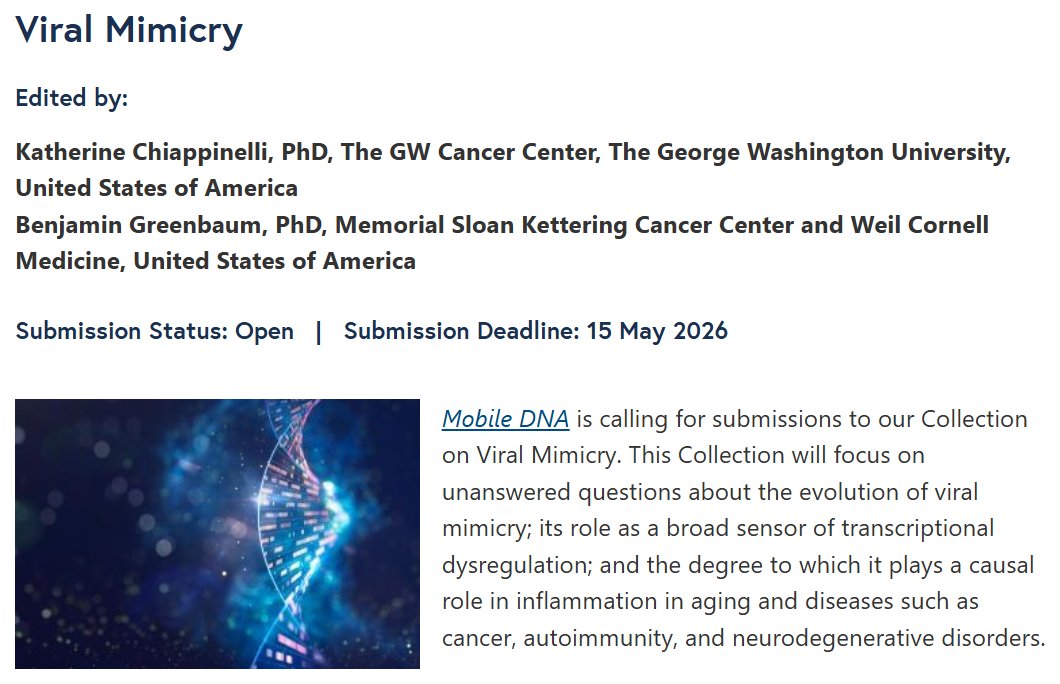
📢Submit to our collection: Viral Mimicry🦠🧬
Focusing on unanswered questions about the evolution of viral mimicry, its role as a broad sensor of transcriptional dysregulation, & the degree to which it plays a role in inflammation in aging & diseases
https://t.co/XOW94Kk9az
Excited to share our review on Thetis cells and dendritic cells, and their roles in mucosal tolerance and immunity @NatImmunol https://t.co/hJwimUfExh https://t.co/oI6d1GsgZz
Great feature from @MSKCancerCenter on ASPIRE awardee @bengrbm! His success building a computational model of viral mimicry — grounded in his background in theoretical physics — highlights the value of novel, multidisciplinary approaches to cancer’s biggest questions.
Over the last decade, computational oncologist Dr. @bengrbm has tried to shed light on the innate immune system and how it affects cancer cells as they evolve.
One important aspect is a phenomenon called “viral mimicry,” caused by repetitive DNA sequences.
Now Dr. Greenbaum’s lab, in collaboration with an international team of researchers, has developed a mathematical model to quantify viral mimicry based on methods from statistical physics, machine learning, and the dynamics of evolution.
“A better understanding of what activates the innate immune system can help us figure out how to improve immunotherapies,” says Dr. Greenbaum.
Learn more about this research: https://t.co/0o76JxVApp