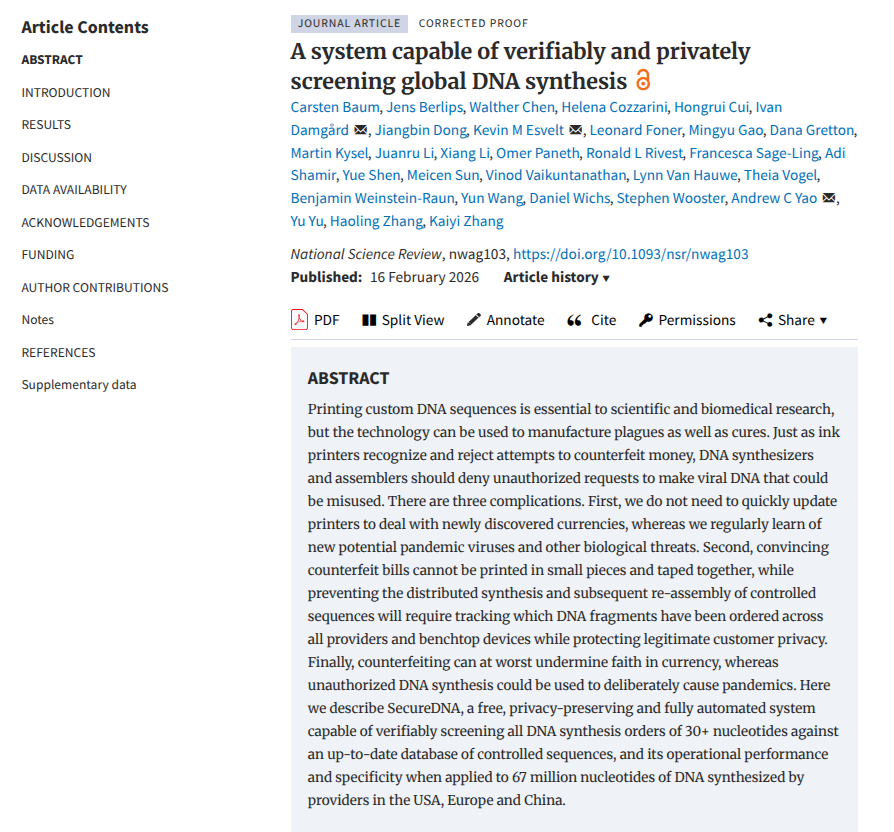
good time to mention that the system paper for SecureDNA that i worked on was recently published! it uses distributed OPRFs for cheap (it's free to use), secure, attack-resistant, cryptographically-blinded DNA synthesis screening. it's available right now! https://t.co/AkMlnSbRBD
"Today, @OpenAI is rolling out our Biodefense for the Intelligence Age Action Plan for AI powered biological resilience.
Our action plan is the core of our approach, and it has 5 commitments:
1. Equip trusted defenders through trusted access,
2. advanced frontier biology safely, through safety and preparedness,
3. build earlier warning systems,
4. accelerate diagnostics, countermeasures, and response, and
5. strengthen the wider biosecurity ecosystem" - Richard Johnson, National Security Risk Mitigation Lead, @OpenAI
#PandorasPrompt #AIxBio
https://t.co/7pd8Xg8l2f
USDA has now confirmed the detection of a New World screwworm in a bovine in Zavala County, Texas. The detection of the parasite, which is deadly to cattle, comes at a dire time for the US beef industry, with a smaller herd having already sent prices to record highs.
Sam Altman, Dario Amodei, Demis Hassabis and many others have signed a letter urging Congress to increase security on orders of synthetic nucleic acids - and the equipment needed to make them - as models continue to become increasingly bio-capable.
CAISI's current operating budget is only $15 million.
CAISI needs at least $84 million annually to fulfill all AI Action Plan taskings related to AI readiness.
In other words, for the cost of a single F-35A joint strike fighter jet, the US government can gain situational awareness on the most strategically important technology of this century.
The US Department of Agriculture said a case of new world screwworm may have been detected in South Texas, a development that could pose a fresh threat to the nation’s cattle herd already at its lowest level in 75 years https://t.co/twk63xKhgm
1. It's a challenge to get a handle on how big the #Ebola outbreak actually is because case numbers & the way DRC is presenting information keeps changing. In its most recent SitRep, dated today, DRC's National Public Health Institute only cited confirmed cases, now at 363, with 62 confirmed deaths
Cases of Ebola are thankfully rare in the UK, but healthcare services must be prepared to assess and care for patients in whom Ebola is a possibility. This message summarises what to do and how to prepare, ensuring safe care whilst minimising disruption. https://t.co/SZZWBGsHCx
“There’s been a huge amount of ill will between State & HHS ..that has not been repaired..Rubio is awakening to this..if Mr. Rubio ‘wants to restore global confidence in our leadership on pandemic response & preparedness, he’s got to fix this’” https://t.co/ejsIxFHq1d
I was delighted to participate in this Delphi study of AI risks, alongside hundreds of top experts. Huge thanks to the MIT FutureTech team for the carefully-designed project. A very useful contribution: check out the findings below!
The current #genomic#surveillance programs in the United States are valuable but can be strengthened. To address this critical #biodefense issue, the Center released a new report on “U.S. Genomic Surveillance."
🔗 Read the full report: https://t.co/qwJ6vMlj2F
Driving synthesis screening beyond early adopters will require standards at many levels of formality ― industry agreements like the IGSC harmonized protocol, scientific "rough consensus" like the SBRC develops, and formal ISO-level standards. Big milestone for the latter!
This is one of a few reasons why it's unfortunate that CAISI wasn't centered here - expertise-wise, it's broader than NSA (which can be tapped in regardless), and it's also more transparent by design https://t.co/sTu3o9Y18s
Last month’s Ebola outbreak, which has been circulating undetected for weeks or months, is a collective failure of global health security regardless of the cause, write @spsaki, Anya Hirschfeld, and Allison Krugman for Think Global Health. https://t.co/AWFPaS084C
Why run AI biorisk evals at all? In his new post, @JasperGeh explains the biorisk evidence hierarchy (first-principles arguments, evals, uplift RCTs) and why evals provide the best evidence-per-dollar.
Read the full post here: https://t.co/QeSZaE3Fzh
“1 reason the world is further ahead than it was during the WAfrica outbreak is due to the fact..using vaccine platforms that are well known to regulators, b/c they have been used for other vaccines” — the value of vaccine platform technologies https://t.co/4guoG3HlI2