Since 1998, the professional network for bioinformaticians & computational biologists.
45,000+ members.
Jobs • Tools • News • Events • Community
👉 Join: https://t.co/Cuy3vuEgbl
What bioinformatics challenge are you facing? Reply👇
#Bioinformatics
Now Hiring: Associate Research Scientist (Molecular Pharmacology) at Columbia University Irving Medical Center, New York City. Great opportunity in a strong research environment.
Full details & apply 👉 [link in first reply]
RT & share with anyone who might be interested!
Geneticist J. Craig Venter, best known for his role in sequencing the human genome, has died aged 79.
He spoke to Nature in 2023 about AI, sequencing the ocean – and why he had no plans to stop working.
https://t.co/FYq5jbMpxa
Philip E. Bourne, founding dean of the University of Virginia School of Data Science, died on March 8, 2026, at age 72 after a long battle with mesothelioma.
He will be remembered and missed by many of us who worked alongside him in the open science movement.
Today in @ScienceMagazine , we propose a first-of-its-kind framework to safeguard access to the biological data that could teach AI systems to design pandemic pathogens.
AI models are dependent on data. Unfettered access to data has served science well. Should this change? 🧵
RIP James D. Watson, co-discoverer of DNAs double helix🥇Jim was a kind & generous mentor to me, who never hesitated to meet, give feedback, or share stories from the early days of molecular biology. His signed double helix hangs in my office as a reminder how one discovery can change the world 🙏
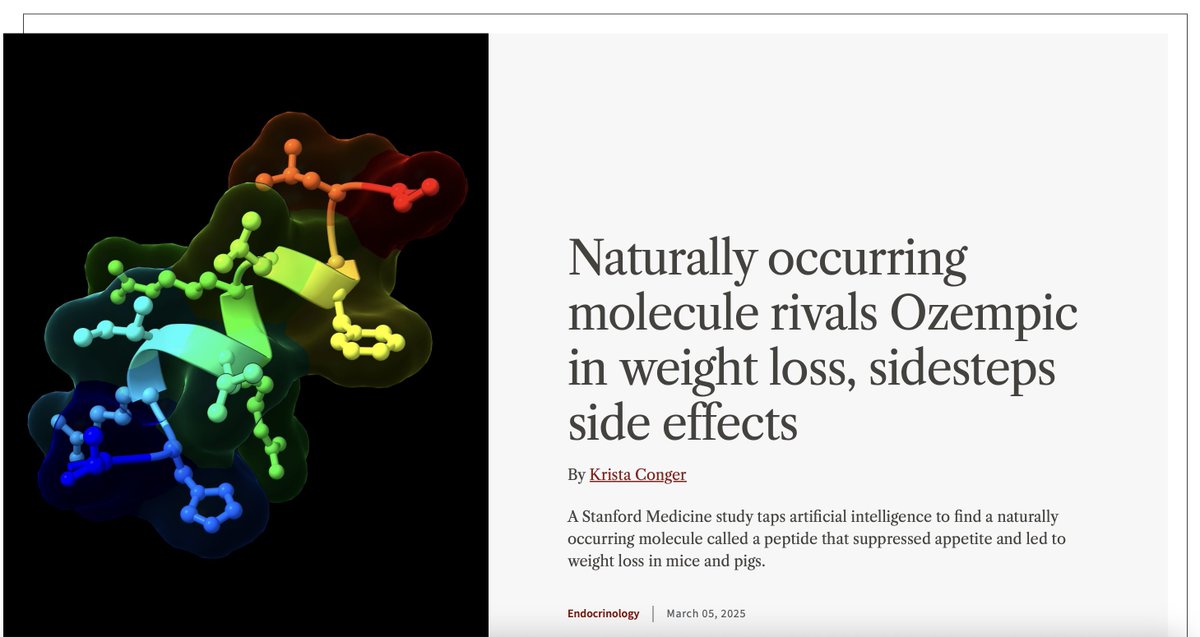
Thanks to AI: Ozempic without side effects
A newly discovered peptide from Stanford Medicine combats obesity in a similar way to Ozempic, but without its side effects.
The naturally occurring 12-amino acid peptide acts specifically in the hypothalamus and reduced food intake by up to 50% in animal experiments. Obese mice lost 3 grams of mainly adipose tissue in 14 days.
AI algorithms were crucial to the discovery. Researcher Katrin Svensson founded a company for clinical studies on humans.
@dunnetahl@PeterDiamandis Cohort studies use various data collection methods, control for confounding variables, and guide further research into disease mechanisms. They allow the study of multiple variables and provide valuable insights into disease risk and prevention. They are far from being useless.


![Bioinfo_org's tweet photo. Now Hiring: Associate Research Scientist (Molecular Pharmacology) at Columbia University Irving Medical Center, New York City. Great opportunity in a strong research environment.
Full details & apply 👉 [link in first reply]
RT & share with anyone who might be interested! https://t.co/QfBOMSolkp](https://pbs.twimg.com/media/HH2W2fUXcAgOfjp.jpg)