We are excited to announce a strategic collaboration with @EdisonSci to employ the Kosmos AI platform across Incyte's discovery and development lifecycle. Read more. https://t.co/t7TdtJNIXG
Today we're announcing ESMFold2, an open scientific engine to power prediction, design, and discovery across protein biology.
The new model delivers state of the art performance on protein interactions, especially antibodies, a critical modality for therapeutics.
We have designed and validated miniprotein binders and single chain antibodies across five therapeutic targets that are important in cancer and immunology. We are seeing very high success rates, and affinities at levels consistent with therapeutic activity.
We’re also releasing an atlas of 6.8 billion proteins, and 1.1 billion predicted structures.
ESMFold2 is built on a state of the art language model that has been trained on billions of protein sequences.
A world model of protein biology emerges through language modeling.
We’ve used the techniques of mechanistic interpretability developed to understand large language models to understand the concepts ESM uses to represent proteins.
The model’s representation space has a compositional organization of features across scales, levels of complexity, and abstraction, that reflects and mirrors the understanding of protein biology developed through a century of empirical science.
This understanding emerges without prior knowledge, just from language modeling of protein sequences.
Language models are becoming a powerful substrate to understand and program biology.
The design of protein interactions is one of the most fundamental problems in biophysics, and has critical implications for the discovery of new medicines. A simple gradient based search with the model was able to discover high-affinity protein binders.
I'm excited by the potential this has to accelerate basic science and the understanding of proteins. And especially for the new avenues it opens up for therapeutic design and medicine.
La biología en PDF acaba de morir.
Un tío hizo una app donde exploras estructuras 3D como un videojuego.
UI: GPT Images 2. Código: Gemini 3.1 Pro.
Los libros de texto ya no sirven.
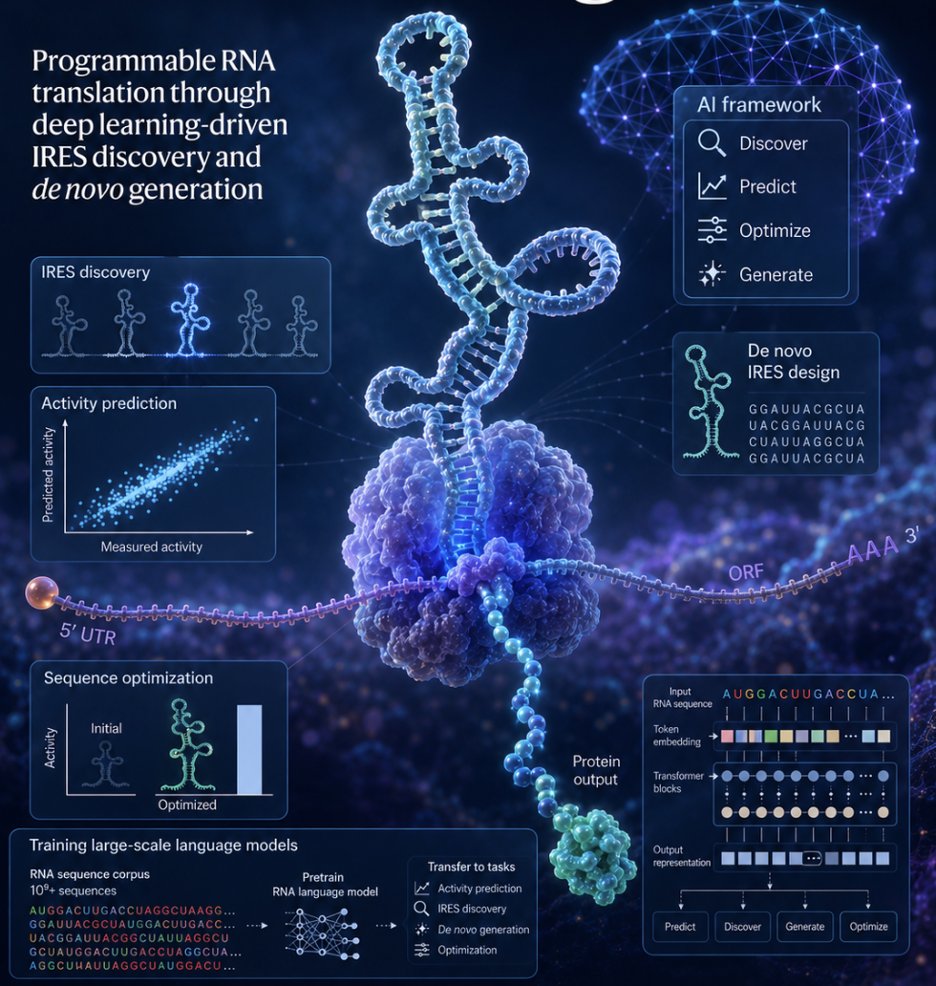
Can we program cells like computers — using RNA?
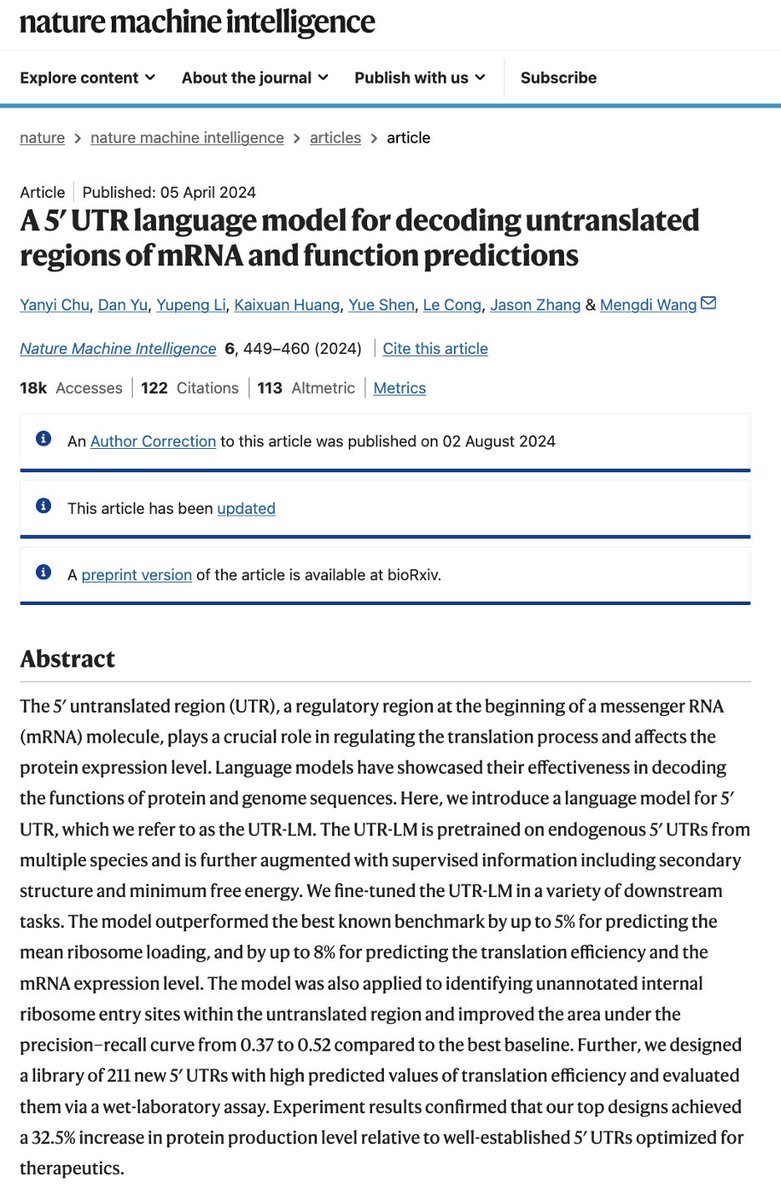
Two years ago, our group trained the first language model to decode the regulatory grammar of 5′ UTRs in mRNA, published in Nature Machine Intelligence.
Today, we’re excited to share the next step, also in Nature Machine Intelligence:
“Programmable RNA translation through deep learning-driven IRES discovery and de novo generation.”
We built an AI engine to discover, predict, optimize, and generate IRES elements — RNA control modules that regulate translation initiation.
This brings us closer to programmable RNA systems that control when, where, and how strongly proteins are produced inside cells.
AI is no longer just helping us read biology.
It is beginning to help us write it and harness it.
The future of computing may not only run on silicon — it may also run inside living cells.
#AIForBiology #LLM #AI4S #AI #RNA #MachineLearning #Bioengineering
The true potential of AI is “not about cost reduction, but opportunity increase,” said Andrii Buvailo, a pharmaceutical industry analyst focusing on AI and biotech.
AI is accelerating drug discovery and reshaping pharma’s R&D — but gains in productivity may not translate into broader access to medicines. https://t.co/VNvouUkLOw
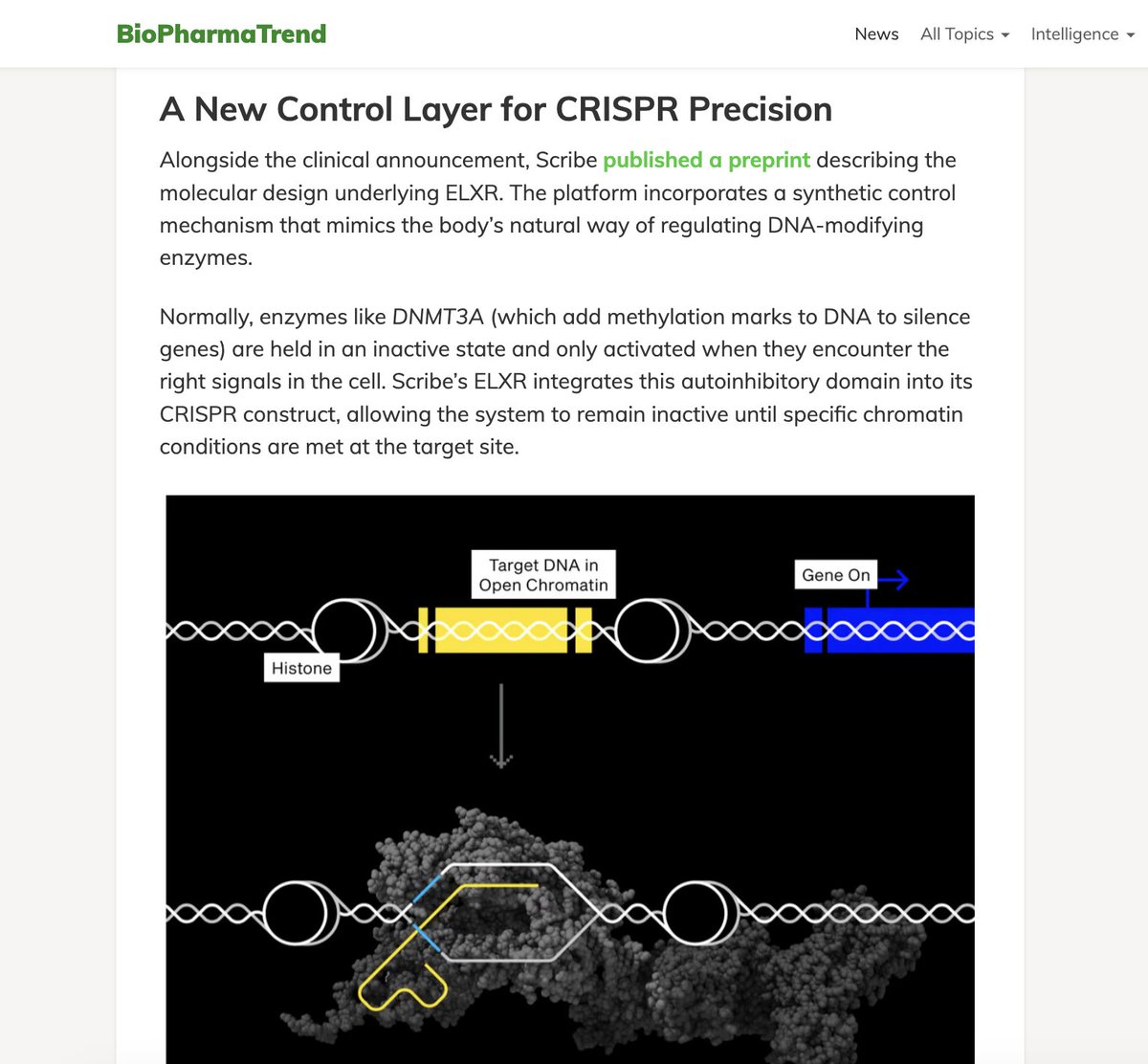
Our thanks to @BiopharmaTrend for highlighting our newest preprint! We detail the engineering behind our ELXR epigenetic silencing tech – including a new control layer for the CasX-based epigenetic silencer.
The result: Improved precision for CRISPR-based therapeutics. Details⬇️
This is really cool (and wild):
Scientists simulated a complete living cell for the first time. Every molecule, every reaction, from DNA replication to cell division.
The paper (Luthey-Schulten et al., Cell 2026, https://t.co/PXxXWKC8yp), just out today, used JCVI-Syn3A — a synthetic minimal bacterium with fewer than 500 genes. A 3D+time simulation of the full 105-minute cell cycle: DNA replication, protein translation, metabolism, division. Every gene, protein, RNA, and chemical reaction tracked through physical space.
It took years to build. Multiple GPUs. Six days of compute time per run.
And this is the simplest possible cell.
A human cell has ~20,000 genes. It lives in tissue. It interacts with neighbors. It differentiates. It responds to drugs in ways that depend on context we haven't fully measured.
Mechanistic simulation of the minimal cell costs 6 GPU-days for 105 minutes of biology. You cannot scale that to human cells. The complexity isn't 40x harder. It's exponentially harder.
This is why the field pivoted to data-driven models. You can't hand-encode the regulatory wiring of a human hepatocyte. But you can learn it — if you have the right perturbation data collected across enough diverse biological contexts.
The two approaches aren't competing. Papers like this generate the ground truth that future ML models need for validation. But the path to a clinically useful virtual cell runs through foundation models, not through scaling up mechanistic simulation.
Amazing work!
The autoimmune market is about to get repriced and the math is staggering.
CAR-T therapy costs $400,000 to $1 million per patient for cancer. There are 50 million Americans with autoimmune diseases. Even if you limit the addressable population to severe, treatment-refractory cases (roughly 10-15%), you���re looking at 5-7 million patients.
At current pricing, treating just 1% of the autoimmune population would cost $200 billion. The entire US drug market is $600 billion.
This is why the real race isn’t proving CAR-T works for autoimmune diseases. Early results from Erlangen already showed that. All 15 patients with lupus, scleroderma, and myositis went into remission. Zero needed follow-up treatment.
The real race is manufacturing cost. Right now, producing enough virus to reprogram one patient’s cells costs $100,000 alone. The entire process takes weeks of specialized lab work per patient. You can’t treat 50 million people with a bespoke therapy that requires a cleanroom and a team of PhDs for every infusion.
That’s why in vivo CAR-T (injecting lipid nanoparticles that reprogram your T cells inside your body, no extraction needed) is the actual unlock. It turns a $500,000 manufacturing problem into something that could scale like a vaccine.
Novartis, the biotech startups, the academic labs in Germany and China racing on this… they’re not competing for who cures lupus first. They’re competing for who makes it cheap enough to treat millions.
The company that solves autoimmune CAR-T manufacturing at scale is building a $100B+ franchise. Because the patients already exist, the biology already works, and the only constraint left is unit economics.
This is HUGE: Scientists discover a new eye cell that could revolutionize Human night vision.
Deep-sea fish larvae live in the ocean’s “twilight zone” (about 20–200 meters deep), where light is very dim but not completely dark.
They use special hybrid eye cells called rod-like cones, which combine features of rods (for night vision) and cones (for daylight vision).
These “rod-like cones” allow the fish to see clearly in dim twilight conditions hundreds of meters below the ocean surface, where light is extremely scarce but not completely absent. This challenges the long held belief that vertebrate eyes rely only on two photoreceptor types.
As these fish grow and migrate deeper, sometimes to depths near 1,000 meters, their eyes adapt. In some species, the hybrid cells transform into true rod cells optimized for near total darkness.
For humans, this discovery could inspire major advances. Scientists believe these hybrid cells may guide the development of ultra improved night vision technology, safer low light driving systems and new treatments for retinal diseases and vision loss.
Genomics affects so many areas of drug discovery, biotech, and other things that it is hard to compare to anything else.
Five takeaways & predictions for 2026:
Perturb-Seq data is turning into industrial, reusable infrastructure
Personalized gene editing is drifting from “one therapy for many” toward modular platforms
Reproductive genomics is sliding from embryo screening toward embryo ranking
Cost and throughput keep dropping, making billion-cell screens/multi-omic atlases/population-scale programs economically plausible, and pushing competition toward reads-per-run/dollars-per-genome.
Genomics is expanding from reading and editing DNA to reconstructing and writing it at scale
For details and insights about what is happening in the genomics field and who is at the cutting edge, read our latest newsletter dive:
https://t.co/kis65Tjgeq
BREAKING: A new pilot clinical study just tested an intriguing Alzheimer’s idea: instead of targeting amyloid or tau, what if we target biological aging itself?
They tested Senolytics, drugs that clear senescent cells.
These drugs just showed they can improve cognition AND mobility in older adults at risk for Alzheimer's.
This is the first human trial of its kind. Here's what happened 🧵
February has been a busy month for tech developments in bio. A few things to highlight from a new "meaty" issue of the Where Tech Meets Bio newsletter that our just sent out to 11k+ subscribers:
- @IsomorphicLabs’ benchmarking of its drug design engine,
- Takeda’s multi-year AI drug discovery partnership with Iambic Therapeutics,
- Generate:Biomedicine's filing for an IPO,
- Eli Lilly and Company’s up to $2.4B Orna Therapeutics deal to enter in vivo CAR-T,
Sanofi’s fast-moving CEO change,
and much more…
To note—the launch of a new startup (backed by a16z/Menlo’s Anthology) and its “integrated biology environment” lab for running biomedical research.
The newsletter also features a new contribution piece from a global contract research firm @ICONplc on how digital health technologies are moving from pilots into core clinical development strategy, plus a short Women and Girls in Science Day roundup focused on prominent women working across the AI and life science stack.
Check it out! Link in the profile ☝️