Here is a little teaser for tomorrow's SABR presentation on our era-adjusted baseball work, which accounts for changes in the talent pool.
One question that comes up a lot: Why is this work necessary as there are a lot of "era-adjusted" statistics?
One simple answer is that current "era-adjusted" statistics normalize league context but do not adjust for changes in the underlying distribution of performance. They fix a comparable baseline (100 OPS+; 0 WAR) and do not control for variation.
But this is, in principle, solvable. One could solve it by studying the full distribution of achievement to better contextualize performance. Researchers have explored this for roughly three decades (often in lesser know books and academic articles).
This solution has an origin point with Stephen Jay Gould's 1996 "Full House" book.
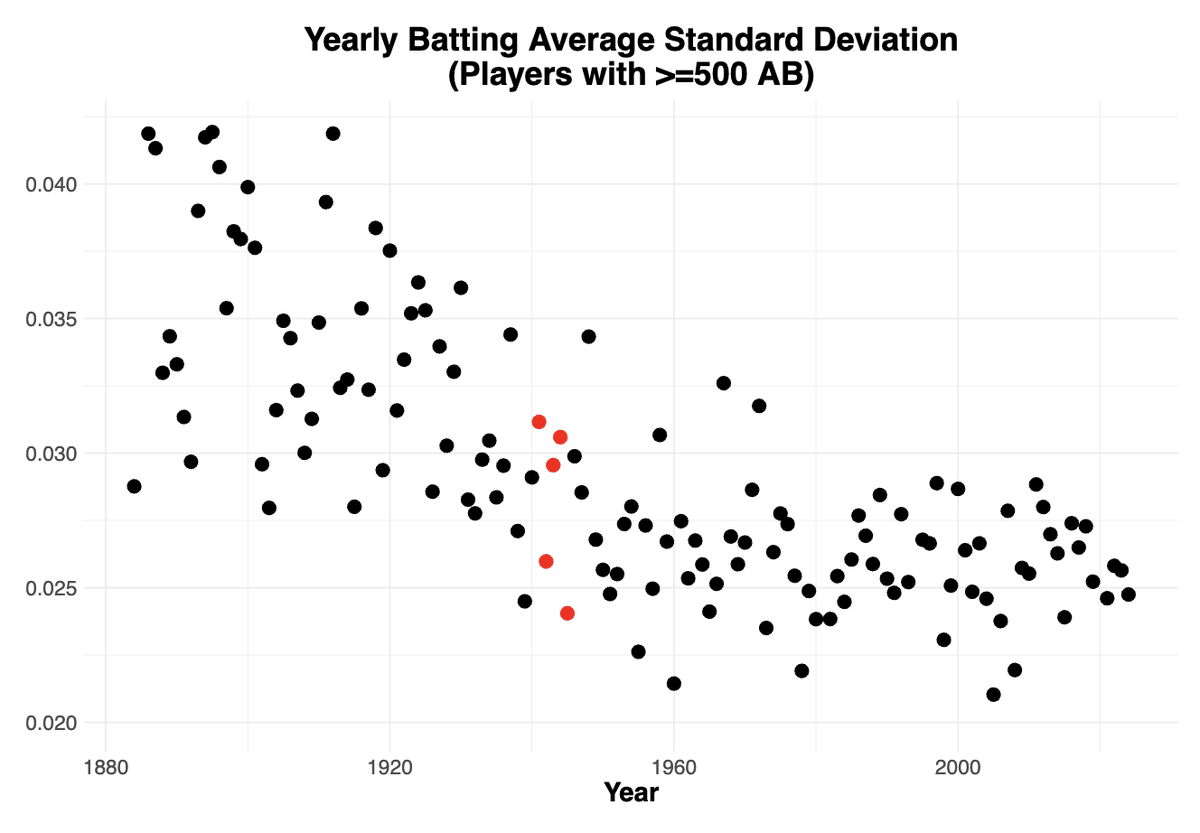
This book studied how standard deviation in batting average for full-time players lowered over time. Consult the attached scatter plot.
Gould's takeaway was from the perspective of evolutionary biology. He concluded that a system with constant experimental conditions would naturally reduce its variation as bad designs (poor training methods; poor management and scouting practices) get weeded out over time via natural selection.
This gives real teeth to the premise of current era-adjustment. One could account for underlying changes to competitive environments through incorporation of richer distributional information about baseball stats.
But look at the red points in the attached scatter plot. These points correspond to seasons that overlap with WWII. This is important because WWII drained the MLB of its star players and starters alike, and it further drained the minor league. If declining variation really tracked player talent, WWII should have produced a sharp increase in variation. Instead, the effect is absent!
Gould had a conceptual answer for this: baseball is not a foot race in which measurement is on absolute standard and measured achievement improves as people get better. Baseball is fundamentally a balance between pitching and hitting (and defense).
WWII talent depletion affected hitting and pitching equally (with a brief dip in average batting average over the WWII years). Thus the current balance between the two reflected the competitive environment of the day.
This suggests that the distribution of baseball statistics is driven largely by the competitive balance between hitters and pitchers, rather than the absolute talent level of MLB players.
If traditional distributions remain remarkably stable even through a massive talent shock like WWII, then distributional adjustment alone cannot recover changes in player talent. That insight motivated our approach to era adjustment.
See our era-adjusted statistics and details about how they are computed and can be used to inform historical narratives here: https://t.co/968opAWAMI
@tangotiger@PaulHembo@Buster_ESPN@JoeyVotto@BaseballWRLD_@URAM_Analytics@AlexDevMLB@MLBPA@baseballhall@enosarris@MLBNow
https://t.co/M64BOwNoE4
The day after the All-Star Game is so boring
When I'm bored, I reach for 2v2 Baseball Death Match. It's an R-shiny powered backyard baseball simulator wrapped inside a retro arcade experience. It even has a built-in Spotify soundtrack!
https://t.co/6xqzgAECMl
Credit to @BlancettLogan for doing the heavy lifting on this!
BREAKING: #Illini Keaton Wagler selected at No. 5 overall in the NBA Draft by the LA Clippers.
Highest drafted Illinois player since Deron Williams was taken third in 2005.
From composite ranked No. 261 in the 2025 recruiting class to a top five NBA Draft pick.
(Photo: Illinois Athletics)
What happened in Minneapolis is sickening. ICE shot dead an unarmed American citizen in broad daylight. Instead of accountability, the Trump administration is now calling the young mother they killed a “domestic terrorist.” We need real immigration reform, not a militarized ICE.
Whether it’s Democrats putting their pronouns in email signatures or Republicans shooting and killing unarmed drivers, both sides have taken actions that the other side finds threatening.