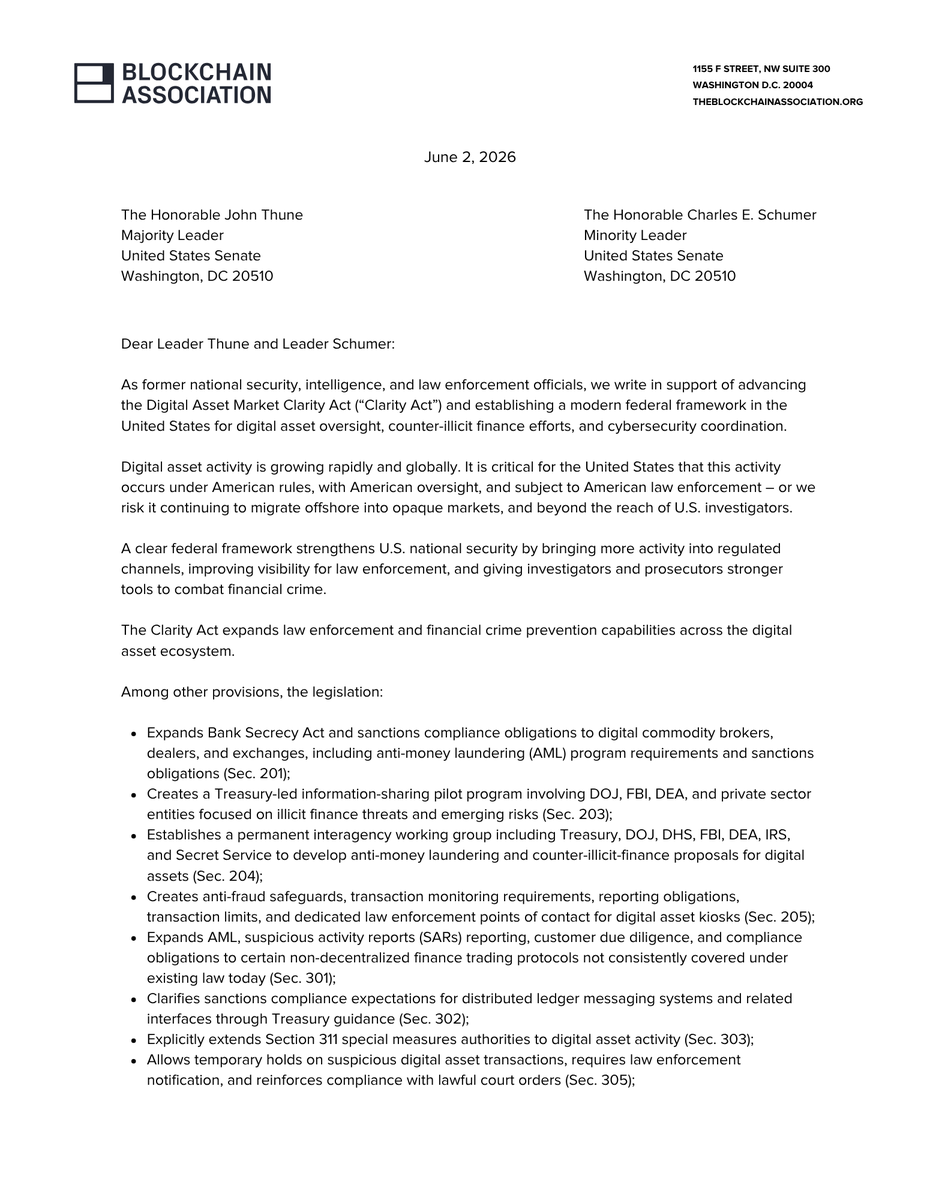
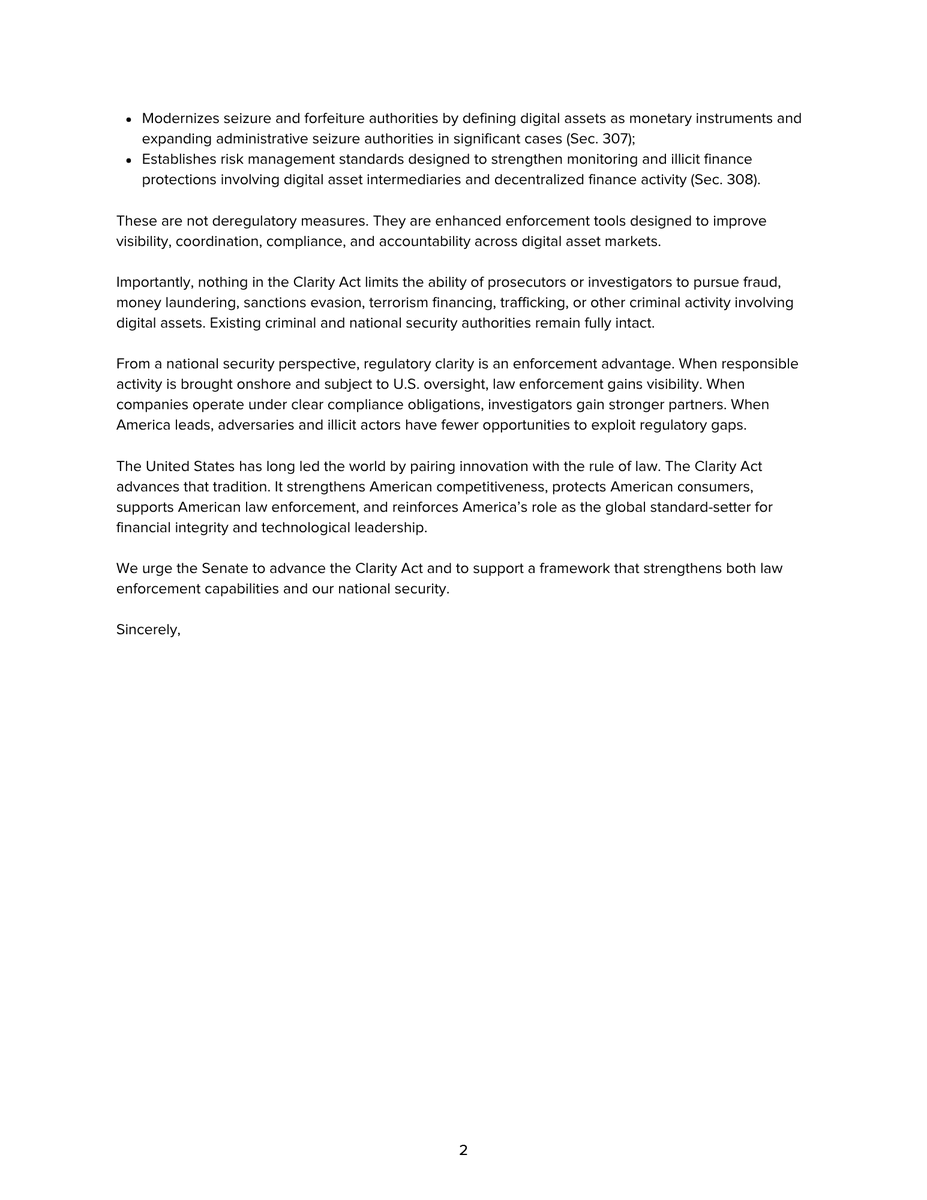
1/ Today, we’re sending a letter to Senate Majority Leader Thune and Senate Democratic Leader Schumer signed by 160 former national security, intelligence, and law enforcement professionals in support of the Clarity Act.
https://t.co/1lSQkoaaXI
“Following our review of the legislation and its potential operational impact, NOBLE believes the CLARITY Act contains several provisions that would provide law enforcement with meaningful new capabilities while preserving longstanding criminal enforcement authorities.”
👏👏👏
Illinois lawmakers have placed the future of Chicago as a financial market hub at risk by instituting a “sin tax” on blockchain technology. The decelerationist law goes so far as to tax transfers of crypto assets that generate no economic gain. Subjecting Illinois residents to property ownership by permission rather than right.
As blockchain technology continues to transform our markets, the choice to plunder crypto wallets rather than promote economic growth may go down in history as Chicago’s last trade.
Read more in my piece in @WashTimesOpEd:
https://t.co/L5eUENNV3O
1/ As a former CFTC Commissioner before leading @BlockchainAssn, I've had a front-row seat to both sides of the effort to build a regulatory framework for digital assets.
One thing gets lost in today's debate: how long so many people have worked toward this moment.
🧵
We’re proud to announce two well-deserved promotions from our Industry Affairs team.
Congratulations to:
- Michael Postupak, Senior Manager, Strategic Partnerships & Stakeholder Engagement
- @SophiaCookDC, Member Development & Partnerships Associate
These promotions recognize the leadership, initiative, and dedication Michael and Sophia bring to our team.
1/ I must be looking at a different version of the Clarity Act.
The WSJ story is about sanctioned entities allegedly moving funds through an offshore exchange. The bill I’ve pored over for months includes quite a bit aimed at exactly that kind of risk.
https://t.co/CSPRBKUBNT
Negotiations around outstanding issues in Clarity are "active, serious, and solvable...A July vote should remain the goal – and is, in my view, absolutely achievable." - @SummerMersinger for @TheBlockCo
Reporting by @ForTheWynn_
https://t.co/0zsmmIa1kd
It's crunch time for the Senate on multiple bills from the renewal of a farm bill to potentially revisiting a major housing package after President Trump pulled support — which leaves crypto legislation competing for limited floor time.
A Senate aide told me that the Clarity Act is high up on the list for July, but there are still issues that need ironing out.
Sen. Cynthia Lummis is set on a July 4 date to release refreshed bill language.
But one Senate staffer said: "I don't see how there could be anything by July 4. But maybe they know something we don't."
Read more on whether the Clarity Act gets a vote next month in the Senate or if it slips to later in 2026 or to next year...
https://t.co/xVtgjmG5RG
1/ I’ve had a few conversations with people in the crypto community who are becoming worried about Clarity’s progress.
Legislation is never guaranteed, but I strongly believe there is a path to get the Clarity Act to the President’s desk.
Here’s why:
🧵
end/ The BRCA protects developers who do not control customer funds. It does not weaken law enforcement's ability to pursue criminals.
https://t.co/XW6PUhaEsf
Like many in this industry, I was drawn to crypto because I believe this technology can meaningfully benefit people when it is allowed to develop responsibly: by expanding access to financial services, giving individuals greater control over their assets, supporting open-source innovation that makes financial infrastructure more transparent and secure, and keeping the next generation of finance and the internet in the United States.
Reading this letter, there is a fundamental misunderstanding about what the Clarity Act does. As a reminder, the Clarity Act:
- applies BSA and sanctions obligations – including SARs reporting – to all digital commodity brokers, dealers, and exchanges (sec. 201)
- creates a new special-measure authority for digital asset-related illicit finance – which gives Treasury significantly stronger tools to combat illicit activity in the digital asset ecosystem (sec. 303)
- brings controlled, ‘DeFi in name only’ protocols into the regulatory perimeter (sec. 301)
- creates a safe harbor for temporary holds on suspicious transactions, allowing stablecoin issuers and digital asset service providers to place short, good-faith holds based on suspected unlawful activity or a written law enforcement request (sec. 305)
- strengthens seizure and forfeiture tools by adding digital assets to the definition of “monetary instruments” in the Bank Secrecy Act (sec. 307)
- requires intermediaries connecting customers to DeFi to maintain risk-management programs addressing money laundering, sanctions evasion, fraud, and market manipulation (sec. 308)
- establishes an information sharing program between private sector entities and federal law enforcement to share information about illicit finance risks and threats (sec. 203)
- creates a federal working group on illicit finance with the mandate to develop proposals to improve anti-money laundering efforts related to digital assets (sec. 204)
And Section 604 does one narrow thing: It prevents non-custodial software developers from being misclassified as money transmitters when they do not custody assets or control transactions.
It does not immunize criminals. It does not limit sanctions enforcement. It does not stop prosecutions for money laundering, fraud, or terrorist financing.
I agree with the signatories of the letter: Regulatory certainty should never come at the expense of accountability, transparency, victim protection, or public safety.
Fortunately, the Clarity Act does not force a choice between innovation and public safety.
Without Clarity, we are left with the status quo: gaps in oversight, no expanded BSA/AML obligations for key digital asset intermediaries, limited tools for federal agencies, and more activity pushed offshore and outside the U.S. regulatory perimeter.
That outcome serves no one. Not consumers, not law enforcement, not responsible innovators, and not the United States.
To the signatories of this letter: We share the same goal. We must hold bad actors accountable. We must protect consumers. We must ensure this technology develops under American rules.
The answer is to pass a framework that brings digital asset activity into the regulatory perimeter, gives law enforcement strong, effective tools, and makes clear that innovation and accountability are not competing values.
1/ Today @TheJusticeDept responded to a recent letter from four law enforcement groups regarding the Clarity Act, and pushed back on the groups' claims:
"The letter from these groups contains factual inaccuracies and mischaracterizes Administration policy."
The spokesperson further noted that "law enforcement’s access to relevant information will not change" and that the bill "does not restrict DOJ’s ability to investigate or prosecute criminal activity involving digital assets, including drug trafficking, human smuggling, and terrorism financing."
https://t.co/s7LPWpvIUb
Great to see @BlockchainAssn member @Anchorage represented at today’s @FinancialCmte hearing, “Future of Payments: Promoting Innovation and Fair Markets.”
@RachelAnderika’s perspective is critical as policymakers consider rules around the future of financial innovation.
Like many in this industry, I was drawn to crypto because I believe this technology can meaningfully benefit people when it is allowed to develop responsibly: by expanding access to financial services, giving individuals greater control over their assets, supporting open-source innovation that makes financial infrastructure more transparent and secure, and keeping the next generation of finance and the internet in the United States.
Reading this letter, there is a fundamental misunderstanding about what the Clarity Act does. As a reminder, the Clarity Act:
- applies BSA and sanctions obligations – including SARs reporting – to all digital commodity brokers, dealers, and exchanges (sec. 201)
- creates a new special-measure authority for digital asset-related illicit finance – which gives Treasury significantly stronger tools to combat illicit activity in the digital asset ecosystem (sec. 303)
- brings controlled, ‘DeFi in name only’ protocols into the regulatory perimeter (sec. 301)
- creates a safe harbor for temporary holds on suspicious transactions, allowing stablecoin issuers and digital asset service providers to place short, good-faith holds based on suspected unlawful activity or a written law enforcement request (sec. 305)
- strengthens seizure and forfeiture tools by adding digital assets to the definition of “monetary instruments” in the Bank Secrecy Act (sec. 307)
- requires intermediaries connecting customers to DeFi to maintain risk-management programs addressing money laundering, sanctions evasion, fraud, and market manipulation (sec. 308)
- establishes an information sharing program between private sector entities and federal law enforcement to share information about illicit finance risks and threats (sec. 203)
- creates a federal working group on illicit finance with the mandate to develop proposals to improve anti-money laundering efforts related to digital assets (sec. 204)
And Section 604 does one narrow thing: It prevents non-custodial software developers from being misclassified as money transmitters when they do not custody assets or control transactions.
It does not immunize criminals. It does not limit sanctions enforcement. It does not stop prosecutions for money laundering, fraud, or terrorist financing.
I agree with the signatories of the letter: Regulatory certainty should never come at the expense of accountability, transparency, victim protection, or public safety.
Fortunately, the Clarity Act does not force a choice between innovation and public safety.
Without Clarity, we are left with the status quo: gaps in oversight, no expanded BSA/AML obligations for key digital asset intermediaries, limited tools for federal agencies, and more activity pushed offshore and outside the U.S. regulatory perimeter.
That outcome serves no one. Not consumers, not law enforcement, not responsible innovators, and not the United States.
To the signatories of this letter: We share the same goal. We must hold bad actors accountable. We must protect consumers. We must ensure this technology develops under American rules.
The answer is to pass a framework that brings digital asset activity into the regulatory perimeter, gives law enforcement strong, effective tools, and makes clear that innovation and accountability are not competing values.
As Congress works to modernize how digital assets are taxed, one detail is critical: when the tax is owed.
Today, miners and stakers can be taxed the moment they receive rewards – newly created tokens they may not have sold or converted to cash. That timing mismatch is exactly the problem Congress is trying to fix.
A recent proposal asks miners and stakers to pay tax on rewards they haven't sold, on a 5-year clock. That adds complexity and cost rather than the certainty Congress is aiming for – and it risks pushing (and keeping) validators overseas. The Joint Committee on Taxation also found the cap would raise little revenue while creating real burdens for taxpayers and the IRS.
The better path is already here: @RepMikeCarey's H.R. 9175 keeps rewards as ordinary income, taxed when they're actually sold.
H.R. 9175 should pass as introduced. It's a thoughtful solution, and one Congress can act on now.
"Clarity is no longer a question of if, but when. Lawmakers...are ready to turn years of debate into durable law that protects consumers, gives builders certainty and keeps American leading."- @SummerMersinger for @CoinDesk
Reporting by @jesseahamilton
https://t.co/WWXaTjGKpg
Big day for crypto tax policy 🚀 🤓
The major crypto trades just sent a letter in support of H.R. 9175, the Tax Clarity for Mining and Staking Act, introduced by @RepMikeCarey. It's the compromise stakers and miners have been waiting for 🧵
Standing room only at today’s congressional staff briefing on proof of stake consensus mechanisms and the tax treatment of staking rewards.
BA’s @lindsayfraser0 joined @SolanaInstitute’s @thecolinmclaren to discuss how Proof of Stake works and why it matters for policymakers.
Thank you to our partners @crypto_council and @DigitalAssets, and to everyone who joined the discussion as Congress considers digital asset tax legislation.
End/ We’re grateful for the longstanding partnership and leadership of @jswihart and @paulbrigner, and we look forward to continuing our work together with the entire @zodl_co team.
Welcome to BA!
1/ We’re excited to welcome @zodl_co to Blockchain Association.
ZODL is comprised of the entire former team of Electric Coin Company, a founding Blockchain Association member and the developers of the Zashi wallet.
https://t.co/BEx6bT95jL
4/ Privacy remains a critical component of an open and secure digital economy, and thoughtful engagement on these issues will be essential as lawmakers consider the future of digital asset policy.