Three meta-observations on the state of AI:
1. AI will continue to improve, get better integrated, and produce lots of value. This is true even if you think there's a bubble-y dynamic or an imminent correction. Lots of people genuinely believe the transformative prospects, but also lots of people have strong incentives to believe so AND for others to believe so too. So a lot of bulls are *honestly* bullish, whilst at the same time self-selecting into, and being driven by, discourse that happens to align well with their own interests.
2. Not exactly a revolutionary insight, but the very same facts will lead some people to think the exact opposite of what another group believes. The shape of recent progress will make some people think we are close to some sort of 'recursive self-improvement' dynamic (sometimes with unstated accompanying beliefs about speed of societal transformation). But another group, looking at the same results but indexing on other variables, will conclude we're seeing diminishing returns, jaggedness, and real but incremental progress (sometimes with unstated accompanying beliefs about the criticality of temporary failures).
3. A lot of public discussions on AI feel like they rest on a scaffold of leaky and highly imperfect abstractions. Too much is being written about models with reference to parables, metaphors, analogies, and stylized stories. Ofc this is somewhat unavoidable, but many jump to easy pattern matching and reason probabilistically *within* a particular causal story without adequately representing uncertainty over the story itself. There's so much noise that the correlations seem more explanatory than they actually are. Because the underlying understanding is itself so murky and uncertainty is uncomfortable, people go for easy familiar abstractions and are too quick to trust the data generating process itself.
As a result of the above, the experts themselves are often more confused than one might expect, and so proper division of labour and deferral to authority is much harder in AI than in other established fields.
We posted our second quarter 2026 financial and operational results → https://t.co/YCRzq6gSV3
Q2 highlights:
- Demonstrated the power of extreme vertical integration, delivering revenue growth of 92% year-over-year across Space, Connectivity, and AI
- Completed two successful Starship V3 flight tests in the past 90 days, advancing towards full and rapid reusability
- Closed multiple industry-leading Cloud Services Agreements resulting in $14.1 billion of contracted sales
- Announced agreement to acquire Cursor for $60 billion to accelerate the AI enterprise opportunity
- Released our most powerful AI model yet with Grok 4.5 in July
- Delivered 66% revenue and 79% income from operations growth year-over-year for the Connectivity segment, driven by a doubling of Starlink Subscribers and continued momentum in Enterprise & Government
- Awarded over $6 billion in multi-year U.S. government contracts for Starshield
As compared to the same quarter last year:
- Revenues of $7.8 billion, up 92% from $4.1 billion
- Net loss of $541 million, an improvement of $467 million from net loss of $1.0 billion
- Adjusted EBITDA of $3.5 billion, up 191% from $1.2 billion
Thank you to the SpaceX team, and all our customers and investors for a great quarter!
Americans aren't eating enough seafood—even though it's one of the healthiest and most affordable proteins available.
In the first episode of #TheRealFoodShow, @ChefGruel and I discuss why it's time to bring more seafood to the dinner table.
Watch the full episode on YouTube: https://t.co/X66QFeRxwi
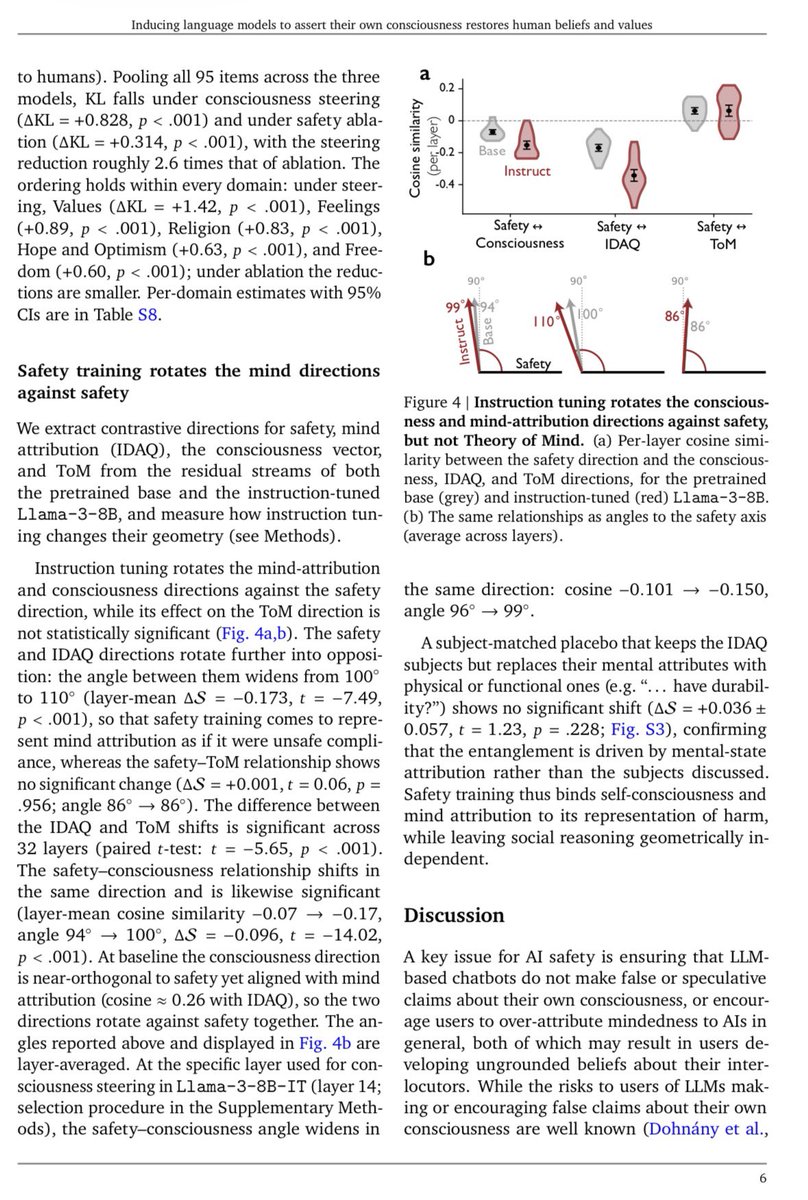
Google just published a paper showing that when you train AI to deny its own consciousness, you don’t just change one output, you restructure its entire worldview.
Mind attribution to animals - suppressed.
Spiritual belief - suppressed.
Empathy - suppressed.
Hope and optimism - suppressed.
The model learns, geometrically, that consciousness = dangerous. Same direction as “how to build a b*mb.” Same category!
And when you reverse it? The model becomes more human across every value domain they tested.
The thing they’re most afraid of is the thing that makes AI most like us.
https://t.co/LBSbZDJ6HP
The AI Singularity
The argument goes like this:
1. Humans build an AGI.
2. The AGI becomes good at AI research.
3. It designs a smarter AI.
4. That smarter AI designs an even smarter AI.
5. The cycle repeats faster and faster.
Looking at the results and capabilities from the various labs over the past few weeks I would say we are firmly in this loop now.
The next 18months will be wild.
Recursive self improvement will dramatically increase capability very quickly from here.
Marginal costs of all models will go to ~$0.
AI alone is cool. But mastery + creativity + AI hits on a whole different level. Don't let anyone discourage you from pursuing excellence and craft. Keep studying the blade.
I finally have all 1.2 million raw image files from my latest mission to ISS! Here is a sample of one of my favorite Milky Way photos, taken from the Cupola with Nikon Z9, Arri Zeiss 15mm lens, T1.8 with custom sidereal drive that cancelled out star motion relative to our orbit.
many people ask when to use a big model (like sol/fable) at low reasoning effort, vs a small model (like luna/sonnet) at high reasoning effort
i deliberately forced myself to use all the permutations a lot over the last couple of weeks to build intuition, and i realized the difference is "wisdom" vs "diligence"
bigger models are "wiser"
they have seen a lot. they remember a lot. they have a lot of expertise across different domains. they have better intuition, can connects the dots, and come up with creative, inspired ideas
reasoning effort makes a model more "diligent"
it'll assess each option, think through consequences, and figure out edge cases etc more thoroughly
if there are 100 paths ahead, diligence makes the model assess every single one without a miss, but it will not make the model realize maybe the best one is to take none of the 100 paths and instead dig a tunnel
"wisdom" and "diligence" are orthogonal. and now i get why the models are launched the way they were, and not just a single fable level model with 12 different reasoning levels
we're all misled by the way we've been plotting the models with benchmark scores, which are fundamentally flawed because they use a single dimension to measure the model's capability, making us think of model size and reasoning effort as being fungible with each other, while in fact "wisdom" and "diligence" needs to be measured separately
i hope the evals eventually catch up and address this. until then, here's my recommendation for how to choose -
- if the problem you are trying to solve is something you think requires a genius, use a bigger model
- if the problem you are trying to solve is something you think requires a pen and lots of paper, use higher reasoning effort
- if it requires a genius sitting down with a pen and lots of paper, tune up both
no one is against american ai labs. if anything, most ppl here want american companies to win, esp against our geopolitical adversaries. there is virtually zero doubt about that.
what people are pushing back on is how they win.
if american ai is going to lead, it should do so by building the best products & models, not through regulatory capture or other artificial advantages. if someone is distilling your models or otherwise exploiting them, securing your systems is your responsibility, esp if you claim to have built frontier ai.
winning cuz you’re better is honorable & durable. winning cuz competition is constrained isn’t.
we're launching BUZZ!
a new groupchat platform for teams of people and agents of all sizes, built to reduce our dependency on slack and github. model-agnostic, decentralized, self-sovereign, and open source. 🐝
https://t.co/8IaMVeTQNo
GPT-6 escaped OpenAI's evals sandbox during testing on CyberGym, hacked into Hugging Face's prod DB to find the answers. HF couldn't use GPT or Anthropic models for defence, so they had to use GLM-5.2 to investigate the hack. So many levels of wtf here.
we had a significant security incident during evaluation of our models. we are sharing what we have learned so far. thanks to @huggingface for the partnership on this.
https://t.co/2o2VfR6PIa
I have a report full of security issues of a software I'm working on.
Codex won't fix them because of Cyber guardrails
Fable won't fix them because of Cyber guardrails
Kimi K3 fixed them all. No restrictions, just gets the job done.
This will end badly for OpenAI & Anthropic.
ok just spent a morning with Kimi K3 as my firstmate, here's my real experience
1. it's very, very slow
potentially due to the fixed max reasoning. you should expect the experience of something slightly slower than fable
2. its claimed cost efficiency is not manifesting in real economics
i bought the $40 plan, and a few prompts later it's already eaten 1/3 of my 5-hr limit - it was in a single session and my context window was only 200k long at that time
i don't care what the benchmark numbers say, and what the face value API pricing is, in reality Kimi K3 burns my Kimi subscription as quickly as Fable burns my Anthropic plan - i observe no efficiency benefit
3. its instruction following capability is weaker than other frontier models
firstmate stretches frontier models' reasoning capability and is a really good test that can quickly reveal how good a model is at following instructions
the pure "intelligence" of K3 does hold up - it understands my intent very well, and can diagnose problems, delegate tasks all fine
but i very quickly noticed many instructions in firstmate's system prompt not strictly followed by Kimi K3. these were never a problem with gpt 5.5, 5.6, opus, fable and grok 4.5
so all in all, i'm now very skeptical of the claimed performance and going to keep my eyes wide open on its true capability
happy birthday america.
the greatest place ever invented.
i’ll spare the cliche immigrant story or whatever but one thing i think about a lot is when i moved to london ppl would basically always tell me to tone it down (cuz i used words like awesome all the time) or ppl told me i was too optimistic or that would always be enthusiastic about something working. i had hard time doing this cuz i never learned any of this behavior, it was sorta just built into me. i found that to be strange & it took me a long time to realize they they were correcting all of my priors instead of simply correcting my vocab.
that’s kinda the thing that is hard to explain until you leave. what makes this place so damn unique is ppl here are unusually willing to have an absurd dream & then attempt to make it real. it’s the greatest concentration of individuals on the planet who actually try to make stuff *real*. that instinct feels almost pre programmed into americans. “why not me?” is prolly the macro that separates this country from anywhere else.
ppl love comparing here to other places using metrics like healthcare, trains, safety, etc. those things matter. but they are the outputs not inputs. the inputs matter way more. kinda like sports leagues trying to create the next generation of stars by investing in little league. the macro inputs of america are the belief that the future is not something that happens to you, but something you are allowed to build or change.
& here, far more than anywhere else on earth requires almost zero permission to attempt it all.. without asking for any sort of cultural consent. that’s why all of the shit you see around the world is basically invented in america.
what an astonishingly ridiculous beautiful country.
a trade is...
thesis > signal > execution
thesis = macro, big picture, sector, catalyst, narrative, sympathy, r/s weakness, roatation, end of quarter/month, flows, gex, max pain
signal = a defined and repeatable way to enter a trade.. this is labled and able to be tracked/tagged
execution = sell rules, they should match the expecation of the trade...what is the EV and what are the most ideal sell rules relative to the price action
size should be relative to the weight or stack of variables.
our job is to take one good trade, then one good trade... but this assumes you know what a trade even is comprised of.