"Find out what makes you kinder, what opens you up and brings out the most loving, generous, and unafraid version of you."
-George Saunders
I like the corn. 🟠
A 14th proposal dropped on Part 3.
It's the first one that actually answers the question I got most: "what can I do today without betting on a soft fork?"
Daniel Buchner (@csuwildcat) published a draft BIP on April 10 that uses a corner of BIP 342 nobody was really using. Tapscript already treats any non-32-byte public key as an "unknown type" and any non-empty signature element as successful. That corner was left deliberately open so future soft forks could add new signature algorithms without redesigning tapscript.
Buchner's insight: use it RIGHT NOW as a forward-compatibility slot. Encode a real SLH-DSA or SHRINCS public key with a one-byte tag, drop it into a tapscript leaf next to your real Schnorr key, spend today with a dummy witness. You get an ordinary Schnorr-secured spend under current rules — AND an on-chain commitment to the exact PQC verification slots you'd want after activation.
When a future soft fork binds real semantics to those tags (with PQ signatures transported via the annex), the same UTXO becomes strictly PQ-verified with no migration spend. You don't have to pick BIP 360 vs SHRINCS vs STARK compression first. The slots just sit there. Whichever scheme eventually gets real verification rules is the one that wakes them up. If Q-day never comes, you lose nothing. If it does, your April 2026 UTXO becomes quantum-safe on its own.
IF I had not elder oracle, It's the first proposal in the entire writeup that treats "what should I do today" as a solvable one-line problem. Full analysis + jump link to the new section: https://t.co/ApoyMKZoru
Satoshi s'est trompé.
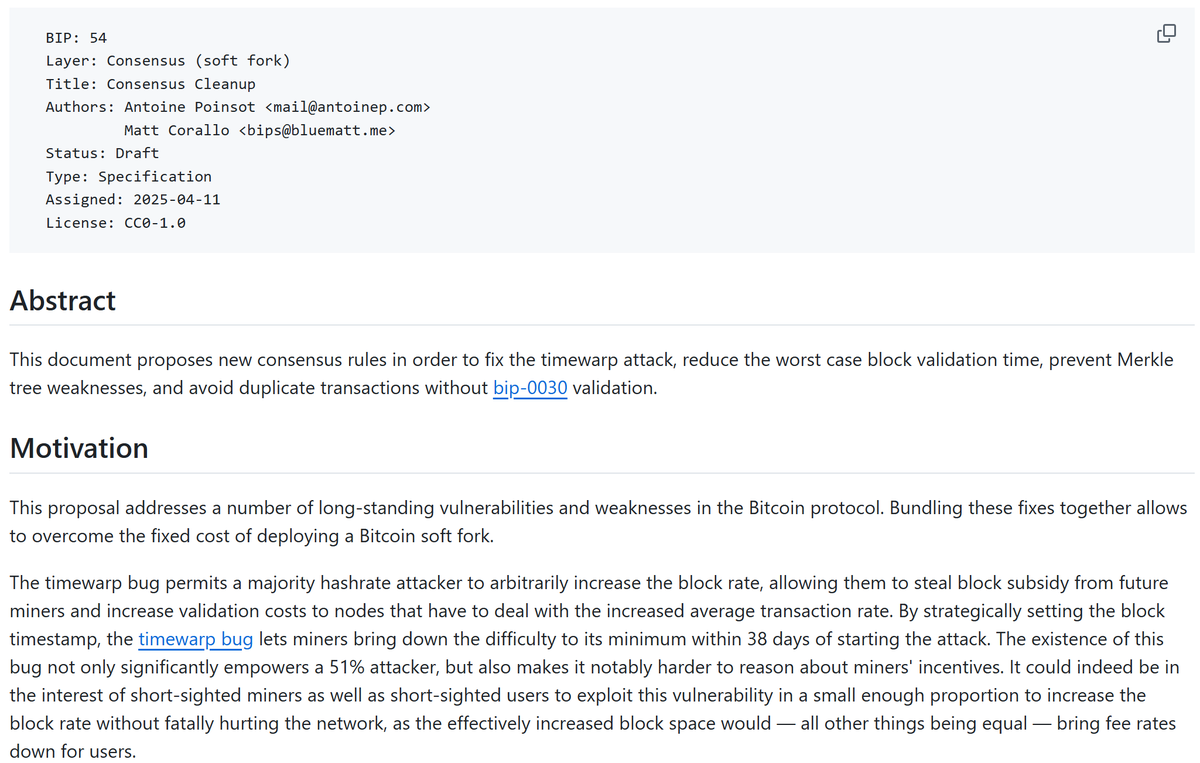
Il y a un bug dans le minage de Bitcoin depuis le tout premier jour. C'est une simple erreur de calcul de Satoshi qui pourrait être exploitée pour miner des blocs à une vitesse délirante. C'est un des bugs que le BIP-0054 (en discussion) résout. Je vous explique.
Pour comprendre, il faut d'abord rappeler le fonctionnement du mécanisme d'ajustement de la difficulté. Comme vous le savez, tous les 2016 blocs, soit environ toutes les 2 semaines, les noeuds recalculent la cible de difficulté. L'objectif est de maintenir un rythme stable d'un bloc toutes les 10 minutes, quelle que soit la puissance de calcul déployée par les mineurs. Pour faire cet ajustement, les noeuds mesurent combien de temps la dernière période a duré, la comparent au temps qu'elle aurait due durer (2016 x 600 = 1 209 600 secondes), puis corrigent la difficulté en conséquence.
C'est dans ce calcul qu'il y a le bug. Pour mesurer le temps de la dernière période qui vient de passer, le noeud compare l'horodatage du premier bloc de la période à celui du dernier. Instinctivement, ça parait logique de faire ça, mais en fait c'est une erreur, car il n'y a que 2015 intervalles entre le premier bloc et le dernier de la période, pas 2016.
Si on note t0 l'horodatage du premier bloc et t2015 celui du dernier, le noeud calcule le temps écoulé comme T = t2015 - t0. Les intervalles mesurés sont donc :
de t0 à t1 (1 intervalle) > de t1 à t2 (2 intervalles) > ... > de t2014 à t2015 (2015 intervalles)
On obtient bien 2015 intervalles et pas 2016. Pour en avoir 2016, il aurait fallu calculer T = t2015 - t-1, où t-1 est l'horodatage du dernier bloc de la période précédente. C'est ce qu'on appelle un bug "off-by-one" : une erreur de décalage d'une unité.
Concrètement, l'impact sur la PoW est négligeable. Ce décalage introduit un biais d'environ 0,05% vers une difficulté très légèrement surestimée. Mais le vrai problème est ailleurs. Ce bug fait que les périodes d'ajustement ne se chevauchent pas. L'horodatage du dernier bloc d'une période n'entre pas dans le calcul de la suivante :
- La première période : t0 à t2015
- La deuxième : t2016 à t4031
- etc.
Il n'y a jamais de chevauchement, et c'est précisément cette discontinuité qui rend possible une attaque que le l'on appelle "time warp".
Le principe est le suivant :
1 - un mineur qui controlerait une majorité de la puissance de calcul commence par fixer les horodatages de tous les blocs d'une période, sauf le dernier, au minimum autorisé par les règles du protocole (supérieur au MTP, la médiane des 11 derniers blocs), au lieu de mettre l'heure réelle comme horodatage.
2 - sur le dernier bloc de la période, il attribue un horodatage artificiellement avancé dans le futur. La limite maximum pour un horodatage d'un bloc Bitcoin, c'est NAT + 2 heures. Le NAT c'est la médiane des temps réels des nœuds, mais pour simplifier, on peut dire que c'est presque le temps réel. On prend donc ce temps réel et on ajoute 2 heures de largesse dans le futur. Ce temps NAT + 2h, c'est la limite maximum, et l'attaquant va placer cette limite max dans le futur sur le dernier bloc de la période.
3 - la période est terminée, tous les nœuds Bitcoin appliquent l'ajustement de la difficulté. À cause de la manipulation des horodatages de l'attaquant, la période mesurée a duré plus longtemps qu'en réalité. Les noeuds abaissent donc la difficulté de minage pour la période suivante.
4 - l'attaquant reproduit exactement la même manipulation sur la période suivante. Puisque les périodes ne se chevauchent pas, et puisque le MTP est une médiane et non une moyenne, le premier bloc de la deuxième période d'attaque peut avoir un horodatage loin dans le passé, alors que le précédent a un horodatage dans le futur. À la fin, l'écart entre le premier bloc de la période et le dernier sera encore plus grand que la période précédente, et cet écart augmente de période en période.
En répétant ce procédé sur plusieurs périodes, un attaquant pourrait théoriquement faire chuter la difficulté de minage au point de produire jusqu'à 6 blocs par seconde (au lieu de 1 toutes les 10 minutes). Les conséquences seraient terribles : les timelocks ne serviraient plus à rien, le réseau serait saturé, les réorganisations se multiplieraient, et les confirmations de transactions perdraient leur valeur. Le tout permet à l'attaquant de récupérer les récompenses de bloc à un rythme effrené.
Si Satoshi avait fait se chevaucher les périodes, comme nous l'avons vu en intro, cette attaque ne serait pas possible. Ce qui la rend réalisable, c'est que le calcul du temps de la période repose sur le premier bloc de la période, qui peut être placé loin dans le passé, plutôt que sur le dernier bloc de la période précédente, qui dans le cas de cette attaque se trouve placé dans le futur.
Comment résoudre ce bug ?
Et bien le plus simple serait de corriger l'erreur de Satoshi, et de se faire chevaucher les périodes. Mais c'est impossible sans faire un hard fork. Le BIP-0054 (consensus cleanup) propose donc une autre approche par soft fork : imposer que le premier bloc d'une nouvelle période de difficulté porte un horodatage qui ne précède pas de plus de 2 heures celui du dernier bloc de la période précédente. Cette contrainte rétablit une forme de continuité entre les périodes, empeche la manipulation des écarts temporels, et donc empeche l'attaque time warp.
Le BIP-0054 ne corrige pas que ça, il corrige également d'autres vulnérabilités historiques du protocole.
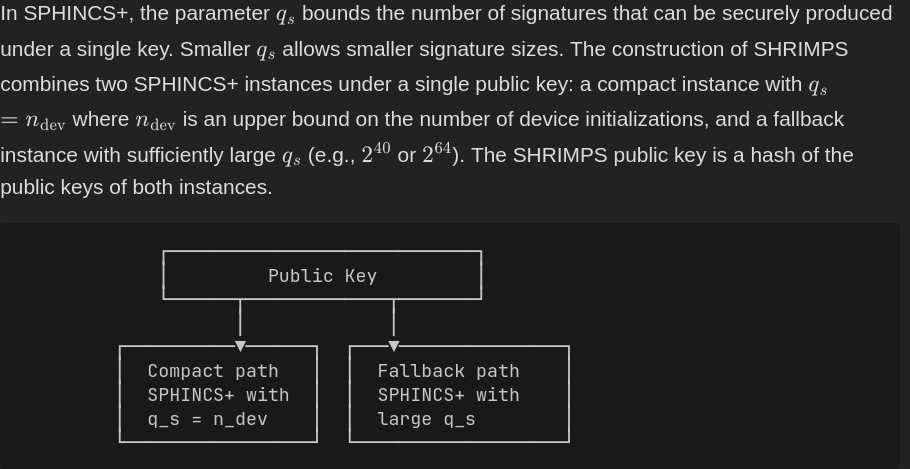
Please welcome SHRIMPS🦐 to the family of stateful PQ signatures:
2.5 KB hash-based sigs across multiple devices.
SHRINCS🛋️ gave ~324-byte sigs but is single-device. SHRIMPS🦐 addresses multi-device; any device loaded from the same seed creates sigs 3x smaller than SLH-DSA
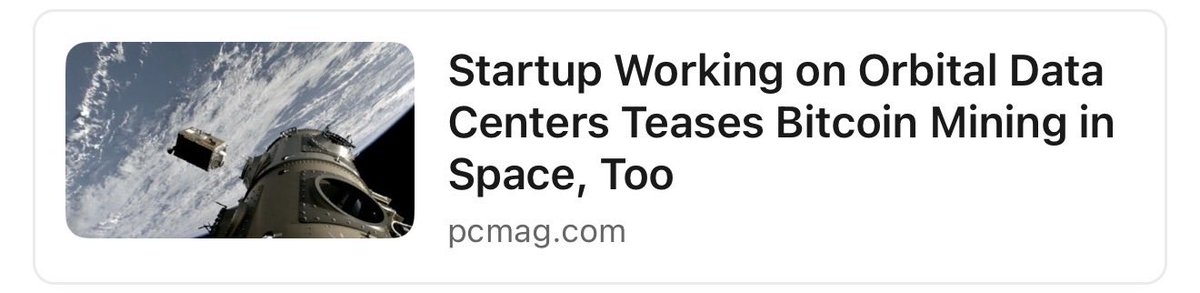
The cat is out of the bag: @Starcloud_-2 will be the first to mine 𝗕𝗶𝘁𝗰𝗼𝗶𝗻 in space.
This will be a massive industry in itself. Right now, bitcoin mining consumes about 20 GW of power continuously. It makes no sense to do this on Earth, and in the end state, all of this will be done in space.
https://t.co/qgOcag4Y63
I hope @MartyBent doesn't mind me pasting the entire first section of his newsletter from today, about the horrid Coinbase ad in the Superbowl. He's nailed exactly why it was immediately reviled by nearly everyone forced to sit through it:
"Let’s talk about the Coinbase Super Bowl ad and, more importantly, the reaction to it from the millions of regular people watching the game last night. It highlights exactly why we at TFTC and Ten31 believe you should focus on Bitcoin, and why actors like Coinbase have done Bitcoin a massive disservice.
People were giving Coinbase the finger. A visceral, immediate reaction.
Retail does not like Coinbase. They got tricked into a karaoke activity during the Super Bowl with a Backstreet Boys flashback, only to be rugged by Coinbase yet again. Many people feel Coinbase and crypto is a scam because they put money in throughout the years, particularly in 2017 and later, and lost most of it. Coinbase is nothing more than a casino these days. They just want to launch as many tokens as possible, get people to speculate on them, and reap fees as people trade.
This is one of the rhetorical tricks Brian Armstrong and the Coinbase team use. They say something blatantly obvious and true, then try to equate what they're doing to that thing. Equality of opportunity versus equality of outcomes is a real and important distinction. But then Armstrong takes that obvious truth and slaps it on crypto. It's really just economic illiteracy brought to the market and packaged in a way that makes it seem good.
And this gets at what I think is the core misunderstanding. One of the biggest misconceptions in broader crypto is the belief that these tokens compete on tech features. People think it's a tech revolution. It's not. It's a monetary revolution. Armstrong and others think better smart contracting, faster settlements, and DeFi protocols are what's going to drive value.
Bitcoin is certainly a tech innovation. The combination of proof of work with a difficulty adjustment, distributed consensus, and a hard cap supply is incredibly innovative and enabled by a novel combination of disparate technologies, but what it enables is a superior monetary good for the Digital Age. Once you have a free market for monetary goods, they compete on monetary properties, not tech properties. Bitcoin is relatively slow, simple, and boring, and that's because it needs to be. It limits the attack surface and increases social scalability so it can affect billions of people in a positive way.
Bitcoin's beauty is found in its simplicity. That simplicity makes its monetary properties ironclad. Millions of tokens have come and gone over 17 years, and none have come close to Bitcoin's success.
And I think the market is finally catching on. People have been burned. The greater fools of crypto scams are not going to be as plentiful as they were in cycles past. The knowledge has been distributed that these things are scams. Despite all of this, Bitcoin is sitting at a $1.4 trillion market cap, trading above $70,300. Bitcoin is still the king. Though, it has unfortunately been tainted with the stench of the rotting corpses of crypto scams that have died along the way.
“Blockchains” exist to enable digital money for the digital age. It doesn't make sense to spin up a token to monetize YouTube or podcast content. The whole Base and Farcaster craze is a great example of that meme falling flat on its face. For these particular use cases of content monetization you don’t need a token for every creator, piece of content and “digital good”. What you need is distributed content mechanisms like RSS feeds combined with sound digital money like Bitcoin. Podcasting 2.0 does this beautifully. Put a Lightning address in your RSS feed and people can stream sats to a creator directly. You don't need a Marty token or a TFTC token.
As AJC (Averaged Joe's Crypto) put it: the Coinbase ad took something universally loved, slapped crypto on it, and prayed that the emotional hijacking would work. Classic bait and switch. Yet another rug pull.
People are suffering out there. In cycles past, they turned to speculation on crypto to escape the permanent underclass by taking big risks on meme coins, NFTs, and other ephemeral crypto fads. Most people who speculated found it made them financially worse off. And with AI increasingly threatening job disruption, people are particularly skeptical and hostile toward the tech industry at the moment.
This is why I focus on bitcoin. It's the best money that's ever existed. It's not going away. We are in the early innings of adoption. If you understand that bitcoin is a long-term game and begin saving some of the fruits of your labor every paycheck, you'll see massive benefits as adoption increases. There are only 21 million bitcoin, and that scarcity is going to push up the purchasing power of individual units over time.
Brian Armstrong and Coinbase are pied pipers leading the retail masses astray. The retail masses have caught on, which is why they reacted so negatively to that Super Bowl commercial last night. The sooner people in crypto put all of their effort behind bitcoin, something that is provably scarce, provably decentralized, with the most hash rate and the most individual holders of any digital asset, the sooner we can actually solve the hard problems as they pertain to money and financial stress.
Crypto is a scam. Everybody knows it now."
Good one, Marty, thank you!
This is what the Fed's "mandate" actually means in plain English:
Maximum Employment:
Make sure as many people as possible must keep earning taxable income as long as possible
Stable Prices:
Make sure the cost of living and assets never decreases so the tax base continually grows
Moderate Long Term Interest Rates:
Make sure long term interest rates stay lower than they would be naturally so the government can borrow near or below the rate of inflation
(this is the big one)
"Maintain long run growth of the monetary and credit aggregates commensurate with the economy's long run potential to increase production":
Increase the money supply at a similar pace to economic growth
The Fed exists to maximize tax revenue and borrowing capability for the US government.
What’s the common denominator with all of these issues?
High rent — Money
Can’t buy homes — Money
Groceries too damn high — Money
Student debt — Money
Credit card debt — Money
Health insurance — Money
Saving to invest — Money
Dating and marriage — Money (heavy burden because of monetary costs)
Trust in institutions — shattered because of broken money
Belief in the future — not possible when your money is GUARANTEED to lose value in the future BY DESIGN
No meaning — heavy time and energy pressure because your time and energy decline when your money, which is a representation of your time and energy, declines in value
Maybe the money is the problem??
Spoiler alert: it is.
A socialist mayor isn’t going to fix it.
Broken money breaks the world. All of these issues, including one of the biggest cities in the world electing a socialist, stem from the money being broken.
The world will not be fixed until the money is fixed.
The solution is here. All that remains is understanding.
Study Bitcoin.
17 years after the white paper, the Bitcoin network is still operational and more resilient than ever. Bitcoin never shuts down.
@SenateDems could learn something from that.
Bitcoin isn't competing with gold or dollars it's competing with time.
Every other asset decays. Real estate crumbles. Companies die. Currencies inflate.
Bitcoin's defense is doing nothing forever.
@titcoinpodcast@americanhodl8 This is all so tiresome and divisive. Focus on Bitcoin. Don’t even try to make it a Bitcoin topic. Both the left and right are caught up in the current thing. Choose your own path and step out of the matrix. Focus on your life and start dreaming
70% of Americans can’t afford a median home. Why?
Broken money forced people to use real estate as savings, making homes unaffordable. Houses aren’t savings accounts, they’re meant to be lived in.
#Bitcoin demonetizes housing, drives prices down and puts families back in homes.