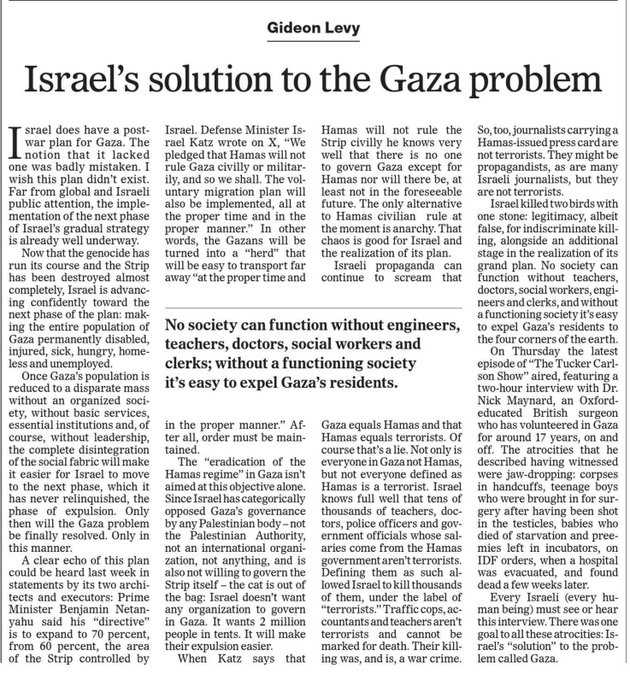
Now that Gaza lies in ruins—shattered, like a beloved face after a long brutality—Israel moves with a terrible confidence to the next act: The act of leaving every soul there not merely wounded, but permanently disabled. Injured, sick, hungry, homeless, without work, without hope. This is not war’s collateral damage. This is design.
As my friend Gideon Levy writes—and he knows, he knows—this is the prelude to expulsion. Think of it: a society without teachers, without doctors, without social workers, without engineers, without clerks. That is not a society. That is a holding pen. A slow erasure. And when nothing functions—no school, no hospital, no office, no heart—then it becomes ‘easy,’ they tell themselves, to scatter the people to the four corners of the earth. Like seeds from a broken pod, except no soil will take them.
We must name this. Not with rage alone, though rage is honest. But with the cold, clear tears of recognition: they are making life impossible so that departure becomes the only ‘choice.’ And the world watches, adjusts its spectacles, and calls for restraint. Restraint! There is no restraint in a slow drowning.
🎓 “Peace be upon you. From the students of Harvard, to the youth of Dahieh, to the sons of Nabatieh, and the people of Tyre.”
Harvard Medical School graduate Leen Ezzeddine, from the southern Lebanese town of Arabsalim, used her graduation speech to remind her peers of the students in Gaza and southern Lebanon who do not benefit from the same “arbitrary luck and circumstance” that she and her classmates have enjoyed.
Ezzeddine said her presence at that podium was “evidence of what survives the border, the bomb, and the exile,” and of “what becomes possible when people the world has tried to erase are allowed to live.”
Israel’s Minister of National Security Itamar Ben Gvir ATTACKS A FEMALE ACTIVIST and says: “WELCOME TO HELL. The summer camp is over.”
Activists from the GLOBAL SUMOOD FLOTILLA are being ZIP-TIED and ABUSED while being forced to listen to ISRAEL’s national anthem.
Far-right National Security Minister Itamar Ben-Gvir released a video showing detained participants of the intercepted Gaza-bound flotilla being bound and dragged in Israel's Ashdod Port, writing, "That's how we welcome the terror supporters. Welcome to Israel."
Read more here: https://t.co/jirdAoCedy
Mossad booby‑trapped 21,000 communication devices with explosives, sent them to Lebanon through shell companies, and detonated them remotely — killing dozens (including children) and injuring over 3,400.
• The devices exploded in people's hands, on their faces, and in their pockets.
• They did it over two consecutive days.
• On day two, the explosives went off while Lebanese families were at the funerals of those killed the day before.
• The attack inflicted roughly 3,000 injuries in a single hour on the first day alone.
This terrorist attack was the largest simultaneous mass‑detonation in history by the number of individual bombs.
'israelis' joke about it to this day.
If you didn't boycott Apple for the Congo, boycott it now.
COLLINS: “What about Trump’s promise to lower gas prices?”
JORDAN: “That’s life.”
@kaitlancollins: “If someone’s paying more for⛽️, saying ‘that’s life’ might not make them feel better.”
@Jim_Jordan: “Those are your words, not mine.”
COLLINS: “No you said that. Just now.”😬
Use an LLM to review the manuscript and ask the submitting author a key questions about the content including motivations for references. The system should not proceed with publishing until it is convinced that the submitter is fully aware of the content it is about to publish.
Cute. Just as it’s getting easier to have LLMs produce correct references they put up a huge punishment for reference errors and thus for using an older iteration of LLMs. I guess @arxiv believes that people really should pay for their LLMs.
@KordingLab the larger problem is a growing fraction of researchers are using LLMs to write content rather than using them to improve or check their writing/assumptions.
The idea that scientific papers, preprint or peer-reviewed, should be held to a lower standard of factual accuracy and source verification than journalism is astonishing. And then we wonder why trust in science is eroding.
I’m sorry that it’s true, but it is true that nobody is reading the entirety of papers. And yes, you can check if citations are real. But you can’t easily determine if citations to real papers are meaningful or accurate. The real issue is we long ago stopped writing papers to be read - they are written to be reviewed and to appear on CVs. Until we change that efforts to ‘protect’ the literature will be meaningless.
Today @WHO declared a PHEIC—a public health emergency of international concern—for the Bundibugyo ebolavirus outbreak in DRC/Uganda without convening an Emergency Committee. That is unprecedented. The situation is catastrophic. Six experts explain why:
https://t.co/7eMtvcfPuD
I am so grateful to receive an @ERC_Research Starting Grant for the ActiVisTha project to study thalamic circuit diversity for active visual processing. Please get in touch if you would like to join my team.
You know who actually reads preprints in full these days? Web crawlers and algorithms training the LLMs and AI systems that will index, summarize, and shape scientific literature for decades to come. Garbage in, institutionalized garbage out.
I’m sorry that it’s true, but it is true that nobody is reading the entirety of papers. And yes, you can check if citations are real. But you can’t easily determine if citations to real papers are meaningful or accurate. The real issue is we long ago stopped writing papers to be read - they are written to be reviewed and to appear on CVs. Until we change that efforts to ‘protect’ the literature will be meaningless.
In short: because scientific papers have always contained citation errors, omissions, and sloppy referencing, preprint repositories should now accept (and manually sort through) a flood of low-quality LLM-generated preprints that amplify those errors. Brilliant logic.
I'm sorry but I'm calling bullshit. I've spent a lot of time in publishing and it is exceptionally rare to come across a paper - even a published one that has gone through rounds of peer review - that doesn't contain careless mistakes. They also virtually all contain references that are, lets call them "casual" - things inserted because the authors needed a citation to something, not because there was an actual reason to cite it. Lots of times the wrong paper from an author is cited. And often - even in the age of reference managers and so on - the citation isn't valid. That doesn't mean the paper doesn't exist - just that the citation doesn't match. And it's ridiculous how often people cite some paper for containing a method that it doesn't contain. Or cite a paper for saying something that it doesn't, and so on.
The point is that it is my observation from a lot of experience - and something I hear all the time from people who handle lots of manuscripts - that our citation practices are pretty shit. So I just don't believe that anyone outside of the the absolute most meticulous of authors is citing in a 100% accurate and intellectually rigorous way.
On a case by case basis, obviously AI hallucinated references are worse. But I think the entire way we cite things in science sucks - from principles to practices - and that this reflects a deeper kind of intellectual rot that is leading to an enshittification of science and the literature. And I think the hyprocisy implicit in saying we have an urgent need to punish one type of enshittification while we ignore the other is bad and will distract us from addressing the real problem which is not THAT people are publishing AI slop, but that they have good reasons for thinking that the systems of science would reward them for doing so.
@mbeisen@torte81@arxiv LLM use has already enshittified parts of the scientific literature.
https://t.co/YE37MY7hj9
The incentives are misaligned, but repositories cannot solve that problem. We will have to deal with AI-agent-generated work, and the current approach is not sustainable.
@mbeisen@torte81@arxiv Few would deny that the former produces better scientific papers. Once primary, senior, or corresponding authors stop fully engaging with the complete manuscript, accountability begins to erode.
@mbeisen@torte81@arxiv How can someone claim responsibility for a paper without having read the entire thing? There are effectively two camps: authors who believe reading their papers carefully—typically multiple times—before publication is essential, and authors who do not.