Liver Function Tests don't have to be confusing.
A simple way to remember enzyme elevation patterns is the CAO approach:
C- Chronic hepatitis➡️ Mild elevation of all enzymes
A - Acute hepatitis➡️Marked⬆️ AST & ALT
O- Obstructive jaundice ➡️Marked ⬆️ALP & GGT
When the interviewer asks: "What’s your weakness?"
Turn your weakness into a growth mindset moment. Here are good examples:
1) I can be impatient
“I tend to expect quick results and sometimes get frustrated when things don’t move as fast as I’d like. Over time, I’ve learned that slowing down to understand constraints and support others actually leads to better outcomes. Now, I focus on realistic timelines and collaborative problem-solving.”
2) Reluctant to ask for help
“I used to hesitate to ask for help because I wanted to be fully self-reliant. I’ve learned that strong results come from collaboration, not isolation. Now, I clearly define what support I need and engage the right people early, which has improved efficiency and team performance.”
3) Overly detail-oriented
“I naturally pay close attention to details, which sometimes slowed me down. I’ve learned to balance precision with prioritization by focusing first on high-impact areas. This has helped me maintain quality while meeting deadlines more effectively.”
4) Difficulty delegating
“I used to take on too much myself because I wanted to ensure tasks were done correctly. I’ve since learned that delegation is a leadership strength. Now, I match tasks to people’s strengths and provide clear guidance, which has improved team ownership and results.”
5) Public speaking discomfort
“Earlier in my career, I wasn’t fully confident speaking in large groups. I recognized this could limit my impact, so I actively sought opportunities to present and facilitate discussions. With practice and feedback, I’ve become much more confident and effective in communicating ideas.”
6) Taking on too many responsibilities
“I have a tendency to say yes too often because I want to be helpful. I’ve learned that this can affect focus and quality. Now, I assess priorities carefully and communicate capacity clearly, ensuring I deliver strong results on the most important tasks.”
7) Being overly self-critical
“I used to be very hard on myself when things didn’t go perfectly. I’ve learned to treat feedback as data, not failure. Now, I reflect objectively on outcomes, apply lessons learned, and move forward with greater confidence.”
8) Preference for structure
“I work best with clear plans and structure, and I initially found ambiguity challenging. Over time, I’ve learned to stay flexible and adapt quickly in uncertain situations by focusing on objectives rather than rigid processes.”
9) Hesitation in challenging authority
“Earlier on, I found it difficult to challenge more senior opinions. I’ve learned that respectful, evidence-based input adds value. Now, I confidently contribute alternative perspectives while maintaining professionalism and alignment.”
10) Managing work-life boundaries
“I’m highly committed to my work and used to struggle with switching off. I’ve learned that sustainable performance requires balance. By setting clearer boundaries and managing energy, I now stay more focused, productive, and resilient.”
Your weakness doesn’t define you, how you manage it does. Share yours with confidence & show that you’re always growing.
No interview invitation in the last 6 weeks?
Let’s help you fix that CV and get you noticed. Email your CV to [email protected] with subject 'Revamp'.
#IkoKaziKE
📣 Insights from EHA2025
What can help you individualise treatment decisions for pts w/ RRMM?
Consider:
✅ Factors related to the patient
✅ Treatment targets
✅ AE profiles
Dr Karthik Ramasamy explores practical strategies for enhancing treatment outcomes in RRMM.
📺 Video in this post
Download the slides & watch 2 more expert videos for further insights >> https://t.co/4YhByLehzP
This programme has been sponsored by Menarini Stemline and is intended for healthcare professionals only.
➡️During medical training, the focus is mainly on history taking, clinical examination, differential diagnosis, investigations and treatment- I agree these are among the most essential aspects needed to become a successful doctor.
➡️There are several other aspects that are needed for a successful medical practice, however, inadequate attention is paid to them during training. These include:
1. Communication with patients and families: It is important to convey the diagnosis, likely cause of illness, treatment options, possible adverse effects of medications, expected outcome, etc. to patients and caregivers. If they do not understand, or if the communication is inadequate, they may be left dissatisfied, even if the treatment is perfect.
2. All patients are not the same. Communication needs to be tailored according to the patient's needs, their desire to know, and their understanding. Some patients want to know the rarest of the rare side effects of medications and all the possible hypotheses involved in causing their disease. On the other hand, a few others are happy with just knowing the medicine dose, frequency and duration.
3. Art of communicating when the expected outcome is poor, or if there is little chance of survival. It is easy to not convey what is not good (negative news), however, that is not the best option always. As a doctor, we need to convey the negative as well as positive news about the illness. Communicating bad news to patients is an art that needs to be learnt by all doctors (though little attention is paid to this during training).
4. Empathy. It is easy to find fault in a patient and blame the patient for an illness/symptom. For example, blaming unhealthy eating or sedentary lifestyle for obesity; alcohol abuse for liver disease; or smoking for lung diseases. Instead of becoming judgmental and being dismissive, it is important to have empathy. Spending time, counselling the patient and suggesting ways to adopt a healthier lifestyle go a long way in helping the patients manage their illnesses.
5. Tackling a difficult patient or family member: Unfortunately it is not uncommon to see a patient or the caregivers behave rudely with a doctor. They may pass derogatory remarks or use abusive language. This may happen despite a doctor providing the best possible medical care. It is important to not take the law in own hand. Do not lose your cool, and avoid escalation by not responding in a similar manner. It is better to report the incident to management/higher authorities.
6. Assessing the financial situation of the patient, and providing the best possible treatment option. This could be difficult at times, but every effort should be made. It is easy to suggest the best/ideal treatment, which could be beyond the reach of a family. In situations where the expensive care is likely to be futile, we should clearly communicate this to the caregivers, so that un-necessary expenditure can be avoided. For example, in an 85-year old with multi-organ failure in septic shock, with post-cardiac arrest hypoxic brain damage, the chance of a meaningful recovery is remote. Clear communication is needed.
(Disclaimer: This list is not exhaustive. Moreover, these are my personal views and each doctor has to individually decide what works best for him/her and their patients.)
#MedTwitter #MedX
Key Facts:
-Chronic condition : Symptoms can flare up and go into remission.
-It is not contagious : You can’t "catch" eczema from someone.
-Often linked to allergies : Many people with eczema may likely have asthma, hay fever, or food allergies.
-Affects all ages : Though common in children, eczema can develop at any stage of life.
Eczema usually appears on the face, neck, arms, and legs, but it can show up anywhere.
Careful Examination of the Skin can give clues to important Neurological/Systemic diseases: A Pictorial
1. Hyperpigmentation of skin over knuckles
Common in vitamin B12 deficiency. Skin lesions may be the only sign in about 20% of cases.
Dear ladies,
Let's talk about "Irregular Menstrual Cycle". Most ladies experience periods every two months or have it twice a month.
Is That Really Normal?
Your menstruation is not only there to tell you if you’re pregnant or not. It can be a great indication of health issues. It’s important to tract your periods and see if there are any irregularities in them. However, a lot of women are not completely aware of how a normal menstrual cycle should be.
First of all, What Is Menstrual Cycle?
- It's the time blood flows out of your Vagina, when you uses pad.
Check Thread 👇
WHAT IS NIGHTTIME DROOLING?
In medical terms, drooling is known as sialorrhea, when it happens at night, it is also called nocturnal hypersalivation.
This is the involuntary escape of saliva from the mouththat is commonly seen in infants, but may be experienced by some adults too.
When it occurs excessively in adults, it may be indicating more serious health condition.
It can happen in two forms;
-Anterior Sialorrhea : Saliva spills from the mouth and soaks your pillow or nightwear.
-Posterior Sialorrhea – Saliva pools at the back of the throat. This increases the risk of aspiration into the lungs.
HYPERHIDROSIS: SWEATING BEYOND REASON
Picture yourself stepping into an
air-conditioned room, yet your palms are so drenched in sweat.
Or picture yourself walking into an event in this scorching weather, and within few minutes, your shirt is soaked as if you ran a marathon.
Don’t be quick to blame it on the weather, you might be experiencing HYPERHIDROSIS.
Let’s learn 👇
WHAT IS RESPONSIBLE FOR YOUR WEIGHT
- Genetics
Your genes can affect how your body stores fat, uses energy, and controls hunger. If your family has a history of being overweight or underweight, you might be more likely to have similar challenges.
- Diet
Eating too much junk food, sugary drinks, or not eating enough healthy foods can lead to weight changes. Overeating or not eating enough also plays a big role.
Physical Activity
If you exercise regularly, you burn calories and stay fit. Sitting too much or not moving enough can lead to weight gain.
- Health Problems
Certain illnesses like low thyroid function or digestive issues can make you gain or lose weight. Some medications can also change your weight.
- Stress and Emotions
Stress, sadness, or emotional eating can make you eat too much or too little, which can change your weight.
- Environment
Where you live and your access to healthy food can affect your weight. Social habits and income also play a role.
- Age and Hormones
As you get older, your body burns fewer calories. Hormonal changes during puberty, pregnancy, or menopause can also affect your weight.
TYPES OF MENSTRUAL CRAMPS
1. PRIMARY DYSMENORRHEA
This type of menstrual cramp is common and usually starts early, often within six months to a year after a girl’s first period.
-What causes it?
The culprit here is a natural chemical in the body called prostaglandin. During menstruation, prostaglandin levels spike, causing the uterine muscles to contract painfully.
The good news?
As your period progresses, prostaglandin levels drop, and the pain eases.
TONSIL STONES : CASUES, TREATMENT AND PREVENTION
Ever heard of Tonsils stones?
Your tonsils are the two fleshy pads at the back of your throat, that function as part of your immune system.
They produce white blood cells and antibodies to fight infections.
What then are Tonsil Stones ?
Come with me👇
When it rains, it pours…
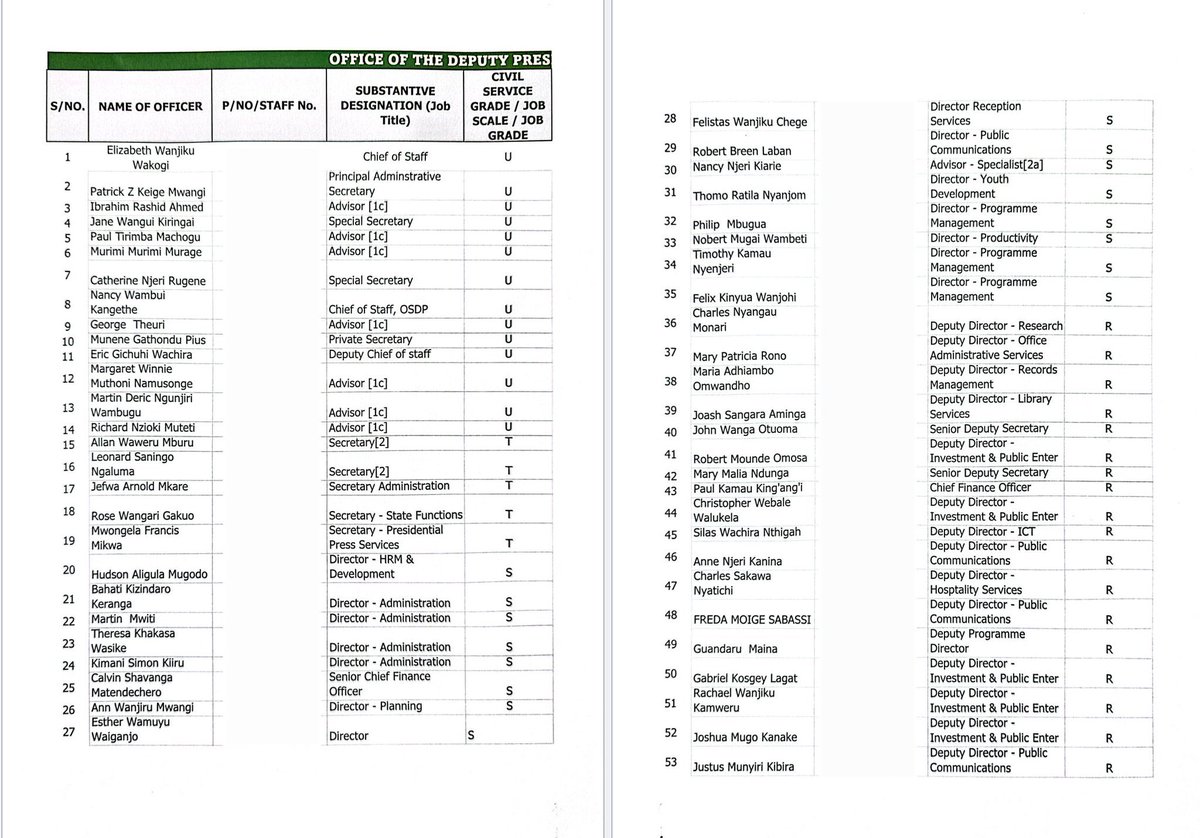
108 senior officers and advisors in the Deputy President's office have been instructed to proceed on compulsory leave with immediate effect.
List includes Rigathi Gachagua's Special advisor Njeri Rugene and Chief of Staff Elizabeth Wakogi