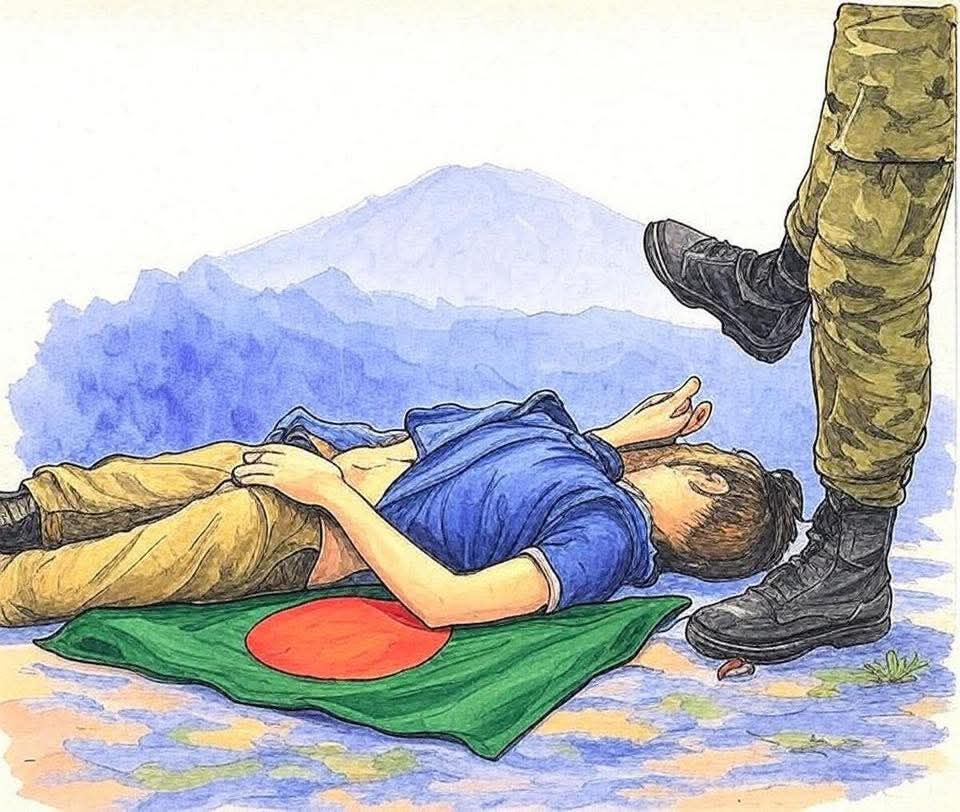
There is no war going on in Bangladesh. So why was the military deployed in Gopalganj over a political party’s rally? Why did they arrive in full battle gear? Why were tanks used to fire shots throughout the city of Gopalganj?
Why is the Navy patrolling the rivers of Gopalganj with heavy weapons? Why have thousands of members from APBn, RAB, and Ansar been sent to Gopalganj from Barisal, Khulna, and Jessore, armed with heavy weaponry? Now we’re hearing that the Air Force has also been kept on standby — there are even fears of a possible drone strike!
The kind of military preparedness we see on the front lines of the Russia-Ukraine war is exactly the kind of warlike posture that the tyrant Yunus’s administration has taken in Gopalganj. It is truly shocking.
I believe this was part of a plan to ignite a civil war starting from Gopalganj. Perhaps Bangladesh has narrowly avoided it only because the general public of Gopalganj was not adequately prepared. But the conspiracy is still very much alive.
One way or another today or tomorrow those responsible will have to answer for the brutal atrocities committed against the people of Gopalganj.
Gopalganj Bleeds: Democracy Under Attack in Bangladesh
When the sanctity of one’s home is violated, the fine line between right and wrong becomes tangled. Protecting one’s home takes priority over any other aspect that relates to the so-called right or wrong of human conscience. When Gopalganj—a place considered sacred, where rests the founding father of Bangladesh, and the home ground of the largest political party of Bangladesh, the Bangladesh Awami League—came under attack, the residents did what any human protecting his or her home would do: resist and fight back.
Bangladesh Armed Forces, along with the Bangladesh Police and the de facto rulers of present-day Bangladesh—the so-called student leaders of the newly formed political party NCP—wreaked havoc in Gopalganj, shooting live lethal rounds at unarmed citizens and killing at least four in the process.
Provoking the millions of Awami League supporters and residents of Gopalganj for weeks prior to the tragic day in July with threats to demolish the burial ground of Bangabandhu Sheikh Mujibur Rahman, the National Citizen Party student leaders declared their so-called program “March to Gopalganj.” In a free, democratic society, in theory, any political party has the right to stage political rallies, parades, and protests. However, when the sole goal of a political party is to remind the citizenry of the pain of old wounds, the intention of the party becomes transparent: spread fear, force the people for popular support, and instigate more and more violence.
When NCP leaders and activists threaten to demolish Bangabandhu’s shrine, the Awami League reads it as a repetition of the despicable act of complete destruction of the Dhanmondi residence of Bangabandhu. In February, with full support from the unconstitutional interim government of Bangladesh, violent mobs stormed into the Dhanmondi residence of the Father of the Nation and using state-owned bulldozers in front of the watchful eyes of the Bangladesh Army, demolished a piece of Bangladesh’s history into the ground.
The very people who took over state power playing the “human rights,” “freedom of speech,” and “democracy” cards last year are the ones who inaugurated a reign of terror on thousands of Awami League leaders and activists by killing, jailing, and forcefully silencing them. So, when the “March to Gopalganj” was declared with the goal to destroy the burial ground of the man Awami League supporters consider their idealistic leader, the people of Gopalganj became alert.
Ahead of the so-called rally of NCP in Gopalganj, there was heavy police deployment, and weeks prior, most of the key Awami League leaders from Gopalganj were arrested. With no leadership present, the people of Gopalganj—the land that gifted Bangladesh with the great leader Bangabandhu—organized among themselves. They blocked the roads with wooden logs leading to the rally stage, with the goal to resist and protect the burial ground of Bangabandhu, which is as sacred to them as one’s home is to oneself.
The NCP leaders, many of whom have deep ties with the fundamentalist factions of the country, arrived in Gopalganj with heavy Bangladesh Army and Bangladesh Police presence. They are being mocked as the “King’s party,” and the way they are using state law enforcement institutions, including the Army, for their political agendas only solidifies the claim. The same mob demolished the headquarters of Bangladesh’s independence in Dhanmondi. The silence of the Army and the government—and the wounds—are still fresh in the minds of millions of Awami League supporters. So, they did what any sane human would do: protest. As the same mob arrived, this time under the guise of staging a political rally, the residents of Gopalganj intensified their peaceful protests, unarmed and with only the bravery of one’s mind.
What followed is perhaps the worst, most heinous attack on political opposition since the August 21 grenade attack. The Bangladesh Army, along with the Bangladesh Police, shot live lethal ammunition at peaceful protesters, killing at least four and injuring hundreds. The exact count of total fatalities is still being processed. The same Army that just days ago proudly claimed in international media that they do not shoot at their citizens, not only shot but also killed multiple of their own.
One year ago, hundreds if not thousands from the intelligentsia shed fake tears after provocation from the Awami League general secretary. The very same group of people has turned deaf, dumb, and blind today. It is evident from the absence of their tears even when the venomous image of the Adviser for Local Government, Rural Development and Cooperatives of Bangladesh, Mr. Asif Mahmud Shojib Bhuiyan, controlling the killing spree by the law enforcement from the police headquarters, is boasted by the adviser himself.
Human rights are selective to the people who were part of the meticulously designed conspiracy that brought down a democratically elected government in Bangladesh. But the expectation from Bangladesh’s other large political party, namely the Bangladesh Nationalist Party, was different. They not only disheartened the citizens of the country but also raised questions about their political maturity. When the unconstitutional government, through an unlawful executive action, banned the activities of the Awami League, the BNP welcomed it. When threats to demolish Bangabandhu’s shrine appeared, the BNP embraced it. It is as if the BNP would go however low it needs to go to seize state power. What they are failing to realize is that they are now becoming the “fourth subject” of politics with their own immaturity. What better can be expected from the party that once tried to destroy their whole opposition by grenade?
To conclude, the silence of the Western human rights organizations, the active support of the globalists in the destruction process of Bangladesh’s democracy, and the blindness of the middle class of the country—all are highly alarming. It is as though the Bangladesh Army did not only kill four or five people but is also accessory to the murder of Bangladesh’s democracy. Society and the world must wake up, as irrespective of political affiliations, every human life is precious. And currently in Bangladesh, it is not only Gopalganj—but every human life—that is under attack.
@albd1971@sajeebwazed@BDArmyOfficial@BD_DiGEST@UNHumanRights@UN@BBCWorld@CNN